
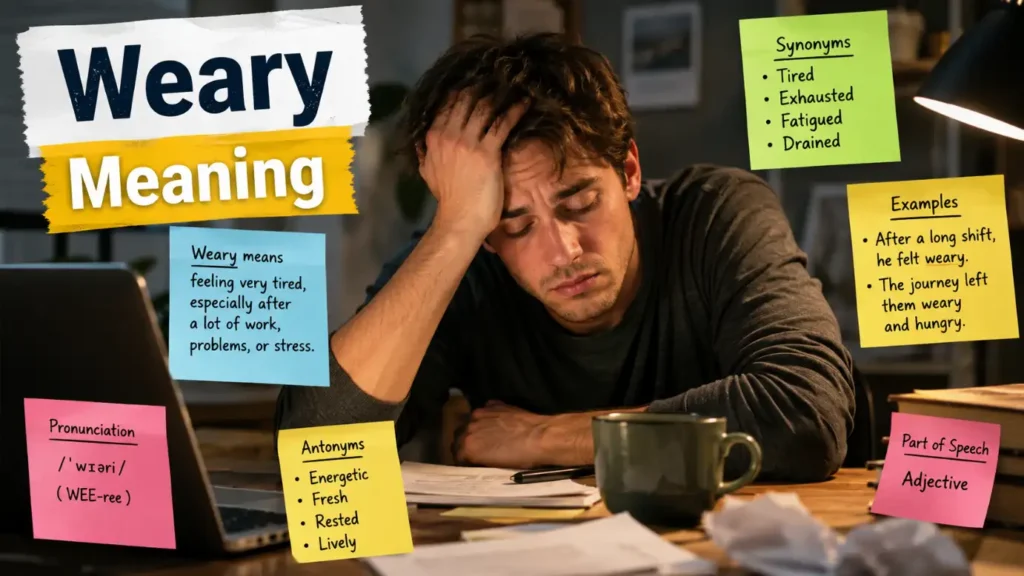
Being tired after a long day is one thing. Being weary is something deeper, the kind of exhaustion that settles in after weeks of stress, or the emotional heaviness of dealing with the same problem over and over. The weary meaning covers both physical and emotional exhaustion, usually the kind that builds up gradually rather than hitting all at once.
This guide covers exactly what “weary” means, where the word comes from, how it differs from simpler words like “tired,” and answers to the questions people ask most often. By the end, you’ll know precisely when “weary” is the right word to reach for.
What “Weary” Means
The simple version: “Weary“ means extremely tired, either physically or emotionally, often as a result of prolonged effort, stress, or a repeated, draining experience.
The fuller picture: “Weary” almost always implies more than ordinary tiredness. While “tired” can describe something as simple as staying up late one night, “weary” usually points to exhaustion that’s built up over time from sustained physical effort, ongoing stress, or the emotional toll of dealing with a difficult situation again and again. The word also extends beyond simple fatigue: people describe themselves as “weary of” something, meaning they’ve grown tired of a repeated experience, complaint, or pattern, even if they aren’t physically exhausted at all. A parent might feel weary after months of sleepless nights; a voter might feel weary of the same political arguments resurfacing every election cycle.
There’s also a slightly literary, reflective quality to “weary” that “tired” doesn’t quite carry. It shows up often in poetry, fiction, and thoughtful writing, partly because it captures a heavier, more resigned kind of exhaustion.
Origin and History

“Weary” traces back to Old English wērig, a word already carrying the sense of being tired or exhausted more than a thousand years ago. Its roots connect to older Germanic language forms associated with fatigue and the effects of exertion, though the precise deeper origins remain somewhat uncertain, as is common with many core, everyday Old English words.
Because “weary” has existed in English for so long, it’s had time to settle into a slightly more formal, literary register compared to newer or more casual words for tiredness. Writers have used it for centuries to describe both physical exhaustion and a deeper, more emotional kind of fatigue, a dual meaning the word has held onto consistently throughout its long history in the language.
Different Meanings and Contexts
Physical exhaustion. “Weary” often describes deep physical tiredness, especially after sustained effort, “weary travelers,” “weary muscles,” or “weary from the long hike” all use the word this way.
Emotional or mental exhaustion. “Weary” frequently describes emotional fatigue, especially the kind that builds from ongoing stress, grief, or a prolonged difficult situation “weary from months of caregiving” or “a weary heart.”
“Weary of” (tired of something specific). This construction means growing tired of a repeated pattern, complaint, or experience, even without physical exhaustion “weary of the same excuses” or “weary of waiting.“
Literary and reflective tone. Writers frequently reach for “weary” in poetry, fiction, and reflective essays because it carries a heavier, more resigned emotional weight than plainer words like “tired.”
Examples of “Weary” in a Sentence

- “After the twelve-hour shift, she was too weary to even make dinner.”
- “The soldiers marched on, weary but determined to reach camp before dark.”
- “He grew weary of hearing the same complaint every single meeting.”
- “Her voice sounded weary on the phone, worn down by weeks of bad news.”
- “The weary travelers finally spotted the lights of the town in the distance.”
- “I’m weary of scrolling through headline after headline of bad news.”
- “By the third round of negotiations, both sides looked visibly weary.”
- “The old dog gave a weary sigh and settled back down by the fire.”
- “She admitted she felt weary of pretending everything was fine.”
- “His weary eyes told the story of months without a real vacation.”
How to Use “Weary” Correctly
“Weary” functions as an adjective, describing a person, body part, tone, or emotional state.
A few usage notes:
- Pair it naturally with words like: travelers, eyes, heart, voice, muscles, and soul.
- Use “weary of” for repeated frustration. This phrasing signals tiredness of a pattern or situation, not physical exhaustion “weary of the arguments,” “weary of waiting.”
- Know the adverb and noun forms. “Wearily” works as the adverb (“she sighed wearily”), while “weariness” is the noun describing the state itself.
- Match the tone of your writing. “Weary” fits reflective, descriptive, or slightly formal writing well; in very casual speech, “tired” or “exhausted” may feel more natural.
Common Mistakes to Avoid
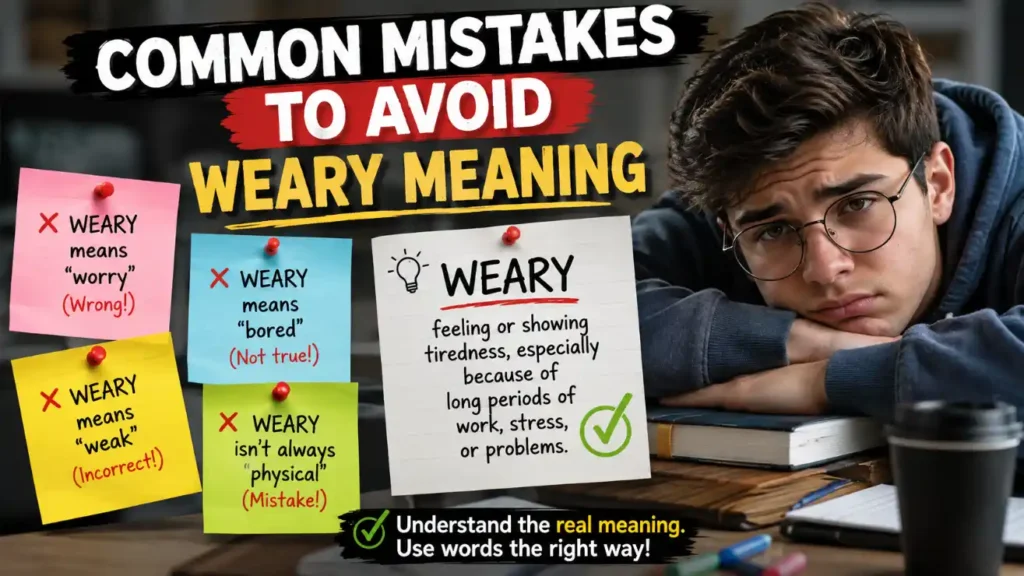
- Treating “weary” and “tired” as fully interchangeable. “Weary” usually implies deeper, more prolonged exhaustion, if physical or emotional, while “tired” can describe something as minor as needing a nap.
- Forgetting the “weary of” construction. Some writers only think of “weary” in terms of physical exhaustion and miss its equally common use for growing tired of a repeated situation.
- Overusing it in casual writing. Because it carries a slightly literary tone, using “weary” too often in very informal contexts can feel a bit heavy-handed.
- Confusing “weary” with “wary.” These words look and sound similar but mean completely different things: “wary” means cautious or suspicious, while “weary” means exhausted.
Similar Words and Phrases
| Word | Meaning | How It Differs |
| Tired | Feeling a need to rest, often after exertion | Broader and more casual; doesn’t necessarily imply the deeper exhaustion “weary” suggests |
| Exhausted | Extremely tired, drained of energy | Very close in meaning, though “exhausted” often implies a more immediate, intense state |
| Fatigued | Experiencing physical or mental tiredness | More clinical or formal in tone, common in medical or scientific writing |
| Burned out | Emotionally and physically depleted, often from prolonged stress | Closely related, especially to the emotional sense of “weary,” but usually tied specifically to work or chronic stress |
| Drained | Feeling emptied of energy or emotional reserves | Similar to “weary,” often used interchangeably in casual speech |
Opposite Words and Phrases
| Word | Meaning | Why It’s an Opposite |
| Energized | Full of energy and enthusiasm | Directly opposite to the depleted state “weary” describes |
| Refreshed | Renewed and restored, often after rest | Opposite of the worn-down feeling implied by “weary” |
| Invigorated | Filled with strength, vitality, or excitement | Contrasts sharply with the tired, heavy quality of “weary” |
| Rested | Having recovered energy through relaxation or sleep | The direct opposite state to physical weariness |
Pronunciation
“Weary” is pronounced WEER-ee, with the stress on the first syllable.
Quick Facts
| Fact | Detail |
| Meaning | Extremely tired, physically or emotionally, often from prolonged effort or stress |
| Origin | Old English wērig, meaning tired or exhausted |
| Part of speech | Adjective |
| Related forms | Wearily (adverb), weariness (noun) |
| Common phrase | “Weary of” tired of a repeated situation |
| Tone | Slightly literary or reflective compared to “tired” |
Frequently Asked Questions
What does it mean to feel weary?
To feel weary means to be physically or mentally tired, exhausted, or lacking energy after effort or stress.
What does weary mean biblically?
Biblically, weary often refers to feeling tired, burdened, or spiritually exhausted and needing strength, rest, and trust in God.
Is it weary or wary?
“Weary” means tired or exhausted, while “wary” means cautious or careful because you sense possible danger.
What does it mean if someone is weary?
If someone is weary, they are very tired, drained, or worn out physically, mentally, or emotionally.
What is another word for “weary”?
Common synonyms for “weary” include tired, exhausted, fatigued, drained, worn-out, and spent.
Does weary mean afraid?
No. “Weary” means tired or exhausted. “Wary” means cautious or alert because of possible danger.
What did Jesus say about weary?
Jesus said, “Come to me, all you who are weary and burdened, and I will give you rest” (Matthew 11:28).
What is spiritual weary?
Spiritual weariness is a feeling of being emotionally or spiritually drained, often accompanied by discouragement, doubt, or a lack of strength.
What to do when your soul is weary?
When your soul is weary, take time to rest, pray, reflect, and seek encouragement from God and trusted people around you.
Key Takeaways
- “Weary” means deep physical or emotional exhaustion, often built up over time.
- It differs from “tired” by implying a heavier, more prolonged kind of fatigue.
- “Weary of” describes growing tired of a repeated situation, not just physical exhaustion.
- “Wearily” and “weariness” are the related adverb and noun forms.
- “Weary” carries a slightly literary tone, common in reflective and descriptive writing.
Conclusion
“Weary” gives language something plainer words like “tired” can’t quite capture: the sense of exhaustion that’s accumulated slowly, if from months of physical strain or from simply enduring the same frustration one too many times. That accumulated weight is exactly what separates a weary person from someone who just needs a good night’s sleep.
The word’s flexibility is part of what keeps it useful. It works just as well for aching muscles after a long journey as it does for the quiet exhaustion of hearing the same bad news on repeat, which is why writers have leaned on it for centuries to describe both kinds of tiredness in a single, precise word.
Next time ordinary tiredness doesn’t quite capture how you feel. If it’s your body or your patience running low, “weary” will likely say exactly what you mean.

I am Stephen King an American author known for compelling storytelling. At writemora.com, we value clear, accurate, and reader-focused content inspired by excellence in writing.