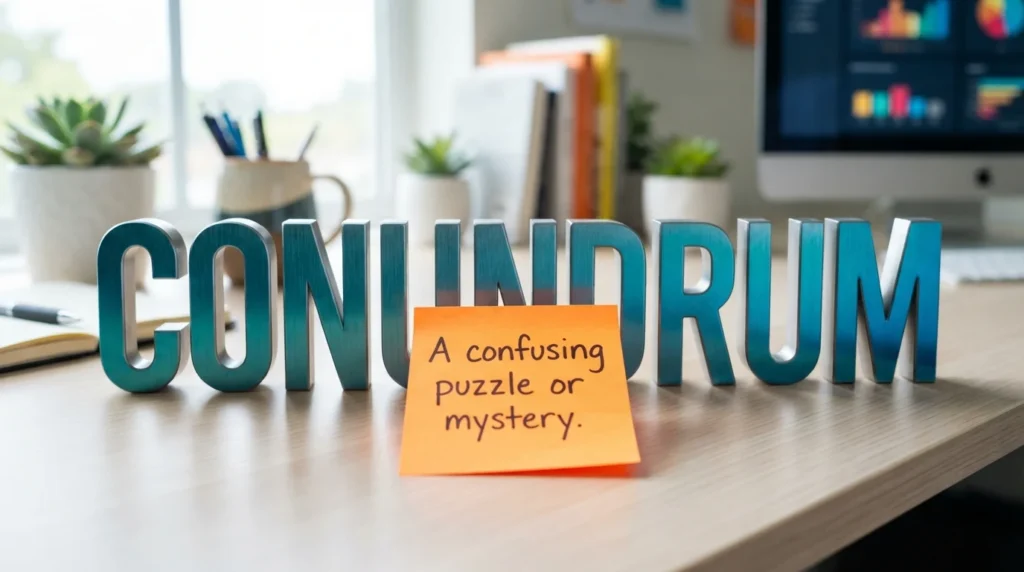
A tricky decision with no clean answer, a riddle with a clever twist, a problem that seems to have two right solutions that contradict each other all of these fit the conundrum meaning. A conundrum is a confusing or difficult problem, question, or puzzle, often one where every possible answer comes with a downside or a catch.
This guide covers exactly what “conundrum” means, the surprisingly murky story behind its origin, how people use the word today, and answers to the questions people search most. By the end, you’ll know exactly when “conundrum” is the right word to reach for.
What “Conundrum” Means
The simple version: A conundrum is a confusing, difficult problem or puzzle often one that seems to have no clearly correct answer, or where every option involves some kind of trade-off.
The fuller picture: “Conundrum” covers two related but slightly different situations. It can describe a literal riddle or wordplay puzzle, especially an old-fashioned one built around a clever or punny answer. More often in modern use, it describes a genuinely difficult real-world dilemma: a situation where reasonable options conflict, where the “right” choice isn’t obvious, or where solving one part of the problem seems to create another. Unlike a simple “problem,” which might have a clear, if difficult, solution, a conundrum usually implies real uncertainty or an inherent contradiction that makes the puzzle hard to resolve cleanly.
The word carries a slightly intellectual, sometimes playful tone. People often use “conundrum” for situations serious enough to matter but not so serious that a lighter, even clever word feels inappropriate.
Origin and History
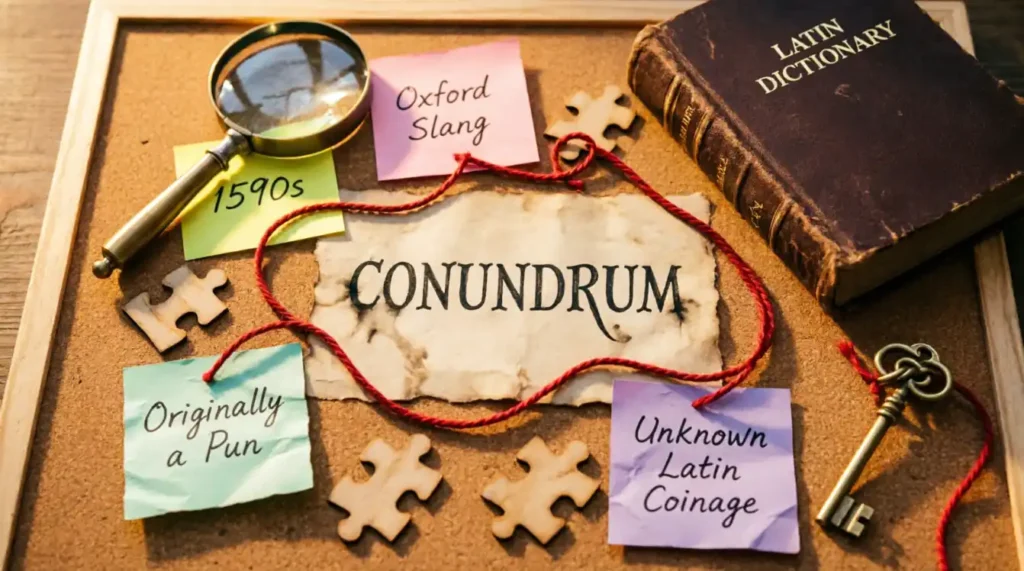
“Conundrum” has one of the more mysterious origin stories in English. Language historians and dictionary editors have long debated exactly where the word came from, and unlike many English words with a clear, traceable Latin or Greek root, “conundrum” doesn’t have a confirmed, agreed-upon source. Some early writers and scholars speculated it may have started as a joking, mock-Latin invention, a playful word made to sound scholarly and impressive without actually deriving from real Latin though this remains a theory rather than a settled fact.
What’s clearer is how the word’s meaning developed over time. It originally leaned more heavily toward describing riddles, particularly punning or wordplay-based riddles meant to entertain rather than genuinely stump someone. Over the following centuries, English speakers broadened “conundrum” to include serious, real-world dilemmas as well, expanding it from a word for clever wordplay into a more general term for any confusing, hard-to-resolve problem.
Today, dictionaries generally describe the word’s exact origin as unknown or uncertain, which makes “conundrum” a fitting example of its own meaning, a genuine puzzle, even to the people whose job it is to track down where English words come from.
Different Meanings and Contexts
Genuine dilemma or difficult problem (most common). In modern use, “conundrum” most often describes a real, complicated situation with no clean or obvious solution, a decision where every option carries some downside.
Riddle or wordplay puzzle. In its older, more literal sense, “conundrum” describes a riddle, especially one built around a clever pun or wordplay answer, often used for entertainment rather than serious problem-solving.
Academic and professional use. Writers and speakers use “conundrum” in business, ethics, science, and policy discussions to describe a genuinely difficult trade-off or dilemma, often one involving competing values or priorities.
Casual, everyday use. People also use “conundrum” more loosely and lightly for everyday tricky decisions like choosing between two great job offers even when the stakes aren’t especially high.
Examples of “Conundrum” in a Sentence
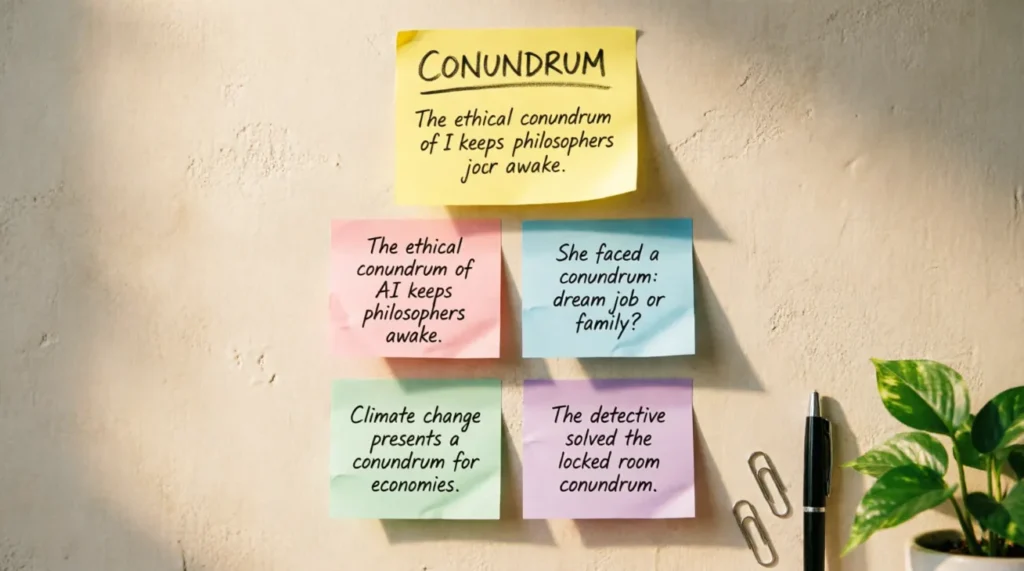
- “Choosing between the two job offers turned into a real conundrum.”
- “The riddle presented a classic conundrum, complete with a clever twist ending.”
- “Scientists face an ethical conundrum when balancing research progress with patient safety.”
- “It’s a bit of a conundrum: fixing one part of the budget always seems to break another.”
- “The mystery novel’s central conundrum kept readers guessing until the final chapter.”
- “Deciding who to invite without hurting anyone’s feelings was a genuine social conundrum.”
- “Policymakers wrestled with the conundrum of balancing growth and environmental protection.”
- “The team faced a scheduling conundrum with three deadlines landing the same week.”
- “It’s a real conundrum trying to please both sides of the family during the holidays.”
- “The professor opened the lecture with a classic logical conundrum to get students thinking.”
How to Use “Conundrum” Correctly
“Conundrum” functions as a noun, describing a specific tricky problem, dilemma, or riddle.
A few usage notes:
- Pair it naturally with words like: ethical, moral, logical, scheduling, and classic to specify what kind of conundrum you mean.
- Use “face” or “present” as common verbs. Phrases like “face a conundrum” or “the situation presents a conundrum” are natural and widely used.
- Reserve it for genuinely tricky situations. Because “conundrum” implies real difficulty or contradiction, using it for a simple, easily solved problem can feel like an overstatement.
- Feel free to use it for both riddles and real dilemmas. Context will make clear which sense you mean a lighthearted riddle or a genuinely serious decision.
Common Mistakes to Avoid

- Using it for a simple, easily solved problem. “Conundrum” implies real difficulty or an inherent trade-off, not just any minor inconvenience.
- Assuming it only refers to literal riddles. While that’s part of its history, modern usage leans much more heavily toward describing genuine dilemmas than wordplay puzzles.
- Overusing it in formal writing. Because it’s a distinctive, slightly playful word, using it too often can feel repetitive compared to simpler alternatives like “dilemma” or “problem.”
- Misspelling it. Common mistakes include dropping a letter or mixing up the ending. Remember it’s “conundrum,” ending in “-drum,” not “-drumb” or “-dram.”
Similar Words and Phrases
| Word | Meaning | How It Differs |
| Dilemma | A situation requiring a difficult choice between options | Very close in meaning, though “dilemma” often implies exactly two competing choices |
| Puzzle | A problem or question designed to test knowledge or skill | Broader term that doesn’t necessarily imply the same level of inherent contradiction |
| Riddle | A question or statement phrased to test cleverness, often with a witty answer | Focuses specifically on wordplay and cleverness, closer to the older sense of “conundrum” |
| Predicament | A difficult, unpleasant, or embarrassing situation | Emphasizes the difficulty of the overall situation rather than the puzzle-like quality of solving it |
| Quandary | A state of uncertainty or confusion over what to do | Nearly synonymous with “conundrum,” though slightly more focused on the feeling of indecision |
Opposite Words and Phrases
| Word | Meaning | Why It’s an Opposite |
| Certainty | A state of being completely sure about something | Directly opposite to the confusion and uncertainty central to a conundrum |
| Simple solution | An easy, straightforward answer to a problem | Opposite of the complicated, trade-off-laden nature of a conundrum |
| Clarity | The quality of being clear and easy to understand | Contrasts with the confusing nature of a conundrum |
| No-brainer | A decision or choice that’s obviously easy to make | The direct opposite of a genuinely difficult conundrum |
Pronunciation
“Conundrum” is pronounced kuh-NUN-drum, with the stress on the second syllable.
Quick Facts
| Fact | Detail |
| Meaning | A confusing, difficult problem, dilemma, or riddle |
| Origin | Uncertain; possibly a playful mock-Latin coinage, according to some historians |
| Part of speech | Noun |
| Older sense | A punning or wordplay-based riddle |
| Modern sense | A genuine dilemma or difficult decision |
| Common pairing | Ethical, moral, logical, or scheduling conundrum |
Frequently Asked Questions
What does “conundrum” mean?
It means a confusing or difficult problem, dilemma, or riddle, often one where no option offers a clean, obvious solution.
Where does the word “conundrum” come from?
Its exact origin is uncertain. Some language historians have speculated it may have started as a playful, mock-Latin invention, though this isn’t fully confirmed.
What’s the difference between a “conundrum” and a “dilemma”?
They’re very close in meaning, but “dilemma” often specifically implies a choice between exactly two options, while “conundrum” can describe a broader range of confusing or contradictory problems.
Is a “conundrum” always a riddle?
Not anymore. While it once leaned more heavily toward wordplay riddles, modern usage most often refers to genuine, real-world dilemmas.
Can “conundrum” be used casually?
Yes, it works well for both serious dilemmas and lighter, everyday tricky decisions, as long as the situation involves some genuine difficulty or trade-off.
How do you pronounce “conundrum”?
“Kuh-NUN-drum,” with stress on the second syllable.
What’s a synonym for “conundrum”?
“Dilemma,” “quandary,” and “puzzle” all work as close synonyms, though each carries a slightly different shade of meaning.
Is “conundrum” formal or casual?
It works in both settings common enough for everyday conversation, but distinctive enough to fit formal or academic writing as well.
Key Takeaways
- “Conundrum” means a confusing, difficult problem, dilemma, or riddle, often with no clean solution.
- The word’s exact origin remains uncertain, which some historians find fittingly ironic.
- It originally leaned toward wordplay riddles but now most commonly describes real-world dilemmas.
- Close synonyms include “dilemma,” “quandary,” and “puzzle,” each with slightly different shades of meaning.
- The word suits both serious, high-stakes situations and lighter, everyday tricky decisions.
Conclusion
“Conundrum” earns its keep in English by naming a very specific kind of difficulty: the sense that a problem isn’t just hard, but genuinely tangled, with every option pulling you in a slightly different direction. That’s a more precise feeling than a simple “problem” captures, which is exactly why the word has stuck around for centuries despite nobody quite agreeing on where it came from.
There’s something fitting about a word for confusing puzzles having a genuinely confusing origin story of its own. Even etymologists, the people whose entire job is tracing words back to their roots, treat “conundrum” as an open question rather than a settled fact.
Next time you’re stuck weighing two imperfect options, or you come across a clever riddle with a witty twist, you’ll have exactly the right word ready one that’s been quietly describing tricky puzzles, real and wordplay alike, for a very long time.

I am Olivia Brooks an American editor and content researcher dedicated to creating clear, accurate content. At writemora.com, I help readers to understand words, phrases, and modern language with confidence.