
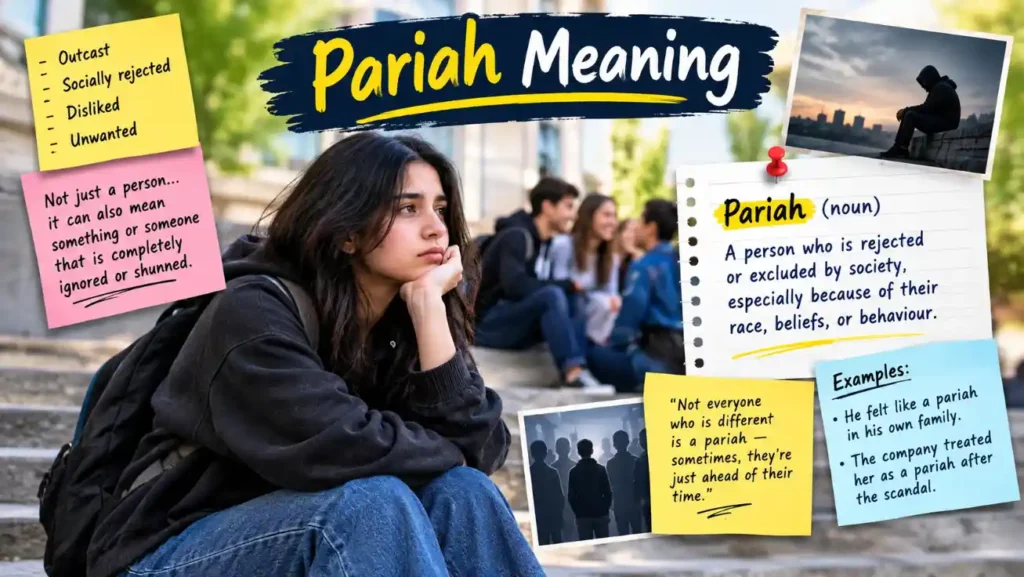
Pariah means a person who is rejected, avoided, or treated as an outcast by a social group or society. The word usually describes someone who is strongly disliked, distrusted, or shunned. It can also describe a country that is isolated internationally, as in “pariah state.”
Key Takeaways
- Pariah is a noun meaning a social outcast or rejected person.
- It suggests stronger rejection than simply being unpopular or different.
- Social pariah describes someone widely shunned by a group or community.
- A pariah state describes a country or government rejected by other nations.
- The word comes from a Tamil term connected historically with a community in South India and has a sensitive history.
What Does Pariah Mean?
The pariah meaning is a person who is rejected, avoided, or treated as an outcast by others. If someone becomes a pariah, people may refuse to associate with that person because they no longer trust, respect, or accept them.
For example:
After the scandal, the executive became a pariah in the company.
This means the executive was not merely unpopular. Other people began avoiding or rejecting them.
Cambridge defines pariah as someone who is not accepted by a social group, particularly because they are not liked, respected, or trusted. Oxford similarly defines it as someone who is not acceptable to society and is avoided by others.
The word can describe an individual, but it can also be used for groups, organizations, or countries in certain contexts.
Pariah Meaning in Simple English
In simple English, pariah means “an outcast.”
Imagine a person who was once accepted by a group but is suddenly rejected by nearly everyone because of a serious action, belief, controversy, or loss of trust. That person might be described as a pariah.
For example:
- After betraying his teammates, he became a pariah in the locker room.
- The politician became a pariah after the corruption scandal.
- She felt like a pariah after being excluded from every social event.
However, being quiet, unusual, or unpopular does not automatically make someone a pariah. The word usually carries the stronger idea of social rejection or deliberate avoidance.
How Do You Pronounce Pariah?
In American English, pariah is commonly pronounced:
puh-RY-uh
/pəˈraɪ.ə/
It has three syllables: puh-RY-uh. The main stress falls on the middle syllable. Cambridge and Oxford give the American pronunciation as approximately /pəˈraɪ.ə/.
The plural form is pariahs.
Example:
“Several former members became pariahs after the dispute.”
Pariah Meaning and Word Origin
The history of pariah is important because its modern meaning developed from a specific South Asian social context.
The word entered English in the early 17th century from Tamil paṟaiyar, related to paṟaiyan, a term associated with a hereditary drummer, and ultimately connected with paṟai, meaning a type of drum. American Heritage notes that the English word initially referred specifically to a historically marginalized community in South India before its meaning broadened.
Over time, English speakers began using pariah more generally for someone who was socially rejected or despised. By the 1800s, the broader figurative meaning of a person who was shunned had become established in English.
Because of this history, modern dictionaries note that the term can be considered offensive in some Indian contexts when used in reference to people or caste. It is therefore better to use the modern English sense carefully and avoid treating the historical caste meaning as a description of people today.
How Is Pariah Used in Modern English?
Today, pariah is most often used figuratively. It can describe a person, organization, or country that has lost acceptance and is being avoided or condemned.
Social Pariah
A social pariah is someone who is rejected or shunned by a particular social group or community.
For example:
After repeatedly betraying his friends, Mark became a social pariah.
The phrase emphasizes social isolation. It does not simply mean that someone has few friends; it suggests that other people actively avoid or reject the person.
The expression appears frequently in discussions of workplaces, communities, politics, schools, and public controversies. Cambridge specifically gives social pariah as a modern usage.
Pariah State
Pariah state is a political expression for a country or government that is widely rejected or isolated by other countries because of its actions or policies.
For example:
The regime became a pariah state after years of actions condemned by other governments.
Cambridge defines a pariah state as a country or government that is not accepted by other countries, particularly because it behaves in ways those countries consider wrong.
This usage is common in journalism, international relations, and political commentary.
Pariah vs. Outcast, Outsider, and Exile
These words overlap, but they are not always interchangeable.
| Word | Meaning | Main Difference |
| Pariah | Someone strongly rejected or shunned | Emphasizes serious social rejection |
| Outcast | Someone excluded from a group or society | Broad and common term |
| Outsider | Someone who is not part of a group | Does not necessarily imply rejection |
| Exile | Someone forced or choosing to live away from a place | Often involves geographic separation |
| Ostracized | Deliberately excluded or avoided | Describes the action or treatment |
For example, someone can be an outsider without being disliked. A person may simply be new to a community.
A pariah, however, is generally someone others actively reject or avoid.
Similarly, an exile may be physically separated from a country or community, while a pariah can remain physically present but be socially excluded.
Examples of Pariah in a Sentence
Here are several natural examples of pariah in American English:
- After the scandal, the CEO became a pariah among industry leaders.
- He was treated like a pariah after breaking the group’s most important rule.
- The once-popular celebrity became a social pariah after the controversy.
- She refused to treat her classmate like a pariah simply because they disagreed.
- The government feared becoming an international pariah.
- After exposing the wrongdoing, the employee became a pariah within the organization.
These examples show that pariah usually involves more than ordinary disagreement. The central idea is rejection by others.
Is Pariah a Negative or Offensive Word?
In modern American English, pariah has a strongly negative meaning because it describes someone who is rejected, despised, or avoided.
It is generally appropriate when discussing social rejection, political isolation, literature, or similar contexts. However, its historical connection to a marginalized South Asian community makes the word sensitive in some contexts, particularly in India. Oxford and Cambridge both flag this concern.
When discussing historical caste communities, it is better to use the specific modern terminology preferred by the people or community being discussed rather than casually applying pariah as a label.
Synonyms and Antonyms for Pariah
Synonyms
Depending on the context, useful synonyms include:
- Outcast
- Reject
- Outsider
- Exile
- Social outcast
- Castaway
- Undesirable
The closest everyday synonym is usually outcast. Collins also lists words such as outcast, exile, outlaw, and undesirable among related terms.
Antonyms
Possible opposites include:
- Insider
- Accepted person
- Member
- Welcome guest
- Popular figure
The exact opposite depends on context. If pariah means someone rejected by a group, an accepted member is often a clearer opposite than a single fixed antonym.
Frequently Asked Questions About Pariah
What does pariah mean?
Pariah means a person who is rejected, avoided, or treated as an outcast by a group or society. It usually suggests strong social rejection rather than simply being unpopular.
Is pariah a negative word?
Yes. Pariah has a negative connotation because it describes someone who is strongly rejected or shunned. It is commonly used in social, literary, journalistic, and political contexts.
What is another word for pariah?
The closest common synonym for pariah is outcast. Other related words include reject, outsider, exile, and social outcast, although each has slightly different nuances.
What does social pariah mean?
A social pariah is someone who is deliberately avoided or rejected by a social group. The phrase emphasizes that the person has been pushed outside normal social acceptance.
What does the pariah state mean?
A pariah state is a country or government that is widely rejected or isolated by other countries because of actions or policies considered unacceptable.
Is pariah offensive?
The modern English word means an outcast, but its historical origin is connected to a marginalized community in South India. Major dictionaries note that the term can be offensive in some Indian contexts, so it should be used carefully when discussing its historical or cultural background.
Conclusion
The pariah meaning is straightforward in modern English: a person who is rejected, avoided, or treated as an outcast. It is a stronger word than simply saying someone is unpopular because it suggests serious social exclusion or loss of acceptance.
You may see pariah in phrases such as social pariah and pariah state, as well as in news reports, literature, and everyday discussions about social rejection. Understanding its historical origin also helps explain why the word should be used thoughtfully, especially when discussing South Asian history and caste.

I am Olivia Brooks an American editor and content researcher dedicated to creating clear, accurate content. At writemora.com, I help readers to understand words, phrases, and modern language with confidence.

