
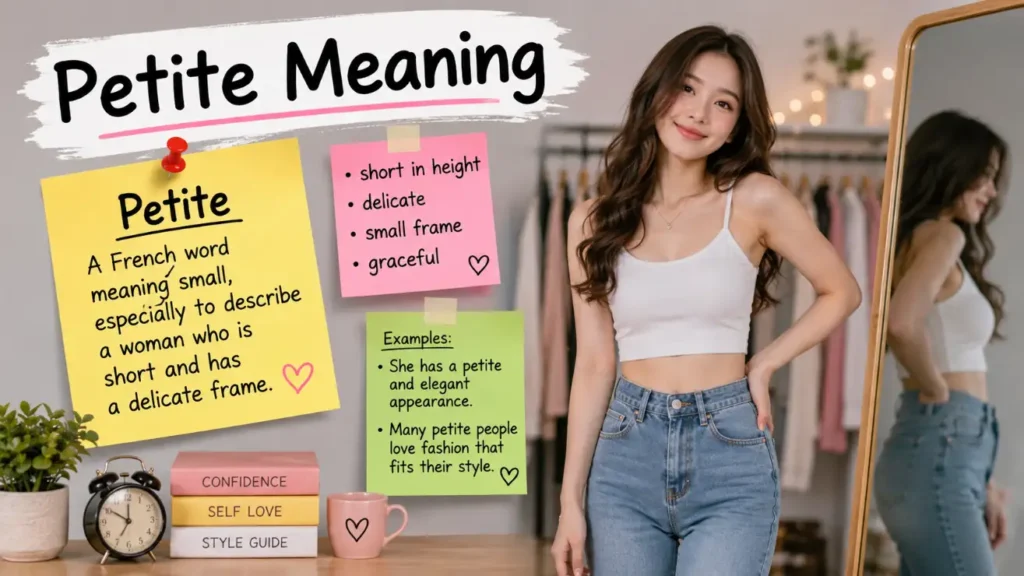
Walk into most clothing stores and you’ll spot a “petite” section, separate from regular sizing. The petite meaning goes beyond simply “small” ; it specifically describes someone (usually a woman) who is shorter than average, and in fashion, it refers to clothing cut and proportioned specifically for that shorter frame, not just clothing in a smaller size.
This guide covers exactly what “petite” means, where the word comes from, how it works as a specific fashion sizing category, and answers to the questions people ask most often. By the end, you’ll know precisely what “petite” means and how it differs from words like “small” or “short.”
What “Petite” Means
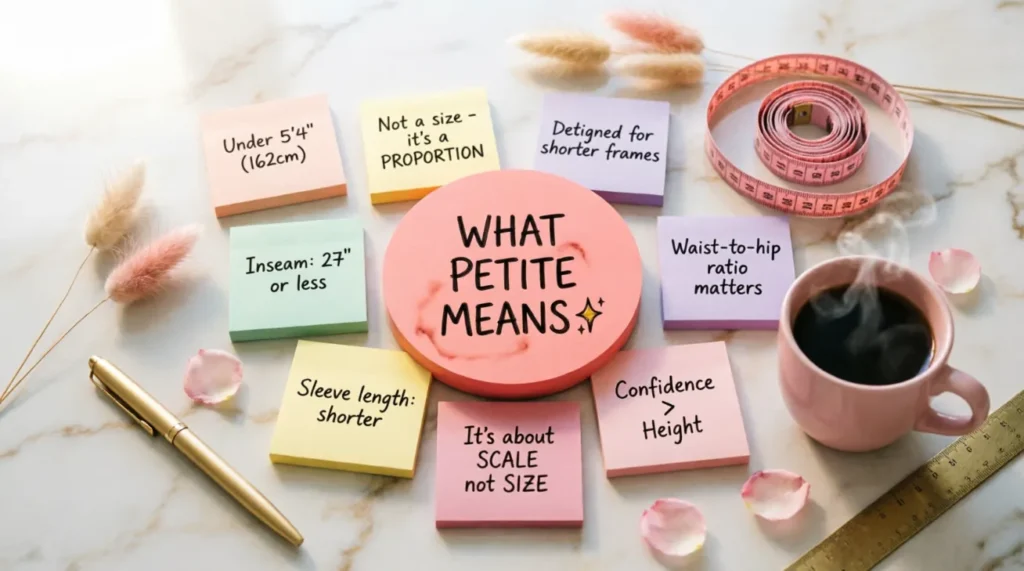
The simple version: “Petite” describes someone who is small and slender, typically shorter than average height. In fashion, “petite” refers to a specific sizing category designed for shorter frames, not simply a smaller size overall.
The fuller picture: As a general descriptive word, “petite” describes a person’s build small, slight, and usually shorter in stature. It’s most commonly applied to women and carries a generally positive, even flattering connotation, unlike some other words for smallness that can sound less complimentary. In fashion and clothing, though, “petite” means something more specific and technical: it’s a sizing category built around height and proportion, not just overall garment size. Petite clothing shortens sleeve length, rise, torso length, and hem length to fit someone who is shorter overall, typically under a certain height threshold (often cited as roughly 5’4″ or under in the U.S. market, though exact cutoffs vary by brand).
This distinction matters because a petite size isn’t simply a smaller number on the tag; a “petite medium” and a “regular medium” might fit similarly around the waist but differ significantly in length and proportion.
Origin and History
“Petite” comes directly from French, where it’s the feminine form of petit, meaning “small” or “little.” English absorbed the word largely intact, keeping both its spelling and its association with smallness, though English speakers eventually broadened its use beyond a strict translation.
The word entered common English usage as a way to describe someone small and slender, particularly women, carrying a softer, more flattering tone than blunter alternatives like “short.” Fashion retailers later adopted “petite” as a formal sizing category, especially as the ready-to-wear clothing industry grew and manufacturers recognized that shorter individuals needed more than just a smaller size; they needed different proportions altogether.
The exact point at which “petite” became a standardized clothing category varies by market and retailer, and sizing conventions have continued to shift over time, but the core concept clothing proportioned for shorter frames rather than simply scaled down has remained consistent since the category first took hold in the fashion industry.
Different Meanings and Contexts
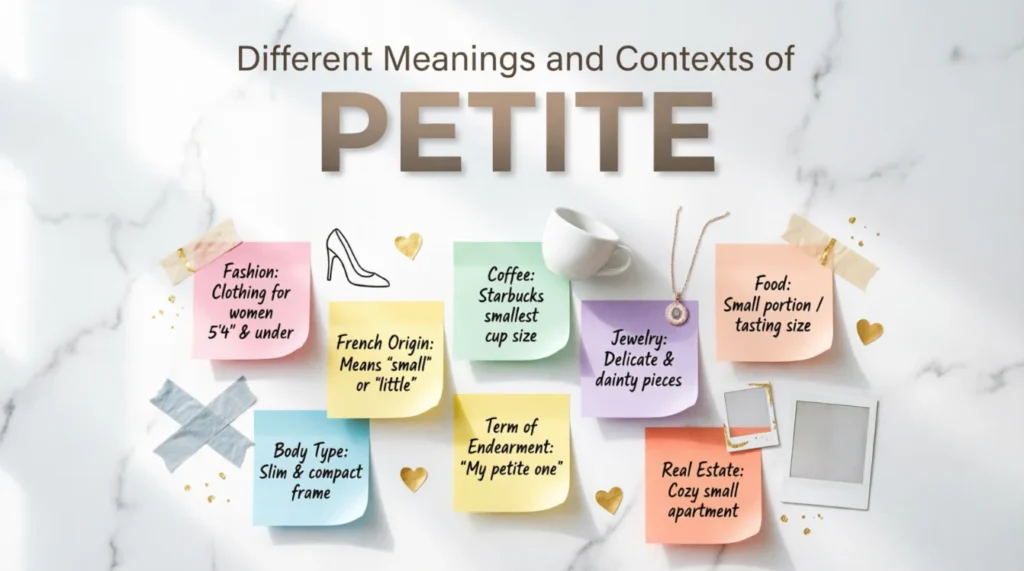
General descriptive use. “Petite” describes someone (most often a woman) who is small, slender, and typically shorter than average, a general compliment-adjacent way to describe build and stature.
Fashion sizing category. In clothing, “petite” refers to a specific size range designed for shorter frames, adjusting proportions like sleeve length, inseam, and torso length rather than simply offering a smaller overall garment size.
French usage (broader meaning). In its original French context, “petit“/”petite” simply means “small” or “little” and applies far more broadly than in English to objects, animals, and situations, not just people’s height and build.
Occasional use for objects or things. English occasionally borrows “petite” more loosely to describe something small and dainty, though this usage is far less common than its application to people.
Examples of “Petite” in a Sentence
- “She’s petite, so she usually shops in the petite section for better-fitting pants.”
- “The dress runs small, so petite customers should size up slightly.”
- “He described her as petite but strong, having competed in gymnastics for years.”
- “The brand recently expanded its petite line to include more work-appropriate options.”
- “Petite sizing typically fits people around 5’4” and under.”
- “Her petite frame made it easy for her to find a seat even on the crowded train.”
- “The store’s petite collection features shorter hems and adjusted sleeve lengths.”
- “Despite her petite stature, she was known for her powerful stage presence.”
- “I finally found jeans in petite that don’t need three inches hemmed off.”
- “The boutique specializes in petite and plus-size clothing alike.”
How to Use “Petite” Correctly
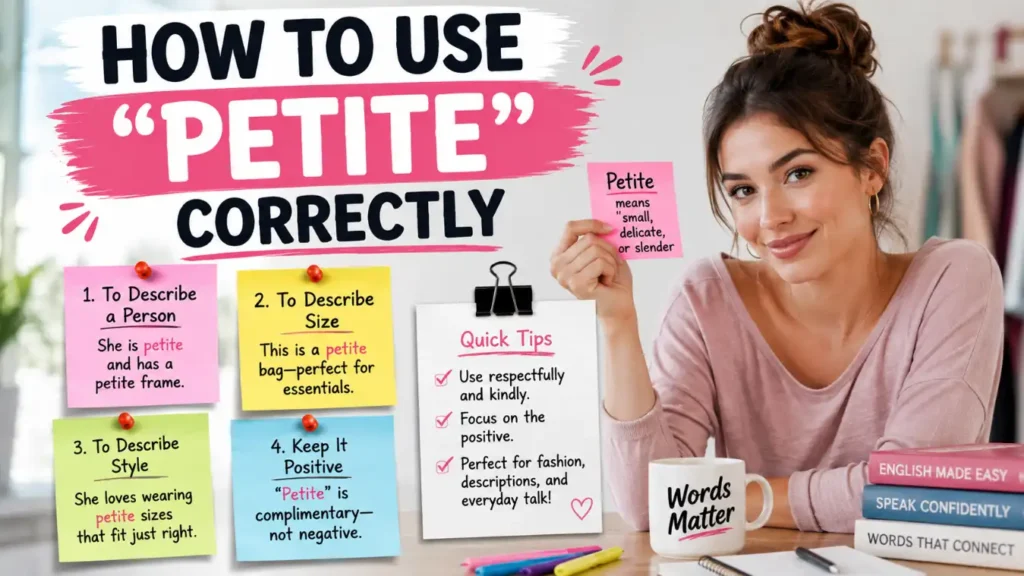
“Petite” functions as an adjective, describing either a person’s build or a category of clothing sized for shorter frames.
A few usage notes:
- Distinguish between general use and sizing use. Calling someone “petite” as a general description differs from referring to “petite sizing,” which is a specific, technical clothing category.
- Pair it naturally with words like: frame, build, stature, section, and sizing.
- Know that petite ≠ small overall size. A petite size adjusts proportions (length, rise, sleeve length) for a shorter body, not just overall garment size; someone can wear a petite large, for example.
- Use it respectfully. “Petite” generally carries a flattering, neutral-to-positive tone in English, unlike blunter words for smallness.
Common Mistakes to Avoid
- Assuming “petite” always means “very small overall.” Petite sizing specifically addresses height and proportion, not necessarily an overall small body size. Someone can be petite and still wear a larger clothing size.
- Confusing “petite” with “short.” While related, “petite” carries a softer, often more flattering tone and is specifically tied to fashion sizing conventions, while “short” is a more general, neutral descriptor.
- Assuming petite sizing standards are identical across all brands. Height cutoffs and proportion adjustments for petite clothing vary somewhat from retailer to retailer.
- Using “petite” for men in most English contexts. While technically gender-neutral in French, “petite” in English overwhelmingly describes women, and using it for men is uncommon outside of specific niche contexts.
Similar Words and Phrases
| Word | Meaning | How It Differs |
| Small | Limited in size | A more general, neutral word that doesn’t specifically imply height or fashion sizing |
| Short | Below average height | More blunt and neutral than “petite,” and applies equally to human beings. |
| Diminutive | Very small in size | Slightly more formal or literary, and can occasionally carry a condescending tone depending on context |
| Slight | Small and slender in build | Focuses more on build and frame than on overall height |
| Compact | Small and efficiently arranged | Rarely used to describe people; more common for objects, vehicles, or spaces |
Opposite Words and Phrases
| Word | Meaning | Why It’s an Opposite |
| Tall | Above average height | Directly opposite the shorter stature “petite” describes |
| Statuesque | Tall and impressively proportioned | Opposite in both height and overall physical impression |
| Plus-size (in fashion contexts) | A sizing category for larger body sizes | A different, unrelated sizing category, though sometimes contrasted with “petite” in retail contexts |
| Towering | Extremely tall | The clear opposite extreme of a petite stature |
Pronunciation
“Petite” is pronounced puh-TEET, with the stress on the second syllable, and the final “e” is silent.
Quick Facts
| Fact | Detail |
| Meaning | Small and slender, typically describing a shorter-than-average build |
| Origin | French, feminine form of petit, meaning “small” |
| Part of speech | Adjective |
| Fashion sizing | A category adjusted for proportion (length, rise, sleeves), not just size |
| Typical height cutoff | Often cited around 5’4″ or under, though it varies by brand |
| Common context | General description and clothing sizing |
Frequently Asked Questions
What does “petite” mean?
It means small and slender, typically describing someone shorter than average height, most often applied to women.
What does “petite” mean in clothing sizes?
It refers to a sizing category specifically proportioned for shorter frames, adjusting things like sleeve length, torso length, and inseam rather than just overall garment size.
Is “petite” the same as “short”?
They’re related, but “petite” carries a softer, more flattering tone and is specifically tied to fashion sizing conventions, while “short” is a more general, neutral term.
How tall do you have to be to wear petite sizing?
It varies by brand, but petite sizing is often designed for people around 5’4″ and under.
Where does the word “petite” come from?
It comes from French, where “petite” is the feminine form of “petit,” meaning “small” or “little.”
Can someone be a larger dress size and still be petite?
Yes. Petite sizing addresses height and body proportion, not overall body size, so someone can wear a petite size in a larger number.
Is “petite” used to describe men?
Rarely in English. While technically gender-neutral in French, “petite” is used almost exclusively to describe women in everyday English usage.
How do you pronounce “petite”?
“Puh-TEET,” with stress on the second syllable and a silent final “e.”
Key Takeaways
- “Petite” describes someone small and slender, typically shorter than average, most often applied to women.
- In fashion, “petite” refers to a sizing category adjusted for proportion, not just overall garment size.
- The word comes from French, meaning “small” or “little.”
- Petite sizing standards vary somewhat by brand, though a common cutoff is around 5’4″ and under.
- “Petite” and “short” are related but carry a different tone and different typical usage.
Conclusion
“Petite” earns its specific place in fashion vocabulary because it solves a real problem: a smaller clothing size and a shorter frame aren’t the same thing, and treating them as identical leaves a lot of shoppers with clothes that technically fit but never quite sit right. The word gives both shoppers and retailers a precise way to talk about proportion, not just size.
Outside of clothing racks, “petite” still does useful work as a simple, flattering way to describe someone’s build carrying a softer tone than blunter alternatives while conveying the same basic idea of smallness and shorter stature.
Next time you’re shopping for clothes that never seem to hit right at the ankle or wrist, you’ll know exactly which section to check and you’ll understand precisely what makes petite sizing different from simply choosing a smaller number on the tag.

I am Olivia Brooks an American editor and content researcher dedicated to creating clear, accurate content. At writemora.com, I help readers to understand words, phrases, and modern language with confidence.