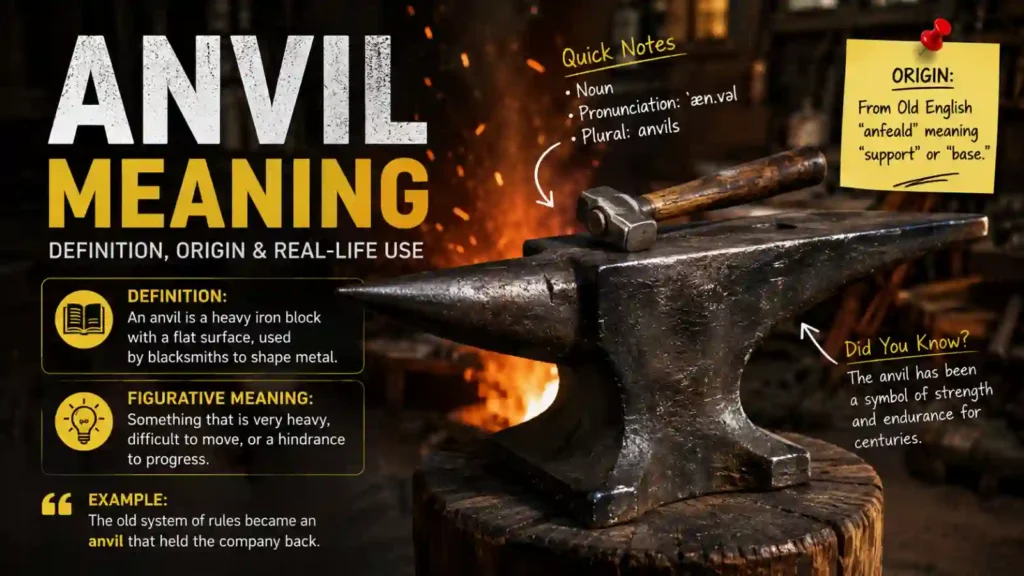
If you’ve ever heard someone say a project is “on the anvil” or seen the word pop up in a cartoon (that classic falling block of metal), you might wonder about the real anvil meaning behind it. At its core, an anvil is a heavy block of metal that blacksmiths use as a surface for hammering and shaping hot metal. But the word has picked up several other meanings over time, from a tiny bone in your ear to a popular metaphor for something being actively worked on.
This guide covers every common sense of the word: the literal tool, the figurative expressions people build around it, the anatomical term, and a few other contexts where “anvil” shows up. By the end, you’ll know exactly what it means, how to use it correctly, and which similar words people sometimes confuse it with.
What Anvil Means (Simple and Detailed)
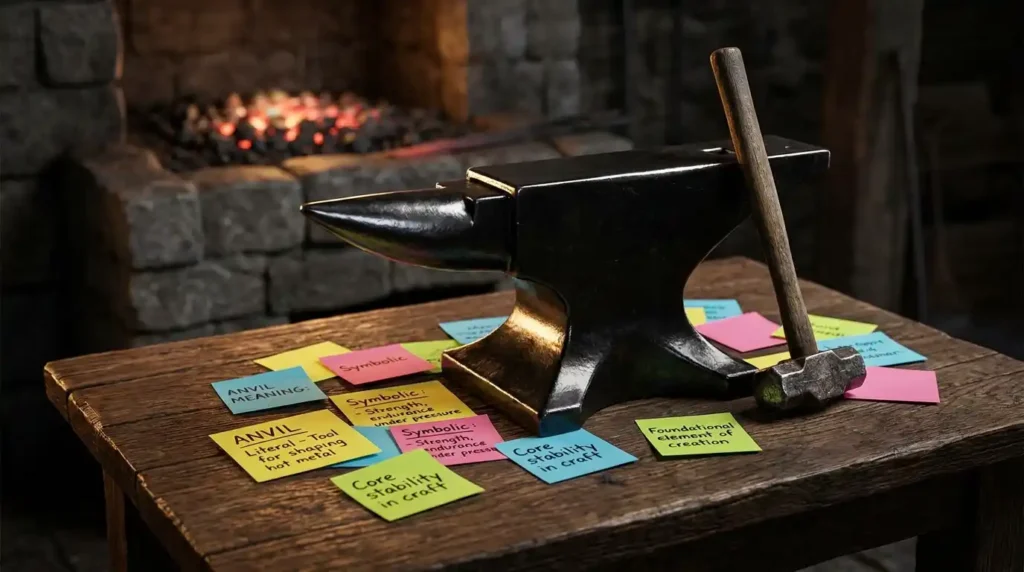
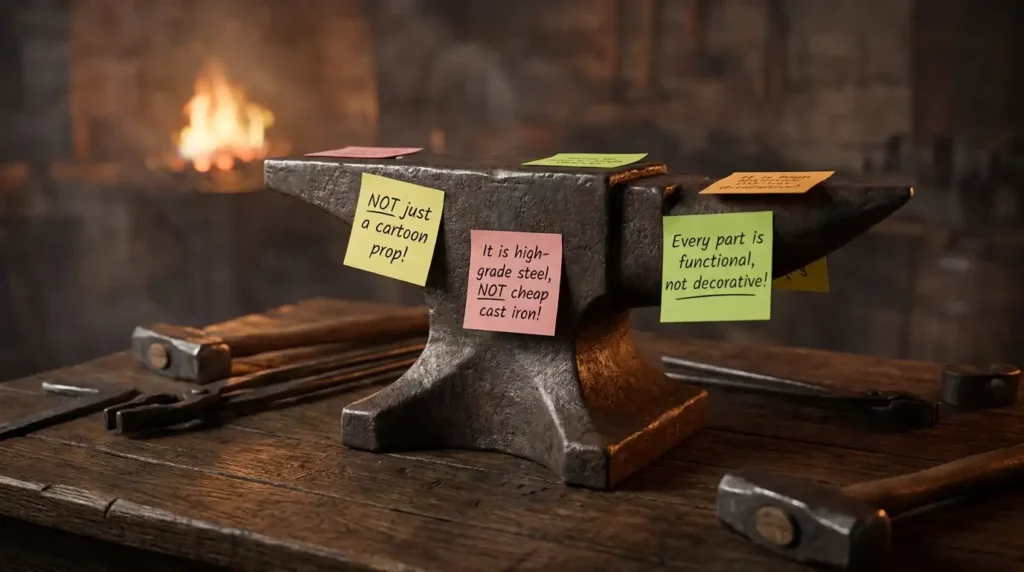
In simple terms, an anvil is a solid block of metal, usually iron or steel, with a flat top and a pointed end called a horn. A blacksmith sets it on a heavy stand, places hot metal on top of it, and hammers the metal into shape. The anvil absorbs the force of the hammer blows and pushes that energy back into the metal, which makes shaping it faster and more precise.
The more detailed picture involves a few key parts:
- Face: The flat top surface where most hammering happens. Manufacturers harden it so it doesn’t dent easily.
- Horn: The pointed, cone-shaped end blacksmiths use for bending metal into curves.
- Hardy hole: A square hole in the face where blacksmiths insert tools like chisels or cutting blades.
- Pritchel hole: A smaller round hole blacksmiths use for punching holes in metal.
- Base: The bottom section that sits on a stand or stump, keeping the anvil stable during heavy blows.
Anvils range from small jeweler’s anvils that fit in one hand to massive shop anvils weighing several hundred pounds. The heavier the anvil, the less energy it loses when struck, which is why blacksmiths generally prefer the heaviest anvil they can work with comfortably.
Origin and History of the Word
The word “anvil” traces back to Old English, where an earlier form linked it to a verb meaning “to beat” or “to strike upon.” Over centuries of use in Middle English, the spelling and pronunciation shifted into the modern word we use today. Because language history often involves gradual, undocumented changes, linguists still debate some of the finer details of exactly when and how the word evolved, so it’s fair to say the precise timeline isn’t perfectly settled.
What is clear is that anvils themselves are ancient tools. Metalworkers have used some form of anvil, if a flat stone or a shaped metal block, for as long as humans have been forging metal. The tool predates the specific English word by a long stretch, since early metalworkers made the first anvils from stone before bronze and iron versions became common.
Different Contexts and Meanings of Anvil
The word “anvil” isn’t limited to blacksmith shops. Here are the contexts where it shows up most often.
The Literal Blacksmithing Tool
This is the original and most direct meaning: a metal block that blacksmiths use for hammering and shaping other metal. It’s still the primary meaning in dictionaries and the one most people picture first.
The Anatomical Term (Incus)
Inside your middle ear sits a tiny bone people commonly nickname the “anvil” because of its shape, which resembles a miniature blacksmith’s anvil. Doctors formally call it the incus. It sits between two other small bones, the malleus (“hammer”) and the stapes (“stirrup”), and together these three bones transmit sound vibrations from your eardrum to your inner ear.
Figurative and Idiomatic Uses
People often use “anvil” outside of any literal metalworking or anatomy context, usually to describe pressure, weight, or ongoing work:
- “On the anvil” means something is currently in progress or in development, similar to saying a project is “in the works.”
- Anvil as a symbol of weight or burden, as in “it felt like an anvil on my chest,” meaning something heavy or oppressive.
- Anvil as a symbol of endurance and toughness, since the tool can withstand constant pounding without breaking. Calling something “built like an anvil” suggests durability.
Cultural and Pop-Culture References
Anvils show up frequently in cartoons and comedy, most famously as objects that comically fall from the sky onto a character’s head. This exaggerated image has made “anvil” a shorthand for slapstick misfortune in casual conversation, even outside its original meaning.
Examples of Anvil Used in a Sentence
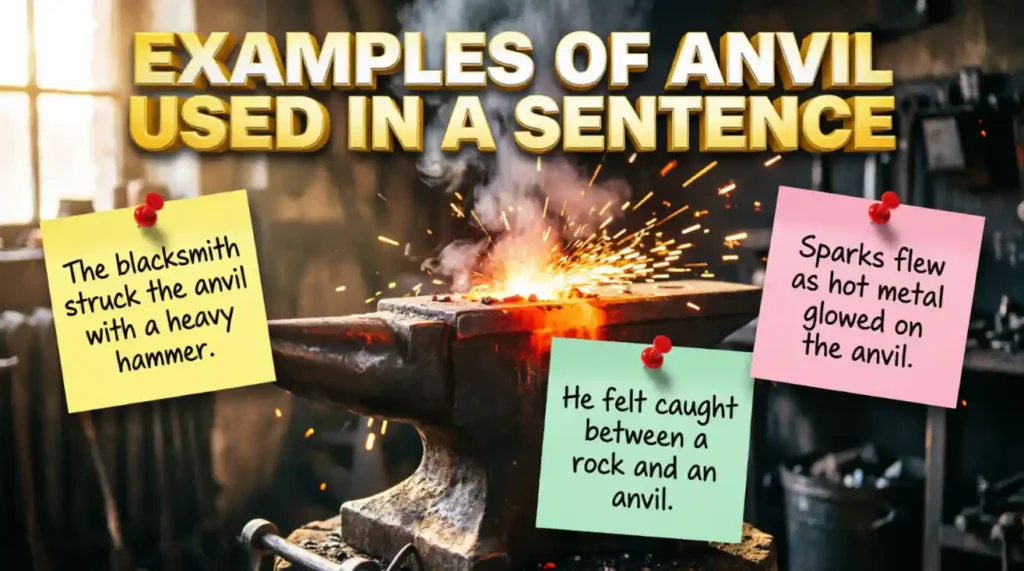
- The blacksmith set the glowing iron bar on the anvil and began hammering it flat.
- Doctors explained that the incus, which people nickname the anvil, helps transmit sound to the inner ear.
- Her new novel has stayed “on the anvil” for nearly two years.
- The old shop anvil weighed close to two hundred pounds.
- He joked that the deadline felt like an anvil sitting on his shoulders.
- The apprentice learned to shape horseshoes using the horn of the anvil.
- In the cartoon, an anvil comically dropped from the sky onto the character.
- The company’s next product is still on the anvil, and no one has announced it yet.
- She bought a small jeweler’s anvil for delicate metalwork.
- The blacksmith’s hammer rang out every time it struck the anvil.
How to Use “Anvil” Correctly
“Anvil” is a noun, and writers almost always use it literally or as part of a set phrase like “on the anvil.” It doesn’t typically function as a verb, so phrases like “to anvil something” aren’t standard usage.
When you’re referring to the tool, it works like any physical object: “a heavy anvil,” “the blacksmith’s anvil,” “an anvil and hammer.” When you’re using it figuratively, it usually appears in a fixed expression rather than a flexible one, so “on the anvil” is common, but inventing new figurative phrases with the word can sound forced or unclear to readers.
Common Mistakes People Make
- Confusing it with “hammer.” The hammer strikes; the anvil is the surface that takes the blow. They’re partners, not the same thing.
- Assuming “anvil” always means the metalworking tool. In a medical context, it almost always refers to the incus bone, not a literal metal block.
- Overusing the falling-anvil cartoon image as if it’s the word’s main meaning. That’s a cultural reference, not the dictionary definition.
- Misusing “on the anvil” to mean something is finished. It specifically means something is still in progress, not complete.
Similar Words to Anvil
| Word | Meaning | Difference from Anvil |
| Hammer | A tool used to strike or shape objects | The hammer delivers the force; the anvil absorbs and reflects it |
| Vise | A clamping tool that holds an object in place | A vise grips material; an anvil supports it during hammering |
| Forge | The furnace or workshop where metal is heated and shaped | The forge is the environment; the anvil is one tool within it |
| Incus | The medical term for the “anvil” bone in the ear | Formal anatomical name versus the everyday nickname |
Opposite Words (Conceptual Contrasts)
| Word | Contrast with Anvil |
| Feather | Represents lightness, the opposite of the anvil’s association with heaviness |
| Fragile | The anvil symbolizes toughness and durability, the reverse of fragility |
| Idle | “On the anvil” implies active work; “idle” implies nothing is happening |
Pronunciation
Say “anvil” as AN-vil (two syllables), with the stress on the first syllable.
Quick Facts About Anvil
| Fact | Detail |
| Part of speech | Noun |
| Primary meaning | A metal block blacksmiths use for shaping heated metal by hammering |
| Anatomical meaning | Common nickname for the incus, a small bone in the middle ear |
| Common idiom | “On the anvil,” meaning something is currently in progress |
| Key parts of a physical anvil | Face, horn, hardy hole, pritchel hole, base |
| Symbolic meaning | Durability, toughness, and heavy or ongoing pressure |
Frequently Asked Questions
What does “on the anvil” mean?
It means something is currently in progress, in development, or in the planning stage, but not yet finished. It’s similar in meaning to “in the works.”
Why is the ear bone called an anvil?
Doctors nicknamed the bone, formally the incus, “anvil” because its shape resembles a small blacksmith’s anvil. It’s one of three tiny bones in the middle ear, alongside the “hammer” (malleus) and “stirrup” (stapes).
What is an anvil used for?
Blacksmiths and metalworkers use it as a solid, stable surface for hammering, bending, and shaping heated metal into tools, horseshoes, decorative items, and more.
What are the main parts of an anvil?
The main parts are the face (flat top), the horn (pointed end for bending metal), the hardy hole and pritchel hole (openings for tools), and the base that keeps it stable.
Is “anvil” a verb?
No. “Anvil” is a noun. There isn’t a standard verb form, so you wouldn’t typically say “to anvil” something.
Why do anvils fall on characters in cartoons?
It’s a long-running comedic device in animation. The anvil’s weight and hard shape make it a visually clear symbol of sudden, exaggerated impact, which is why it became a running gag rather than a reflection of the word’s actual meaning.
What materials are anvils made from?
Manufacturers typically make modern anvils from steel or cast iron. Historically, metalworkers made earlier versions from stone or bronze before iron and steel became the standard.
How heavy is a typical anvil?
Sizes vary widely, from small hobbyist anvils weighing a few pounds to large blacksmithing anvils weighing several hundred pounds. Heavier anvils generally perform better because they absorb hammer blows more efficiently.
Is “anvil” used in any other industries or brand names?
Yes, companies sometimes use the word as a name for tools, software, or products meant to evoke strength and reliability, since the anvil itself is widely recognized as a symbol of toughness.
Key Takeaways
- An anvil is primarily a heavy metal block that blacksmiths use for hammering and shaping hot metal.
- The word also refers to the incus, a small bone in the middle ear shaped like a tiny anvil.
- “On the anvil” is a common idiom meaning something is currently in progress.
- Anvils symbolize durability and toughness because they can absorb constant impact without breaking.
- The word is a noun, not a verb, and its figurative uses tend to follow set phrases rather than free-form expressions.
- Anvils appear frequently in cartoons as a symbol of comedic, exaggerated impact.
Conclusion
The anvil meaning goes well beyond the blacksmith’s workshop. It’s a literal tool for shaping metal, a nickname for a bone that helps you hear, and a handy figure of speech for describing something still in progress or something built to endure pressure.
Once you know these different layers, you’ll recognize the word instantly if it shows up in a shop, a doctor’s office, or a casual conversation. If you’re curious about related tools and terms, it’s worth looking into how a forge and hammer work alongside the anvil in traditional blacksmithing.

I am Stephen King an American author known for compelling storytelling. At writemora.com, we value clear, accurate, and reader-focused content inspired by excellence in writing.