
TMI stands for “too much information.” People say it when someone shares a detail, usually personal, embarrassing, or graphic, that’s more than the listener wanted or needed to know.
It’s one of the most common abbreviations in casual English, showing up in texts, comments, and everyday conversation. The TMI meaning hasn’t changed much since it became popular, but the situations people use it for keep expanding as more of life gets shared online.
This guide breaks down exactly what TMI means, where it came from, the different ways people use it, and how to use it correctly yourself.
What It Means
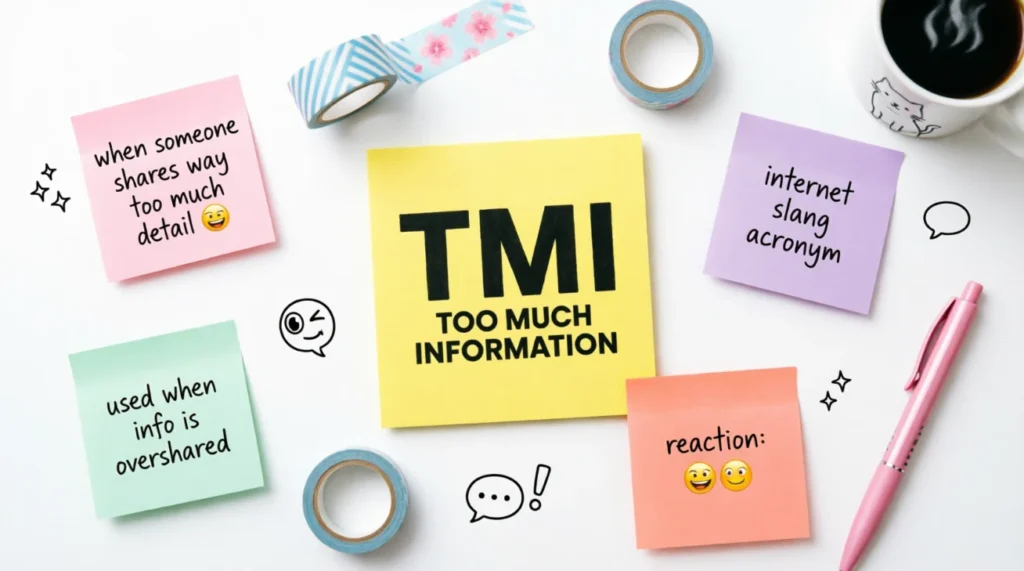
In simple terms, TMI is short for “too much information.” People say it as a reaction when someone reveals something overly personal, graphic, or awkward often about health, bodily functions, relationships, or private habits.
In a fuller sense, TMI works as both a warning and a reaction. As a warning, someone might say “TMI incoming” before sharing something oversharing-adjacent, giving the listener a chance to brace themselves or opt out. As a reaction, it’s a quick way to say “that’s more detail than I needed” without being harsh about it.
The phrase carries a light, often joking tone. People rarely mean it as a serious scolding, more a shorthand acknowledgment that a personal or social boundary around information just got crossed, usually in a way both people find a little funny.
Origin & History
TMI is an abbreviation that grew out of everyday spoken English before becoming a written internet staple. People already said “too much information” in casual speech by the 1990s, using it to react to oversharing in person.
As texting, instant messaging, and online forums spread through the late 1990s and 2000s, people naturally shortened the phrase to the initialism TMI, following the same pattern as other common abbreviations like LOL or BRB. It caught on quickly because it filled a real gap: a fast way to flag oversharing without typing out a full sentence.
Unlike some internet slang, TMI didn’t originate from a specific site, show, or subculture. Its exact first use online is hard to pin down, and it’s best understood as a natural shortening of a phrase people were already saying out loud.
Different Contexts and Meanings
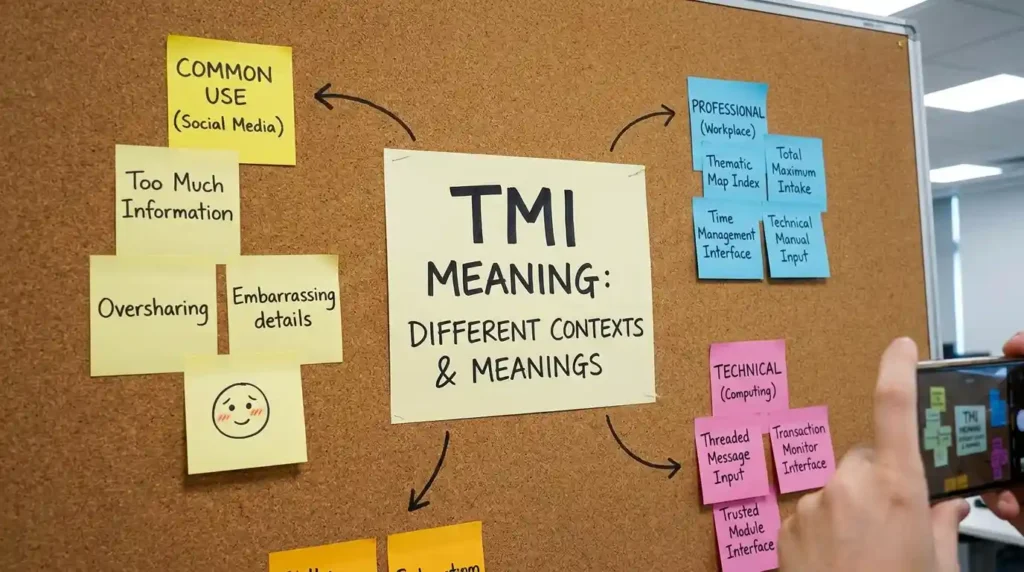
In casual conversation. The most common use: reacting when a friend or family member shares an oversharing detail, especially about health, bathroom habits, or relationships.
In texting and messaging. People often type “TMI” as a quick, standalone reaction to a message, sometimes pairing it with a laughing emoji to keep the tone light rather than critical.
As a warning before sharing. Some people say “TMI, but…” right before telling an oversharing story, acknowledging in advance that what’s coming might be more than the listener bargained for.
In social media and comments. Readers post TMI under posts where someone has shared something very personal, a health update, a relationship detail, or a graphic story often as one of the top comments.
In workplace or professional settings. Coworkers also use TMI, sometimes more pointedly, when someone shares personal details that don’t belong in a professional context, using it as a gentle social cue to redirect the conversation.
Examples
- “He told the whole office about his surgery in way too much detail total TMI.”
- “TMI, but I haven’t slept in three days because of this cold.”
- “She posted a TMI update about her breakup on social media.”
- “I don’t need to know what you had for lunch and what happened after TMI!”
- “My coworker gave me a TMI rundown of her dating app messages.”
- “Warning: TMI incoming about my dentist appointment.”
- “The group chat went full TMI after someone brought up their diet.”
- “That’s a bit TMI for a first date conversation.”
- “He shared a TMI story about his workout injury at dinner.”
- “I love you, but that’s TMI for breakfast.”
How to Use It (Grammar and Context)
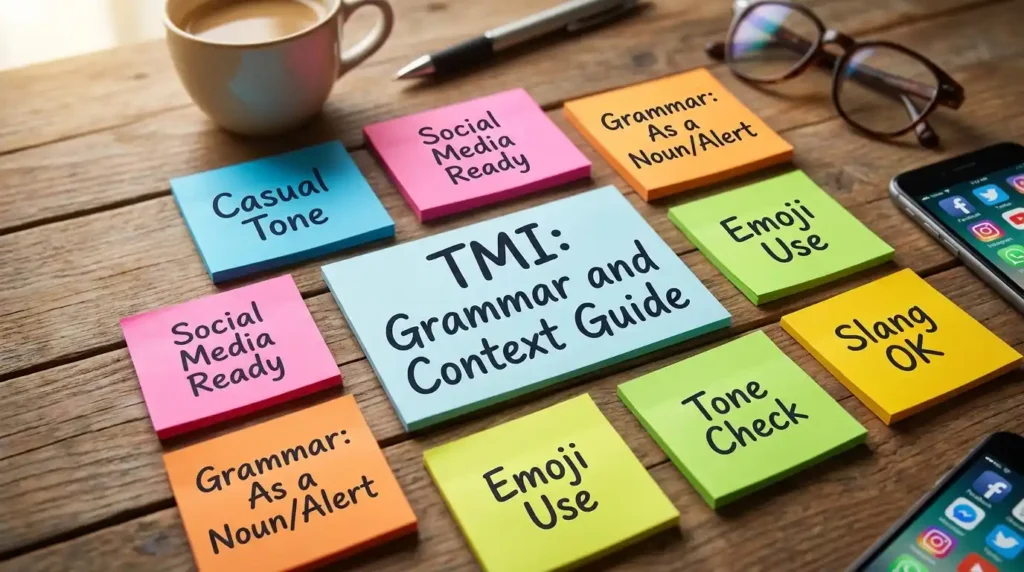
People usually write TMI in all capitals, since it’s an initialism (each letter pronounced or read individually, unlike an acronym pronounced as a word). It most often appears as a standalone reaction (“TMI!”) or as a short lead-in phrase (“TMI, but…”).
It can also function as a modifier before a noun, as in “a TMI moment” or “a TMI story,” meaning a moment or story that crosses into oversharing territory. Unlike some abbreviations, TMI shows up in both spoken and written English, so it’s fine to say it out loud in conversation as well as type it.
Common Mistakes
Treating it as harsh criticism. People almost always use TMI lightly, not as a serious reprimand. Saying it in a cold or dismissive tone can come across as ruder than intended.
Confusing it with similar abbreviations. People sometimes mix up TMI with other three-letter texting shorthand. It specifically means “too much information,” not “too many issues” or other phrases people occasionally guess.
Using it in serious or sensitive moments. If someone is sharing something genuinely difficult, not just an awkward or graphic detail, but a real emotional struggle, responding with “TMI” can feel dismissive rather than playful.
Overusing it as a deflection. Saying TMI to shut down every personal topic can come across as avoidant rather than funny if it happens too often in a relationship or friendship.
Similar Words
| Word/Phrase | Meaning | Difference from TMI |
| Overshare | To reveal more personal information than is socially appropriate | TMI is the reaction; “overshare” describes the act itself |
| NSFW | “Not safe for work” content inappropriate for a work setting | NSFW is about setting and content type, not amount of personal detail |
| Cringe | Something that causes secondhand embarrassment | Cringe is a broader reaction to awkwardness, not specific to information-sharing |
| Spill the tea | To share gossip or juicy information, usually invited | People usually welcome and request spilled tea; they rarely want TMI |
Opposite Words
| Word/Phrase | Meaning | Why It’s an Opposite |
| Need-to-know basis | Sharing only essential, relevant information | The direct opposite of oversharing |
| Discreet | Careful and restrained about revealing personal details | Discretion avoids the situations that lead to a TMI reaction |
| Vague | Deliberately unclear or lacking in detail | Too little information, rather than too much |
Pronunciation
People pronounce TMI by saying each letter individually: T-M-I (tee-em-eye).
Quick Facts
| Fact | Detail |
| Stands for | “Too much information” |
| Type of abbreviation | Initialism (letters said individually) |
| Common tone | Light, joking, rarely harsh |
| Typical topics | Health, bodily functions, relationships, personal habits |
| First widely used | Common in casual speech before spreading through texting and online use |
| Common pairing | Often paired with a laughing emoji or exclamation point |
FAQs
What does TMI mean in texting?
TMI means “too much information.” People say it when someone shares a personal or graphic detail that’s more than the reader wanted to know.
Is TMI rude to say?
Usually not people typically say it in a light, joking tone rather than as a serious criticism, though tone and context matter.
What’s an example of a TMI moment?
Sharing overly graphic details about a medical procedure, bathroom habits, or a breakup with someone who didn’t ask for that level of detail counts as a classic TMI moment.
Can TMI be used before sharing something, not just after?
Yes people often say “TMI, but…” right before an oversharing story, as a heads-up to the listener.
Is TMI only used for embarrassing topics?
Mostly, yes. People typically reserve it for personal, graphic, or awkward details rather than neutral information.
Does TMI apply to serious personal struggles?
Not usually. Using TMI to react to genuine emotional difficulty can come across as dismissive, since the phrase fits lighter oversharing better.
Is TMI used the same way in professional settings?
Yes, though it often carries a slightly more pointed meaning at work, signaling that personal details don’t fit the professional context.
Where did the phrase TMI come from?
It’s a shortened version of the everyday phrase “too much information,” which became common as an abbreviation once texting and online messaging spread.
Key Takeaways
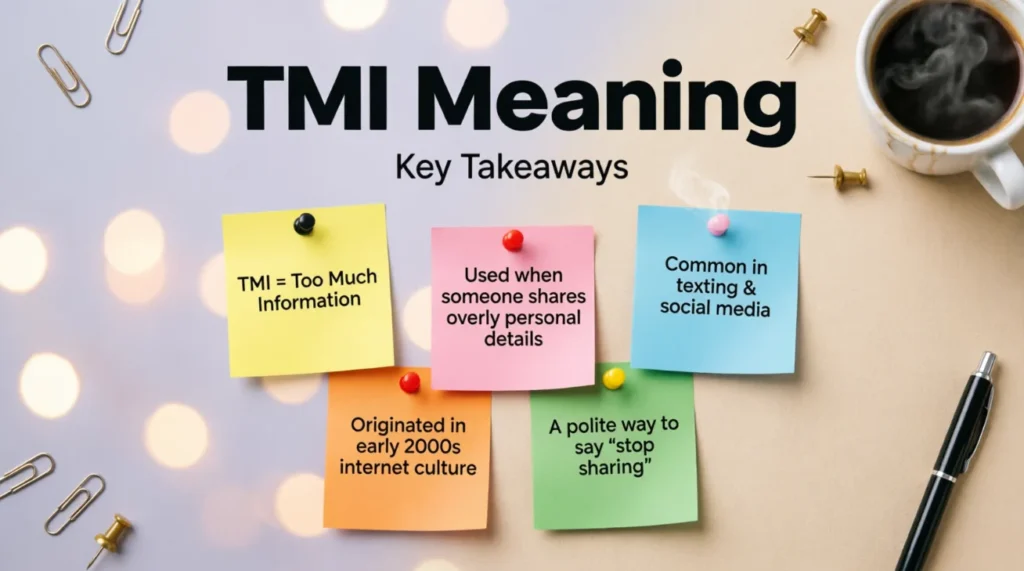
- TMI stands for “too much information.”
- People use it as both a reaction to oversharing and a warning before sharing something personal.
- The tone is almost always light and joking, not a serious criticism.
- It applies mainly to personal, graphic, or awkward details, not serious emotional struggles.
- People write it as all-caps letters and pronounce it by saying each letter individually.
Conclusion
The TMI meaning is simple once you break it down: “too much information,” used to flag oversharing in a friendly, low-stakes way. It’s stuck around because it captures a very common social moment, someone sharing more than needed in just three letters, and because it lets people set a boundary without starting an argument.
That’s really the whole appeal: TMI does a lot of social work in a very small package. It softens what could otherwise feel like a rejection, it gives the other person an easy way to laugh it off and change the subject, and it works just as well typed in a group chat as it does said out loud at the dinner table. Because it’s so lightweight, it travels well across generations and platforms parents, teenagers, and coworkers all reach for it the same way, even if they’d never use the same slang for anything else.
Next time a conversation veers into overly personal territory, you’ll know exactly when, and how, to drop a TMI and now you’ll also understand why those three letters have stuck around for so long.

I am Olivia Brooks an American editor and content researcher dedicated to creating clear, accurate content. At writemora.com, I help readers to understand words, phrases, and modern language with confidence.