
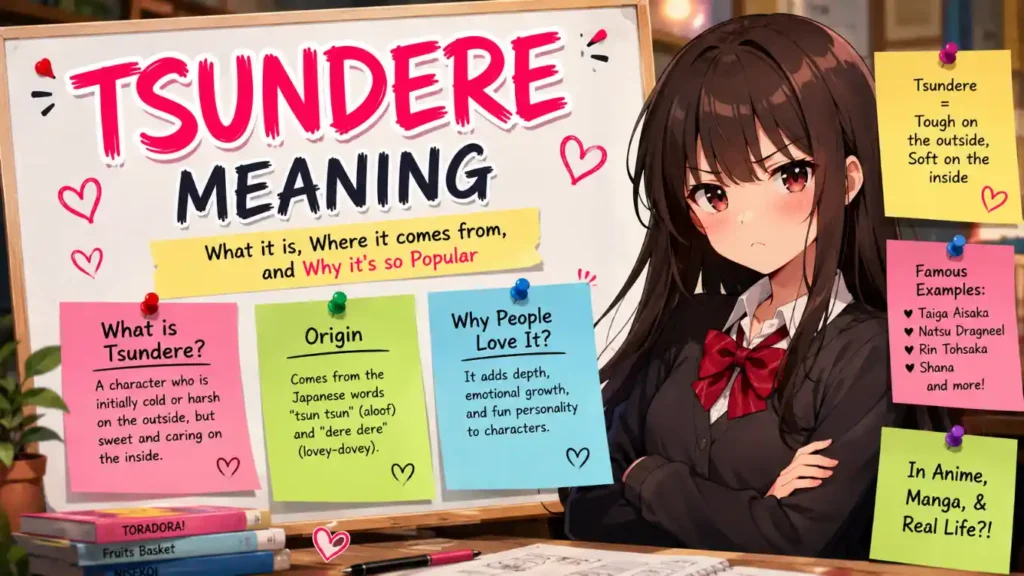
Tsundere describes a character who acts cold, harsh, or dismissive at first, then gradually reveals a warmer, affectionate side underneath. It’s one of the most recognizable personality archetypes in anime and manga, and fans use it constantly to describe characters, real people, and even pets.
The term comes from Japanese and blends two contrasting emotional states into a single word. Understanding the tsundere meaning helps explain why this personality type shows up so often in fiction, and why fans find it so appealing.
This guide covers exactly what tsundere means, where the word came from, how people use it in different contexts, and the mistakes people commonly make when using it.
What It Means
In simple terms, tsundere describes someone who switches between being prickly or standoffish and being sweet or caring, usually toward the same person. The “cold” behavior often hides genuine affection that the character isn’t ready to admit.
In a fuller sense, tsundere refers to a specific emotional pattern rather than a fixed personality. A tsundere character typically starts a relationship or interaction with sharp words, insults, or a dismissive attitude. Over time sometimes within a single scene, sometimes across an entire story that same character shows kindness, concern, or embarrassment that reveals real feelings underneath the tough exterior.
Fans often describe the shift itself as the appeal. Watching a character’s guard drop, even briefly, creates a payoff that a consistently sweet character can’t offer in the same way.
Origin & History

Tsundere combines two Japanese onomatopoeic words: tsun tsun, which describes acting aloof, curt, or irritable, and dere dere, which describes acting lovestruck, affectionate, or openly fond. Put together, the word captures a personality that moves between these two states.
The term grew out of Japanese fan communities and gaming culture in the late 1990s and early 2000s, particularly around visual novels and dating simulation games, where character archetypes get discussed and labeled in detail. Fans needed a quick way to describe a specific, recurring character type, and tsundere filled that need.
As anime and manga gained a wider international audience through the 2000s and 2010s, English-speaking fans adopted the term directly rather than translating it, and it now functions as a standard piece of anime vocabulary worldwide.
Different Contexts and Meanings
In anime and manga. This is the term’s home turf. Fans use tsundere to label a specific character archetype, often as shorthand in reviews, character descriptions, and fan discussions.
In gaming. Visual novels and dating sims frequently include a tsundere route or love interest, and players often discuss these characters using the same vocabulary as anime fans.
As a description of real people. Fans sometimes jokingly call a real friend, partner, or family member “tsundere” if that person acts gruff or teasing but clearly cares underneath it.
As an internet shorthand. Tsundere has become common enough that people use it outside anime fandom entirely, applying it to pets, coworkers, or even brands that seem harsh on the surface but turn out generous or thoughtful.
As one of several related archetypes. Tsundere sits alongside other Japanese personality-type terms like yandere (obsessively devoted, sometimes dangerously so) and kuudere (cool and emotionally distant, rarely warming up at all). Fans often compare these types directly.
Examples
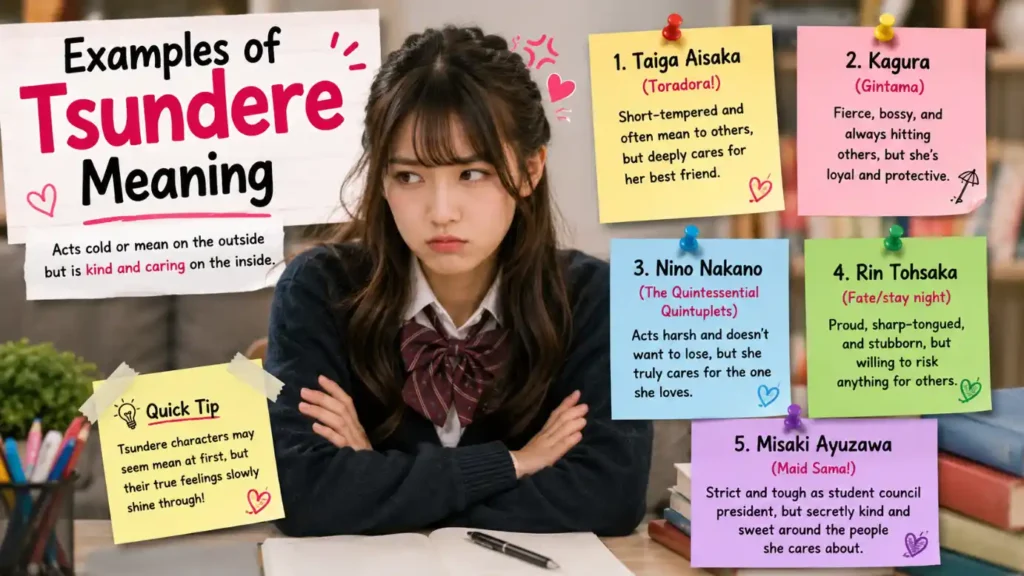
- “She insults him constantly, but everyone can tell she’s a total tsundere.”
- “That character started out mean and turned into the classic tsundere by episode five.”
- “My cat acts tsundere, ignores me all day, then curls up on my lap at midnight.”
- “He’s stunned about admitting he liked the movie.”
- “The dating sim has a tsundere route where the character slowly opens up.”
- “She yelled at him for worrying about her, which is peak tsundere behavior.”
- “Don’t be stunned about it, just say you had fun.”
- “The show leans hard into the tsundere trope with its female lead.”
- “He acts tough around his friends but goes full tsundere with his little sister.”
- “That barista is tsundere grumpy at first, then slips you extra whipped cream.”
How to Use It (Grammar and Context)
Tsundere functions as both a noun and an adjective in English usage. As a noun, it refers to the character type itself: “She’s a tsundere.” As an adjective, it describes behavior: “He’s being tsundere about it.”
Writers and fans capitalize it inconsistently; some treat it as a regular English loanword and lowercase it, others capitalize it as a proper term borrowed directly from Japanese. Both styles appear regularly in fan writing and reviews, so neither is strictly wrong.
Common Mistakes
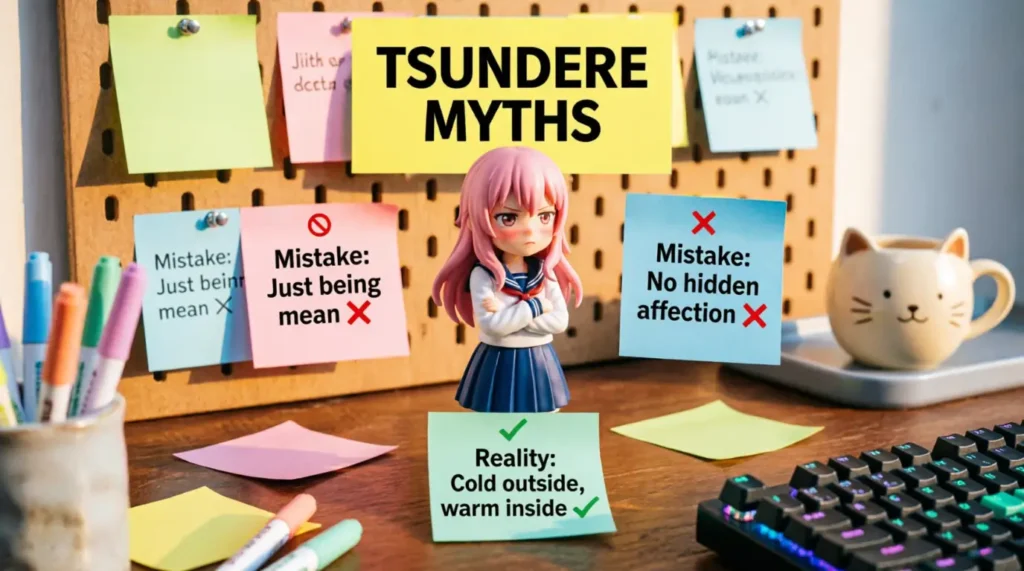
Confusing it with simple rudeness. A character who is just consistently mean, with no underlying warmth or vulnerability, doesn’t count as tsundere the softer side has to eventually show through.
Mix it up with yandere. People sometimes confuse tsundere with yandere, but they describe very different things. Tsundere centers on hiding affection behind a cold exterior; yandere centers on obsessive, sometimes possessive devotion.
Assuming it only applies to female characters. Tsundere started as a common trait for female characters in anime and games, but plenty of male characters fit the same pattern, and fans apply the term to any gender.
Treating it as a full personality rather than a pattern. Tsundere describes a specific emotional dynamic, not an entire character. A tsundere character can still have other unrelated traits, interests, and flaws.
Similar Words
| Word | Meaning | Difference from Tsundere |
| Yandere | A character who is obsessively, sometimes dangerously devoted to someone | Yandere involves obsession and possessiveness rather than hidden affection under a cold exterior |
| Kuudere | A character who stays cool and emotionally distant, rarely showing warmth | Kuudere characters rarely soften; tsundere characters eventually do |
| Dandere | A character who is shy and quiet until they open up around people they trust | Dandere softens through shyness fading, not through hiding affection behind harshness |
| Deredere | A character who is openly affectionate and sweet from the start | Deredere skips the cold phase entirely |
Opposite Words
| Word | Meaning | Why It’s an Opposite |
| Deredere | Consistently sweet and affectionate | The opposite of the “cold” half of tsundere, with no harsh phase at all |
| Kuudere | Consistently cool and emotionally distant | The opposite of the “warm” half of tsundere no soft side ever emerges |
| Straightforward | Direct and consistent in expressing feelings | Tsundere relies on mismatch between words and true feelings; straightforward behavior has no gap between them |
Pronunciation
Tsundere is pronounced tsoon-DEH-reh, with four syllables and even emphasis, following standard Japanese pronunciation rules.
Quick Facts
| Fact | Detail |
| Word origin | Combines Japanese “tsun tsun” (aloof/irritable) and “dere dere” (lovestruck/affectionate) |
| First popularized in | Japanese fan communities and visual novel/dating sim culture, late 1990s–early 2000s |
| Core pattern | Cold or harsh behavior that gradually reveals genuine affection |
| Common in | Anime, manga, visual novels, and dating simulation games |
| Related terms | Yandere, kuudere, dandere, deredere |
| Can apply to | Any gender, and even real people or pets in casual use |
FAQs
Tsundere describes someone who acts cold or harsh at first, then gradually shows real affection or warmth underneath.
It combines two Japanese words: “tsun tsun” (aloof, irritable) and “dere dere” (affectionate, lovestruck), describing a personality that moves between the two.
No. While it started with anime and manga, fans now use it casually to describe real people, pets, and even brands that seem tough but turn out kind.
Tsundere hides affection behind a cold exterior that eventually softens. Yandere involves obsessive, sometimes possessive devotion, which is a very different and often more intense dynamic.
Yes. The trait applies to any gender, even though it was originally more common in female characters in early anime and games.
It’s usually meant affectionately or playfully, describing an endearing personality quirk rather than a criticism.
A character insulting someone while secretly worrying about them, or acting annoyed while doing something thoughtful, both count as classic tsundere behavior.
The key is the eventual reveal of genuine warmth or affection. Without that softer side showing through at some point, the character is simply unkind, not tsundere.
Tsundere describes someone who acts cold or harsh at first, then gradually shows real affection or warmth underneath.
It combines two Japanese words: “tsun tsun” (aloof, irritable) and “dere dere” (affectionate, lovestruck), describing a personality that moves between the two.
No. While it started with anime and manga, fans now use it casually to describe real people, pets, and even brands that seem tough but turn out kind.
Tsundere hides affection behind a cold exterior that eventually softens. Yandere involves obsessive, sometimes possessive devotion, which is a very different and often more intense dynamic.
Yes. The trait applies to any gender, even though it was originally more common in female characters in early anime and games.
It’s usually meant affectionately or playfully, describing an endearing personality quirk rather than a criticism.
A character insulting someone while secretly worrying about them, or acting annoyed while doing something thoughtful, both count as classic tsundere behavior.
The key is the eventual reveal of genuine warmth or affection. Without that softer side showing through at some point, the character is simply unkind, not tsundere.
Key Takeaways
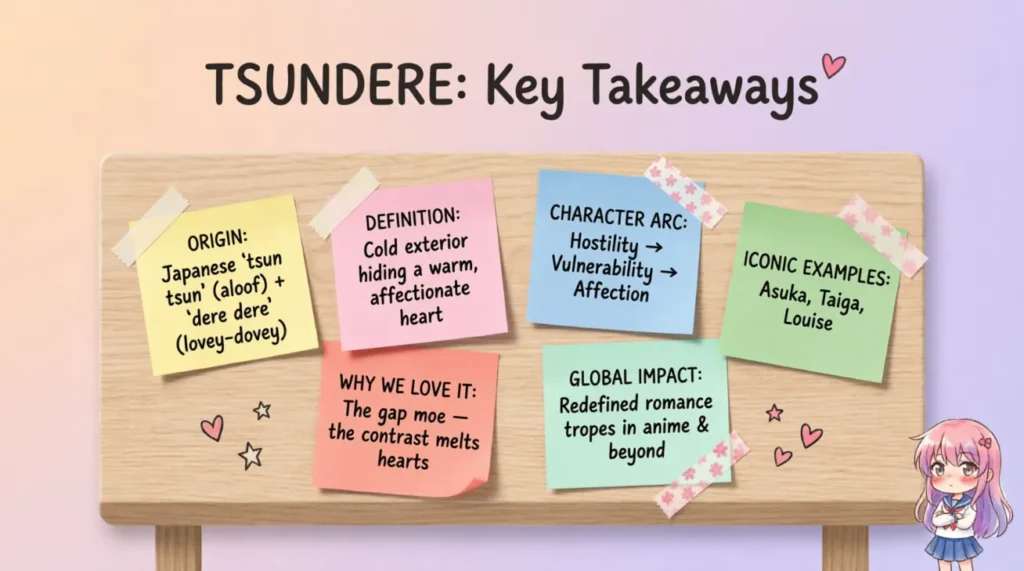
- Tsundere describes a character who starts cold or harsh and gradually reveals genuine affection.
- The word combines “tsun tsun” (aloof) and “dere dere” (affectionate).
- It originated in Japanese fan and gaming culture before spreading internationally.
- It differs from related terms like yandere (obsessive) and kuudere (consistently distant).
- The term applies to any gender and often gets used playfully to describe real people or pets.
Conclusion
The tsundere meaning boils down to a simple emotional arc: cold on the outside, warm underneath, with the warmth eventually winning out. That contrast is exactly why the trope has stayed so popular for decades; it gives a story a small, satisfying payoff every time the character’s guard slips, even for just a moment.
Part of the appeal is how relatable the pattern feels outside of fiction, too. Most people know someone who acts tough, teasing, or distant around the people they actually care about most, which is probably why the term jumped so easily from anime forums into everyday conversation. Calling a friend, a pet, or even a coworker “tsundere” has become a quick, affectionate way to describe that specific kind of guarded warmth without needing a longer explanation.
Once you know what to look for, you’ll likely start spotting tsundere behavior everywhere in shows you’re watching, games you’re playing, and maybe even in people you already know.

I am Stephen King an American author known for compelling storytelling. At writemora.com, we value clear, accurate, and reader-focused content inspired by excellence in writing.