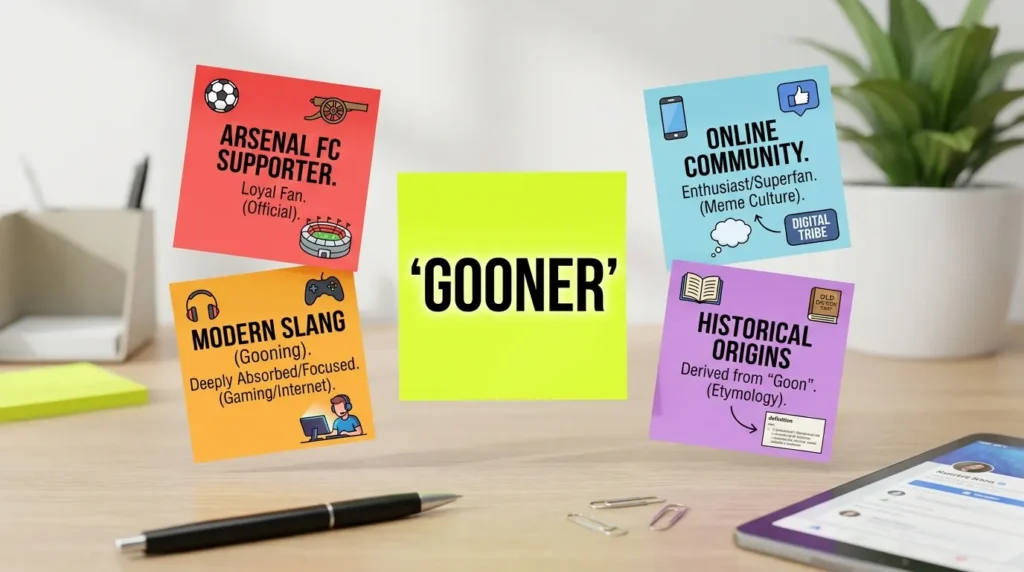
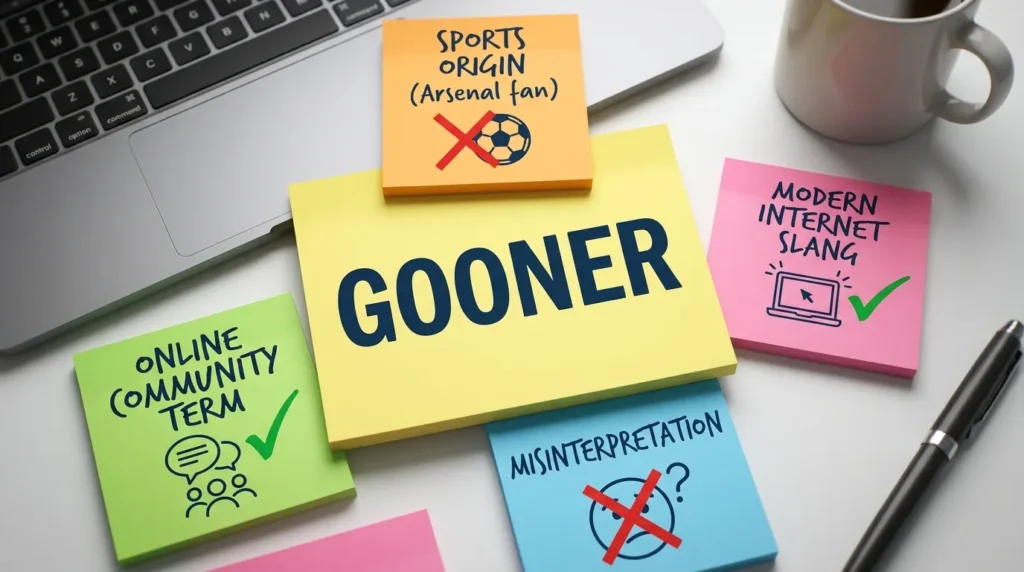
Gooner has two very different meanings depending on where you encounter it. In football (soccer), it’s a long-established nickname for a fan of Arsenal Football Club. Separately, in more recent internet slang, people use the same word to describe someone engaged in excessive, compulsive pornography use and masturbation, a behavior pattern sometimes called “gooning.”
Because both meanings use the exact same word, context matters enormously in figuring out which one applies. This guide covers where each meaning comes from and how to tell them apart, without going into explicit detail on the newer slang sense.
What It Means
In its original and much older sense, a Gooner refers to a supporter of Arsenal Football Club, one of England’s most storied Premier League clubs. Fans, commentators, and the club’s own community have used the term affectionately for decades, similar to how fans of other clubs use their own nicknames.
In its newer internet-slang sense, “gooner” and the related term “gooning” describe a person engaged in prolonged, compulsive pornography consumption and masturbation, often discussed within specific online communities that frame the behavior humorously, self-deprecatingly, or as a subject of concern about compulsive habits. This guide won’t go into explicit detail on that usage beyond identifying what the term refers to, since the topic involves sexual content better suited to a mature, specialized context than a general definitions guide.
Context almost always makes clear which meaning applies: sports commentary and football fan culture point to the Arsenal meaning, while certain online forums and slang-heavy internet spaces point to the newer usage.
Origin & History
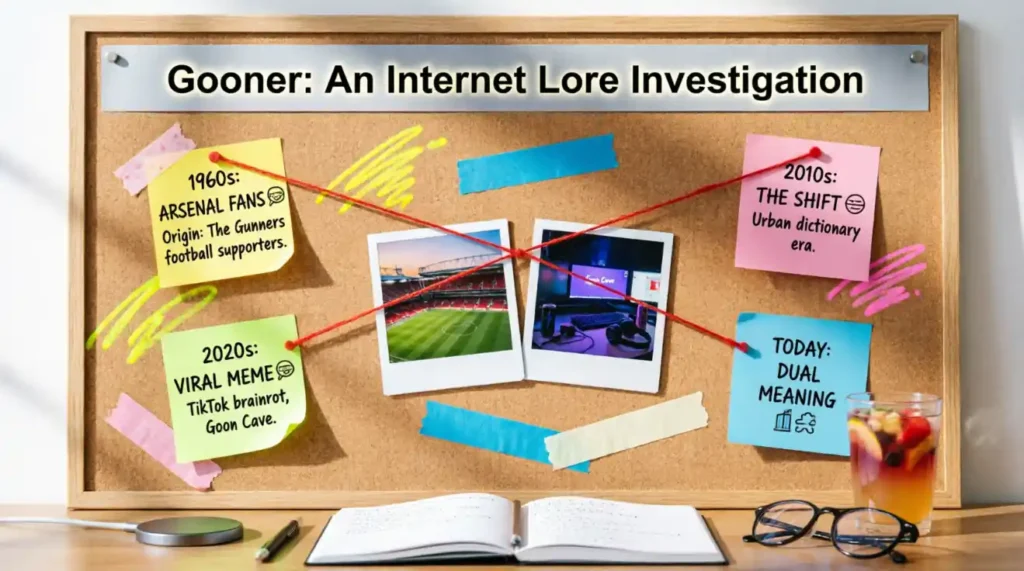
The football sense of “Gooner” has circulated among Arsenal supporters for decades, though its exact origin remains debated. Some trace it to “Gunners,” Arsenal’s official nickname (referencing the club’s cannon logo and its historical connection to the Royal Arsenal armament factory), suggesting “Gooner” developed as an informal variant pronunciation or spelling among fans.
The internet slang sense emerged much more recently, spreading primarily through online forums, meme culture, and social media communities in the 2010s and 2020s. This usage developed independently of the football term, and the overlap in spelling appears coincidental rather than connected in any meaningful way.
Because the two meanings developed in completely separate contexts decades apart, dictionaries and slang references typically treat them as entirely unrelated definitions that simply happen to share the same word.
Different Contexts and Meanings
In football and sports media. This remains the term’s original and most widely recognized meaning a nickname for Arsenal fans, used in match commentary, fan forums, social media, and everyday conversation among football supporters.
In Arsenal fan culture specifically. Fans use “Gooner” with pride and affection, similar to how supporters of other clubs embrace their own nicknames, and it appears in fan club names, forum titles, and casual conversation among supporters.
In newer internet slang. Certain online communities use “gooner” and “gooning” to reference compulsive pornography use, often discussed with a mix of humor, self-awareness, and sometimes genuine concern about the underlying behavior pattern.
As a source of confusion. Because the two meanings are so different, people unfamiliar with the newer slang usage can be caught off guard encountering the word outside a football context, and vice versa.
Examples
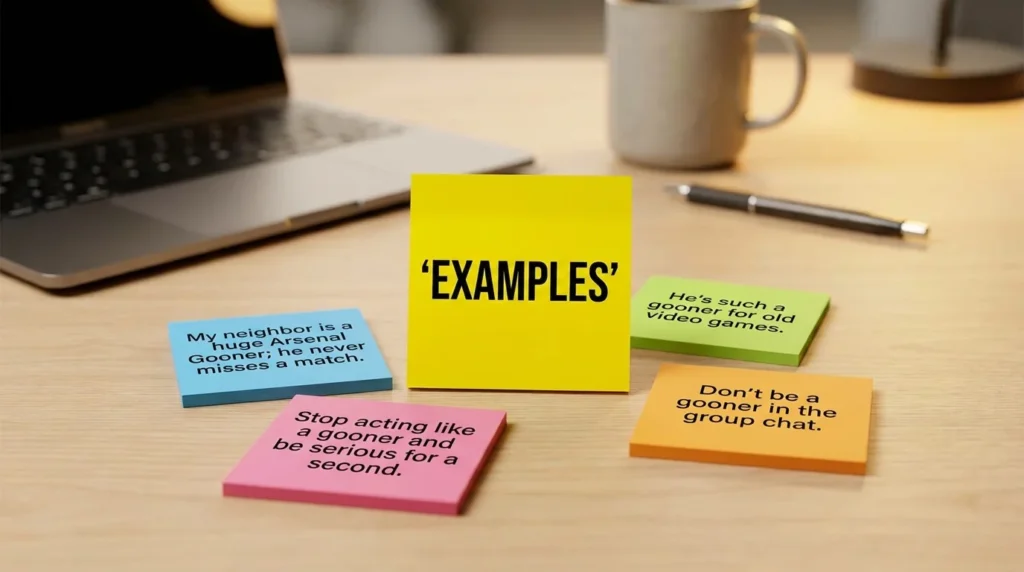
- “As a lifelong Gooner, he’s watched Arsenal through decades of ups and downs.”
- “The stadium was packed with Gooners for the derby match.”
- “She started a podcast specifically for Gooners to discuss transfer news.”
- “The commentator pointed out the traveling Gooners cheering from the away section.”
- “He joined an online Gooner forum to discuss Arsenal’s latest signings.”
- “The fan account listed ‘proud Gooner since 1998′ in its bio.”
- “Local Gooners gathered at the pub to watch the match together.”
- “The club store sells merchandise specifically aimed at loyal Gooners.“
How to Use It (Grammar and Context)
Gooner functions as a noun in both senses, and writers typically capitalize it when referring specifically to Arsenal fans, treating it similarly to a proper nickname (“Gooner,” like “Gunner”). In its newer internet-slang sense, people generally write it lowercase.
Because context carries so much weight with this word, writers covering football should make clear they mean the Arsenal fan sense if there’s any chance of ambiguity, particularly in headlines or captions viewed outside their original context.
Common Mistakes
Assuming only one meaning exists. Long-time football fans may not know about the newer internet slang meaning, while people who encountered the slang usage first may not recognize the much older football nickname.
Confusing the two meanings in casual conversation. Because both usages are common in different online spaces, mentioning “Gooners” without context can lead to genuine confusion about which meaning you intend.
Assuming the two meanings share a common origin. Despite using the same spelling, the football nickname and the internet slang term developed independently, decades apart, with no established historical connection between them.
Using the term carelessly online without checking context. Given how differently the word reads depending on the audience, using “Gooner” without clarifying context, especially outside football-specific spaces, can create unintended confusion or awkwardness.
Similar Words
| Word | Meaning | Difference from Gooner |
| Gunner | Arsenal’s official club nickname, referencing its cannon logo | Closely related to the football sense of Gooner; some consider them interchangeable, others see subtle differences in usage |
| Supporter | A general term for a fan of any sports team | Supporter is neutral and universal; Gooner specifically identifies an Arsenal fan |
| Fanatic | Someone intensely devoted to a particular interest or team | Fanatic is a general term; Gooner specifically applies to Arsenal within football culture |
Opposite Words
| Word | Meaning | Why It’s an Opposite |
| Rival fan | A supporter of an opposing football club | Represents the opposite team allegiance from a Gooner within football fan culture |
| Casual viewer | Someone with no particular team loyalty or deep interest | Contrasts with the dedicated, identity-driven fandom the Gooner nickname implies |
Pronunciation
People pronounce Gooner as GOO-ner, rhyming with “tuner.”
Quick Facts
| Fact | Detail |
| Primary meaning | A nickname for Arsenal Football Club supporters |
| Related term | “Gunner,” Arsenal’s official club nickname |
| Secondary meaning | Internet slang referencing compulsive pornography use, unrelated to football |
| Origin of football sense | Long-established among Arsenal fans, exact origin debated |
| Origin of slang sense | Emerged separately through internet forums and meme culture, 2010s–2020s |
| Context dependency | The two meanings are unrelated; context determines which applies |
FAQs
In slang, “gooner” usually refers to someone who regularly engages in “gooning,” a term associated with prolonged sexual stimulation.
Among Gen Z, “gooner” is commonly used online for someone associated with the practice of gooning, though it can also be used jokingly or as a meme.
“Gooning” is internet slang for spending an extended period focused on sexual stimulation, often used in adult online communities.
On TikTok, “gooner” can refer to someone who is associated with gooning, but the word is also frequently used as an edgy joke, meme, or slang reference.
Young people may repeat “gooning” because they see it in memes, comments, and online trends, sometimes without fully understanding its adult meaning.
In a chat, “gooner” usually refers to someone associated with gooning, although context can determine if it is meant seriously, jokingly, or as an insult.
If someone calls you a “Gooner,” they usually mean you are someone who engages in or is strongly associated with gooning.
“Female gooner” generally refers to a woman who engages in or identifies with gooning. The term describes the behavior rather than a specific identity.
“Gooner” memes typically use the term as internet humor, often exaggerating or joking about someone being obsessed with sexual content or online trends.
Key Takeaways
- Gooner primarily refers to a supporter of Arsenal Football Club, closely related to the club’s official “Gunner” nickname.
- A separate, newer internet slang meaning references compulsive pornography use, unrelated to football.
- The two meanings developed independently, decades apart, and share no established historical connection.
- Context determines which meaning applies in any given situation.
- Long-time football fans and people familiar with internet slang may each be unaware of the other meaning.
Conclusion
The Gooner meaning ultimately splits into two completely separate stories that happen to share a single word. One traces back decades through English football culture, tied to a beloved club nickname and generations of loyal supporters. The other emerged far more recently online, in a completely different corner of internet culture, with no real connection to the first beyond spelling.
That kind of coincidental overlap happens more often in language than people expect, especially as internet slang keeps generating new terms at a rapid pace, sometimes landing on words that already carry an established, unrelated meaning elsewhere. It’s a reminder that context does most of the real work in language. The same four letters can mean something completely different depending on if you’re reading a match report or scrolling through an unrelated corner of the internet.
If you come across the word yourself, checking the surrounding context will almost always tell you immediately which Gooner someone actually means.
Read More Posts
- ASL Meaning Slang What Does ASL Mean in Text & TikTok?
- Liaison Meaning Definition, Examples, Pronunciation, and How to Use
- La Migra Meaning What It Means and Why You Keep Hearing It

I am Olivia Brooks an American editor and content researcher dedicated to creating clear, accurate content. At writemora.com, I help readers to understand words, phrases, and modern language with confidence.