

A good cry during a sad movie. Screaming along to music after a rough week. Finally saying the thing you’ve been holding back for months. All of these can feel cathartic; the cathartic meaning points to a powerful release of built-up emotion, usually leaving a person feeling lighter, calmer, or relieved afterward.
This guide covers exactly what “cathartic” means, where the word comes from in ancient Greek theater, how people use it today, and answers to the questions people ask most often. By the end, you’ll know precisely when “cathartic” is the right word for an experience.
What does cathartic mean

The simple version: “Cathartic” describes something that provides a powerful release of pent-up emotions, leaving a person feeling relieved, lighter, or emotionally cleansed afterward.
The fuller picture: The word describes both the experience itself and the effect it has. A cathartic experience often involves intense emotion crying, laughing, shouting, or otherwise letting out feelings that had been building up or suppressed. What makes something specifically “cathartic,” rather than just emotional, is the sense of release and relief that follows. People describe all kinds of experiences as cathartic: finishing a difficult project, having an honest conversation after avoiding one for too long, working out hard after a stressful day, or simply watching a movie that lets them cry about something unrelated to their own life.
The word carries a generally positive connotation, even when the emotions involved (grief, anger, sadness) are themselves difficult. The value lies in the release, not in the emotion being pleasant in the moment.
Origin and History

“Cathartic” comes from the Greek word katharsis, meaning “purification” or “cleansing.” The concept originally had roots in Greek medicine, where it referred to the physical cleansing or purging of the body. From there, the philosopher Aristotle famously applied the idea to tragedy and drama, describing how watching a tragic play could produce an emotional purification in the audience allowing viewers to experience intense emotions like pity and fear in a safe, controlled setting, and come away feeling emotionally cleansed rather than burdened.
This theatrical and philosophical sense of catharsis heavily shaped how the word entered English and other European languages. “Cathartic” as an adjective developed from this same root, describing anything that produces that same kind of emotional release and relief.
Over time, the word expanded well beyond theater criticism into everyday psychological and emotional vocabulary, describing any experience not just watching a tragic play that provides that same sense of built-up emotion finally finding release.
Different Meanings and Contexts
Emotional and psychological use (most common). “Cathartic” most often describes an experience that releases built-up emotion, leaving someone feeling relieved or lighter, crying, venting to a friend, or working through grief are common examples.
Artistic and creative use. People frequently describe creating or experiencing art writing, painting, music, film as cathartic, especially when the work processes difficult emotions or experiences.
Therapeutic and psychological terminology. In psychology and therapy contexts, “catharsis” describes the therapeutic release of repressed emotions, a concept with roots in early psychoanalytic theory, though modern therapeutic approaches vary in how much emphasis they place on catharsis alone as a treatment goal.
Medical (older, less common use). In its original medical sense, “cathartic” could describe something that physically purges or cleanses the body, a usage now largely historical and much less common than the emotional meaning in everyday English.
Examples of “Cathartic” in a Sentence

- “Writing the letter, even though she never sent it, felt incredibly cathartic.”
- “The concert turned into a cathartic release for everyone in the crowd after a hard year.”
- “He found running to be a cathartic way to process his anger.”
- “The film’s ending offered a genuinely cathartic release after two hours of tension.”
- “Talking it through with a therapist finally gave her that cathartic sense of relief.”
- “There’s something cathartic about screaming along to your favorite song in the car.”
- “The novel’s final chapter delivers a cathartic payoff for readers who stuck with it.”
- “Cleaning out her childhood bedroom turned out to be surprisingly cathartic.”
- “He described finishing the marathon as one of the most cathartic experiences of his life.”
- “Painting has become her main cathartic outlet during stressful periods.”
How to Use “Cathartic” Correctly
“Cathartic” functions as an adjective, describing an experience, activity, or piece of art that produces emotional release.
A few usage notes:
- Pair it naturally with words like: experience, release, outlet, effect, and moment.
- Know the noun form. “Catharsis” is the noun describing the release itself (“she finally found catharsis after months of holding it in”).
- It doesn’t require sadness. While often associated with processing grief or difficult emotions, cathartic experiences can also involve relief, joy, or a mix of emotions; the key is the sense of release.
- Use it for genuinely significant release. Because “cathartic” implies real emotional weight and relief, using it for minor everyday satisfaction can feel like an overstatement.
Common Mistakes to Avoid
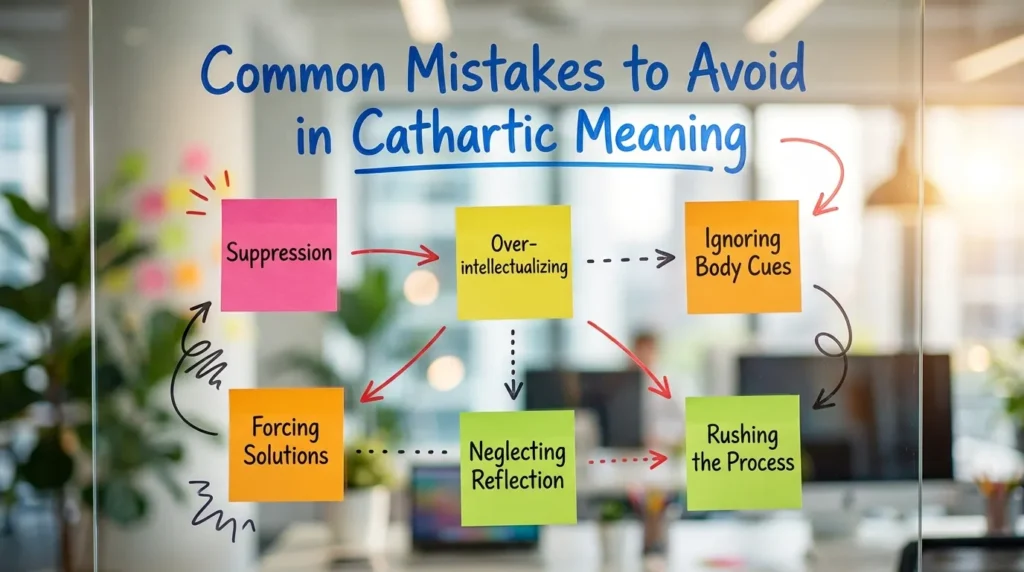
- Confusing “cathartic” with simply “emotional.” Not every emotional experience is cathartic; the word specifically implies release and relief, not just the presence of strong feeling.
- Forgetting the noun form, “catharsis.” Some writers only use the adjective and miss the more precise noun for describing the experience of release itself.
- Assuming catharsis always requires crying. While tears are common, catharsis can also come through laughter, physical exertion, creative expression, or honest conversation.
- Overusing it for minor relief. Reserve “cathartic” for genuinely significant emotional release rather than small, everyday conveniences or satisfactions.
Similar Words and Phrases
| Word | Meaning | How It Differs |
| Purging | Getting rid of something unwanted, often forcefully | Shares the “cleansing” root idea, though “purging” can apply to physical or non-emotional contexts as well |
| Relief | A feeling of reassurance following release from anxiety or distress | Close in meaning, though “cathartic” specifically implies an intense emotional release process |
| Healing | The process of becoming well again, physically or emotionally | Broader and more gradual than the often sudden release implied by “cathartic” |
| Venting | Expressing strong emotions, often through talking | A specific method that can produce a cathartic effect, rather than a synonym for the feeling itself |
| Liberating | Freeing, especially from a restrictive or oppressive situation | Overlaps with “cathartic” but focuses more on freedom than on emotional purification specifically |
Opposite Words and Phrases
| Word | Meaning | Why It’s an Opposite |
| Suppressive | Holding back or restraining emotions | Opposite of the release “cathartic” describes |
| Stifling | Preventing free expression or breath | Contrasts with the open, releasing quality of a cathartic experience |
| Bottled up | Holding emotions inside without expressing them | The unresolved state a cathartic experience typically relieves |
| Numbing | Causing a lack of feeling or emotional response | Opposite of the intense, felt release central to catharsis |
Pronunciation
“Cathartic” is pronounced kuh-THAR-tik, with the stress on the second syllable.
Quick Facts
| Fact | Detail |
| Meaning | Providing powerful emotional release, relief, or purification |
| Origin | Greek katharsis, meaning “purification” or “cleansing” |
| Historical link | Associated with Aristotle’s writing on tragedy and emotional release through drama |
| Part of speech | Adjective (noun form: catharsis) |
| Common pairing | Cathartic experience, release, outlet, or effect |
| Field of use | Psychology, art criticism, everyday emotional vocabulary |
Frequently Asked Questions
It describes something that provides a powerful release of pent-up emotion, leaving a person feeling relieved or emotionally lighter afterward.
It comes from the Greek word “katharsis,” meaning “purification” or “cleansing,” a concept famously applied by Aristotle to the emotional effect of watching tragic drama.
“Catharsis” is the noun describing the release itself, as in “she finally found catharsis.”
No, catharsis can come through laughter, physical activity, creative expression, or honest conversation. The key element is emotional release, not a specific method.
Not necessarily. While often linked to processing grief or difficult feelings, catharsis can also involve relief, joy, or a complex mix of emotions.
Common examples include crying during an emotional film, writing about a difficult experience, having an honest conversation you’ve been avoiding, or exercising intensely after a stressful day.
Yes, it has roots in early psychoanalytic theory and remains a concept discussed in psychology and therapy, though modern approaches vary in how central they consider catharsis to emotional healing.
“Kuh-THAR-tik,” with stress on the second syllable.
It describes something that provides a powerful release of pent-up emotion, leaving a person feeling relieved or emotionally lighter afterward.
It comes from the Greek word “katharsis,” meaning “purification” or “cleansing,” a concept famously applied by Aristotle to the emotional effect of watching tragic drama.
No, catharsis can come through laughter, physical activity, creative expression, or honest conversation. The key element is emotional release, not a specific method.
Not necessarily. While often linked to processing grief or difficult feelings, catharsis can also involve relief, joy, or a complex mix of emotions.
Common examples include crying during an emotional film, writing about a difficult experience, having an honest conversation you’ve been avoiding, or exercising intensely after a stressful day.
Yes, it has roots in early psychoanalytic theory and remains a concept discussed in psychology and therapy, though modern approaches vary in how central they consider catharsis to emotional healing.
“Kuh-THAR-tik,” with stress on the second syllable.
Key Takeaways
- “Cathartic” describes an experience that provides powerful emotional release and relief.
- The word comes from the Greek “katharsis,” meaning purification, famously linked to Aristotle’s writing on tragedy.
- Catharsis doesn’t require crying laughter, exercise, creativity, and honest conversation can all be cathartic.
- “Catharsis” is the noun form, describing the release itself.
- The experience can involve difficult emotions while still leaving a generally positive, relieving effect.
Conclusion
“Cathartic” names something almost everyone has felt but rarely stops to describe precisely: that specific relief that follows letting go of something you’ve been carrying, if it’s grief, anger, stress, or simply too much unspoken feeling. Aristotle noticed it in ancient Greek theater audiences centuries ago, and the same basic human experience still shows up today in concerts, therapy sessions, workout classes, and quiet moments alone with a sad movie.
What makes the word so useful is its flexibility. It doesn’t demand a specific method: crying, screaming, running, painting, and talking can all lead to the same underlying release which is exactly why “cathartic” fits such a wide range of very different experiences.
Next time you feel that particular kind of relief after finally letting something out, you’ll have precisely the right word for it, one with roots stretching all the way back to ancient theater audiences discovering the same release for themselves.

I am Stephen King an American author known for compelling storytelling. At writemora.com, we value clear, accurate, and reader-focused content inspired by excellence in writing.