
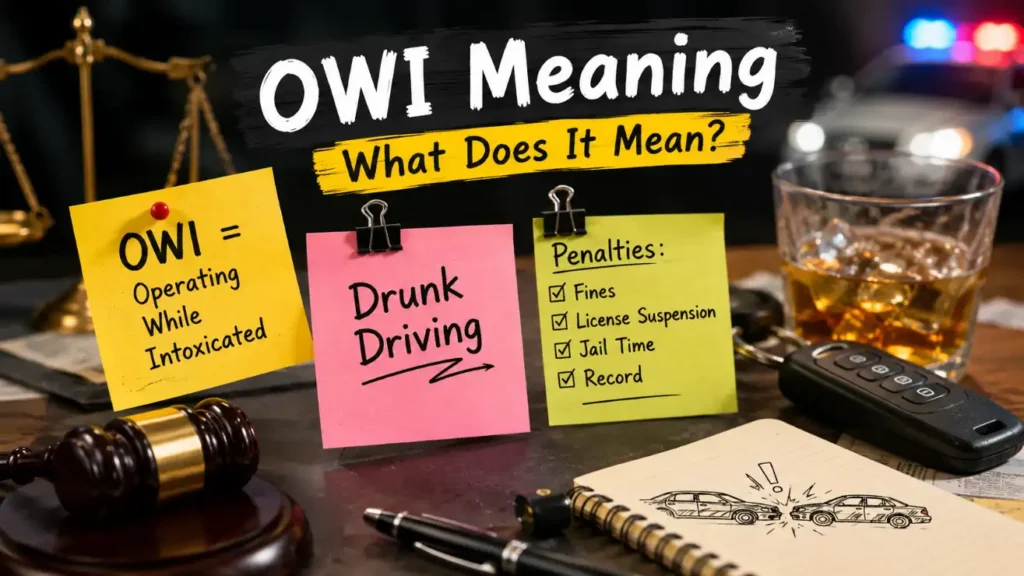
OWI stands for “Operating While Intoxicated,” a legal term some states use instead of the more familiar “DUI” or “DWI” to describe the crime of driving under the influence of alcohol or drugs.
You’ll mainly encounter this term if you live in, drive through, or read news from a handful of specific states that use “operating” instead of “driving” in their impaired-driving laws. Understanding the OWI meaning helps clear up why some states use different terminology for what looks, on the surface, like the same basic offense.
This guide covers what OWI stands for, which states use it, how it differs from DUI and similar terms, and the mistakes people commonly make when discussing it. This article explains general terminology only and isn’t legal advice anyone facing an actual charge should consult a licensed attorney in their state.
What It Means
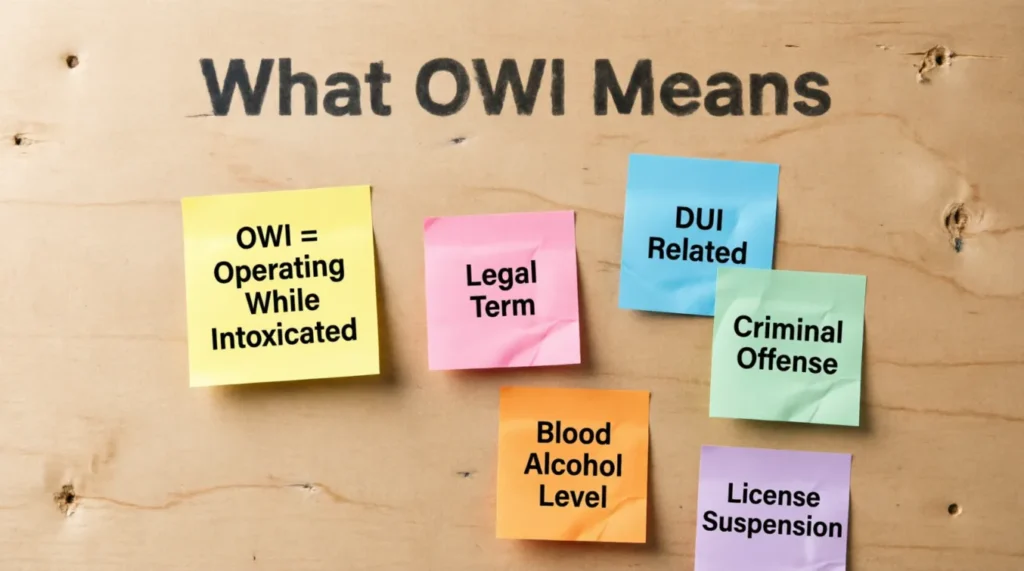
In simple terms, OWI stands for “Operating While Intoxicated.” It describes the offense of operating a motor vehicle while impaired by alcohol, drugs, or a combination of substances, above the legal limit set by that state.
In a fuller sense, several states specifically chose the word “operating” instead of “driving” for a legal reason: it broadens the offense beyond active driving. Under an OWI-style law, someone can potentially face charges even if the vehicle wasn’t moving. For example, sitting in the driver’s seat with the engine running or the keys in the ignition may count as “operating” a vehicle, depending on the state’s specific statute.
States that use OWI or similar “operating” terminology include Indiana, Michigan, Iowa, and Wisconsin, though each state defines and penalizes the offense somewhat differently.
Origin & History
Every U.S. state writes its own traffic and criminal statutes, and each legislature independently chooses the specific wording for impaired-driving laws, often decades apart from one another. That’s why the country ended up with several different abbreviations DUI, DWI, OWI, OVI, and OUI all describing essentially the same underlying behavior.
States that settled on “operating” language, including Indiana and Michigan, designed their statutes to cover a broader range of situations than states using “driving” language. This distinction became especially relevant in court cases involving parked or stationary vehicles, where if someone was technically “driving” could be disputed, but “operating” more easily covered situations like sitting behind the wheel with the engine on.
Over time, OWI became the standard, commonly recognized term in the states that adopted it, appearing consistently in news coverage, court documents, and law enforcement records specific to those jurisdictions.
Different Contexts and Meanings
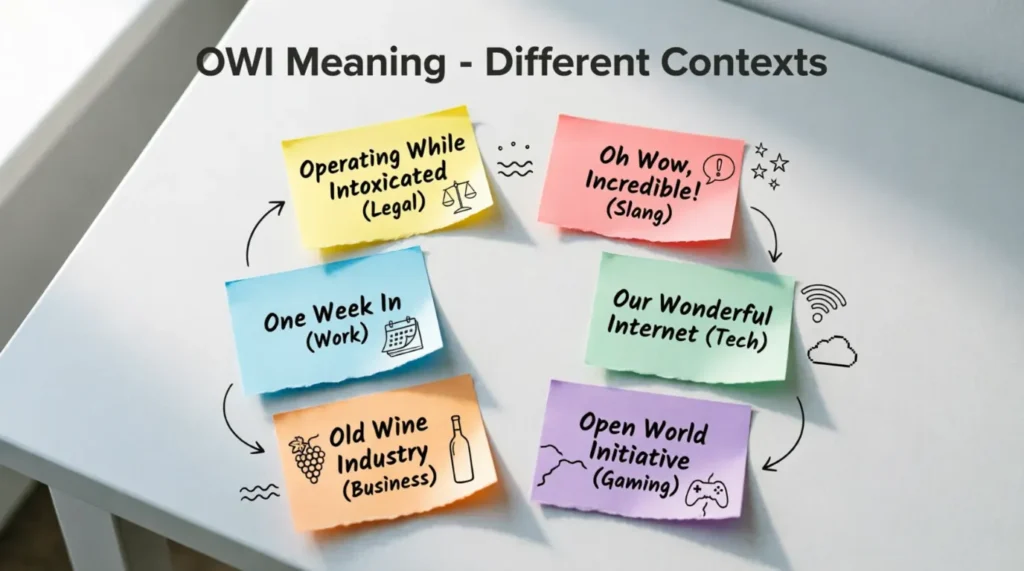
In Indiana. Indiana defines OWI as operating a vehicle with a blood alcohol concentration (BAC) of 0.08% or higher, or with a controlled substance present in the bloodstream. The state also uses the related term “Operating a Vehicle While Intoxicated” (OVWI), though OWI remains the more commonly used abbreviation.
In Michigan. Michigan uses OWI as its standard impaired-driving offense, applying it to drivers with a BAC of 0.08% or higher, as well as those impaired by drugs or a combination of substances. Michigan also has a separate, lesser offense called “Operating While Visibly Impaired” (OWVI) for drivers who show signs of impairment even below the 0.08% threshold.
In Iowa and Wisconsin. Both states also use OWI as their standard legal term for impaired driving, applying similar “operating” language to broaden the scope of the offense.
In news and everyday conversation. People in OWI states typically use the term the same way people elsewhere use “DUI,” as the standard shorthand for an impaired-driving charge or arrest.
In comparison to similar terms. Other states use related but distinct abbreviations: Ohio uses OVI (“Operating a Vehicle Impaired”), while Maine and Massachusetts use OUI (“Operating Under the Influence”). All describe the same core behavior with slightly different legal wording.
Examples
- “He was arrested for OWI after failing a roadside sobriety test.”
- “Michigan treats OWI as a serious criminal offense, even for a first arrest.”
- “The article reported an eighth OWI charge for the same driver.”
- “Indiana’s OWI law covers both alcohol and drug impairment.”
- “She hired an attorney who specializes in OWI defense cases.”
- “The officer charged him with OWI after finding him asleep behind the wheel with the engine running.”
- “OWI penalties can include fines, license suspension, and jail time.”
- “Iowa OWI Defense” is the title of a legal guide for attorneys handling these cases.
- “A first-offense OWI in Michigan carries different penalties than a repeat offense.”
- “He asked if an OWI charge showed up on a background check.”
How to Use It (Grammar and Context)
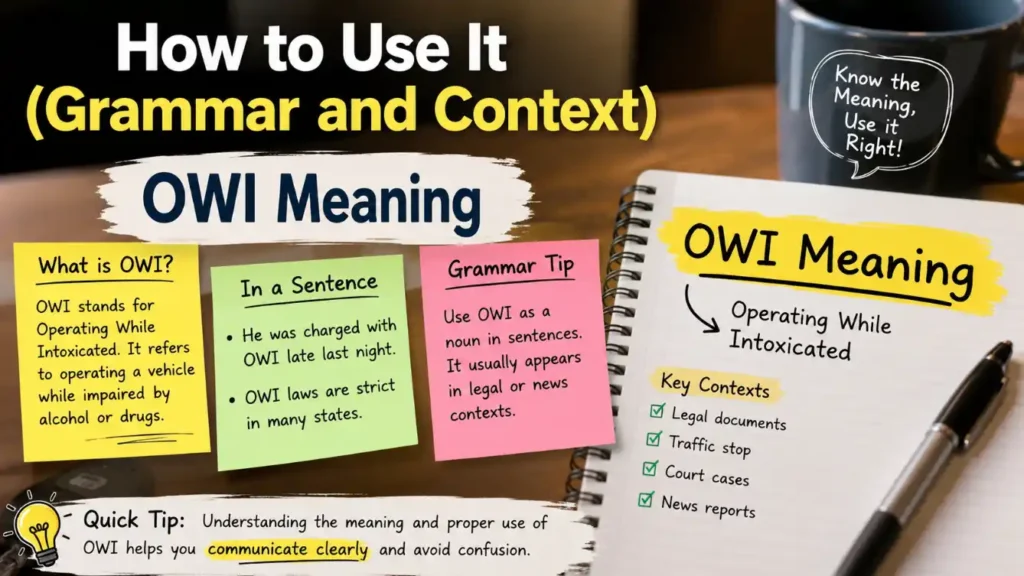
People write OWI in all capitals, as a standard legal abbreviation, and it typically functions as a noun: “an OWI,” “an OWI charge,” “an OWI conviction.” It can also modify other nouns, as in “OWI defense,” “OWI penalties,” or “OWI law.”
Because OWI is jurisdiction-specific, writers covering multi-state topics often clarify which state’s terminology they’re using, since a reader in a DUI state might not immediately recognize OWI without context.
Common Mistakes
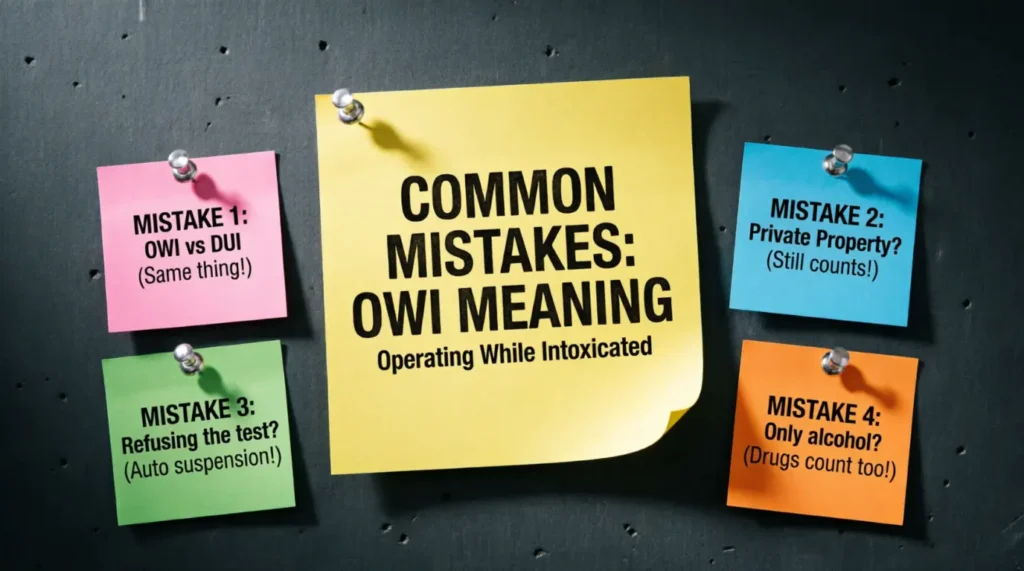
Assuming OWI is a nationwide term. OWI specifically applies in states like Indiana, Michigan, Iowa, and Wisconsin. Most other states use DUI or DWI instead, even though the underlying offense is similar.
Treating OWI, DUI, and DWI as identical in every legal sense. While all these terms describe impaired driving, the specific legal definitions, penalties, and what counts as “operating” a vehicle can vary meaningfully from state to state.
Assuming a vehicle has to be moving for an OWI charge to apply. Because “operating” covers more than active driving, someone can potentially face an OWI charge while parked, depending on the specific facts and the state’s statute.
Confusing OWI with OWVI. In Michigan specifically, OWVI (“Operating While Visibly Impaired”) describes a separate, generally less severe charge than OWI, based on visible impairment rather than meeting the full BAC threshold.
Similar Words
| Term | Meaning | Difference from OWI |
| DUI | Driving Under the Influence | The most widely recognized term nationally; typically requires evidence the vehicle was actually being driven |
| DWI | Driving While Impaired/Intoxicated | Similar to DUI; used by different states, also generally tied to active driving |
| OVI | Operating a Vehicle Impaired | Ohio’s specific term, functionally similar to OWI’s “operating” framing |
| OUI | Operating Under the Influence | Used in Maine and Massachusetts; also broadens the offense beyond active driving |
Opposite Words
There’s no true “opposite” of a legal term like OWI, but related contrasts include:
| Term | Meaning | Why It Contrasts with OWI |
| Sober driving | Operating a vehicle without impairment from alcohol or drugs | The lawful behavior an OWI charge specifically penalizes the absence of |
| Designated driver | A person who abstains from alcohol specifically to drive others safely | Represents the preventive behavior meant to avoid an OWI situation entirely |
Pronunciation
People typically pronounce OWI by saying each letter individually: O-W-I.
Quick Facts
| Fact | Detail |
| Stands for | “Operating While Intoxicated” |
| States that use it | Indiana, Michigan, Iowa, Wisconsin |
| Key legal distinction | “Operating” can include a stationary vehicle, not just active driving |
| Common BAC threshold | 0.08% or higher in most states, though thresholds and specifics vary |
| Related Michigan term | OWVI (Operating While Visibly Impaired), a separate, lesser charge |
| Similar terms elsewhere | DUI, DWI, OVI, OUI |
FAQs
What does OWI stand for?
OWI stands for “Operating While Intoxicated,” a legal term used in states like Indiana, Michigan, Iowa, and Wisconsin to describe impaired driving.
Is OWI the same as DUI?
They describe the same basic behavior driving impaired by alcohol or drugs but different states use different legal terms, and the specific definitions and penalties can vary.
Can you get an OWI without driving?
Potentially, yes. Because OWI-style laws use “operating” rather than “driving,” someone can face charges in some situations even if the vehicle wasn’t moving, such as sitting behind the wheel with the engine running.
Which states use OWI?
Indiana, Michigan, Iowa, and Wisconsin all use OWI as their standard term for impaired driving offenses.
What’s the difference between OWI and OWVI?
In Michigan, OWI applies to drivers who meet the full legal BAC threshold, while OWVI (Operating While Visibly Impaired) applies to drivers showing signs of impairment even below that threshold.
What are the penalties for an OWI?
Penalties vary by state and by if it’s a first or repeat offense, but they can include fines, license suspension, and jail time.
Does OWI apply to drug impairment as well as alcohol?
Yes. Most OWI statutes cover impairment from alcohol, drugs, or a combination of substances, not just alcohol alone.
Why do some states use “operating” instead of “driving” in their laws?
Using “operating” broadens the offense to cover situations beyond active driving, closing a potential loophole where someone impaired but not actively driving might otherwise avoid charges.
Key Takeaways
- OWI stands for “Operating While Intoxicated,” a state-specific legal term for impaired driving.
- Indiana, Michigan, Iowa, and Wisconsin use OWI as their standard terminology.
- “Operating” broadens the offense beyond active driving, potentially covering stationary vehicles.
- OWI functions similarly to DUI and DWI, though specific legal definitions and penalties vary by state.
- This article explains general terminology only; anyone facing an actual charge should consult a licensed attorney.
Conclusion
The OWI meaning comes down to a single word choice with real legal consequences: “operating“ instead of “driving.” That distinction, adopted by states like Indiana and Michigan, widens what counts as an offense, which is exactly why the terminology matters beyond just being a regional quirk in vocabulary.
Understanding which term your state actually uses matters more than it might seem, since legal outcomes, defense strategies, and even how a case gets reported in the news can hinge on the specific statute involved. Someone reading about an “OWI” case in Michigan and someone reading about a “DUI” case in California are technically reading about different legal frameworks, even though both describe impaired driving in everyday terms.
If you’re trying to make sense of a specific charge, news article, or legal document that uses the term OWI, the safest next step is checking your state’s exact statute or speaking with a licensed attorney, since the general definition covered here won’t capture every detail that applies to an individual case.

I am Olivia Brooks an American editor and content researcher dedicated to creating clear, accurate content. At writemora.com, I help readers to understand words, phrases, and modern language with confidence.