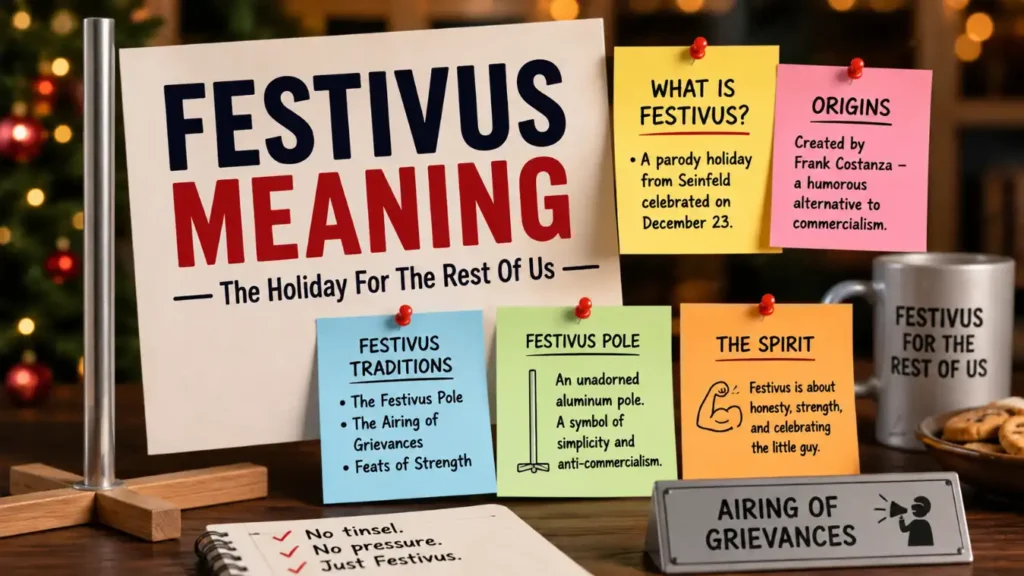
Festivus is a made-up December holiday that pokes fun at the stress and commercialism of the regular holiday season. It centers on a plain aluminum pole instead of a decorated tree, a dinner where family members air their grievances out loud, and a wrestling match called the Feats of Strength.
The word entered pop culture through a well-known sitcom, but the idea behind it is older and stranger than most people realize. Understanding the Festivus meaning helps explain why the word still shows up every December in office parties, on social media, and even in a few government buildings.
This guide covers what Festivus actually means, where the term came from, the different ways people use it today, and how to run your own Festivus if you’re curious enough to try.
What It Means
In simple terms, Festivus names a secular, anti-commercial alternative to Christmas, celebrated on December 23. Its creators built it as a joke, a holiday with no religious meaning, no gift-buying pressure, and no need to pretend everything is perfect.
In a fuller sense, Festivus refers to a specific set of mock traditions: setting up an unadorned aluminum pole in place of a tree, holding a family dinner, “airing grievances” by telling relatives how they’ve disappointed you over the past year, and finishing the night with the Feats of Strength, a wrestling challenge where the head of the household has to be pinned before the holiday can officially end.
Today people use the word two ways. Some celebrate it literally, as a tongue-in-cheek family tradition. Others use “Festivus” more loosely, as shorthand for any low-key, no-frills, complaint-friendly alternative to a stressful or overly commercial event.
Origin & History
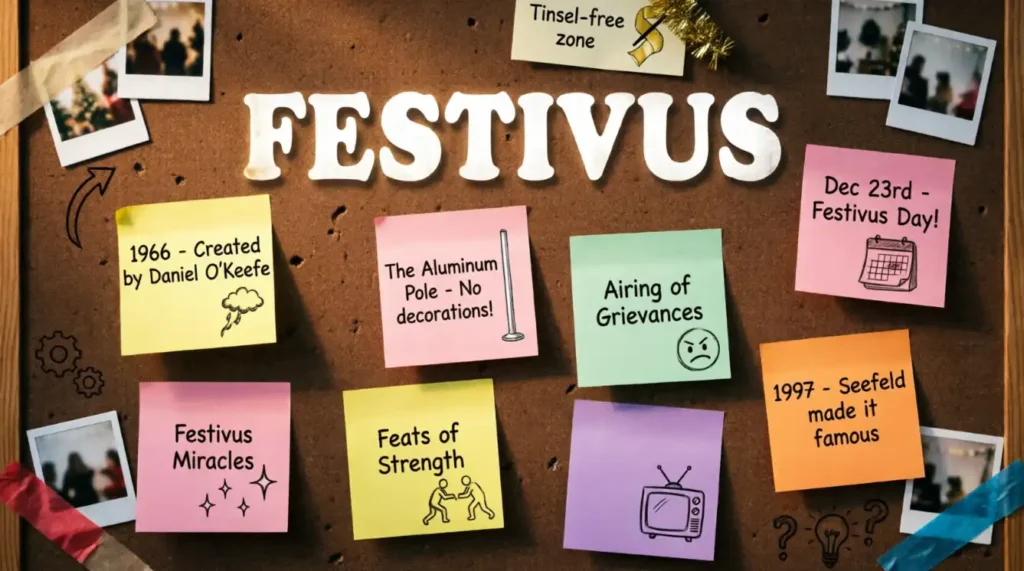
Festivus didn’t start as a TV writer’s invention out of nowhere, it started as a real family tradition. Writer Dan O’Keefe based the holiday on a strange, semi-serious ritual his father, Daniel O’Keefe, held with their family starting in the 1960s. The elder O’Keefe reportedly created it as a way to mark an early event in his life, and it evolved over the years into an odd, argument-filled family gathering that had little to do with any specific date on the calendar.
Dan O’Keefe brought a version of it to a popular 1990s sitcom, where it appeared in a season 9 episode that aired in December 1997. In the episode, one character claims to have invented Festivus years earlier, in a fictional backstory, as a reaction against the commercialism of Christmas shopping. That episode introduced the aluminum pole, the Airing of Grievances, and the Feats of Strength to a mass audience, and the holiday’s name stuck.
After the episode aired, Festivus moved from a private family joke and a one-off sitcom bit into an actual, if informal, cultural tradition that some people now observe every year on December 23.
Different Contexts and Meanings
As a TV reference. Most people first hear “Festivus” as a callback to that sitcom episode, a punchline about an oddball, complaint-heavy alternative to Christmas.
As a real, if joking, tradition. Some families and friend groups genuinely set up a pole, hold a grievance dinner, and attempt the Feats of Strength every December, treating it as a lighthearted, low-pressure alternative to a more formal holiday gathering.
As shorthand for venting. “Airing grievances” has taken on a life of its own outside the holiday itself. People sometimes describe any moment of blunt, unfiltered complaint-sharing as “airing grievances, Festivus-style,” even outside of December.
In public and political life. Because Festivus carries no religious content, some U.S. state capitol buildings have allowed Festivus poles to stand alongside religious holiday decorations, as a way of keeping public displays officially secular. This has made the word a recurring reference in stories about church-and-state disputes around holiday displays.
As a general internet joke. Outside of any specific ritual, people often use “Festivus” simply to mean “the holiday nobody has to take seriously” a stand-in for any deliberately unglamorous, imperfect, complaint-tolerant version of a celebration.
Examples
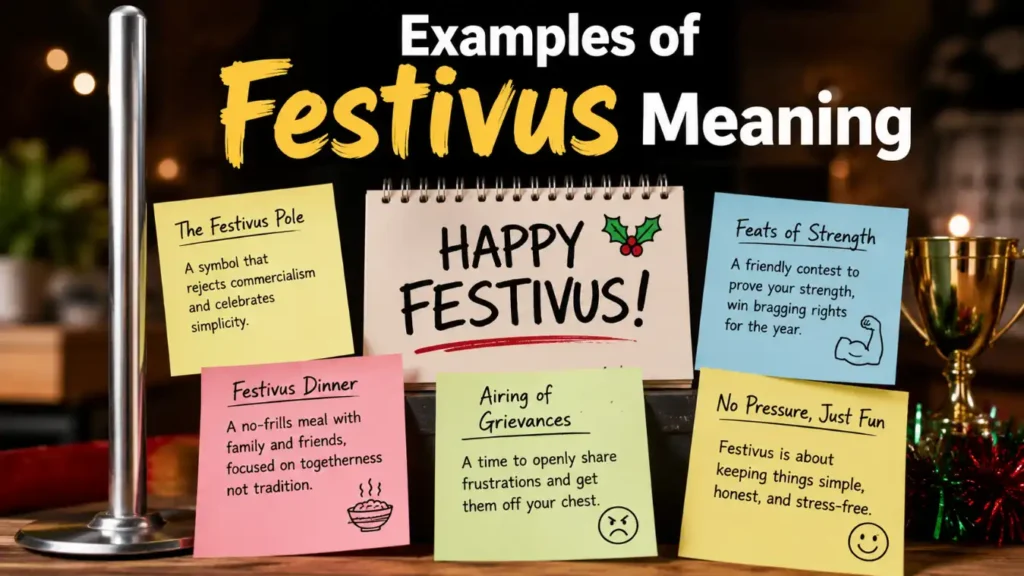
- “We’re skipping the big family dinner this year and just doing Festivus instead.”
- “He set up an aluminum pole in the living room for Festivus.”
- “Every December 23, they go around the table airing grievances, Festivus-style.”
- “The office holiday party turned into an unofficial Festivus once people started listing complaints.”
- “A Festivus pole appeared next to the nativity scene at the state capitol.”
- “I don’t have the energy for a real holiday party, let’s just call it Festivus.”
- People often use “Feats of Strength” sarcastically for any pointless test of who’s tougher.
- “Their Festivus dinner ended, as always, with someone getting pinned.”
- “This meeting basically turned into a corporate Festivus, everyone just aired grievances.”
- “We don’t do gifts for Festivus, just complaints and a plain pole.”
How to Use It (Grammar and Context)
Festivus functions as a proper noun and takes a capital letter, the same way Christmas or Hanukkah would. People typically pair it with “for” when quoting the holiday’s tagline “a Festivus for the rest of us” , a phrase that describes it as an alternative for people who don’t want a traditional holiday.
It can stand alone as a noun (“We celebrate Festivus”) or work as a modifier (“a Festivus pole,” “a Festivus dinner,” “Festivus grievances”). Writers often capitalize the related phrase “airing of grievances” when referring to the specific ritual, but lowercase it when using it loosely to mean general complaining.
Common Mistakes

Assuming it’s an ancient or genuinely old holiday. People often mistake Festivus for a real historical or religious observance. It isn’t a modern invention with a specific, traceable origin.
Confusing the date. Festivus falls specifically on December 23, not on a floating date or “sometime around Christmas.”
Overlooking the real-family origin. Many people assume Festivus started purely as a TV invention. In fact, the sitcom version adapted an actual family tradition that predates the show.
Treating “Feats of Strength” as just a phrase. In the original context, it names a specific wrestling-style challenge, not just any display of effort or
Opposite Words
| Word | Meaning | Why It’s an Opposite |
| Traditional holiday | A long-established, culturally or religiously rooted celebration | Festivus intentionally rejects tradition and history |
| Commercial holiday | A holiday associated with heavy gift-buying and marketing | Festivus’s creators built it specifically to reject commercialism |
| Formal celebration | A polished, etiquette-driven gathering | Festivus embraces complaints and roughness instead of polish |
Pronunciation
People pronounce Festivus as FES-tih-vuss (rhymes loosely with “festive us”), stressing the first syllable.
Quick Facts
| Fact | Detail |
| Date celebrated | December 23 |
| Origin | Adapted from a real family tradition, popularized by a 1997 sitcom episode |
| Main symbol | A plain, undecorated aluminum pole |
| Core rituals | Festivus dinner, Airing of Grievances, Feats of Strength |
| Tagline | “A Festivus for the rest of us” |
| Religious affiliation | None it’s explicitly secular |
FAQs
Festivus names a joke, secular December holiday centered on rejecting commercialism, featuring a plain aluminum pole, a grievance-airing dinner, and a wrestling challenge called the Feats of Strength.
It counts as real in the sense that some people genuinely celebrate it every year, but it never became an officially recognized or traditional holiday; it started as a family in-joke and later a sitcom bit.
December 23.
Not entirely. A popular sitcom popularized it, but the concept adapted a real tradition from the family of the writer who brought it to the show.
It’s a plain, undecorated aluminum pole that stands in for a Christmas tree, chosen specifically because it carries no elaborate decoration and costs little.
It’s a Festivus dinner ritual where participants take turns telling others how they’ve been disappointed by them over the past year.
A Festivus tradition where the head of the household must be physically pinned by another participant before the celebration can end.
Because Festivus carries no religious content, some public officials have allowed Festivus poles to stand alongside religious holiday decorations to keep public spaces officially secular.
No. Many people celebrate both, using Festivus as a lighthearted, low-pressure add-on rather than a replacement.
Yes, plenty of people adopt the pole, the grievances, and the general “no-frills holiday” spirit without any deep familiarity with where it came from.
Festivus names a joke, secular December holiday centered on rejecting commercialism, featuring a plain aluminum pole, a grievance-airing dinner, and a wrestling challenge called the Feats of Strength.
It counts as real in the sense that some people genuinely celebrate it every year, but it never became an officially recognized or traditional holiday; it started as a family in-joke and later a sitcom bit.
December 23.
Not entirely. A popular sitcom popularized it, but the concept adapted a real tradition from the family of the writer who brought it to the show.
It’s a Festivus dinner ritual where participants take turns telling others how they’ve been disappointed by them over the past year.
A Festivus tradition where the head of the household must be physically pinned by another participant before the celebration can end.
Because Festivus carries no religious content, some public officials have allowed Festivus poles to stand alongside religious holiday decorations to keep public spaces officially secular.
No. Many people celebrate both, using Festivus as a lighthearted, low-pressure add-on rather than a replacement.
Yes, plenty of people adopt the pole, the grievances, and the general “no-frills holiday” spirit without any deep familiarity with where it came from.
Key Takeaways
- Festivus means a secular, joke-based alternative to Christmas, celebrated December 23.
- It adapted from a real family tradition and gained popularity through a 1997 sitcom episode.
- Its core traditions include the aluminum pole, the Airing of Grievances, and the Feats of Strength.
- It carries no religious content, which has made it relevant in debates over public holiday displays.
- People use the word both literally (as an actual family ritual) and loosely (as slang for any complaint-friendly, low-pressure gathering).
Conclusion
The Festivus meaning has grown well beyond its television origins. What started as one family’s odd private ritual became a widely recognized shorthand for rejecting holiday stress, commercialism, and forced cheer. If you set up an actual aluminum pole this December or just use the word to describe a blunt, complaint-filled family dinner, you’re tapping into the same basic idea: a holiday that doesn’t take itself too seriously.
Part of why Festivus has lasted is that it gives people permission to skip the performance that other holidays sometimes demand. Nobody has to decorate perfectly, buy the right gifts, or pretend the year went smoothly. The whole point is admitting what actually went wrong, then moving on with dinner. That honesty, wrapped in a joke, is probably why the idea outlived the sitcom episode that made it famous.
If you’re curious enough to try it yourself, you don’t need much: a plain pole, a willingness to say what’s actually bothering you, and someone game enough to attempt the Feats of Strength. From there, you’re already celebrating it the same way people have for decades half joke, half genuine tradition.

I am Stephen King an American author known for compelling storytelling. At writemora.com, we value clear, accurate, and reader-focused content inspired by excellence in writing.