

Spate describes a large number of similar events happening close together in time, usually in a sudden, unexpected rush. When news reports mention “a spate of” break-ins, resignations, or storms, they’re describing a cluster of similar incidents occurring in quick succession, more than would normally be expected.
You’ll encounter spate constantly in news writing, where it efficiently signals a noticeable, often concerning pattern of similar events. Understanding the spate meaning helps you use the word precisely and recognize its slightly negative, journalistic tone.
This guide covers what spate means, where the word comes from, how it’s typically used, and the mistakes people sometimes make with it.
What It Means
In simple terms, spate describes a sudden, large number of similar things happening in a short period of time. Almost always used in the phrase “a spate of,” the word signals that something is occurring more frequently or intensely than usual, often implying a concerning or noteworthy pattern.
In a fuller sense, spate carries connotations beyond simple frequency. It implies a sudden surge or rush, rather than a gradual increase, and the events described are usually similar in kind a spate of burglaries, a spate of resignations, a spate of storms rather than a random assortment of unrelated occurrences.
The word also has an older, more literal meaning tied to flooding rivers, and that original sense of a sudden rush or overflow still shapes how “spate” feels when applied metaphorically to events, giving it a slightly more vivid, urgent quality than plainer alternatives like “series” or “number.”
Origin & History
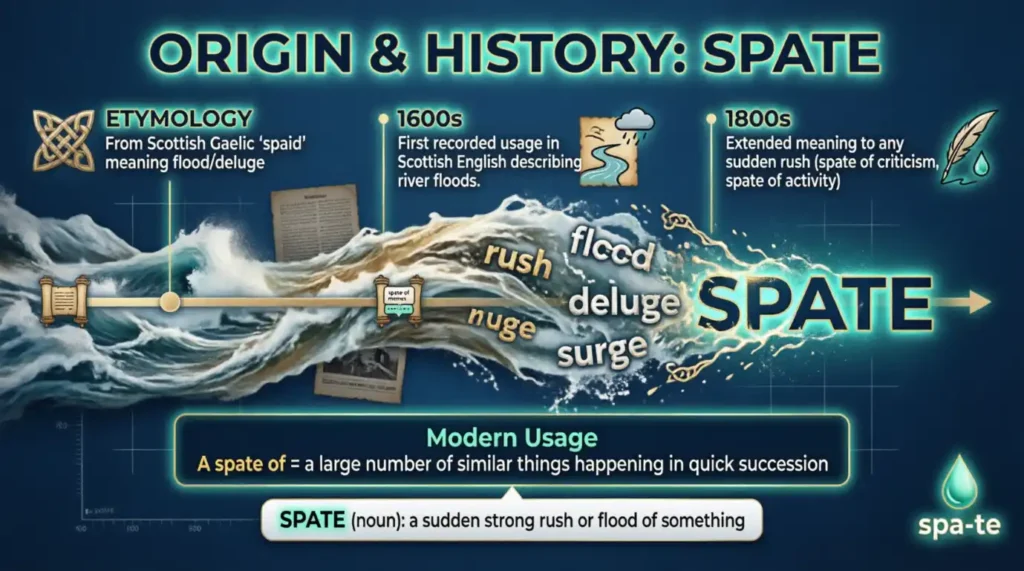
Spate comes from Middle English, with origins that remain somewhat uncertain, though many etymologists connect it to Scottish and Northern English dialect words describing a sudden flood or rush of water in a river. This original, literal meaning a river in “spate” refers to it flooding or overflowing dramatically due to heavy rain remains in use today, particularly in British English and outdoor or environmental writing.
The figurative extension of the word, applying “spate” to any sudden rush of similar events rather than just literal flooding, developed later, likely drawing directly on the vivid, sudden, overwhelming quality of an actual river flood. Just as a spate of water rushes forward suddenly and intensely, a “spate of” events rushes forward in a similarly sudden, concentrated burst.
By the time this figurative sense became well established, likely by the 19th or 20th century, “spate” had become a common, useful word in journalism and general writing, particularly for describing clusters of negative or noteworthy events.
Different Contexts and Meanings
In news and journalism. This is the world’s most common modern context describing a sudden cluster of similar events, often crimes, accidents, resignations, or other notable incidents: “a spate of burglaries in the neighborhood.”
In its original, literal sense (flooding). British and Scottish English particularly, “spate” still describes an actual river flooding or swelling due to heavy rainfall: “the river was in spate after days of rain.”
In business and professional writing. Reports and analyses sometimes describe a “spate of” layoffs, mergers, or resignations, signaling a noteworthy pattern within a specific industry or company over a short period.
In everyday conversation. People occasionally use “spate” more casually to describe any noticeable cluster of similar occurrences in their own life: “We’ve had a spate of bad luck lately.”
As a word implying negative or neutral, rarely positive, events. While technically neutral in definition, “spate” appears overwhelmingly in contexts describing problems, incidents, or unwelcome patterns, rather than positive developments.
Examples

- “Police investigated a spate of car break-ins across the downtown area.”
- “The company faced a spate of resignations following the leadership change.”
- “After days of heavy rain, the river was in spate.“
- “A spate of technical glitches delayed the product launch.”
- “The town experienced a spate of power outages during the storm season.”
- “There’s been a spate of similar complaints filed with the agency this month.”
- “The league saw a spate of injuries early in the season.”
- “A spate of negative reviews prompted the restaurant to reevaluate its menu.”
- “The region has faced a spate of wildfires in recent years.”
- “The team endured a spate of losses before finally turning things around.”
How to Use It (Grammar and Context)
Spate functions as a noun, almost always appearing in the fixed phrase “a spate of,” followed by a plural noun describing the specific events: “a spate of accidents,” “a spate of complaints.” The word rarely stands alone without this construction in its figurative sense.
In its literal, flooding-related sense, particularly in British English, it commonly appears in the phrase “in spate,” describing a river’s swollen, flooding condition: “the river was in spate.”
Common Mistakes
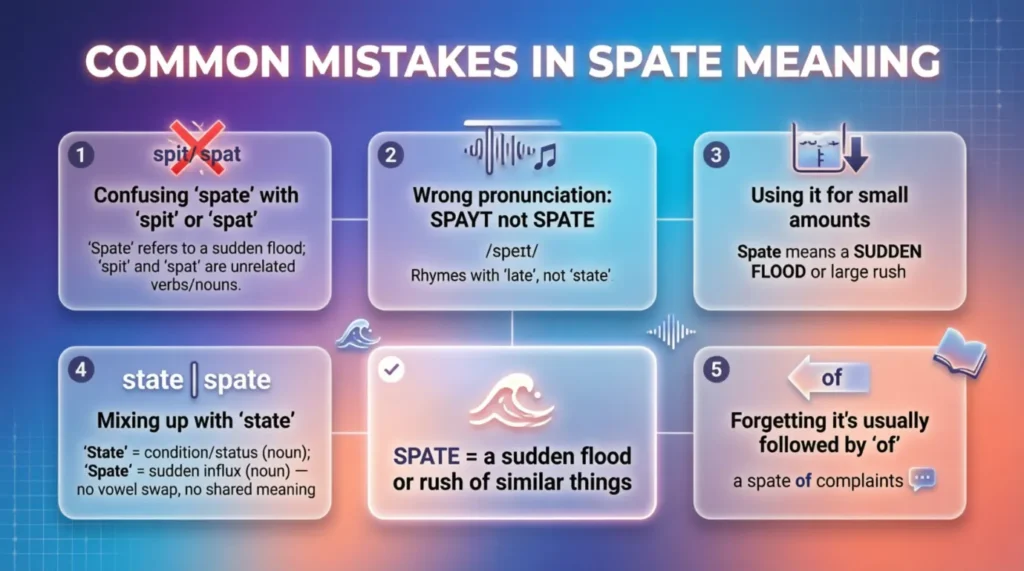
Using spate for a single event. The word specifically implies multiple similar occurrences happening close together; applying it to just one incident misuses its core meaning.
Applying spate to unrelated events. Spate works best describing similar or related incidents (several burglaries, several resignations), not a random assortment of unrelated happenings.
Assuming spate always implies something negative. While the word appears overwhelmingly in negative contexts, its literal definition remains neutral; a “spate of good news” is grammatically correct, even if less commonly used.
Forgetting the word’s connection to sudden flooding. Understanding the word’s watery origin helps clarify its implication of suddenness and intensity, distinguishing it from more neutral words like “series,” which doesn’t carry that same sense of an unexpected rush.
Similar Words
| Word | Meaning | Difference from Spate |
| Series | A number of similar or related events, objects, or actions occurring one after another | Series is more neutral and doesn’t necessarily imply suddenness; spate implies a sudden, often unwelcome surge |
| Wave | A sudden increase or surge of a particular activity or feeling | Very close to spate in figurative use, both implying sudden, sweeping intensity |
| Rash | A large number of unwelcome things occurring within a short time | Nearly synonymous with spate, particularly in describing negative event clusters |
| Outbreak | A sudden start or increase of something unwelcome, often used for disease or conflict | Outbreak often implies a more severe, urgent situation, particularly regarding illness or violence, compared to spate’s broader application |
Opposite Words
There’s no true grammatical opposite of “spate,” but related contrasts include:
| Word | Meaning | Why It Contrasts |
| Lull | A period of calm or reduced activity | Directly opposes the sudden surge implied by a spate |
| Trickle | A small, slow, gradual occurrence of something | Contrasts sharply with spate’s implication of a sudden, concentrated rush |
| Rarity | Something occurring infrequently or uncommonly | Opposes the frequent, clustered nature of events described as a spate |
Pronunciation
Spate is pronounced SPAYT, rhyming with “gate” and “late.”
Quick Facts
| Fact | Detail |
| Word origin | Middle English, likely connected to Scottish/Northern English dialect for a flooding river |
| Original literal meaning | A river flooding or swelling due to heavy rain |
| Modern figurative meaning | A sudden, large number of similar events in a short period |
| Common phrase | “A spate of,” followed by a plural noun |
| Related literal phrase | “In spate” (describing a flooding river), especially in British English |
| Typical tone | Usually implies negative or concerning events |
FAQs
How do you use spate in a sentence?
“The region experienced a spate of heavy storms last week.”
What is the synonym of spate?
Synonyms include flood, surge, rush, wave, and outpouring, depending on the context.
What does it mean when a river is in spate?
A river is in spate when it is unusually full and flowing very fast, usually because of heavy rain or flooding.
What does speech mean?
“Spetch” is not a common standard English word. It may be a misspelling of spate, speech, or another word depending on the context.
What does “spate” mean?
Spate means a sudden large amount or series of something, such as events, criticism, or problems.
What does the phrase “full spate” mean?
Full spate means operating or happening at maximum force, speed, or intensity, especially when describing water or activity.
How do you pronounce spate?
Spate is pronounced with one syllable and rhymes with “late” and “fate.”
What are 5 good synonyms?
Five good synonyms for spate are surge, flood, rush, wave, and outpouring.
What is a sophisticated word for “climax”?
Depending on context, sophisticated alternatives include culmination, apex, zenith, and pinnacle.
Key Takeaways
- Spate describes a sudden, large number of similar events happening close together in time.
- The word almost always appears in the fixed phrase “a spate of.”
- It originates from a term describing a flooding, swollen river, still used literally in British English.
- Spate typically appears in negative or concerning contexts, despite being technically neutral.
- It differs from “series” by implying suddenness and intensity, rather than simple sequence.
Conclusion
The spate meaning captures something more specific than a plain list of similar events; it implies a rush, a surge, the same energy you’d picture in a river suddenly swollen and overflowing after days of hard rain. That watery origin still gives the word its distinctive punch, even centuries after it moved from describing literal floods to describing clusters of burglaries, resignations, or bad news.
That’s exactly why journalists reach for it so often. “A spate of accidents” carries more urgency and immediacy than “several accidents” or “a series of accidents,” efficiently signaling to readers that something notable, and usually concerning, is happening in a concentrated burst rather than gradually over time.
Next time you spot the word in a headline, you’ll recognize exactly what it’s doing: borrowing the image of a river bursting its banks to describe a rush of events that arrived all at once, faster and more intensely than anyone expected.

I am Olivia Brooks an American editor and content researcher dedicated to creating clear, accurate content. At writemora.com, I help readers to understand words, phrases, and modern language with confidence.