
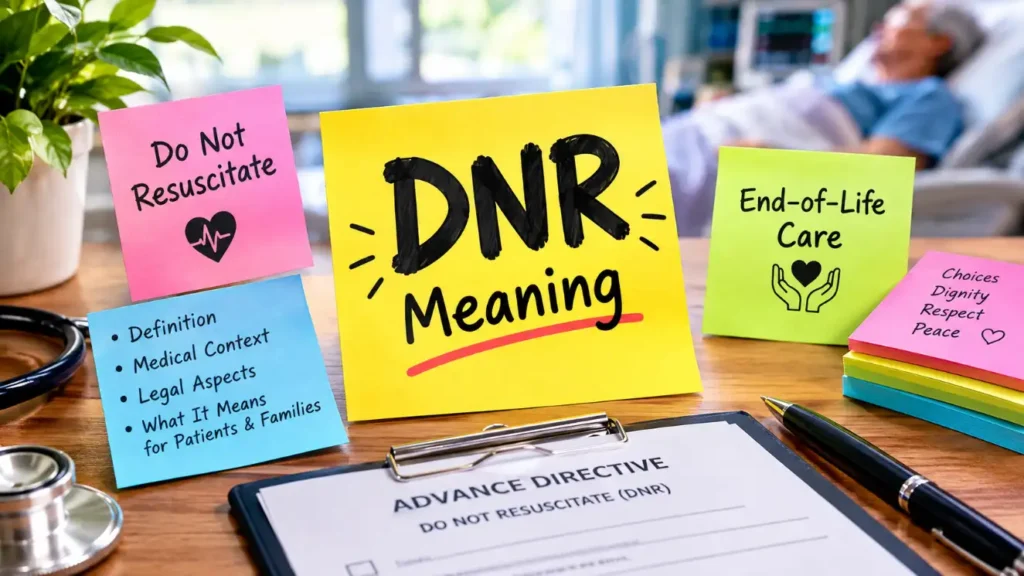
DNR most commonly stands for “Do Not Resuscitate,” a medical order indicating that a patient does not want CPR or other resuscitation efforts performed if their heart stops or they stop breathing. The abbreviation also has a separate, unrelated meaning in the United States: “Department of Natural Resources,” the state-level agency overseeing wildlife, land, and natural resource management.
Because the same three letters cover such different topics, context makes an enormous difference in understanding which meaning applies. This guide covers both meanings clearly, with particular focus on the medical sense, since it carries serious real-world implications for patients and families.
This article explains general terminology only and isn’t medical or legal advice. Anyone making decisions about resuscitation orders should speak directly with a doctor or, where relevant, a lawyer familiar with their state’s specific laws.
What It Means
In its primary and most significant sense, DNR stands for “Do Not Resuscitate.” It refers to a medical order, documented in a patient’s chart or on a specific legal form, instructing healthcare providers not to perform cardiopulmonary resuscitation (CPR) if the patient’s heart stops beating or they stop breathing.
A DNR order applies specifically to resuscitation efforts; it doesn’t mean a patient refuses all other medical treatment. Patients with a DNR can still receive pain management, medication, surgery, and other forms of care; the order applies narrowly to CPR and related resuscitation measures.
In its secondary, unrelated sense, DNR stands for “Department of Natural Resources,” a term used by many U.S. states for the government agency responsible for managing wildlife, forests, parks, fishing and hunting regulations, and other natural resources within that state.
Origin & History
The medical use of DNR developed alongside the broader growth of modern resuscitation medicine in the mid-20th century. As CPR and related emergency interventions became standard medical practice starting in the 1960s, doctors, patients, and families needed a clear, documented way to indicate when a patient did not want these interventions performed, particularly for patients with terminal illnesses or those nearing the end of life.
Hospitals and medical systems formalized DNR orders over subsequent decades, and most U.S. states eventually developed specific legal forms and processes for documenting a patient’s wishes, ensuring that emergency responders and medical staff could quickly identify and honor a patient’s choice.
The Department of Natural Resources meaning developed entirely separately, tied to the establishment of state-level conservation and resource management agencies throughout the 20th century, unrelated to the medical term in any historical sense.
Different Contexts and Meanings
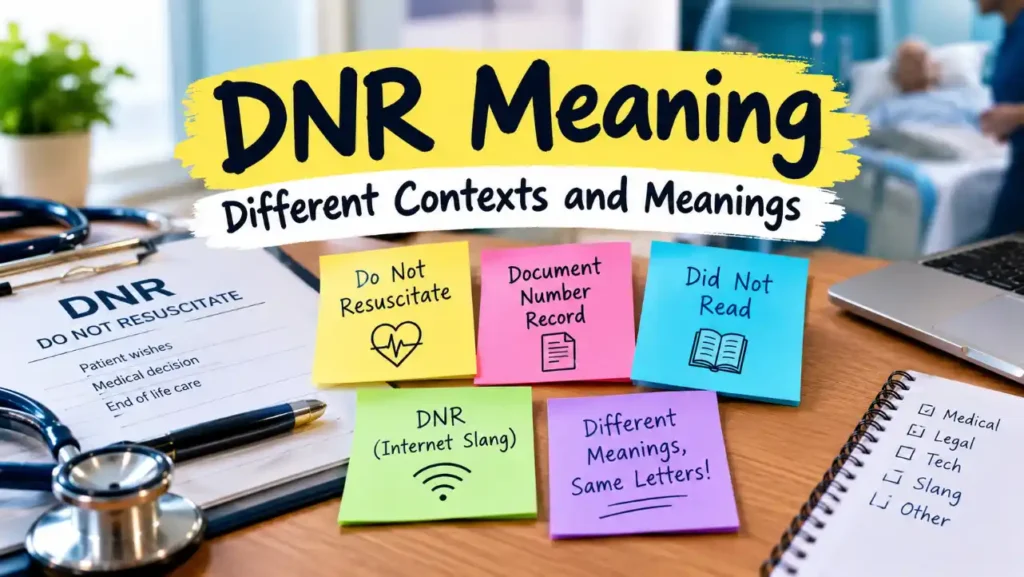
In hospitals and medical settings. A DNR order becomes part of a patient’s medical chart, instructing staff not to perform CPR if the patient’s heart or breathing stops, while other medical treatments continue as normal.
In legal and end-of-life planning. Many states offer specific legal forms, sometimes called a DNR order, POLST (Physician Orders for Life-Sustaining Treatment), or similar documents, allowing patients to formally document their resuscitation wishes as part of broader advance care planning.
In emergency medical services (EMS). Paramedics and first responders check for a documented, often physically visible DNR order (such as a bracelet or posted form) when responding to a medical emergency, since these orders carry legal weight outside hospital settings as well.
As a state government agency. “DNR” commonly refers to a U.S. state’s Department of Natural Resources, an agency overseeing hunting and fishing licenses, park management, wildlife conservation, and related natural resource issues.
In casual conversation about state agencies. People often refer to their state’s DNR when discussing hunting regulations, park permits, or wildlife concerns, particularly in states like Michigan, Wisconsin, Ohio, and Minnesota, where the agency plays a prominent public role.
Examples
- “The patient’s chart clearly noted a DNR order requested by the family.”
- “She filled out a DNR form as part of her advance care planning with her doctor.”
- “Paramedics checked for a DNR bracelet before beginning treatment.”
- “He contacted the state DNR office to ask about fishing license requirements.”
- “The hospital explained that a DNR order doesn’t mean stopping all treatment.”
- “The Michigan DNR manages several state parks and wildlife areas.”
- “Her DNR status was documented and shared with the entire care team.”
- “The DNR issued new hunting regulations for the upcoming season.”
- “He discussed DNR options with his doctor after his diagnosis.”
- “The DNR website listed updated boating safety requirements.”
How to Use It (Grammar and Context)

People write DNR in all capitals, and it typically functions as a noun or modifier: “a DNR order,” “DNR status,” “the state DNR.” Because the abbreviation carries two entirely unrelated meanings, writers should clarify which sense they intend whenever the surrounding context doesn’t make it immediately obvious.
In medical and legal writing specifically, DNR appears alongside related terms like “advance directive,” “living will,” and “POLST,” all part of the broader vocabulary around documenting a patient’s care preferences.
Common Mistakes
Assuming a DNR order means “do not treat.” A DNR specifically applies to resuscitation efforts like CPR; patients with a DNR can still receive full medical care, pain management, and treatment for their condition.
Assuming DNR forms work identically across every state. Requirements, forms, and legal recognition of DNR orders vary by state, so a form valid in one state may need to be reissued or reformatted to carry legal weight in another.
Confusing the medical and agency meanings without context. Because both meanings use the same three letters, readers unfamiliar with one sense can easily misread a sentence, particularly in headlines or short social media posts.
Assuming a DNR applies automatically without documentation. A DNR order generally needs proper legal documentation, often signed by both the patient (or their legal representative) and a physician, to be recognized and honored by medical staff and first responders.
Similar Words
| Term | Meaning | Difference from DNR |
| DNI (Do Not Intubate) | An order specifically against mechanical ventilation or intubation | DNI applies specifically to breathing support, while DNR applies to CPR and resuscitation efforts more broadly |
| Advance directive | A broader legal document outlining a patient’s overall medical care wishes | Advance directives can include DNR preferences alongside many other care decisions |
| POLST | Physician Orders for Life-Sustaining Treatment, a specific medical order form | POLST often includes DNR status alongside other treatment preferences, functioning as a broader document |
| Living will | A legal document expressing a person’s wishes for future medical treatment | A living will may reference DNR preferences but covers a wider range of end-of-life decisions |
Opposite Words
| Term | Meaning | Why It Contrasts |
| Full code | A medical status indicating a patient wants all possible resuscitation efforts performed | The direct opposite of a DNR order within medical terminology |
| CPR consent | Explicit agreement to receive cardiopulmonary resuscitation if needed | Represents the choice a DNR order specifically declines |
Pronunciation
People typically pronounce DNR by saying each letter individually: D-N-R.
Quick Facts
| Fact | Detail |
| Primary meaning | “Do Not Resuscitate” a medical order against CPR |
| Secondary meaning | “Department of Natural Resources” a U.S. state government agency |
| Applies to | Specifically CPR and resuscitation efforts, not all medical treatment |
| Related terms | DNI, POLST, advance directive, living will |
| Documentation | Requires proper legal forms, often state-specific |
| Recognized by | Hospitals, medical staff, and emergency responders (EMS) |
FAQs
Why would someone have a DNR?
Someone may choose a DNR to avoid CPR if their heart or breathing stops, often due to personal wishes or serious health conditions.
What happens if you save someone with a DNR?
If a valid DNR is ignored and CPR is performed, medical providers may face legal or ethical consequences, depending on local laws and circumstances.
What’s the difference between DNR and DNI?
A DNR means no CPR if the heart or breathing stops, while a DNI means no breathing tube or mechanical ventilation.
Can a healthy person get a DNR?
In many places, a healthy person can request a DNR, but the rules and requirements depend on local laws and healthcare providers.
Do I need a living will if I have a DNR?
No, but a living will can provide additional instructions about other medical treatments that a DNR does not cover.
How do EMTs know if someone has a DNR?
EMTs may check for an official DNR form, bracelet, necklace, or medical documentation, depending on local emergency procedures.
Why do hospitals push for DNR?
Hospitals generally should not pressure patients into a DNR; they discuss it to understand and respect a patient’s treatment wishes.
Is it painful to be resuscitated?
CPR can cause injuries such as broken ribs and soreness, especially if the person survives and regains consciousness afterward.
How long does a DNR stay in place?
A DNR usually remains valid until it is revoked or replaced, though specific rules may vary by location and healthcare system.
Can my family override my DNR?
A valid DNR generally reflects your wishes and may not be overridden by family, but laws and circumstances can vary.
Do you do CPR if someone has a DNR?
No. If a valid and applicable DNR is known, healthcare professionals generally do not perform CPR when the person’s heart or breathing stops.
Key Takeaways
- DNR most commonly stands for “Do Not Resuscitate,” a medical order against performing CPR.
- A separate, unrelated meaning, “Department of Natural Resources,” refers to a U.S. state agency.
- A DNR order applies specifically to resuscitation efforts, not all medical treatment.
- DNR documentation and legal requirements vary by state.
- This article explains general terminology only; DNR decisions should involve a doctor and, where relevant, legal guidance.
Conclusion
The DNR meaning depends entirely on context, splitting into two completely unrelated uses: a serious medical order that shapes how emergency care unfolds, and a state agency that manages parks, wildlife, and natural resources. Reading the surrounding sentence almost always makes clear which one applies.
The medical sense carries real weight for patients and families, which is exactly why understanding it precisely matters. A DNR order narrows one specific choice if to attempt CPR without touching the broader spectrum of care a patient continues to receive, a distinction that often gets lost in casual conversation about what the order actually covers.
If you or someone you care about is considering a DNR order, the most useful next step isn’t a general explainer like this one, but a direct conversation with a doctor who can walk through what the decision means for your specific situation, health history, and state’s requirements.

I am Olivia Brooks an American editor and content researcher dedicated to creating clear, accurate content. At writemora.com, I help readers to understand words, phrases, and modern language with confidence.