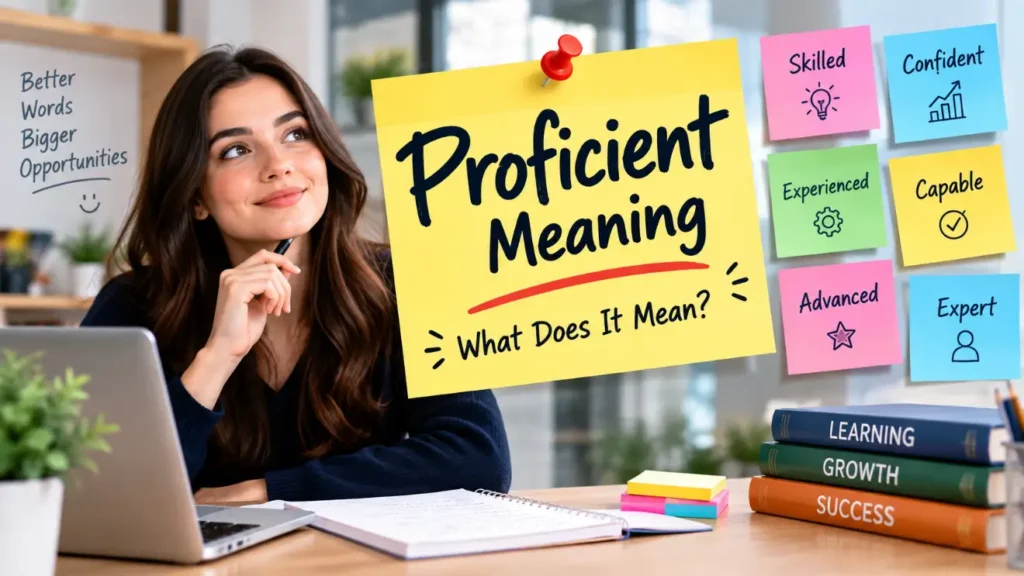
Proficient describes someone who has developed solid, practical competence in a skill or subject through training and experience. A proficient person performs a task well and reliably, though the word implies a level short of true mastery or elite expertise.
You’ll see proficiency used constantly in job listings, language learning, education standards, and skill assessments, always describing a meaningful, tested level of competence. Understanding the proficient meaning helps you use the word accurately, distinguishing it from both beginner-level ability and full expert mastery.
This guide covers what proficient means, where the word comes from, how it’s used across different fields, and the mistakes people sometimes make when applying it.
What It Means
In simple terms, proficient describes someone competent and capable in a particular skill, task, or subject, having reached a solid, dependable level of ability through practice, training, or experience. A proficient person can perform relevant tasks accurately and efficiently, without needing extensive guidance or supervision.
In a fuller sense, proficient occupies a specific middle position on the skill spectrum. It sits above basic competence or familiarity but generally below true expertise or mastery. Someone proficient in a language, for instance, can communicate effectively and handle most everyday and even complex situations, but might still fall short of native-level fluency or specialized expert vocabulary.
The word carries a positive, respectful tone, acknowledging real skill and capability without necessarily claiming the very highest possible level of achievement.
Origin & History

Proficient comes from the Latin word “proficiens,” the present participle of “proficere,” meaning “to make progress” or “to advance,” built from “pro-“ (forward) and “facere” (to make or do). This root captures the word’s underlying sense of forward movement and development through effort.
The word entered English in the 16th century, initially describing someone who had made significant progress in learning or developing a skill. This connection to ongoing progress and development, rather than a static, fixed endpoint, still echoes in the word’s modern meaning, even though “proficient” now typically describes an achieved, stable level of skill rather than active, ongoing advancement.
Over centuries, proficient became firmly established across education, professional certification, and skill assessment contexts, retaining its core sense of solid, demonstrated competence gained through deliberate effort and practice.
Different Contexts and Meanings
In education and skill assessment. Educational standards and testing frameworks frequently define specific “proficient” levels, describing a benchmark of solid, expected competence in a subject, often distinguished clearly from “basic,” “advanced,” or “expert” categories.
In language learning. Language proficiency frameworks use “proficient” to describe a level of fluency where someone can communicate effectively across a wide range of situations, though possibly still short of full native-level command.
In professional and job contexts. Job listings commonly require candidates to be “proficient” in specific software, tools, or skills, indicating a practical, dependable competence rather than necessarily deep specialized expertise.
In everyday conversation. People describe themselves or others as proficient in hobbies, sports, or general skills, indicating solid, reliable capability: “He’s quite proficient at chess.”
In formal certifications and standards. Various professional and academic certification systems use “proficient” as a specific, defined tier within a broader competency scale, often with clear criteria distinguishing it from adjacent levels.
Examples
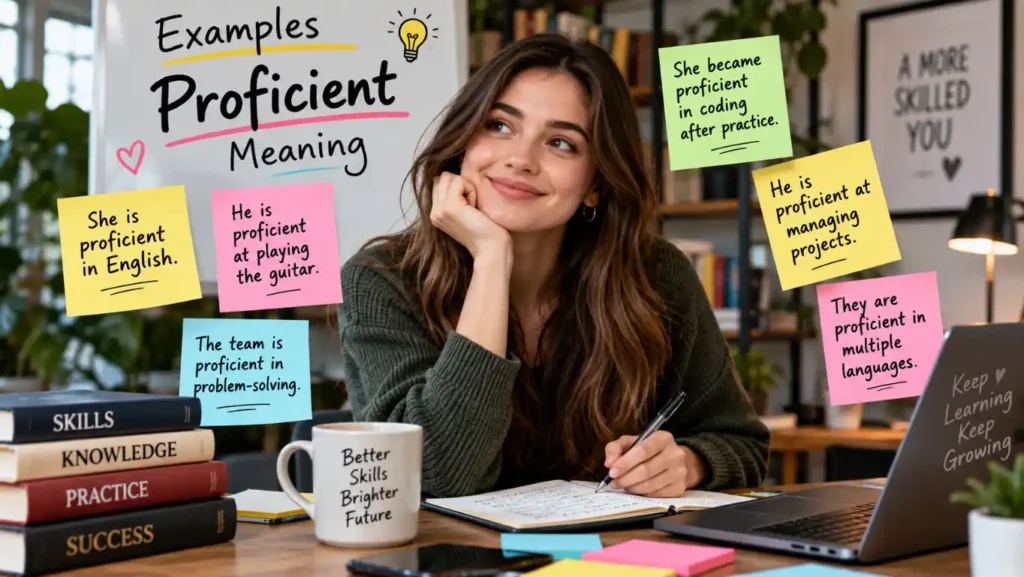
- “She’s proficient in three programming languages.”
- “The job listing required candidates proficient in Excel and data analysis.”
- “After a year of lessons, he became proficient at playing the guitar.”
- “The language exam certified her as proficient, though not yet fluent.”
- “He’s proficient enough to handle most routine repairs himself.”
- “The report rated the school’s students as proficient in reading comprehension.”
- “She developed proficient skiing skills after several winters on the slopes.”
- “The team considered him proficient, though the senior engineers still had more expertise.”
- “Being proficient in a second language opened up new career opportunities.”
- “The training program aims to make employees proficient in the new software within a month.”
How to Use It (Grammar and Context)
Proficient functions as an adjective, typically paired with the preposition “in” or “at”: “proficient in Spanish,” “proficient at cooking.” It often modifies a noun directly as well: “a proficient writer,” “a proficient athlete.”
The related noun form, “proficiency,” names the quality or level of skill itself: “her proficiency in French impressed the interviewers.” The adverb form, “proficiently,” describes how an action gets performed: “she completed the task proficiently.”
Common Mistakes
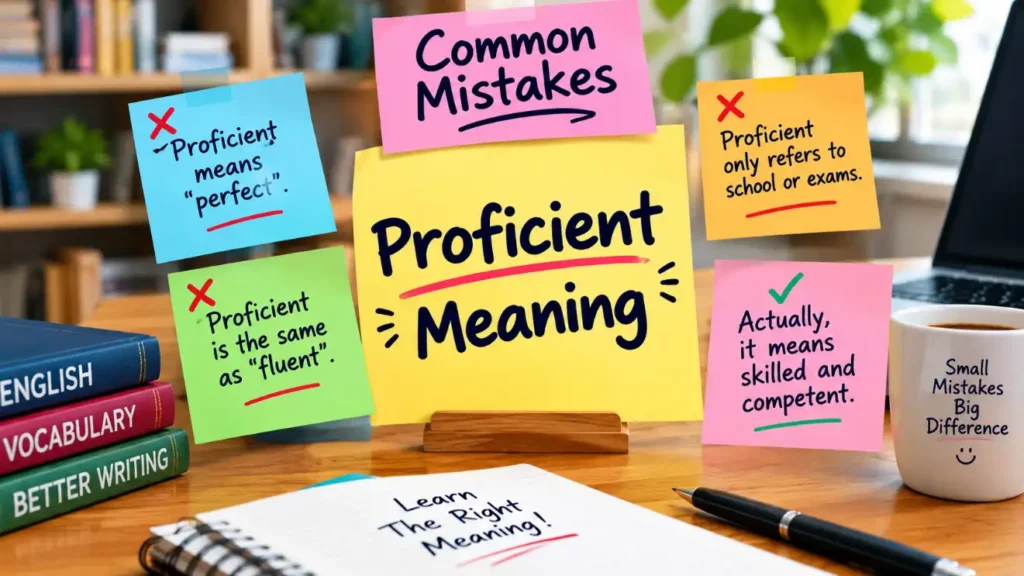
Confusing proficient with expert. Proficient implies solid, dependable competence, while “expert” implies a higher level of mastery, deep specialized knowledge, or exceptional skill the two words aren’t interchangeable.
Overstating skill level in job applications. Listing yourself as “proficient” in a skill you’ve only briefly encountered can overstate your actual competence; the word implies a meaningful, demonstrated level of capability.
Understating genuine skill by underusing the word. Conversely, some people avoid calling themselves proficient out of excessive modesty, even when they’ve genuinely reached that solid, competent level.
Assuming “proficient” always refers to a formally tested level. While proficient often appears in formal assessment frameworks, people also use it informally and correctly to describe everyday competence without any official certification involved.
Similar Words
| Word | Meaning | Difference from Proficient |
| Skilled | Having ability and expertise in a particular activity | Very close in meaning; skilled can apply across a wider range of ability levels, while proficient often implies a specific, solid competence tier |
| Competent | Having sufficient skill or knowledge to do something successfully | Competent can sometimes imply a slightly more basic, adequate level; proficient generally implies stronger, more confident capability |
| Expert | Possessing comprehensive, authoritative knowledge or skill in a field | Expert implies a significantly higher level of mastery than proficient, often including deep specialized knowledge |
| Adept | Very skilled or proficient at something, often with a sense of natural aptitude | Adept and proficient overlap closely, though adept sometimes implies a slightly more polished or effortless quality |
Opposite Words
| Word | Meaning | Why It’s an Opposite |
| Novice | Someone new to a skill or activity, with little experience | Directly opposes the solid, developed competence implied by proficient |
| Incompetent | Lacking the necessary skill or ability to perform a task successfully | The clearest opposite of proficient’s implication of capability |
| Unskilled | Lacking training or expertise in a particular activity | Contrasts with the trained, developed competence central to being proficient |
Pronunciation
Proficient is pronounced pruh-FISH-unt, with the stress on the second syllable.
Quick Facts
| Fact | Detail |
| Word origin | Latin “proficiens” (making progress), from “proficere” (to advance) |
| Core meaning | Solid, dependable competence in a skill or subject |
| Related noun | Proficiency |
| Related adverb | Proficiently |
| Skill level position | Above basic competence, generally below full expert mastery |
| Common contexts | Education standards, language learning, job requirements |
FAQs
Is proficient good or bad?
Proficient is a positive word. It means someone has a good level of skill or ability in something.
What is a better word for “proficient”?
Depending on the context, stronger alternatives include skilled, capable, accomplished, or highly competent.
Is proficient better than expert?
No. “Expert” generally describes a higher level of knowledge or skill than “proficient.”
Is proficient higher than advanced?
Not necessarily. “Advanced” and “proficient” can overlap, but proficient usually emphasizes demonstrated skill rather than a specific level.
What is a stronger word than “proficient”?
Stronger choices include expert, highly skilled, accomplished, adept, and exceptionally competent.
Is being proficient a good thing?
Yes. Being proficient means you can perform a task or use a skill effectively and with a good level of competence.
What to say instead of proficient?
You can use skilled, capable, competent, adept, experienced, or highly skilled, depending on the context.
How do you say “very good” in a professional way?
You can say excellent, highly capable, accomplished, outstanding, or exceptional in professional writing.
What do you call a person who is proficient?
A person who is proficient can be called skilled, competent, adept, capable, or experienced in that particular area.
Key Takeaways
- Proficient describes solid, dependable competence in a skill or subject, gained through training or experience.
- The word comes from Latin roots meaning “making progress” or “advancing.”
- It sits above basic competence but generally below full expert mastery on the skill spectrum.
- Related forms include the noun “proficiency” and the adverb “proficiently.”
- Proficient differs meaningfully from both “novice” (too little skill) and “expert” (implying deeper mastery).
Conclusion
The proficient meaning marks a genuinely useful middle point on the skill spectrum: not a beginner still finding their footing, but not necessarily a master either. That specific positioning is exactly why the word shows up so often in job listings, language certifications, and education standards, where a precise, honest description of skill level actually matters.
Tracing the word back to its Latin root for “making progress” adds a nice layer to its modern meaning: someone proficient has clearly put in real effort and advanced meaningfully, even if they haven’t reached the absolute top of their field. That sense of earned, solid competence is part of what gives the word its quietly respectful tone.
Whether you’re describing your own abilities on a resume or assessing someone else’s skill level, proficient remains one of the most precise words available for saying “genuinely good at this,” without overclaiming mastery that hasn’t actually been earned yet.

I am Stephen King an American author known for compelling storytelling. At writemora.com, we value clear, accurate, and reader-focused content inspired by excellence in writing.