
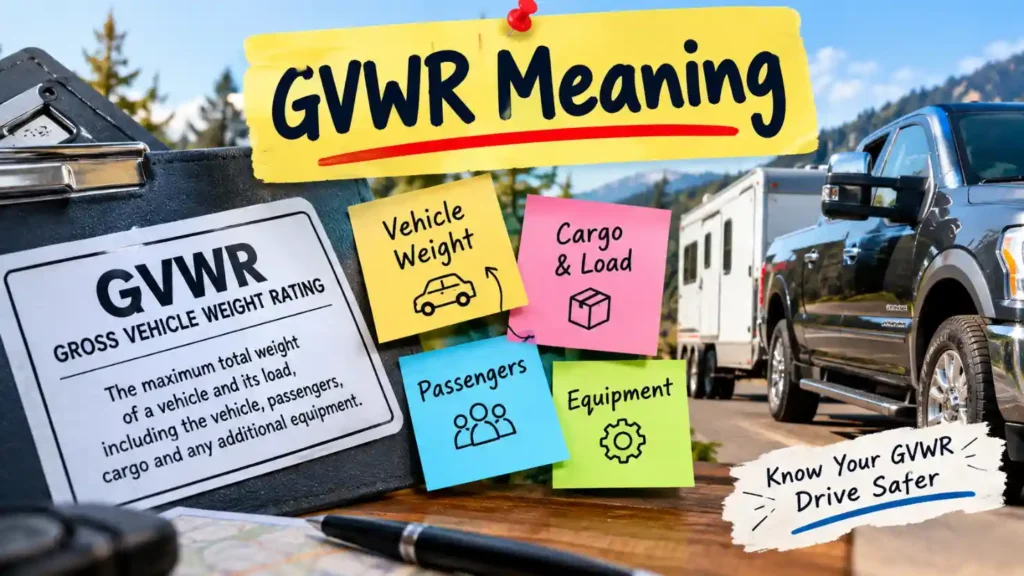
GVWR stands for “Gross Vehicle Weight Rating,” the maximum total weight a vehicle can safely carry, including the vehicle itself, all passengers, cargo, fuel, and any accessories or equipment installed. Manufacturers determine this number through engineering and safety testing, and exceeding it can compromise handling, braking, and overall vehicle safety.
You’ll find GVWR listed on a sticker inside most vehicles, typically on the driver’s side door frame, and it plays a major role in towing capacity, cargo planning, and certain licensing requirements. Understanding the GVWR meaning helps drivers, truck owners, and anyone hauling cargo stay within safe and legal limits.
This guide covers what GVWR stands for, how it’s calculated and used, how it differs from related weight terms, and the mistakes people commonly make when working with it.
What It Means
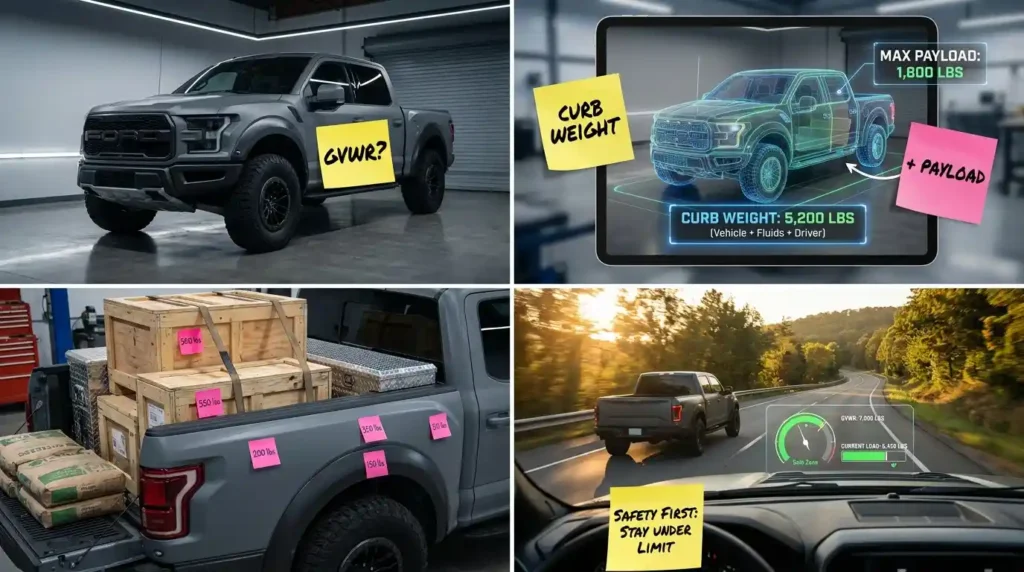
In simple terms, GVWR represents the absolute maximum weight a vehicle can safely weigh while fully loaded, set by the manufacturer based on the vehicle’s engineering, including its frame, suspension, brakes, tires, and axle capacity. This number never changes regardless of how the vehicle is actually loaded on any given day it represents a fixed safety ceiling.
In a fuller sense, GVWR includes everything: the vehicle’s own weight (called curb weight), plus the weight of the driver, passengers, cargo, fuel, and any aftermarket accessories or equipment added after purchase. The difference between a vehicle’s curb weight and its GVWR represents its payload capacity essentially, how much additional weight it can safely carry.
Manufacturers calculate GVWR specifically to ensure a vehicle’s components brakes, tires, suspension, and frame can handle the stress of that maximum weight without failing or compromising safe handling, which is why exceeding it creates genuine safety risks rather than just theoretical concerns.
Origin & History
The concept of standardized vehicle weight ratings developed alongside the growth of the American automotive and trucking industries through the 20th century, as manufacturers, regulators, and safety officials recognized the need for clear, consistent weight limits to ensure vehicles operated safely on public roads.
In the United States, the National Highway Traffic Safety Administration (NHTSA) formalized GVWR requirements as part of broader vehicle safety standards, requiring manufacturers to calculate and clearly display this rating on every vehicle sold. This standardization allowed consistent enforcement of weight limits across different vehicle types, manufacturers, and states.
GVWR became especially significant with the growth of the trucking and towing industries, since commercial vehicle regulations, licensing requirements, and road infrastructure planning all depend heavily on accurate, standardized weight classifications across different vehicle categories.
Different Contexts and Meanings
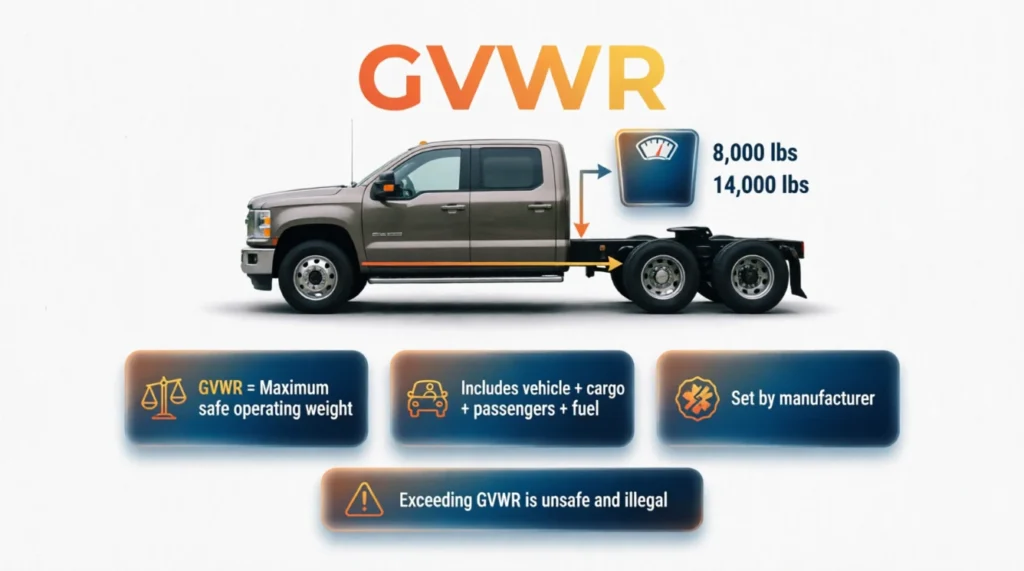
On personal vehicles. Cars, SUVs, and pickup trucks all carry a specific GVWR, found on the door-frame sticker, used by owners to determine safe passenger and cargo limits for everyday driving.
In towing and trailer calculations. GVWR plays a central role in determining a vehicle’s safe towing capacity, since the combined weight of the tow vehicle, trailer, and cargo must stay within safety limits related to GVWR and the related Gross Combined Weight Rating (GCWR).
In commercial trucking and licensing. GVWR determines specific vehicle weight classes (Class 1 through Class 8 in the U.S.), which affect licensing requirements, road regulations, and if a driver needs a commercial driver’s license (CDL) to operate that vehicle.
In vehicle modification and aftermarket upgrades. People adding equipment, storage, or accessories to a vehicle need to consider GVWR carefully, since added weight from modifications counts toward the vehicle’s total safe weight limit.
In insurance and regulatory contexts. Some insurance policies and regulations reference GVWR specifically to determine coverage requirements or applicable rules for a given vehicle.
Examples
- “The truck’s GVWR is 10,000 pounds, including passengers and cargo.”
- “He checked the door sticker to find the vehicle’s GVWR before loading the trailer.”
- “Exceeding the GVWR can strain the brakes and suspension system.”
- “The van’s payload capacity is the difference between its curb weight and GVWR.”
- “Commercial trucks with a GVWR over 26,000 pounds typically require a CDL.”
- “He upgraded his truck’s suspension to increase its safe GVWR.”
- “The dealership explained how GVWR affects the vehicle’s towing capacity.”
- “She calculated the total weight of passengers and gear to stay under the GVWR.”
- “The rental company listed the moving truck’s GVWR in the vehicle specs.”
- “Overloading a vehicle beyond its GVWR can void certain warranty protections.”
How to Use It (Grammar and Context)
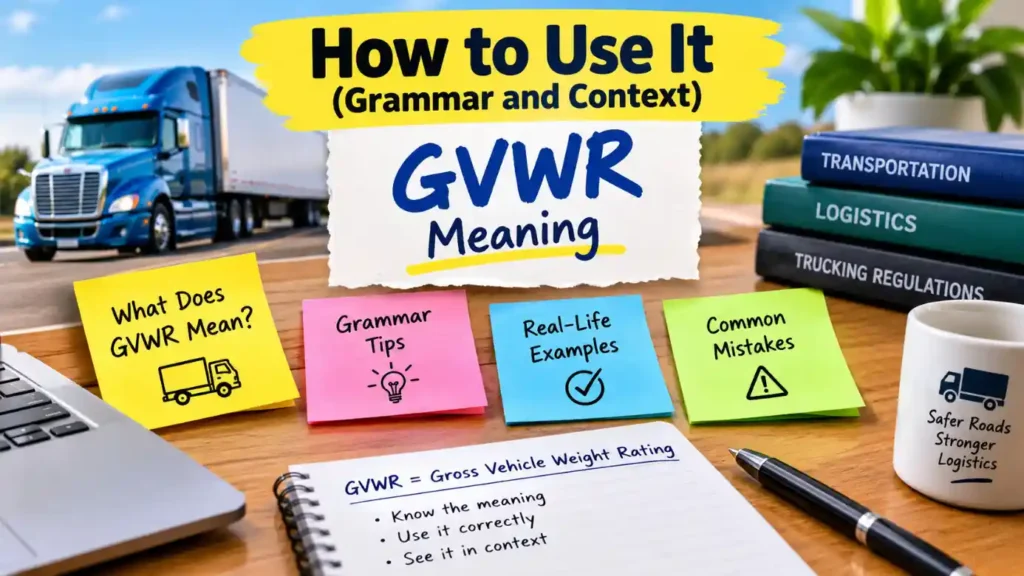
GVWR functions as a noun, typically written in all capitals as a standard technical abbreviation: “the vehicle’s GVWR,” “check the GVWR rating.” It’s almost always paired with a specific number and unit of weight, commonly pounds in the U.S.: “a GVWR of 8,500 pounds.“
The term appears alongside related weight terms like curb weight, payload capacity, and Gross Combined Weight Rating (GCWR), each describing a related but distinct aspect of a vehicle’s total weight capabilities.
Common Mistakes
Confusing GVWR with curb weight. Curb weight refers to the vehicle’s own weight alone, empty of passengers or cargo, while GVWR represents the maximum total weight including everything loaded onto it.
Assuming GVWR equals towing capacity. GVWR specifically describes the vehicle’s own maximum weight; towing capacity involves separate calculations, often tied to the related Gross Combined Weight Rating, which includes the weight of a trailer as well.
Overlooking passenger weight when calculating cargo limits. Some people focus only on cargo weight without accounting for passengers and fuel, both of which count toward the total GVWR limit.
Assuming all modifications are safe as long as they fit. Adding equipment or storage that fits physically on a vehicle doesn’t guarantee it stays within the safe GVWR limit; actual weight matters more than physical fit.
Similar Words
| Term | Meaning | Difference from GVWR |
| Curb weight | The vehicle’s own weight, empty of passengers, cargo, or additional fluids beyond standard operating fluids | Curb weight represents the empty vehicle alone; GVWR represents the maximum weight fully loaded |
| Payload capacity | The maximum additional weight (passengers, cargo) a vehicle can carry | Payload capacity equals GVWR minus curb weight, representing what can safely be added |
| GCWR (Gross Combined Weight Rating) | The maximum combined weight of a tow vehicle and its attached trailer, fully loaded | GCWR includes the trailer’s weight in addition to the tow vehicle’s own GVWR |
| GAWR (Gross Axle Weight Rating) | The maximum weight a specific vehicle axle can safely support | GAWR applies to individual axles, while GVWR applies to the vehicle’s total weight across all axles combined |
Opposite Words
There’s no true grammatical opposite of “GVWR,” but related contrasts include:
| Term | Meaning | Why It Contrasts |
| Empty weight | The vehicle with no cargo, passengers, or extra fluids | Represents the minimum baseline weight, contrasting with GVWR’s maximum weight limit |
| Underloaded | A vehicle carrying significantly less weight than its safe capacity | Contrasts with the concern of exceeding GVWR through overloading |
Pronunciation
People typically pronounce GVWR by saying each letter individually: G-V-W-R.
Quick Facts
| Fact | Detail |
| Stands for | “Gross Vehicle Weight Rating” |
| What it measures | Maximum safe total weight of a fully loaded vehicle |
| Set by | The vehicle manufacturer, based on engineering and safety testing |
| Where to find it | Typically on a sticker inside the driver’s side door frame |
| Related terms | Curb weight, payload capacity, GCWR, GAWR |
| Regulatory relevance | Determines commercial vehicle classes and CDL licensing requirements in the U.S. |
FAQs
What does GVWR stand for?
GVWR stands for “Gross Vehicle Weight Rating,” the maximum total weight a vehicle can safely carry, including passengers, cargo, and fuel.
Where can I find my vehicle’s GVWR?
It’s typically listed on a manufacturer’s sticker located on the driver’s side door frame or door jamb.
What’s the difference between GVWR and curb weight?
Curb weight is the vehicle’s own weight when empty, while GVWR represents the maximum total weight when fully loaded with passengers, cargo, and fuel.
What happens if I exceed my vehicle’s GVWR?
Exceeding GVWR can strain the brakes, suspension, and tires, potentially compromising safe handling and braking performance, and may void certain warranty protections.
How much can I tow if my GVWR is 7000 lbs?
GVWR alone does not determine towing capacity. Check your vehicle’s tow rating, payload capacity, hitch rating, and the trailer’s actual loaded weight.
Is GVWR the actual weight?
No. GVWR is the maximum allowable loaded weight of the vehicle, including passengers, cargo, and tongue weight, not its actual weight.
What does 10,000 GVWR mean on a truck?
A 10,000-lb GVWR means the truck and everything in it must not exceed 10,000 pounds when fully loaded.
What is GVWR of the Chevy Silverado?
The Silverado’s GVWR varies by model, cab, drivetrain, and configuration. It can range from roughly 6,000 to over 11,000 lbs depending on the specific truck.
Do I need a CDL to pull a 20,000 lb trailer?
It depends on your vehicle, trailer, and state regulations. In the U.S., a combination with a GVWR over 26,000 lbs generally requires a CDL.
Can a 1500 pull a 8000 lb camper?
Some 1500-series trucks can tow an 8,000-lb camper, but capacity varies by configuration. Check the truck’s specific tow rating and payload before towing.
Key Takeaways
- GVWR stands for “Gross Vehicle Weight Rating,” the maximum safe total weight of a fully loaded vehicle.
- It’s set by the manufacturer and found on a sticker inside the driver’s side door frame.
- GVWR differs from curb weight (the empty vehicle’s weight) and towing capacity (related to GCWR).
- Payload capacity equals GVWR minus curb weight.
- GVWR affects commercial vehicle classifications and licensing requirements in the U.S.
Conclusion
The GVWR meaning boils down to a single, carefully engineered safety ceiling: the most a vehicle can weigh, fully loaded, before its brakes, suspension, and frame start operating beyond what they were designed to handle. That number isn’t arbitrary; manufacturers calculate it through real testing, which is exactly why treating it as a hard limit rather than a rough guideline matters.
Understanding GVWR becomes especially important the moment you start adding weight beyond the vehicle itself, if that’s passengers heading out on a road trip, cargo for a move, or a trailer hitched up for towing. The math is straightforward once you know the terms curb weight, payload capacity, and GVWR all work together to tell you exactly how much room you actually have before you’re pushing past what the vehicle can safely carry.
Next time you’re loading up a vehicle for a trip, a move, or a haul, checking that door-frame sticker takes just a few seconds and tells you everything you need to know about how much weight you’re actually working with.

I am Stephen King an American author known for compelling storytelling. At writemora.com, we value clear, accurate, and reader-focused content inspired by excellence in writing.