

You’ve almost certainly felt it, even if you never knew the word for it: that small flicker of satisfaction when a rude driver gets pulled over, or a rival team blows a big lead. The schadenfreude meaning captures exactly that feeling of pleasure or satisfaction you get from someone else’s misfortune, failure, or embarrassment.
This guide covers what “schadenfreude” means, where the word comes from, the different situations people use it to describe, and answers to the questions people ask most about it. By the end, you’ll know exactly how to spot schadenfreude, name it, and use the word correctly in your own writing or conversation.
What “Schadenfreude” Means
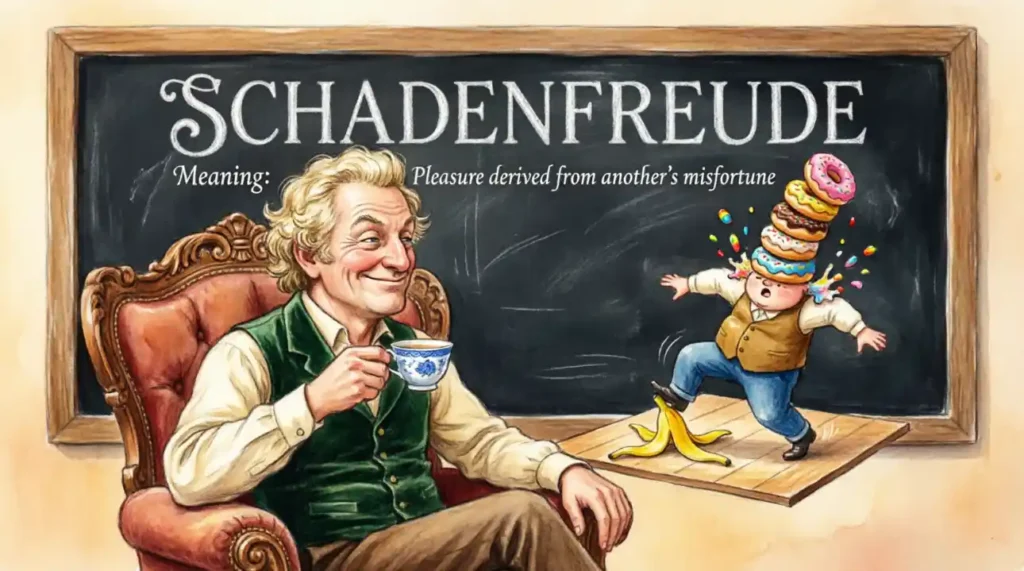
The simple version:
Schadenfreude is the feeling of pleasure, amusement, or satisfaction you get from watching someone else fail, suffer, or experience misfortune.
The fuller picture:
English borrowed “schadenfreude” directly from German, and it fills a genuine gap in the language. English simply doesn’t have its own single word for this specific emotion. People experience schadenfreude in small, often harmless doses: laughing at a friend’s minor mishap, feeling a quiet satisfaction when an arrogant coworker gets called out, or enjoying a plot twist where a villain finally faces consequences. It can also describe something darker: real delight in someone else’s genuine suffering, especially when that person “deserved it” in the observer’s eyes.
The feeling usually depends on a sense of justice or comeuppance. People tend to feel schadenfreude most strongly when the person suffering seems to have brought the misfortune on themselves, or when the person is someone the observer already disliked, envied, or felt outmatched by.
Origin and History
“Schadenfreude” comes directly from German, formed by combining two words: Schaden, meaning “damage” or “harm,” and Freude, meaning “joy.” Put together, the word literally translates to “harm-joy” joy taken in someone else’s harm.
English speakers and writers have used the German word as a loanword for a long time, borrowing it rather than translating it, because no single native English word captures the same precise meaning. Dictionaries in English-speaking countries have long since folded “schadenfreude” into standard usage, and it now appears regularly in psychology writing, journalism, and everyday conversation without needing italics or explanation in most contexts.
Psychologists and researchers have also studied the emotion itself for decades, exploring why humans feel it, what triggers it most strongly, and how it connects to concepts like envy, justice, and social comparison. The exact evolutionary or psychological explanation for why humans experience schadenfreude remains an area researchers continue to study and debate, rather than a single settled answer.
Different Meanings and Contexts

Everyday, lighthearted use. Most commonly, people use “schadenfreude” to describe small, relatively harmless amusement, laughing at a friend’s minor stumble or enjoying a funny fail video, without any real malice behind it.
Social and cultural commentary. Writers often reach for the word when discussing public figures, celebrities, or public downfalls describing the collective satisfaction audiences feel when someone arrogant or dishonest faces consequences.
Psychological and academic use. Researchers use “schadenfreude” as a technical term when studying emotion, social comparison, envy, and empathy, treating it as a specific, measurable psychological response rather than just a casual figure of speech.
Darker or more serious use. In some contexts, the word describes genuine, less innocent pleasure in real suffering for example, taking satisfaction in a rival’s serious misfortune rather than a harmless mishap. Context and tone usually make clear which end of that spectrum a writer means.
Examples of “Schadenfreude” in a Sentence
- “I felt a twinge of schadenfreude watching the guy who cut in line miss his flight.”
- “There’s a real sense of schadenfreude online whenever a scam artist gets caught.”
- “She admitted her schadenfreude when her rival’s presentation crashed halfway through.”
- “The show leans heavily on schadenfreude, letting viewers enjoy every embarrassing mistake.”
- “He tried to hide his schadenfreude, but everyone could tell he was thrilled his ex got dumped.”
- “Fans of the losing team’s rival couldn’t hide their schadenfreude after the final whistle.”
- “Psychologists study schadenfreude to understand how envy shapes our reactions to other people’s failures.”
- “The article explored the schadenfreude fans feel when an overhyped movie flops.”
- “I know it’s petty, but I felt pure schadenfreude when the bully finally got in trouble.”
- “There’s a certain schadenfreude in watching reality TV villains lose.”
How to Use “Schadenfreude” Correctly

“Schadenfreude” functions as a noun, and it’s uncountable if you don’t say “a schadenfreude” or “schadenfreudes.” It typically pairs with verbs like feel, experience, or take (“take a little schadenfreude in”).
A few usage notes:
- No capitalization needed. Although German capitalizes all nouns, English writing doesn’t require a capital “S” for “schadenfreude” once it’s treated as a standard English loanword.
- Pronunciation flexibility. English speakers often anglicize the pronunciation somewhat, and that’s widely accepted. You don’t need to nail perfect German pronunciation to use the word correctly.
- Tone matters. The word can describe something playful and harmless or something more uncomfortable and mean-spirited, so the surrounding sentence should make clear which one you mean.
- Pair it with context. Naming the specific situation (“schadenfreude over his parking ticket”) makes the word land better than using it vaguely on its own.
Common Mistakes to Avoid
- Treating it as a countable noun. Avoid phrases like “a schadenfreude” or “many schadenfreudes” ; the word works as an abstract, uncountable concept, similar to “joy” or “envy.”
- Assuming it always means cruelty. Schadenfreude covers a wide emotional range, from harmless amusement to genuine malice. Don’t assume every use of the word implies something dark.
- Overusing it as a buzzword. Because it’s a fun, distinctive word, writers sometimes reach for it even when a simpler word (“relief,” “irony,” “satisfaction”) fits the situation better.
- Mispronouncing it so heavily it distracts listeners. You don’t need flawless German pronunciation, but garbling the word entirely can make spoken conversation stumble.
Similar Words and Phrases
| Word/Phrase | Meaning | How It Differs |
| Gloating | Openly showing smug satisfaction over a win or someone else’s loss | Describes the visible behavior, not just the internal feeling |
| Envy | Wanting what someone else has | A different emotion entirely, though it often fuels schadenfreude |
| Vindication | Feeling proved right after being doubted | Focuses on being right, not specifically on someone else’s misfortune |
| Poetic justice | A fitting, ironic outcome that feels deserved | Describes the situation itself rather than the emotional reaction to it |
| Comeuppance | A deserved punishment or bad outcome | Refers to the event, while schadenfreude refers to the pleasure someone feels watching it happen |
Opposite Words and Phrases
| Word/Phrase | Meaning | Why It’s an Opposite |
| Sympathy | Feeling sorrow or concern for someone else’s misfortune | Directly opposite emotional response to someone’s suffering |
| Compassion | A deep concern for someone else’s pain, paired with a desire to help | Focuses on care rather than pleasure |
| Empathy | Understanding and sharing another person’s feelings | Involves genuinely feeling someone’s pain rather than enjoying it |
| Mudita | A Buddhist concept meaning joy in someone else’s happiness or success | The direct emotional opposite joy in someone’s good fortune, not their bad fortune |
Pronunciation
“Schadenfreude” is pronounced roughly SHAH-dun-froy-duh. English speakers commonly simplify the ending slightly, and this relaxed pronunciation is widely accepted in everyday conversation.
Quick Facts
| Fact | Detail |
| Meaning | Pleasure or satisfaction felt at someone else’s misfortune |
| Language of origin | German |
| Literal translation | “Harm-joy” (Schaden = harm, Freude = joy) |
| Part of speech | Noun (uncountable) |
| Field of study | Frequently discussed in psychology and social science |
| Common pairing | “Feel,” “experience,” or “take” schadenfreude |
Frequently Asked Questions
What does “schadenfreude” mean?
It means the pleasure or satisfaction someone feels when they see another person fail, suffer, or experience misfortune.
Where does the word “schadenfreude” come from?
It comes from German, combining Schaden (harm) and Freude (joy) into a single word meaning roughly “harm-joy.”
Is schadenfreude a normal emotion, or is it always cruel?
It’s widely considered a normal human emotion. Most people experience it in small, harmless doses, though it can also describe something more mean-spirited depending on the situation.
Is “schadenfreude” an English word now?
It’s a loanword originally German, but so widely used in English that dictionaries and everyday speakers treat it as standard vocabulary.
How do you pronounce “schadenfreude”?
Roughly “SHAH-dun-froy-duh.” English speakers commonly use a slightly simplified pronunciation of the German original.
Is there an opposite word to schadenfreude?
Yes, the Buddhist concept “mudita” describes the opposite feeling: joy in someone else’s happiness or success rather than their misfortune.
Why do people feel schadenfreude?
Researchers connect it to factors like envy, a sense of justice, and social comparison, though the exact psychological reasons remain an active area of study.
Can schadenfreude be a good thing?
In small, harmless doses, many psychologists view it as a normal and relatively harmless part of human emotion, rather than something inherently negative.
Key Takeaways
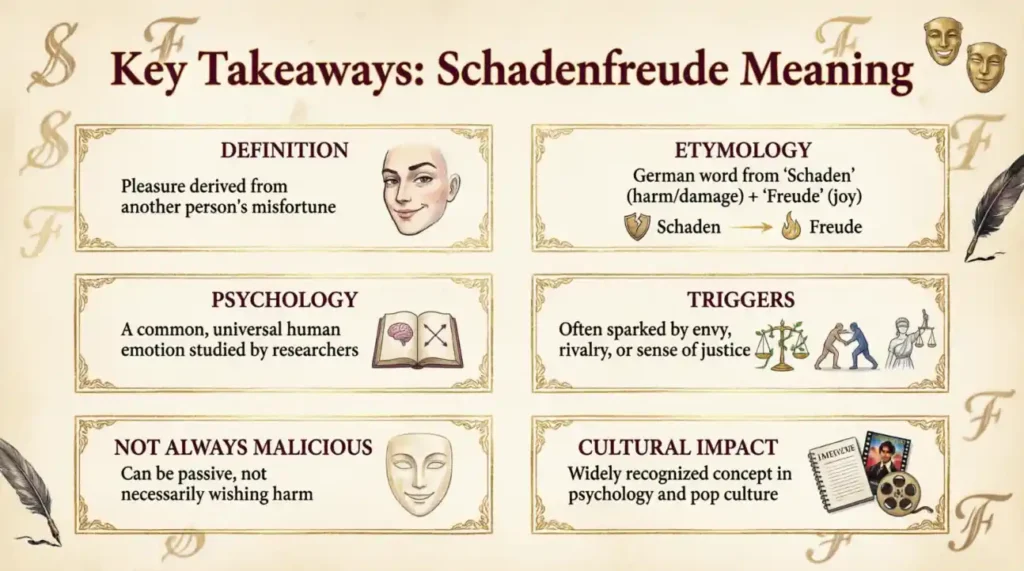
- Schadenfreude means feeling pleasure or satisfaction at someone else’s misfortune, failure, or embarrassment.
- The word comes from German, combining “Schaden” (harm) and “Freude” (joy).
- English treats it as a standard loanword with no italics or translation needed in most writing.
- The emotion ranges from harmless amusement to something darker, depending on context and intent.
- “Mudita,” joy in someone else’s happiness, works as its closest emotional opposite.
Conclusion
“Schadenfreude” earns its place in English because it names something almost everyone has felt but few languages bother to label directly. That gap is exactly why the word crossed over from German so smoothly. It’s precise, a little cheeky, and instantly recognizable once you know it.
Understanding the word also means understanding the emotion behind it a bit better. Recognizing schadenfreude in yourself, that flicker of satisfaction at someone else’s stumble doesn’t make you a bad person; it makes you human, and psychologists generally treat it as a normal, even predictable, response tied to fairness, envy, and social comparison.
Next time you catch yourself smiling at someone else’s small misfortune, you’ll have the exact word for it. And next time you want to describe that oddly specific mix of guilt and satisfaction in your own writing, “schadenfreude” will say it more precisely than almost any English alternative could.

I am Stephen King an American author known for compelling storytelling. At writemora.com, we value clear, accurate, and reader-focused content inspired by excellence in writing.