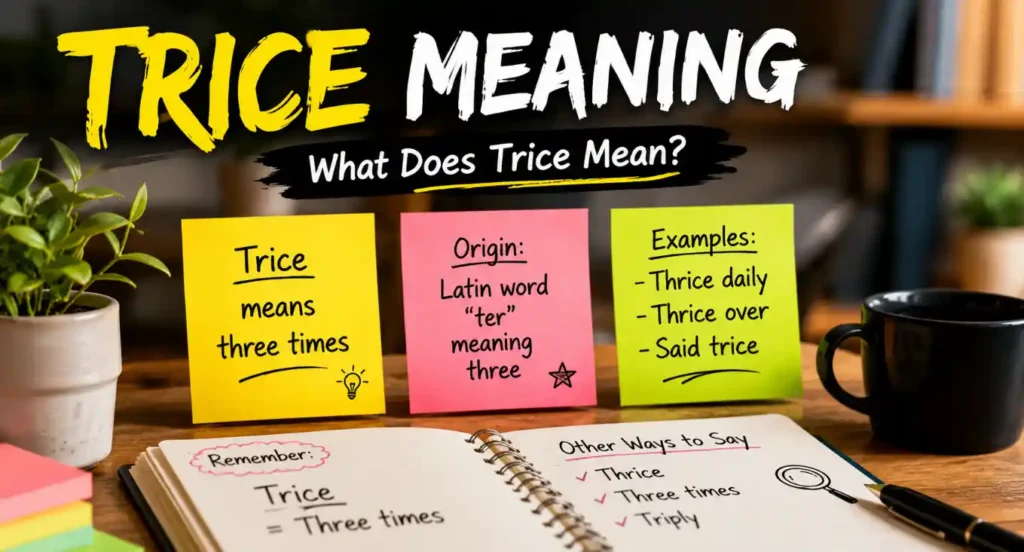
If someone says they’ll be back “in a trice,” they mean they’ll be back almost instantly, no long wait involved. The trice meaning is simple: a trice is a very short, almost immediate span of time. You’ll rarely see the word “trice” standing alone; it survives today almost entirely inside the fixed phrase “in a trice.”
This guide covers exactly what “trice” means, where the word and phrase came from, how people use it today, and answers to the most common questions about it. By the end, you’ll know how to use “in a trice” correctly and confidently in your own writing or conversation.
What “Trice” Means
The simple version:
A trice is a moment, an extremely brief period of time. “In a trice” means “very quickly” or “in an instant.”
The fuller picture:
“Trice” is one of those English words that has narrowed almost entirely down to a single set phrase. As a standalone noun, it once referred generally to a short space of time, but modern English keeps it alive almost exclusively through “in a trice,” which functions as an adverbial phrase meaning “immediately“ or “in a flash.” You won’t typically hear someone say “give me a trice” the way you’d say “give me a minute” ; the word only really works inside that one fixed expression.
Because it sounds old-fashioned, “in a trice” carries a slightly literary or storybook tone. Writers reach for it when they want a phrase that feels a bit more vivid or old-world than “in a second” or “in no time.”
Origin and History
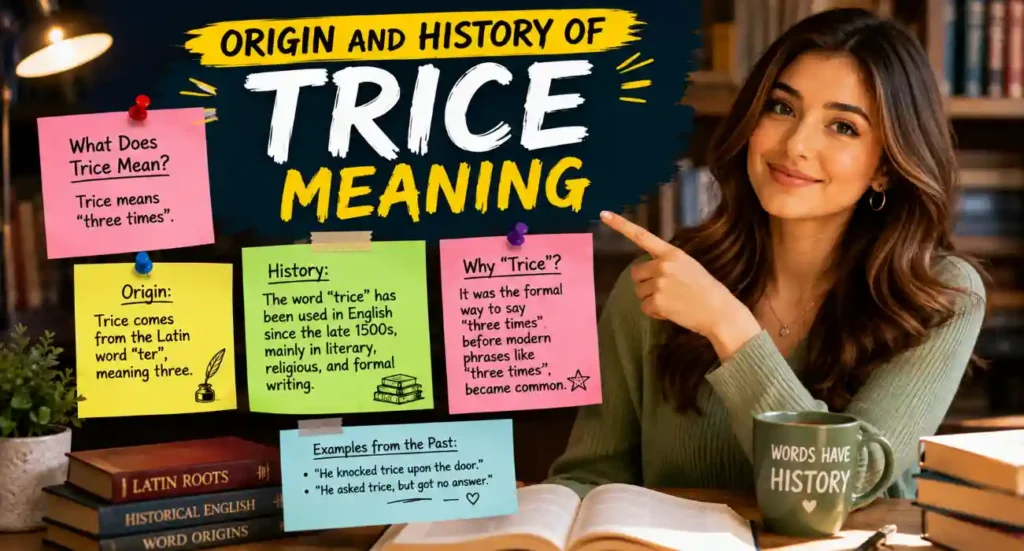
“Trice” traces back to Middle English, and most etymologists connect it to a Middle Dutch or Middle Low German word related to pulling or hoisting the idea being a single sharp tug or pull, done in one quick motion. That sense of “one quick pull” gradually shifted toward describing a single quick moment in time, which is the meaning that survived into modern English.
The exact century the word first appeared and the precise path it took through Middle English are matters language historians still debate in detail, since word origins from this period often rely on scattered written records rather than a single documented source. What’s well established is that “trice” has existed in English for centuries, and the phrase “in a trice” appears throughout older literature, giving it that slightly antique, storybook feel readers still notice today.
Different Meanings and Contexts
Standard meaning (most common). “In a trice” means “very quickly” or “in an instant.” This is by far the phrase’s dominant use in modern English.
Literary and old-fashioned tone. Because the word rarely appears outside this one phrase, using “in a trice” instantly gives a sentence a slightly formal, old-fashioned, or fairy-tale quality; you’ll spot it often in classic literature, folk tales, and writing that deliberately evokes an earlier era.
Nautical origin (historical). The word’s root sense of “pulling” or “hoisting” ties it loosely to sailing and rigging terminology from earlier centuries, though this connection shows up mainly in etymology discussions rather than in everyday usage today.
Examples of “Trice” in a Sentence

- “Give me a second, I’ll be back in a trice.“
- “The magician made the rabbit disappear in a trice.”
- “In a trice, the whole room fell silent.”
- “She solved the puzzle in a trice, barely pausing to think.”
- “The storm rolled in and, in a trice, the sky turned black.”
- “He packed his bag in a trice and ran for the train.”
- “In a trice, the argument was over and everyone was laughing again.”
- “The cat vanished under the couch in a trice.”
- “Their plans changed in a trice when the weather turned.”
- “In a trice, she’d finished the whole plate.”
How to Use “Trice” Correctly
“Trice” almost always appears inside the fixed phrase “in a trice,” which functions as an adverbial phrase describing how quickly something happens.
A few usage notes:
- Stick to the fixed phrase. Modern readers rarely encounter “trice” outside of “in a trice.” Using it any other way (as a plural, for example) will likely confuse readers rather than sound natural.
- Place it for emphasis. Writers often put “in a trice” at the start of a sentence for dramatic effect (“In a trice, the door slammed shut”) or at the end for a punchy finish.
- Match the tone. Because the phrase sounds a little old-fashioned, it fits best in storytelling, descriptive writing, or a deliberately whimsical tone that can feel out of place in a formal business report.
- Don’t overuse it. Like most vivid, slightly archaic phrases, “in a trice” loses its charm if a piece of writing leans on it too many times.
Common Mistakes to Avoid
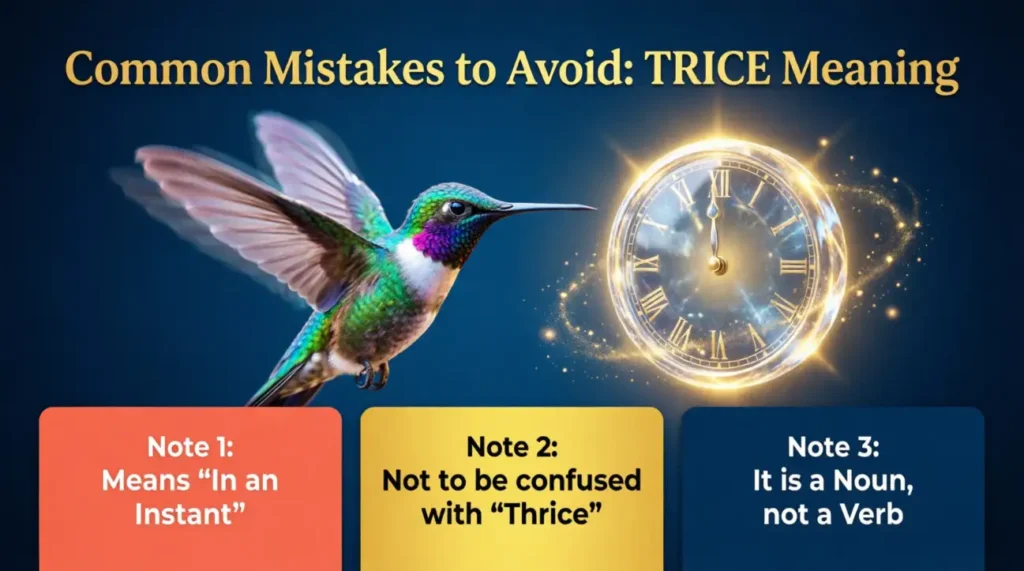
- Using “trice” as a standalone noun in casual speech. Saying “wait a trice” instead of “in a trice” sounds unnatural to most modern readers, even though it’s grammatically close to the word’s older use.
- Confusing it with “twice.” The words look and sound similar on the page, but they mean completely different things: “trice” refers to speed, “twice” refers to a count of two.
- Overusing it in formal writing. The old-fashioned tone that makes “in a trice” charming in a story can feel out of place in a business email or technical document.
- Assuming it’s outdated slang. “In a trice” isn’t slang, it’s a genuinely old phrase with a long literary history, not a recent invention or trend.
Similar Words and Phrases
| Phrase | Meaning | How It Differs |
| In a flash | Very quickly | More common in everyday modern speech; carries less of an old-fashioned tone |
| In no time | Very quickly, without delay | Slightly more casual and widely used than “in a trice” |
| In the blink of an eye | Extremely quickly | Leans on a visual image rather than the older “quick pull” origin of “trice” |
| At once | Immediately | Focuses on immediacy of action rather than sheer speed |
| Momentarily | For or within a very short time | More neutral and formal in tone, common in modern American English |
Opposite Words and Phrases
| Phrase | Meaning | Why It’s an Opposite |
| Eventually | At an unspecified, later time | Implies a long, open-ended wait rather than speed |
| In due course | After the proper or expected amount of time | Suggests patience rather than immediacy |
| At a snail’s pace | Very slowly | Directly opposite in both tone and speed |
| Ages from now | A long time from now | The literal opposite of “very soon” |
Pronunciation
“Trice” rhymes with “ice,” “mice,” and “twice.” It’s pronounced TRYSE, with a single syllable.
Quick Facts
| Fact | Detail |
| Meaning | A very short, almost instant period of time |
| Most common form | “In a trice” (adverbial phrase) |
| Origin | Middle English, likely linked to a Middle Dutch or Middle Low German word for pulling or hoisting |
| Part of speech | Noun (used almost exclusively within a fixed phrase) |
| Tone | Slightly old-fashioned, literary |
| Common pairing | “Back,” “gone,” “done,” or “over” + “in a trice” |
Frequently Asked Questions
What does “in a trice” mean?
It means “very quickly” or “in an instant.” Something that happens “in a trice” happens almost immediately.
Is “trice” an old word?
Yes, it traces back to Middle English and has carried its “quick moment” meaning for centuries, which gives the phrase “in a trice” its slightly old-fashioned feel today.
Can you use “trice” without “in a”?
Rarely, and it will sound unusual to most modern readers. The word survives almost entirely inside the phrase “in a trice.”
Is “trice” related to “twice”?
No, despite looking similar, the two words have separate meanings and separate origins. “Trice” refers to speed; “twice” refers to a count of two.
Is “in a trice” still used today?
Yes, though mostly in writing rather than everyday conversation. It shows up often in fiction, storytelling, and descriptive or slightly formal writing.
What’s the difference between “in a trice” and “in a flash”?
They mean nearly the same thing, but “in a flash” sounds more modern and casual, while “in a trice” carries an older, more literary tone.
Does “trice” have a nautical meaning?
The word’s root sense connects loosely to pulling or hoisting, which ties it to older sailing and rigging terminology, though this connection mostly comes up in etymology discussions rather than everyday use.
How do you pronounce “trice”?
It rhymes with “ice” and “mice” pronounced like “tryse,” one syllable.
Key Takeaways
- “Trice” means a very short, almost instant moment in time.
- The word survives today almost entirely inside the fixed phrase “in a trice,” meaning “very quickly.”
- It traces back to Middle English, likely linked to an older word for pulling or hoisting in one quick motion.
- “In a trice” carries a slightly old-fashioned, literary tone compared to phrases like “in a flash” or “in no time.”
- Writers use it for emphasis and dramatic effect, especially in storytelling.
Conclusion
“In a trice” earns its place in modern English by doing something few phrases manage: sounding both fast and a little magical at the same time. It’s the kind of phrase a fairy tale reaches for when a spell takes hold or a door slams shut, and that storybook quality is exactly what keeps writers coming back to it centuries after it first appeared.
You won’t need “trice” for everyday small talk “in a sec” or “real quick” will usually do the job just fine. But when you want a sentence to feel a touch more vivid, more old-world, or more dramatic, “in a trice” gives you all of that in three short words.
Next time you read an old story and a character vanishes, arrives, or finishes something “in a trice,” you’ll know exactly what’s happening and you’ll have a small, sharp phrase ready the next time you want your own writing to move just as fast.

I am Olivia Brooks an American editor and content researcher dedicated to creating clear, accurate content. At writemora.com, I help readers to understand words, phrases, and modern language with confidence.