
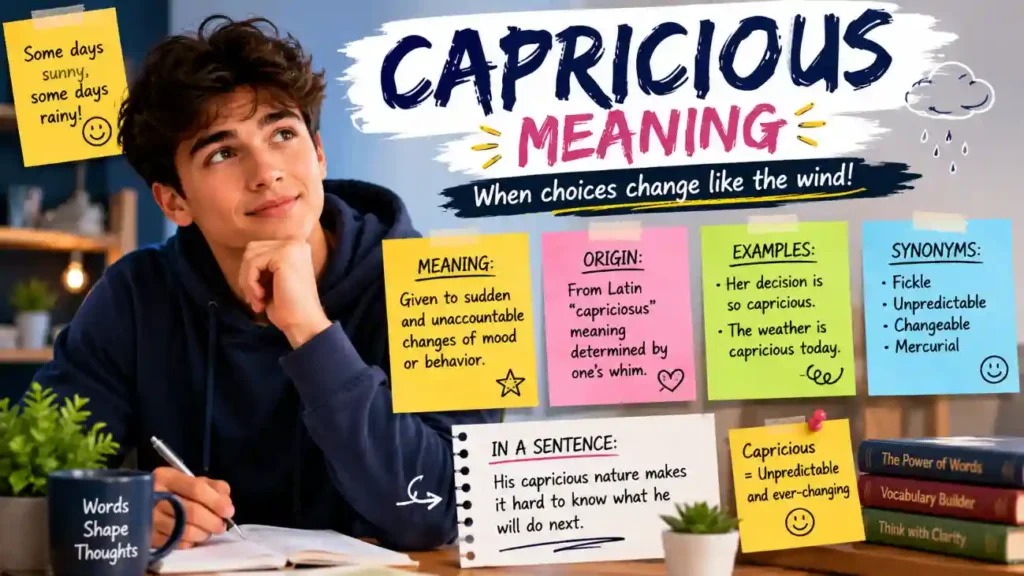
A boss who changes the rules on a whim. Weather that swings from sunshine to storm in an hour. A friend whose mood you can never quite predict. All of these fit the capricious meaning sudden, impulsive, and unpredictable, without any clear reason or pattern behind the change.
This guide covers exactly what “capricious” means, where the word comes from, how people use it in different contexts, and answers to the questions people ask most often. By the end, you’ll know how to use “capricious” precisely and confidently in your own writing or conversation.
What “Capricious” Means
The simple version:
“Capricious” describes something or someone that changes suddenly and unpredictably, often based on a passing whim rather than logic, reason, or a real pattern.
The fuller picture:
People most often use “capricious” to describe behavior, decisions, or personalities that shift without warning or justification. A capricious person might change plans, moods, or opinions on impulse. A capricious decision might seem arbitrary, made on a whim rather than through careful thought. The word carries a mild negative undertone in most contexts; it usually signals that the unpredictability causes frustration, confusion, or unfairness for the people affected by it, rather than simply describing spontaneity in a neutral or positive light.
The word also extends naturally to non-human things. Writers often describe weather, markets, fate, or nature itself as capricious, capturing the sense that these forces change suddenly and defy any confident prediction.
Origin and History
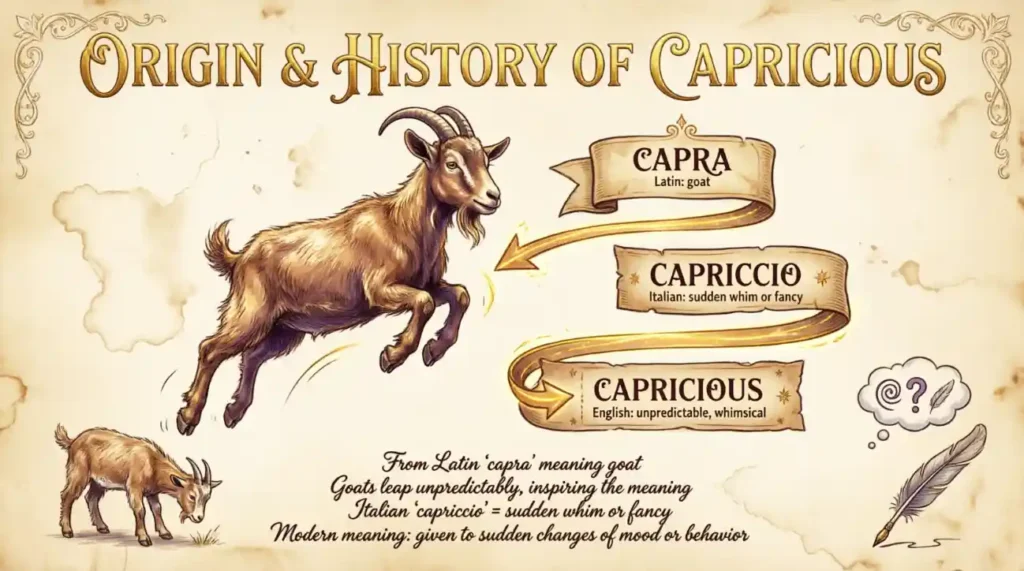
“Capricious” traces back to the Italian word capriccio, which originally carried the sense of a sudden shudder, a shiver, or a spontaneous impulse. Some etymologists connect the earlier root to words associated with a hedgehog bristling, or with a sudden fright, though scholars still debate the precise path the word took as it developed. Over time, “capriccio” broadened from describing a sudden physical or emotional jolt into describing any sudden, whimsical change in behavior or thought.
The word entered English by way of French, arriving during a period when English borrowed heavily from both French and Italian vocabulary for describing personality, temperament, and artistic style. “Capriccio” also survives today as a musical term, describing a lively, free-form piece that doesn’t follow strict traditional structure, a meaning that echoes the word’s core sense of unpredictability and spontaneity.
Different Meanings and Contexts
Describing people. Most commonly, “capricious” describes a person whose moods, decisions, or behavior change suddenly and without clear reason someone others find hard to predict or rely on.
Describing decisions and authority. Writers frequently use “capricious” to criticize decisions, rulings, or exercises of power that seem arbitrary or inconsistent, especially in legal, political, or workplace contexts; a “capricious ruling,” for example, implies it lacked a fair or logical basis.
Describing nature and forces beyond human control. “Capricious weather,” “capricious seas,” or “capricious fate” all use the word to capture the sense that these forces shift suddenly and can’t be reliably predicted or reasoned with.
Legal usage. In legal writing, the phrase “arbitrary and capricious” appears often as a specific standard used to challenge decisions made without a reasonable basis, particularly in administrative and regulatory law.
Examples of “Capricious” in a Sentence
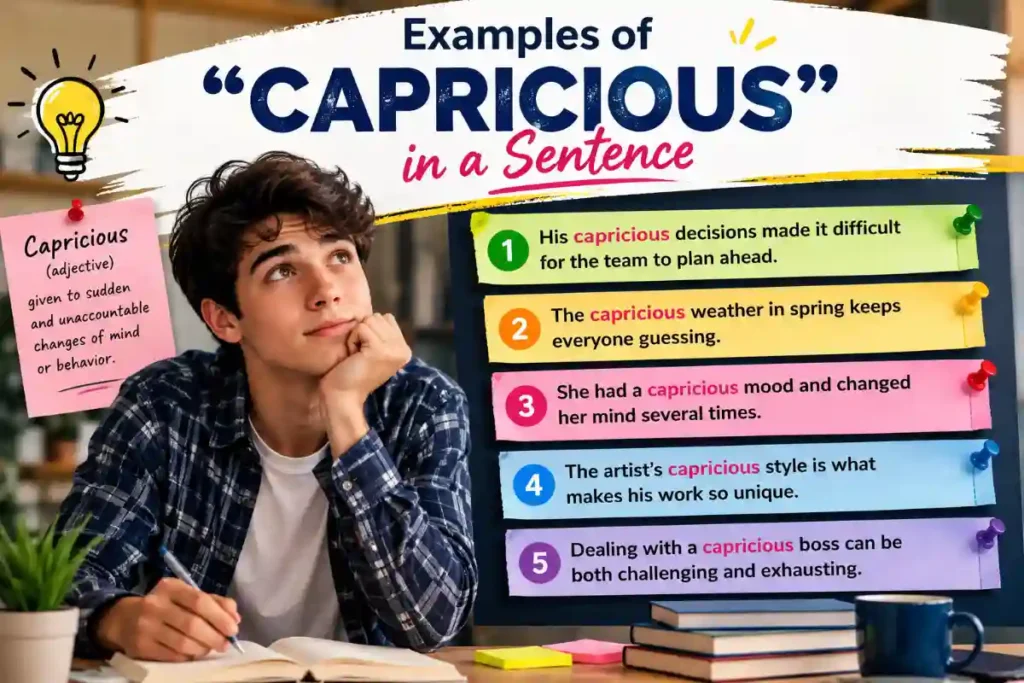
- “The manager’s capricious decisions made it impossible to plan ahead.”
- “Mountain weather can turn capricious in minutes, so pack for anything.”
- “Her capricious moods left her friends constantly guessing which version of her they’d get.”
- “The court ruled the policy arbitrary and capricious, striking it down.”
- “He’s talented, but his capricious work habits make him hard to rely on.”
- “The sea seemed capricious that day, calm one moment and violent the next.”
- “Critics called the sudden rule change capricious and unfair to everyone already enrolled.”
- “The character’s capricious nature drives most of the novel’s conflict.”
- “Fashion trends can feel capricious, shifting with little warning from one season to the next.”
- “Their capricious landlord raised the rent twice in one year for no clear reason.”
How to Use “Capricious” Correctly
“Capricious” functions as an adjective, describing a noun such as a person, decision, mood, or force of nature.
A few usage notes:
- Pair it naturally with nouns like: decision, mood, weather, ruling, behavior, nature, personality, and fate.
- Watch the tone. “Capricious” almost always carries a mildly negative or critical shade, implying unfair, frustrating, or unreliable unpredictability; it’s rarely used as a purely neutral or flattering description.
- Use the adverb form when needed. “Capriciously” describes how an action happens (“she capriciously canceled the meeting”), while “capricious” describes the noun itself.
- Know the related noun. “Caprice” refers to the impulsive whim itself, a sudden, unreasoned urge or decision and pairs naturally with “capricious,” which describes something driven by that kind of impulse.
Common Mistakes to Avoid
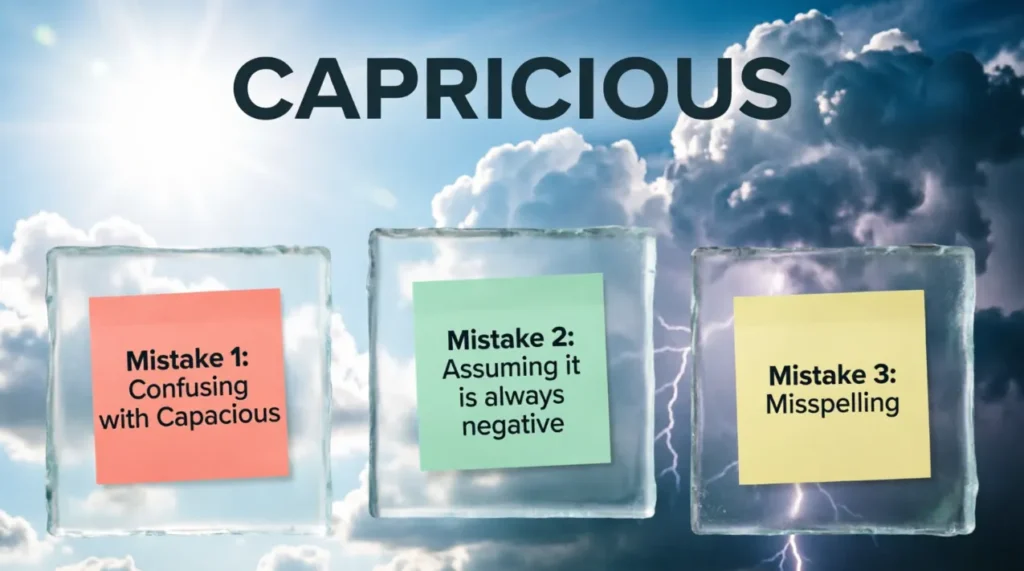
- Confusing it with “spontaneous.” “Spontaneous” often carries a positive or neutral spark of fun and energy, while “capricious” usually implies unreliability or unfairness. Swapping them can send the wrong tone.
- Using it for someone simply flexible or open-minded. “Capricious” implies a lack of pattern or reason, not just a willingness to change course thoughtfully.
- Misspelling it. Common misspellings include “capricous” and “capricious” with an extra or missing letter double-check the “i” before “-ous.”
- Overusing it in formal writing. Because it’s a vivid, slightly literary word, it can feel forced if a piece of writing leans on it repeatedly instead of varying vocabulary.
Similar Words and Phrases
| Word | Meaning | How It Differs |
| Whimsical | Playfully unpredictable or fanciful | Usually carries a lighter, more charming tone than “capricious” |
| Erratic | Irregular and inconsistent | Focuses more on lack of pattern than on impulsiveness or whim |
| Impulsive | Acting suddenly without thinking things through | Describes a single action or tendency rather than an overall unpredictable nature |
| Fickle | Changing opinions or loyalties frequently | Focuses specifically on inconsistency in feelings or preferences, especially loyalty |
| Mercurial | Subject to sudden, unpredictable mood swings | Closely related, but leans more specifically toward emotional volatility |
Opposite Words and Phrases
| Word | Meaning | Why It’s an Opposite |
| Steady | Consistent and unchanging | Directly opposite to the sudden shifts implied by “capricious” |
| Reliable | Consistently trustworthy and predictable | Emphasizes exactly the dependability “capricious” lacks |
| Consistent | Acting or behaving the same way over time | The core opposite of unpredictable change |
| Deliberate | Careful and intentional | Opposite of the impulsive, whim-driven quality of “capricious” |
Pronunciation
“Capricious” is pronounced kuh-PRISH-us, with the stress on the second syllable.
Quick Facts
| Fact | Detail |
| Meaning | Sudden, unpredictable, and impulsive, without clear reason |
| Origin | Italian capriccio, meaning a sudden shudder or impulse |
| Part of speech | Adjective |
| Related words | Caprice (noun), capriciously (adverb) |
| Common legal phrase | “Arbitrary and capricious” |
| Tone | Usually mildly negative or critical |
Frequently Asked Questions
What does “capricious” mean?
It means sudden, unpredictable, and impulsive describing behavior, decisions, or forces that change without clear reason or pattern.
Is “capricious” a compliment or an insult?
It usually carries a mildly negative tone, implying unreliability or unfairness, though the exact feel depends on the surrounding context.
Where does the word “capricious” come from?
It comes from the Italian word capriccio, originally meaning a sudden shudder or impulse, which entered English through French.
What’s the difference between “capricious” and “spontaneous”?
“Spontaneous” usually sounds positive or neutral, like fun energy or a burst of creativity. “Capricious” leans negative, implying unreliable or unfair unpredictability.
What does “arbitrary and capricious” mean in legal contexts?
It’s a legal standard used to challenge decisions or rulings made without a reasonable, consistent basis, common in administrative and regulatory law.
What’s the noun form of “capricious”?
“Caprice” is the related noun, referring to a sudden, unreasoned whim or impulse.
How do you pronounce “capricious”?
“Kuh-PRISH-us,” with stress on the second syllable.
What’s a good synonym for “capricious”?
“Erratic,” “fickle,” “whimsical,” and “mercurial” all work as close synonyms, though each carries a slightly different shade of meaning.
Key Takeaways
- “Capricious” describes sudden, unpredictable behavior or change, usually without a clear or fair reason behind it.
- It comes from the Italian word capriccio, meaning a sudden shudder or whim.
- The word carries a mildly negative tone, implying unreliability or unfairness more than playful spontaneity.
- It applies to people, decisions, and forces of nature alike moods, rulings, weather, even fate.
- “Steady,” “reliable,” and “consistent” all work as solid opposites.
Conclusion
“Capricious” gives writers a precise way to describe a very specific kind of frustration: the sense that something, a person, a decision, a force of nature changes on a whim, with no pattern you can count on. That precision is exactly why the word has stuck around since it crossed over from Italian centuries ago.
Knowing the word also sharpens how you read the world around you. Once you can name capricious behavior clearly, it becomes easier to spot the difference between someone who’s genuinely flexible and thoughtful, and someone whose choices simply follow whatever impulse hits them next.
Next time a decision, a mood, or the weather flips without warning, you’ll have exactly the right word for it and you’ll know precisely what tone you’re setting when you reach for “capricious” instead of a softer, more neutral alternative.

I am Olivia Brooks an American editor and content researcher dedicated to creating clear, accurate content. At writemora.com, I help readers to understand words, phrases, and modern language with confidence.