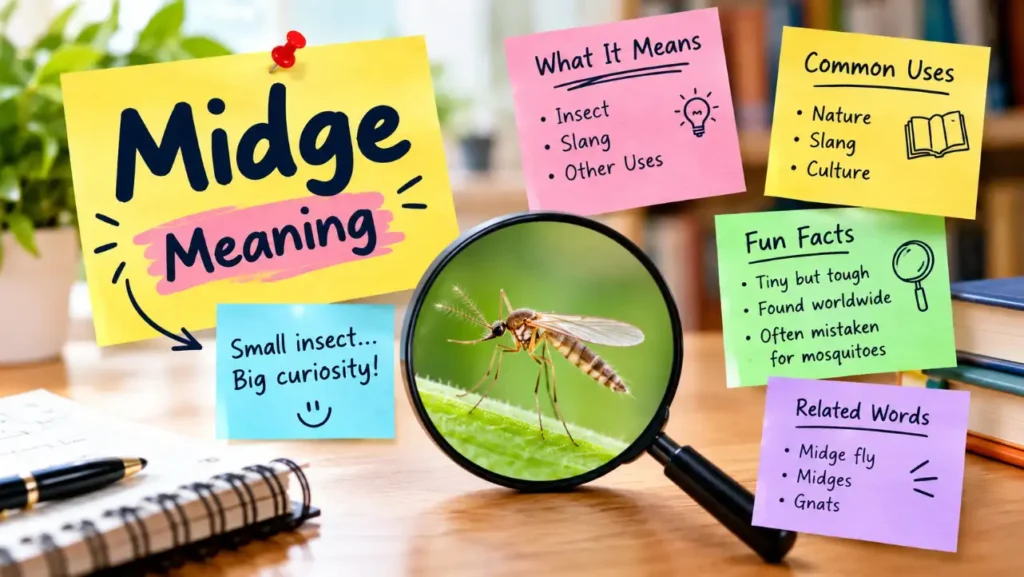
A midge is a tiny flying insect, usually just a few millimeters long, often seen swarming in large clouds near water, damp soil, or grassy areas, especially at dusk. The word covers a wide range of small fly species rather than one single, precisely defined insect.
People frequently lump midges together with gnats and mosquitoes, since all three are small, flying, and often equally annoying. Understanding the midge meaning helps clear up what actually separates these insects, and why some midges bite while others don’t.
This guide covers what midges are, where the word comes from, the different types you’ll encounter, and how to tell them apart from similar-looking bugs.
What It Means
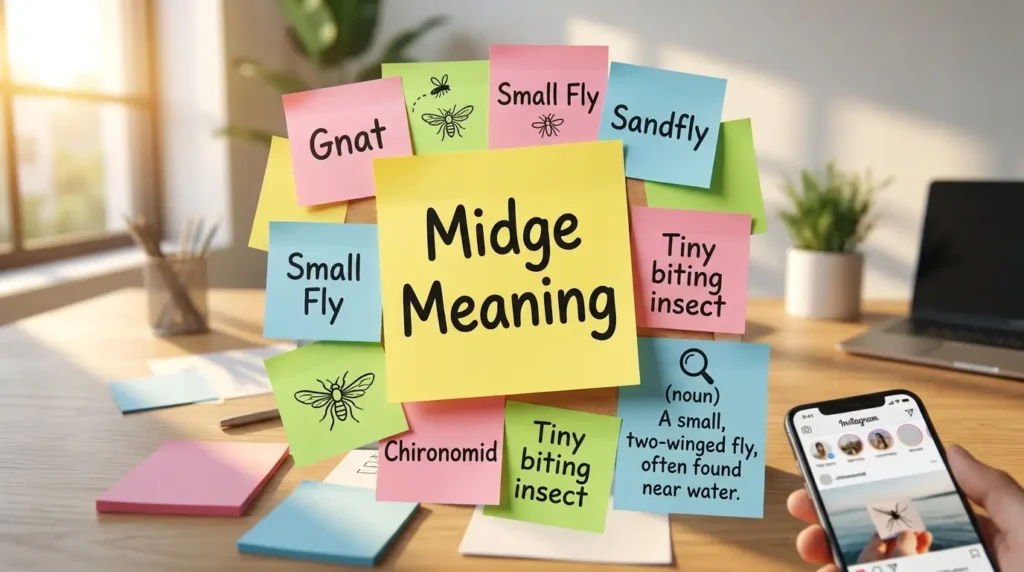
In simple terms, midge refers to any of several types of small flying insects belonging to a group of fly families, most notably Chironomidae (non-biting midges) and Ceratopogonidae (biting midges, also called no-see-ums). The word functions more as a general, common-use category than a precise scientific classification.
In a fuller sense, “midge” covers insects that share a few key traits: small size (typically 1 to 5 millimeters), a tendency to form dense swarms, and a strong association with wet or humid environments like ponds, marshes, and riverbanks. Some midges bite and feed on blood, while others don’t bite at all and exist purely to mate and lay eggs during their brief adult lifespan.
Because “midge” describes such a broad category, the exact species someone means often depends heavily on region, since different countries and areas use the word for slightly different local insects.
Origin & History
Midge comes from the Old English word “mycg,” which itself traces back to a common Germanic root shared with similar words in other Germanic languages, including the German word “Mücke,” which also means a small biting or flying insect. The word has existed in English for well over a thousand years, describing small, swarming flies long before modern entomology formally classified them into distinct species and families.
Historically, people used “midge” as a broad, practical term for any small, annoying flying insect, without needing precise scientific distinctions between species. As entomology developed as a formal science, researchers began separating midges into specific families and species, though the everyday, common use of the word never adopted that same precision.
Today, the word remains largely a common name rather than a strict scientific term, which is why “midge” can refer to dozens of different species depending on context and location.
Different Contexts and Meanings
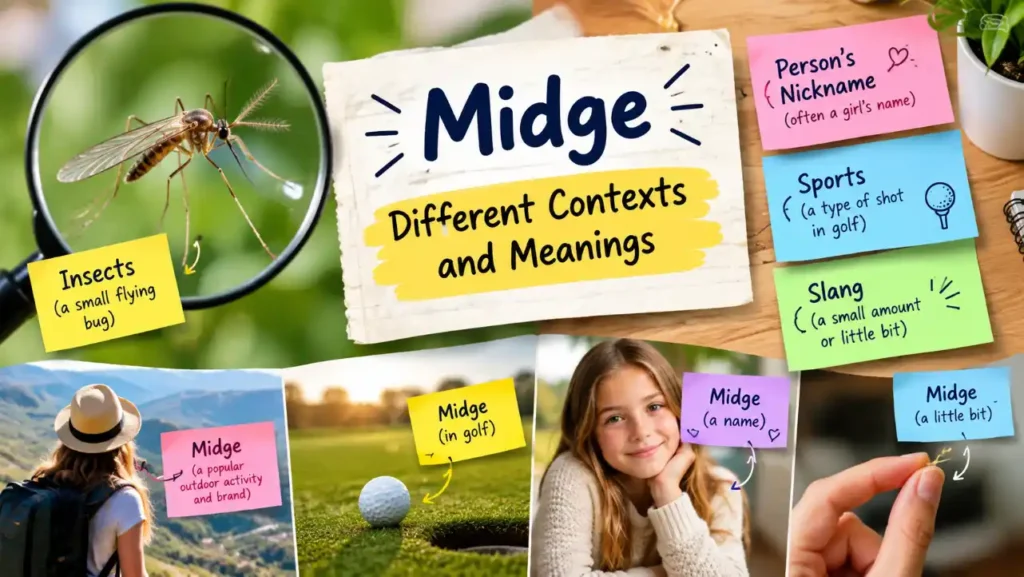
Non-biting midges (Chironomidae). These midges make up one of the largest and most common groups, often seen swarming in massive clouds near lakes and rivers at dusk. Despite their intimidating numbers, they don’t bite people at all.
Biting midges (Ceratopogonidae). Also called “no-see-ums” due to their extremely small size, these midges do bite and feed on blood, and their bites can cause itchy, irritating welts, particularly in coastal and wetland areas.
In Scotland and the UK. The word “midge” carries particular cultural weight in Scotland, where biting midges are notorious for swarming outdoor spaces, especially in the Highlands during summer, and have become a well-known nuisance tied to outdoor life and tourism.
In fishing culture. Anglers use “midge” specifically to describe small aquatic fly patterns designed to imitate the insects fish feed on, an important category in fly-fishing technique and equipment.
As a general catch-all term. In everyday conversation, people often use “midge” loosely for any tiny flying insect they can’t easily identify, regardless of its actual scientific classification.
Examples
- “A swarm of midges hovered over the pond as the sun went down.”
- “The Scottish Highlands are famous for their aggressive biting midges in summer.”
- “He tied a tiny midge pattern to catch trout feeding near the surface.”
- “Non-biting midges look similar to mosquitoes but don’t bite at all.”
- “The campsite was overrun with midges near the lake at dusk.”
- “She applied repellent specifically formulated for no-see-um midge bites.”
- “The wetland area supports large populations of both biting and non-biting midges.“
- “Midge swarms can look alarming, even though most species are completely harmless.”
- “He complained about itchy midge bites after the camping trip.”
- “Fly fishers often study local midge hatches to time their trips.”
How to Use It (Grammar and Context)
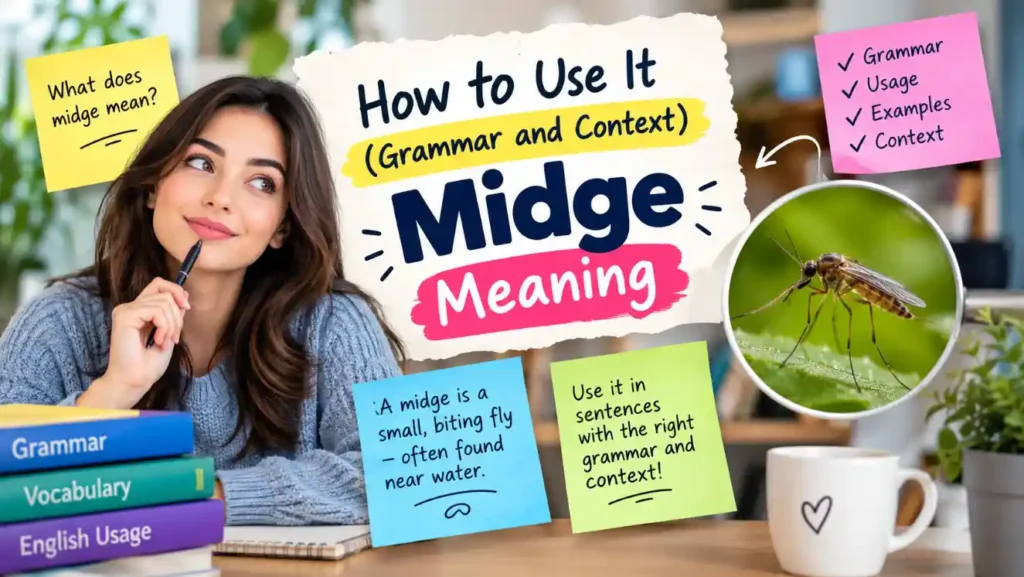
Midge functions as a noun, typically used in either singular (“a midge landed on my arm”) or plural (“swarms of midges“) form. It commonly pairs with descriptive terms like “biting midge,” “non-biting midge,” or “midge swarm” to clarify which type someone means.
Because the word covers such a broad category, writers discussing specific species for scientific or pest-control purposes often specify the exact family or common regional name, rather than relying on “midge” alone.
Common Mistakes
Assuming all midges bite. Many midge species, including some of the most commonly seen swarming types, don’t bite people at all biting behavior applies specifically to certain families, not midges as a whole.
Confusing midges with mosquitoes. While related and similar in appearance, midges and mosquitoes belong to different insect families, and midges generally don’t transmit the same range of diseases mosquitoes are known for.
Confusing midges with gnats. “Gnat” is another broad, common term that overlaps significantly with “midge,” and the two words are sometimes used interchangeably, though they don’t always refer to identical species.
Underestimating regional differences. Because “midge” describes such a wide category, the specific insect someone means can vary significantly depending on where they live, particularly between North America, the UK, and other regions.
Similar Words
| Word | Meaning | Difference from Midge |
| Gnat | A general term for small flying insects, often overlapping with midge | Gnat and midge frequently describe similar or identical insects, though usage varies by region and context |
| Mosquito | A blood-feeding flying insect known for spreading certain diseases | Mosquitoes belong to a distinct family and are generally larger, with a more distinctive biting proboscis than most midges |
| No-see-um | A common nickname for biting midges, due to their extremely small size | No-see-um refers specifically to biting midges, a subset within the broader midge category |
| Fruit fly | A small fly commonly found around ripening or rotting fruit | Fruit flies belong to a different family and don’t swarm near water the way many midges do |
Opposite Words
There’s no true grammatical opposite of “midge,” but related contrasts include:
| Word | Meaning | Why It Contrasts |
| Large insect | Any insect noticeably bigger in size, such as a beetle or dragonfly | Directly contrasts with the midge’s defining trait of extremely small size |
| Solitary insect | An insect that doesn’t form large groups or swarms | Contrasts with the dense swarming behavior commonly associated with midges |
Pronunciation
Midge is pronounced MIJ, rhyming with “ridge.”
Quick Facts
| Fact | Detail |
| Word origin | Old English “mycg,” from a shared Germanic root |
| Typical size | About 1 to 5 millimeters long |
| Main families | Chironomidae (non-biting) and Ceratopogonidae (biting, also called no-see-ums) |
| Common habitats | Ponds, lakes, marshes, riverbanks, and other damp areas |
| Notable regional reputation | Scotland’s Highlands, known for aggressive biting midge swarms |
| Fishing relevance | Small artificial fly patterns designed to imitate midges |
Key Takeaways
- Midge refers broadly to several types of tiny flying insects, some biting and some non-biting.
- The word comes from Old English, with roots shared across Germanic languages.
- Non-biting midges often form large, harmless swarms; biting midges (no-see-ums) can cause itchy bites.
- Midges are commonly confused with gnats and mosquitoes, though they belong to different insect families.
- Scotland’s Highlands carry a particular cultural reputation for aggressive biting midges.
FAQs
What is another name for a midge?
Another name for a midge is a small gnat or biting midge, depending on the species.
What is a midge in slang?
In slang, “midge” can be a nickname for someone small or short, often used informally.
What is a midge?
A midge is a tiny, two-winged insect that resembles a small mosquito. Some species bite, while others do not.
Is a midge a mosquito?
No. Midges and mosquitoes are different insects, although they can look similar and some midges bite.
What’s worse, midges or mosquitoes?
It depends on the situation. Mosquitoes can spread diseases, while biting midges are mainly known for painful, irritating bites.
What smell do midges hate?
Midges tend to avoid strong scents such as citronella, eucalyptus, lavender, and peppermint, although effectiveness varies.
What is a midge nickname for a girl?
“Midge” is commonly a nickname for Margaret, and sometimes for Mildred or other names beginning with “Mid.”
How do Scots cope with midges?
People in Scotland commonly use insect repellent, protective clothing, head nets, and avoid areas with large midge populations during peak times.
What does midge mean in England?
In England, a midge usually means a very small flying insect, especially one belonging to the midge family.
Why are midges so bad in Scotland?
Scotland’s cool, damp climate and numerous wetland areas create ideal breeding conditions for midges, especially during warmer months.
Is a midge a nymph?
No. A midge is an adult insect. Its immature stage is called a larva, not a nymph.
Conclusion
The midge meaning covers far more ground than most people realize, spanning everything from harmless swarming clouds over a lake to the tiny biting insects that make Scottish summer evenings famously uncomfortable. That range exists because “midge” functions as a common, everyday word rather than a precise scientific term, grouping together dozens of related but distinct species under one convenient label.
Knowing the difference matters more than it might seem, especially outdoors. A cloud of non-biting midges near a pond might look intimidating but poses no real threat, while a handful of nearly invisible no-see-ums can leave you covered in itchy bites within minutes. That distinction between “annoying but harmless” and “small but genuinely bothersome” is exactly why the word midge tends to blur together in everyday conversation.
Next time you find yourself swatting at a cloud of tiny insects near water, you’ll have a better sense of which kind of midge you’re actually dealing with, and whether you need to worry about it at all.
Read More Posts
- ASL Meaning Slang What Does ASL Mean in Text & TikTok?
- Indubitably Meaning Definition, Pronunciation, and Usage Guide
- Holistic Meaning Definition, Pronunciation, and Usage Guide

I am Olivia Brooks an American editor and content researcher dedicated to creating clear, accurate content. At writemora.com, I help readers to understand words, phrases, and modern language with confidence.