

Vain carries two distinct meanings: it describes someone excessively proud of their appearance or achievements, and separately, it describes an effort that fails to produce any result. Both meanings show up constantly in everyday English, and context usually makes clear which one applies.
The word also causes frequent spelling confusion, since it sounds identical to two unrelated words: “vein” and “vane.” Understanding the vain meaning means understanding both of its actual definitions and knowing how to keep it separate from its homophones.
This guide covers what vain means in each sense, where the word comes from, common phrases built with it, and the mistakes people make most often.
What It Means
In its first common sense, vain describes a person who has excessive pride in their appearance, abilities, or accomplishments. A vain person spends unusual amounts of time or attention on how they look or how impressive they seem to others, often at the expense of humility.
In its second, distinct sense, vain describes an action, effort, or attempt that fails to achieve its intended result, something someone does without success, despite genuine effort. This sense appears most often in the phrase “in vain,” as in “he tried in vain to fix the engine.”
Though these two meanings look and sound identical, they don’t share an obvious logical connection at first glance; one describes a personality trait, the other describes futility. Both trace back to the same Latin root, which explains the shared word despite the different modern meanings.
Origin & History
Vain comes from the Latin word “vanus,” meaning “empty,” “idle,” or “without substance.” This single root produced both modern meanings of the English word, even though they now feel quite different from each other.
The “excessive pride” meaning grew from the idea of empty or hollow self-regard pride based on appearance or ego rather than genuine substance or merit. The “unsuccessful effort” meaning grew from the same root’s sense of emptiness, applied instead to effort that produces nothing, or “empty” results.
The word entered English through Old French in the 13th and 14th centuries, already carrying both senses, and English speakers have kept the dual meaning ever since, unlike some borrowed words that eventually lose one sense over time.
Different Contexts and Meanings
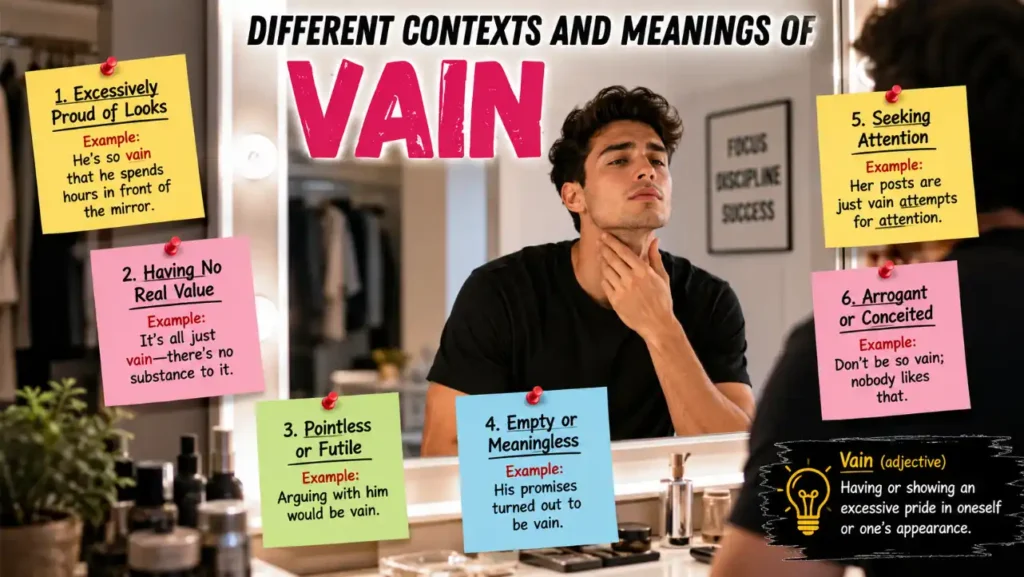
Describing excessive pride. This is the most common standalone use of “vain” as an adjective describing a person: “She’s so vain, she checks the mirror constantly.”
In the phrase “in vain.” This fixed phrase describes an unsuccessful, fruitless effort: “They searched in vain for survivors,” meaning the search produced no result despite real effort.
In the phrase “take someone’s name in vain.” This specific idiom, rooted in the biblical commandment against using God’s name disrespectfully, has broadened in casual use to mean mentioning someone, often critically or lightly, especially when that person unexpectedly shows up: “Were you taking my name in vain?”
In literary and formal writing. Writers sometimes use “vain” in its “futile” sense in more formal or poetic contexts, as in “a vain attempt” or “vain hope,” lending a slightly elevated tone compared to plainer words like “useless” or “pointless.”
As a description of appearance-focused behavior. People commonly use “vain” specifically in relation to looks, describing someone overly focused on their physical appearance, though the word applies to pride about talents or achievements too.
Examples
- “He’s too vain to leave the house without checking his hair three times.”
- “She tried in vain to convince him to change his mind.”
- “The rescue team searched in vain through the night.”
- “Don’t be so vain, nobody’s staring at your outfit.”
- “It was a vain hope that the flight would somehow arrive on time.”
- “He made a vain attempt to fix the leak himself before calling a plumber.”
- “She’s vain about her accomplishments, always finding a way to bring them up.”
- “Their efforts to save the business ended in vain.”
- “Was someone taking my name in vain while I was out of the room?”
- “He’s not vain, exactly, but he does love compliments.”
How to Use It (Grammar and Context)
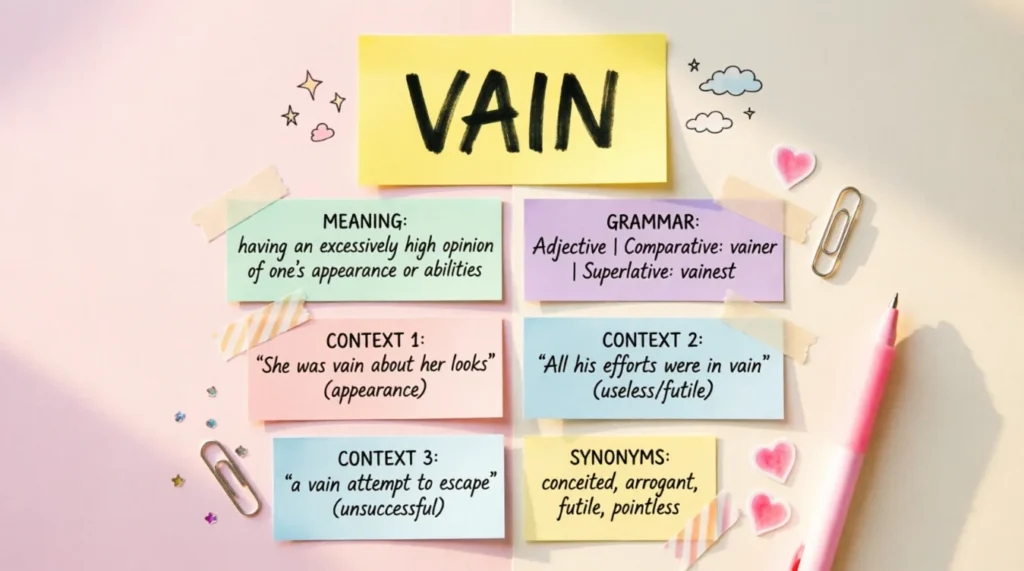
Vain functions as an adjective in both senses. In the “excessive pride” sense, it typically describes a person directly: “a vain person,” “he is vain.” In the “unsuccessful” sense, it usually modifies an action or attempt: “a vain effort,” “a vain hope,” or appears in the fixed phrase “in vain,” which functions adverbially to describe how an action turned out.
The related noun form, “vanity,” specifically connects to the “excessive pride” meaning, describing the quality or trait itself, rather than the “futile effort” sense of vain.
Common Mistakes
Confusing vain with vein. “Vein” refers to a blood vessel or a similar streak or channel (as in a vein of ore), an entirely unrelated word that happens to sound identical to “vain.”
Confusing vain with vane. “Vane,” as in “weathervane,” refers to a flat blade or surface that catches wind or airflow, another unrelated homophone that often gets mixed up in writing.
Missing the “futile” meaning entirely. Many people only recognize the “excessive pride” sense of vain and mistakenly assume “in vain” relates to pride or ego, when it actually describes an unsuccessful effort.
Overusing “vain” for mild self-care. Ordinary grooming or self-care doesn’t necessarily make someone vain; the word implies excessive, ego-driven focus on appearance or achievement, not just basic upkeep.
Similar Words
| Word | Meaning | Difference from Vain |
| Conceited | Excessively proud of oneself, often dismissive of others | Very close to vain’s “pride” meaning, though conceited often implies looking down on others specifically |
| Futile | Producing no useful result despite effort | Nearly identical to vain’s “unsuccessful” meaning, though futile applies more broadly outside the fixed phrase “in vain” |
| Narcissistic | Excessively self-focused or self-admiring, often in a clinical or exaggerated sense | Narcissistic implies a deeper, more persistent self-obsession than the everyday sense of vain |
| Fruitless | Producing no positive result or outcome | Closely matches vain’s “futile” meaning, often used interchangeably in that context |
Opposite Words
| Word | Meaning | Why It’s an Opposite |
| Humble | Modest, not excessively proud | Directly opposes the “excessive pride” meaning of vain |
| Modest | Not boastful or overly focused on one’s own appearance or achievements | Contrasts with vain’s self-focused, appearance-driven connotation |
| Successful | Achieving the intended result or outcome | Opposes vain’s “futile effort” meaning, where the effort produces no result |
Pronunciation
People pronounce vain as VAYN, rhyming exactly with “vein” and “vane,” which is part of why the three words so often get confused in writing.
Quick Facts
| Fact | Detail |
| Word origin | Latin “vanus” (empty, idle, without substance) |
| Two core meanings | Excessively proud, or unsuccessful/futile |
| Common phrase | “In vain” (describing a failed effort) |
| Related idiom | “Take someone’s name in vain” |
| Related noun | Vanity (connects to the “pride” meaning) |
| Common homophones | Vein, vane |
FAQs
What does vain mean simply?
Vain has two meanings: it describes someone excessively proud of their appearance or achievements, and separately, it describes an effort that fails to produce a result.
What does “in vain” mean?
“In vain” describes an effort or attempt that fails despite real effort, as in “they searched in vain,” meaning the search produced no result.
What’s the difference between vain, vein, and vane?
Vain relates to pride or futility, vein refers to a blood vessel or similar streak, and vane refers to a blade that catches wind, as in “weathervane” all three sound identical but mean completely different things.
Where does the word vain come from?
It comes from the Latin word “vanus,” meaning “empty” or “without substance,” which produced both of the word’s modern meanings.
What does “take someone’s name in vain” mean?
Originally a biblical phrase warning against using God’s name disrespectfully, people now use it more loosely and often jokingly to mean mentioning someone, especially if they show up right after being talked about.
Is calling someone vain an insult?
Generally yes it implies excessive, ego-driven pride, particularly about appearance, and typically carries a negative connotation rather than a neutral or complimentary one.
Can “vain” describe something other than a person’s personality?
Yes. In its second sense, it describes efforts, attempts, or hopes that fail to achieve their goal, unrelated to personal pride.
What’s the noun form of vain?
“Vanity” is the noun form connected to the “excessive pride” meaning of vain.
Key Takeaways
- Vain has two distinct meanings: excessively proud, or unsuccessful/futile.
- Both meanings trace back to the same Latin root, “vanus,” meaning “empty.”
- “In vain” specifically describes a failed effort, unrelated to pride or ego.
- Vain sounds identical to “vein” and “vane,” two entirely unrelated words.
- The related noun “vanity” connects specifically to the “excessive pride” sense of vain.
Conclusion
The vain meaning actually covers two separate ideas hiding inside one word: a person too focused on their own image, and an effort that never pays off. Both senses trace back to the same Latin idea of emptiness, which makes more sense once you see the connection of empty pride on one side, empty results on the other.
Because English keeps both meanings instead of letting one fade out, context has to do all the work of telling them apart, and the identical-sounding “vein” and “vane” only add to the confusion when the word appears in writing. Paying attention to the sentence around it usually clears things up fast: a person can be vain, but only an effort, attempt, or hope can happen “in vain.”
Once you sort out those two meanings and their spelling twins in your head, “vain” stops being a word you second-guess and becomes one you can use precisely, if you’re describing someone’s ego or someone’s failed attempt at something.

I am Olivia Brooks an American editor and content researcher dedicated to creating clear, accurate content. At writemora.com, I help readers to understand words, phrases, and modern language with confidence.