
Cuck is internet slang shortened from “cuckold,” a much older word for a man whose partner is unfaithful. Online, people have stretched the word far beyond its original meaning, turning it into an insult aimed at men perceived as weak, submissive, or insufficiently assertive.
The term shows up most often in political arguments, gaming communities, and social media disputes, almost always as a put-down. Understanding the cuck meaning means understanding both its older, narrower definition and the newer, broader insult it became online.
This guide covers where the word comes from, how its meaning shifted, the different contexts it appears in today, and why many people consider it offensive or inappropriate in most settings.
What It Means
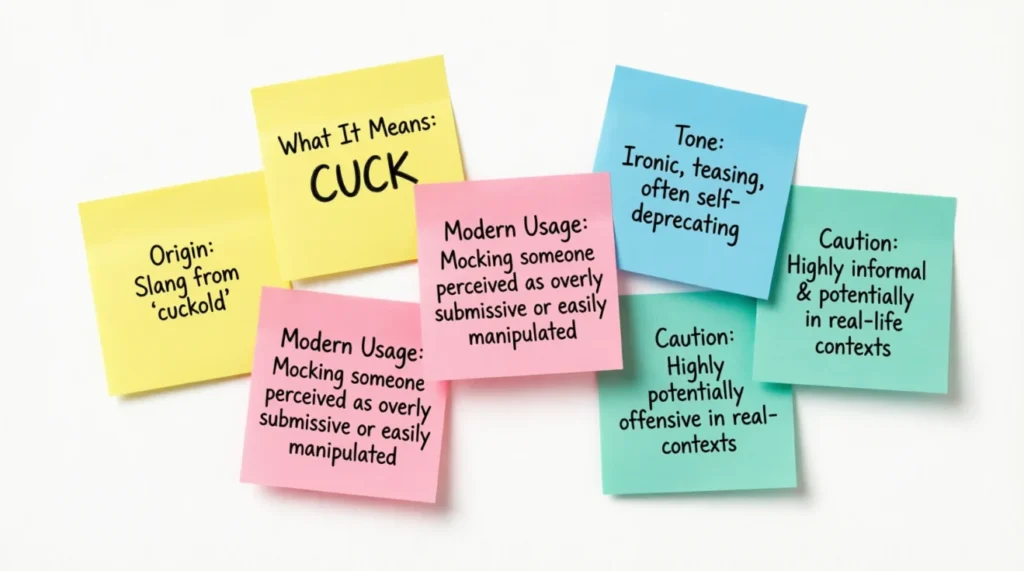
In its original, older sense, cuckold names a man whose wife or partner has cheated on him, a word that has existed in English for centuries. “Cuck” functions as a shortened, informal version of that word.
In its newer, internet-slang sense, people use “cuck” as an insult that has little to do with actual infidelity. Instead, it mocks a man for seeming weak, overly compliant, easily controlled, or lacking assertiveness accusing him of being “cucked” by circumstances, other people, or even entire political positions, without any literal connection to a relationship or infidelity.
This second meaning strips away the original, specific definition and turns the word into a general-purpose insult about masculinity and perceived weakness, most often thrown at men by other men in online arguments.
Origin & History
“Cuckold” comes from Old French and Middle English, tracing back centuries, likely connected to the cuckoo bird, which lays its eggs in other birds’ nests, a reference to a man unknowingly raising or supporting another man’s offspring. The word carried a specific, narrow meaning in English literature and everyday speech for hundreds of years, describing a betrayed husband.
The shortened slang term “cuck” gained new life on internet forums in the 2000s and 2010s, initially tied to a specific pornography genre before spreading into broader insult culture. Around 2015 and 2016, the word picked up heavy political usage, particularly through the term “cuckservative,” an insult some on the political right aimed at conservative figures they viewed as too accommodating or insufficiently combative.
From there, “cuck” spread widely across social media, gaming communities, and online arguments generally, shedding most of its literal connection to infidelity and becoming a catch-all insult for perceived weakness, submissiveness, or being “controlled” by someone or something else.
Different Contexts and Meanings
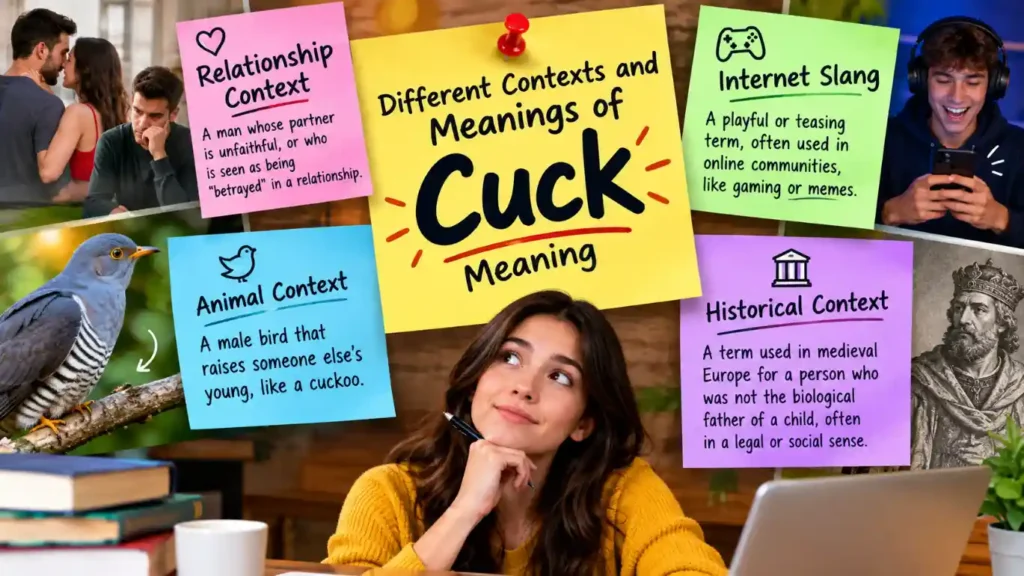
In its original, literal sense. “Cuckold” still appears in its traditional meaning, referring to a man whose partner has cheated on him, particularly in literature, historical contexts, and formal writing.
As a political insult. The word appears frequently in political arguments, especially online, where people use it to attack men they see as too moderate, submissive, or willing to compromise on their stated positions.
As a general insult about masculinity. Beyond politics, people use “cuck” broadly to mock men for seeming weak, passive, or easily pushed around, often in gaming communities, social media arguments, and meme culture.
As part of a specific pornography genre. The word’s contemporary internet usage partly traces back to a fetish subgenre involving infidelity themes, which helped the slang term spread before it took on its broader insult meaning.
As a term widely considered offensive. Because of its aggressive, gendered, and often politically charged use, many people consider “cuck” inappropriate or offensive in most contexts, including professional, educational, and general social settings.
Examples
- “He’s constantly calling political opponents ‘cucks’ online, regardless of context.”
- “The term cuckold originally described a man whose wife had cheated on him.”
- “That insult doesn’t really apply here, people are just using it as a generic put-down.”
- “The word gained traction as ‘cuckservative’ during political debates around 2015 and 2016.”
- “Several platforms have flagged the term as harassment when someone uses it repeatedly against another person.”
- “He didn’t realize the word had such an old literary history before it became internet slang.”
- “The insult shows up constantly in online gaming chat, often with no clear meaning behind it.”
- “Historians point out that cuckoldry has appeared in English literature for centuries.”
- “Moderators removed the comment for using the slur as harassment.”
- “The term’s modern usage barely resembles its original, narrower definition.”
How to Use It (Grammar and Context)
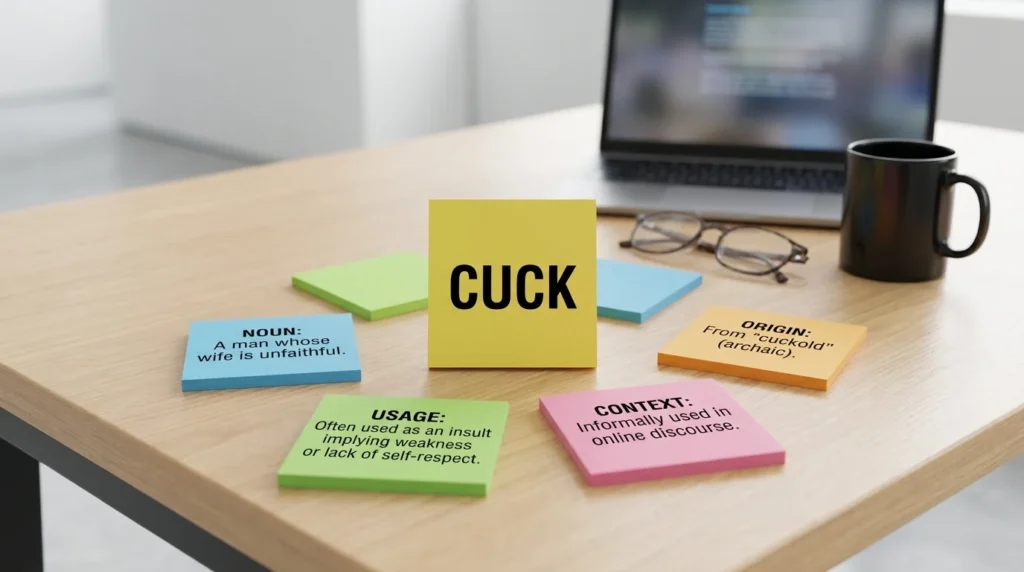
“Cuckold” functions as a noun with a long, specific history in English. “Cuck” functions as a shortened noun and sometimes a verb (“to cuck someone”) in modern slang, almost always as an insult rather than a neutral description.
Given how frequently people use the word as harassment or a slur, most style guides, platforms, and professional contexts treat it as inappropriate outside of specific historical, literary, or academic discussions of its origin.
Common Mistakes
Assuming the word is neutral or harmless. Many people underestimate how aggressive or offensive “cuck” reads to others, especially given its frequent use in harassment and political attacks.
Missing the word’s older, unrelated literary history. Some assume “cuckold” is purely modern internet slang, when it actually carries centuries of use in English literature, predating any internet context.
Using it casually without recognizing its charged context. Because of its association with harassment campaigns and political insults, using the word casually can carry more weight or offense than the speaker intends.
Conflating the insult with its literal, original meaning. The modern slang insult rarely relates to actual infidelity; interpreting it literally in most current contexts misses how people actually use the term now.
Similar Words
| Word | Meaning | Difference from Cuck |
| Cuckold | The original, literal term for a man whose partner has cheated on him | Cuckold carries centuries of literary and historical use; “cuck” is a modern slang shortening people use mostly as a broad insult |
| Simp | Internet slang mocking a man for seeming overly attentive or submissive toward someone he’s attracted to | Simp focuses specifically on romantic or attention-seeking behavior; Chuck focuses more on perceived weakness or political compliance |
| Pushover | Someone easily persuaded or taken advantage of | Pushover is a milder, non-gendered, non-slur term with the same general implication of weakness |
| Sellout | Someone who compromises their values, often for personal gain | Sellout focuses on betraying principles; cuck (in its political sense) focuses more on perceived weakness or submission |
Opposite Words
| Word | Meaning | Why It’s an Opposite |
| Assertive | Confident and direct in expressing oneself or one’s positions | Represents the opposite of the “weakness” the insult tries to imply |
| Uncompromising | Firm and unwilling to back down from a position | Contrasts with the “cuckservative” political usage, which mocks perceived compromise |
| Independent | Acting according to one’s own judgment, free from outside control | Opposes the “controlled by others” implication behind the modern slang usage |
Pronunciation
People pronounce cuck as kuk, rhyming with “luck,” and cuckold as KUK-old.
Quick Facts
| Fact | Detail |
| Original word | “Cuckold” centuries-old English term for a man whose partner is unfaithful |
| Likely etymological root | Connected to the cuckoo bird, which lays eggs in other birds’ nests |
| Modern slang shortening | “Cuck,” gained internet traction in the 2000s–2010s |
| Major political usage spike | Around 2015–2016, via the term “cuckservative” |
| Common modern use | A broad insult about perceived weakness, often in political or online arguments |
| General reception | Widely considered offensive or inappropriate in most professional and social contexts |
FAQs
What does cuck mean?
Cuck is slang shortened from “cuckold,” an old English word for a man whose partner is unfaithful; online, people now use it more broadly as an insult about perceived weakness or submissiveness.
Where does the word cuckold come from?
It’s a centuries-old English word, likely connected to the cuckoo bird, which lays its eggs in other birds’ nests.
Why do people use cuck in political arguments?
The term picked up heavy political usage around 2015–2016 through “cuckservative,” an insult aimed at political figures viewed as too accommodating or insufficiently combative.
Do people consider cuck an offensive word?
Yes, many people consider it offensive or inappropriate, especially given its frequent use in online harassment and aggressive political rhetoric.
Does cuck still relate to infidelity in its modern usage?
Rarely. Most current uses of the slang term have little or nothing to do with actual infidelity, functioning instead as a general insult.
What’s the difference between cuck and cuckold?
Cuckold is the older, literal term with centuries of literary history; cuck is the modern slang shortening, mostly used as a broad insult unrelated to its original meaning.
Is cuck a gendered term?
Yes, it specifically targets men and ties closely to ideas about masculinity, weakness, and perceived control by others.
Should I use this word casually?
Given its association with harassment and political attacks, most people avoid using it casually, especially in professional, educational, or general social settings.
Key Takeaways
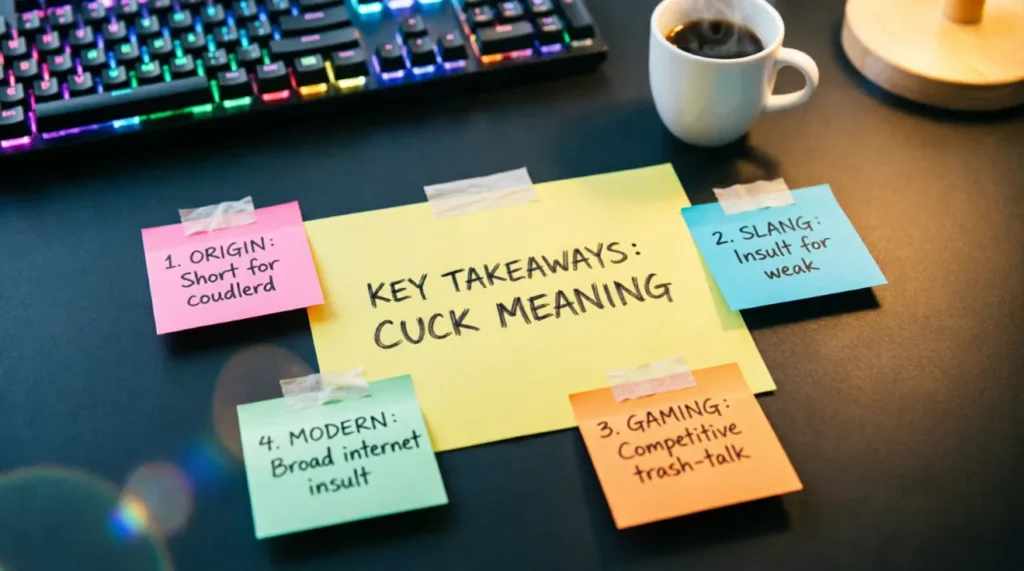
- Cuck is slang shortened from “cuckold,” a centuries-old English word for a man whose partner is unfaithful.
- Its modern internet usage has little connection to actual infidelity, functioning instead as a broad insult about perceived weakness.
- The term picked up major political traction around 2015–2016 through “cuckservative.”
- Many people consider the word offensive or inappropriate, particularly given its frequent use in online harassment.
- The word’s older, literary meaning predates its internet slang usage by centuries.
Conclusion
The cuck meaning splits cleanly into two very different eras: a centuries-old literary term for a betrayed husband, and a modern internet insult that barely resembles its original definition anymore. Tracing that shift shows how quickly slang can strip a word down to its emotional charge while discarding almost all of its original, specific meaning.
That shift also explains why the word carries so much tension today. What started as a narrow, if unflattering, description of a specific situation became a blunt political and social weapon, one people throw in arguments where the target’s actual relationship status has nothing to do with the insult itself. Understanding that history doesn’t make the term any less charged, but it does explain why the word lands so differently depending on who’s using it and why.
If you come across the term online, recognizing both halves of its history, the old and the new helps explain not just what someone means by it, but why so many people consider it worth avoiding altogether.

I am Olivia Brooks an American editor and content researcher dedicated to creating clear, accurate content. At writemora.com, I help readers to understand words, phrases, and modern language with confidence.