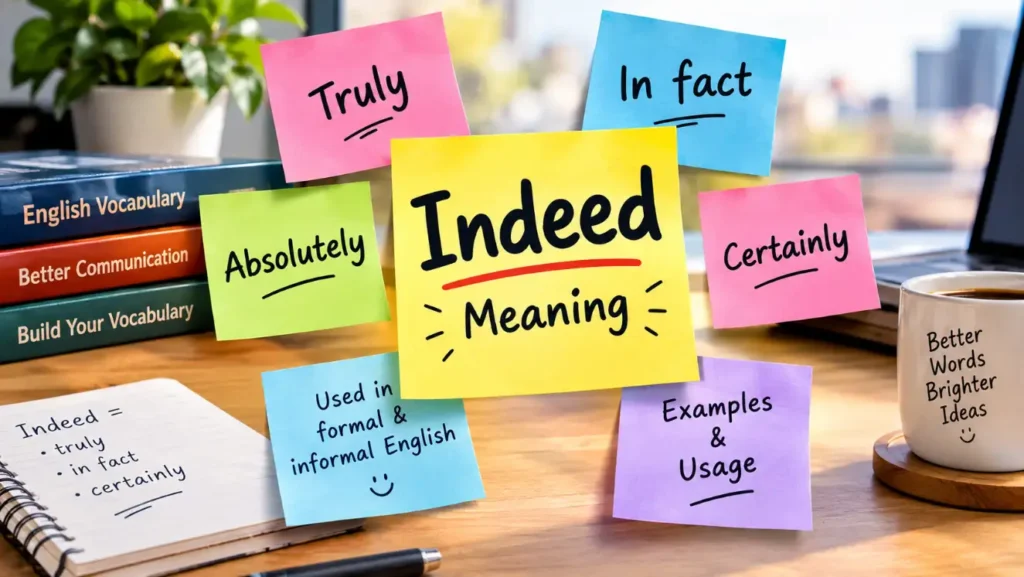
Indeed means “in truth,” “certainly,” or “without a doubt.” It’s a word that adds emphasis or confirms something that’s already been said. You’ll see it in everyday conversation, formal writing, job listings, and even as a company name. But its meaning shifts slightly depending on how it’s used, and that’s where people get confused.
This article breaks down the indeed meaning in all its common forms. You’ll learn where the word came from, how to use it correctly in sentences, the difference between “indeed” and similar words like “in fact,” and the mistakes to avoid. By the end, you’ll know exactly when “indeed” fits and when it doesn’t.
What Does “Indeed” Mean?
At its core, indeed is an adverb that does one of two jobs:
- Emphasizes the truth of a statement “That is indeed correct.”
- Confirms or agrees with something that just said “It was a hard test.” “Indeed, it was.”
Think of it as a verbal highlighter. It doesn’t change the meaning of a sentence so much as it underlines it.
Simple Definition
- Indeed (adverb): In truth; certainly; really; without question.
Detailed Definition
The word works on a spectrum of certainty. When you say “indeed,” you’re not just saying something is true, you’re saying it’s definitely true, often in response to doubt or as a stronger confirmation.
It can also express surprise or irony, depending on tone. “That was a great idea, indeed” can be sincere or sarcastic, and only context tells you which.
Origin and History of “Indeed”

“Indeed” comes from the Middle English phrase “in dede,” which literally meant “in deed” as in, in action or in fact. The idea was that something wasn’t just spoken or promised; it was done. Over time, the two words merged into one, and the spelling settled into “indeed” by the 14th century.
The shift from “in deed” to “indeed” mirrors how English often compresses common phrases. What started as a literal reference to actions became a general marker of truth and emphasis. Sources vary on the exact first recorded use, but the word has been part of English for roughly 700 years.
The Different Meanings of “Indeed”
“Indeed” isn’t a one-trick word. Its meaning depends on where it sits in a sentence and what it’s responding to.
1. As a Confirmation or Agreement
This is the most common use. You’re agreeing with or confirming what someone else said.
- “It’s cold outside.” “Indeed, it is.”
- “She’s the best candidate.” “Indeed.”
2. As an Emphasis Marker
Here, “indeed” stresses that something is true, often more true than expected.
- “This is indeed the best cake I’ve ever had.”
- “He is indeed the man we’ve been looking for.”
3. As a Response to a Question
Used alone, “Indeed?” can mean “Really?” or “Is that so?” It signals interest or mild surprise.
- “I’m moving to Japan.” “Indeed?”
4. In Formal or Literary Writing
“Indeed” appears often in essays, speeches, and older literature to add weight.
- “Indeed, the evidence supports no other conclusion.”
5. As a Company Name
Indeed is also a well-known job search website. In that context, it’s a proper noun, not a dictionary word. People searching “indeed meaning” sometimes mean the site, so it’s worth noting: the company name uses the word in its sense of “certainly” as in, the right job is certainly out there.
Examples of “Indeed” in Sentences
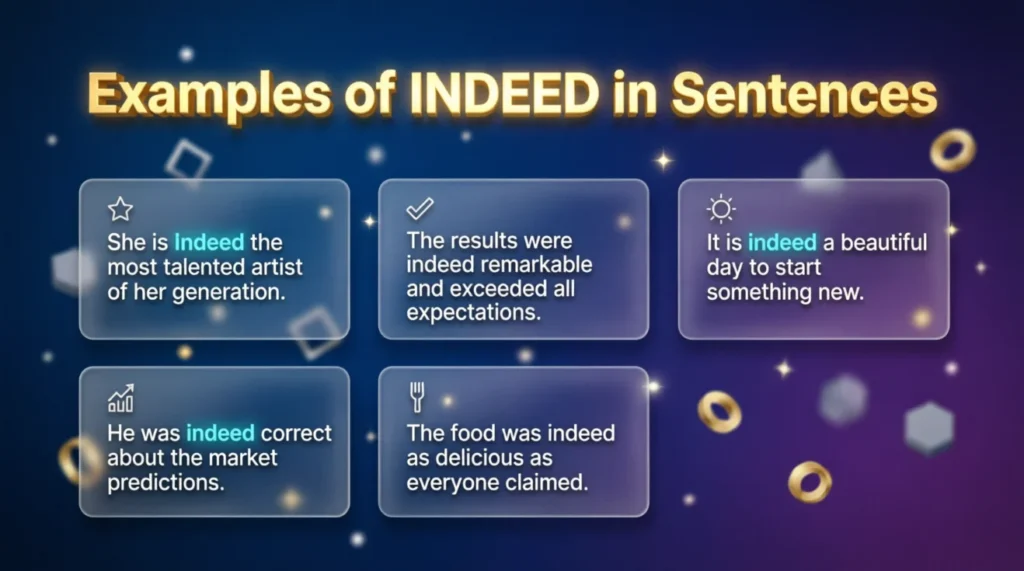
Here are 12 examples showing the word in action across different contexts.
- “The movie was long, but indeed worth watching.”
- “Are you sure?” “Indeed, I am.”
- “It was a difficult year. Indeed, the hardest I’ve had.”
- “She is indeed the author of the report.”
- “Indeed, the results surprised everyone.”
- “That is indeed a problem we need to solve.”
- “He’s a genius.” “Indeed, he is.”
- “The weather was bad. Indeed, it rained all week.”
- “I was indeed the one who called.”
- “Indeed, the rule applies to everyone.”
- “You’re right.” “Indeed, I am.”
- “This is indeed the last time I’ll ask.”
Notice that in each case, “indeed” could be removed and the sentence would still make sense. It adds emphasis or confirmation, not new information.
How to Use “Indeed” Correctly
Placement Matters
“Indeed” usually goes:
- Before the verb: “He indeed finished the race.”
- After the verb “to be”: “She is indeed ready.”
- At the start of a sentence, followed by a comma: “Indeed, that’s true.”
- As a standalone response: “Indeed.”
Punctuation
When “indeed” starts a sentence, use a comma after it. When it’s in the middle, commas often set it off for emphasis, but they aren’t always required. “She is indeed ready” needs no commas. “She is, indeed, ready” adds a pause for effect.
Tone
“Indeed” is slightly formal. In casual conversation, people often replace it with “yeah,” “for sure,” or “definitely.” Using “indeed” in casual talk can sound posh or playful, depending on your delivery.
Common Mistakes with “Indeed”
1. Using It as a Filler
“Indeed” isn’t a transition word like “however” or “therefore.” If you’re using it to connect ideas, you probably want a different word.
2. Overusing It
Because “indeed” adds emphasis, using it too often dilutes its effect. One or two per page is plenty in most writing.
3. Confusing It with “In Fact”
These two are close, but not identical. “In fact” often introduces new or contrasting information. “Indeed” usually confirms what’s already there.
- In fact: “He’s not just a good cook; in fact, he trained in Paris.”
- Indeed: “He’s a good cook.” “Indeed, he is.”
4. Forgetting the Comma
When “indeed” opens a sentence, skip the comma and the sentence reads wrong. “Indeed that’s true” looks rushed. “Indeed, that’s true” is correct.
Indeed vs. Similar Words
| Word | Meaning | Key Difference |
| Indeed | Certainly; in truth | Confirms or emphasizes an existing statement |
| In fact | Actually; really | Often adds new or contrasting information |
| Certainly | Without doubt | Stronger, more formal agreement |
| Absolutely | Completely; yes | More emphatic, more casual |
| Truly | Sincerely; genuinely | Focuses on sincerity, not confirmation |
| Really | In reality; very | Can be a question or a mild emphasis |
Opposite Words for “Indeed”
| Word | Meaning | Why It’s Opposite |
| Doubtfully | With uncertainty | Opposite of certainty |
| Questionably | Open to doubt | Opposite of confirmed truth |
| Allegedly | Supposedly | Opposite of verified fact |
| Supposedly | As claimed | Opposite of confirmed |
| Perhaps | Maybe | Opposite of definite |
How to Pronounce “Indeed”
- IPA: /ɪnˈdiːd/
- Syllables: in-DEED
- Stress: Second syllable
It rhymes with “succeed” and “proceed.” The first syllable is short and quick; the second is longer and stressed.
Quick Facts About “Indeed”
| Fact | Detail |
| Part of speech | Adverb |
| Origin | Middle English “in dede” (in deed) |
| First recorded use | 14th century (approximate) |
| Common synonyms | Certainly, truly, in fact, really |
| Common antonyms | Doubtfully, perhaps, allegedly |
| Formal or informal? | Slightly formal |
| Can it start a sentence? | Yes, followed by a comma |
| Can it stand alone? | Yes, as a one-word response |
FAQs
What does “indeed” mean in a sentence?
It means “in truth” or “certainly.” It confirms or emphasizes what’s being said. For example, “She is indeed the winner” means she is certainly the winner.
Is “indeed” a formal word?
It’s slightly formal. You’ll see it more in writing, speeches, and polite conversation than in casual texting. In everyday talk, people often use “yeah” or “definitely” instead.
Can “indeed” be used at the end of a sentence?
Yes, though it’s less common. “That was a great show, indeed” works, but it sounds a bit old-fashioned or dramatic. Most people put it at the start or middle.
What’s the difference between “indeed” and “in fact”?
“Indeed” confirms what’s already been said. “In fact” often adds new information or corrects a misconception. “He’s smart. In fact, he’s a genius” introduces new info. “He’s smart.” “Indeed, he is” just confirms.
Is “indeed” a yes or no?
It’s closer to “yes” when used as a response, but it’s not a direct yes. It means “that’s true” or “certainly.” “Are you coming?” “Indeed” means yes, but with emphasis.
What does “indeed” mean?
On the job site, “Indeed” is just the company name. It uses the word in its sense of “certainly” implying the right job is certainly findable. It’s not a separate meaning.
Can “indeed” be sarcastic?
Yes. Tone changes everything. “That was a brilliant idea, indeed” can be sincere or sarcastic, depending on how it’s said. In writing, context has to carry the irony.
Is “indeed” one word or two?
It’s one word now. It came from the two-word phrase “in dede” in Middle English, but it merged into a single word centuries ago.
What type of word is “indeed”?
It’s an adverb. It modifies verbs, adjectives, or other adverbs to add emphasis or confirmation.
Does “indeed” need a comma?
Only when it starts a sentence or when you want a pause for effect. “Indeed, you’re right” needs a comma. “You’re indeed right” does not.
Key Takeaways
- Indeed means “in truth,” “certainly,” or “without a doubt.”
- It works as a confirmation, an emphasis marker, or a standalone response.
- It comes from the Middle English “in dede,” meaning “in deed.”
- It’s slightly formal and best used sparingly for impact.
- “Indeed” confirms; “in fact” often adds new information.
- It’s also the name of a popular job search website, which is a separate proper-noun use.
Conclusion
The indeed meaning is simpler than it looks. It’s a word that confirms, emphasizes, and occasionally surprises. Use it when you want to underline the truth of something, agree strongly, or add a touch of formality. Avoid overusing it, and don’t confuse it with “in fact.”
If you’re writing and want to check if “indeed” fits, ask yourself: am I confirming something, or adding something new? If it’s confirmation, “indeed” works. If it’s new information, reach for “in fact” instead. One quick swap can make your writing sharper.

I am Olivia Brooks an American editor and content researcher dedicated to creating clear, accurate content. At writemora.com, I help readers to understand words, phrases, and modern language with confidence.