
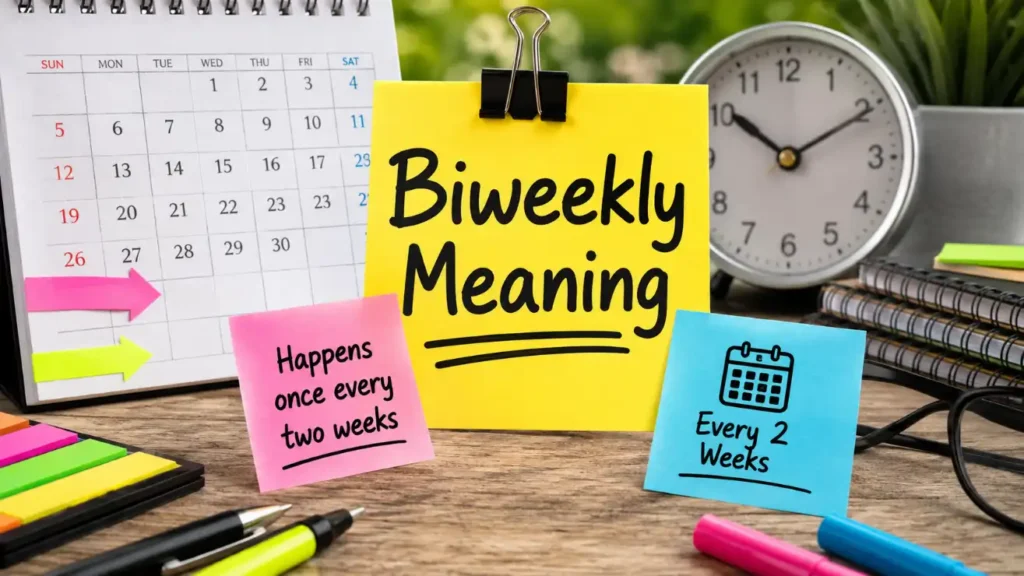
Biweekly carries two conflicting definitions: it can mean “every two weeks” or “twice a week.” Both meanings appear in dictionaries, and context alone usually determines which one a speaker or writer intends.
This double meaning trips up a lot of people, especially in scheduling, payroll, and publishing, where getting the timing wrong actually matters. Understanding the biweekly meaning means understanding why the confusion exists in the first place, not just picking one definition and hoping for the best.
This guide covers both meanings of biweekly, why the word ended up this way, how to figure out which meaning applies in a given sentence, and clearer alternatives you can use instead.
What It Means
In its first common sense, biweekly means “occurring every two weeks,” or once every fortnight. A biweekly meeting under this definition happens six times over twelve weeks roughly every other week.
In its second common sense, biweekly means “occurring twice a week,” happening two times within a single seven-day period. A biweekly newsletter under this definition arrives twice every week, not once every two weeks.
Because dictionaries list both definitions as valid, biweekly counts as a genuinely ambiguous word sometimes called a “Janus word” or “contronym,” a term for words that carry two opposite or contradictory meanings. Readers have to rely entirely on context, or on the writer clarifying directly, to know which meaning applies.
Origin & History
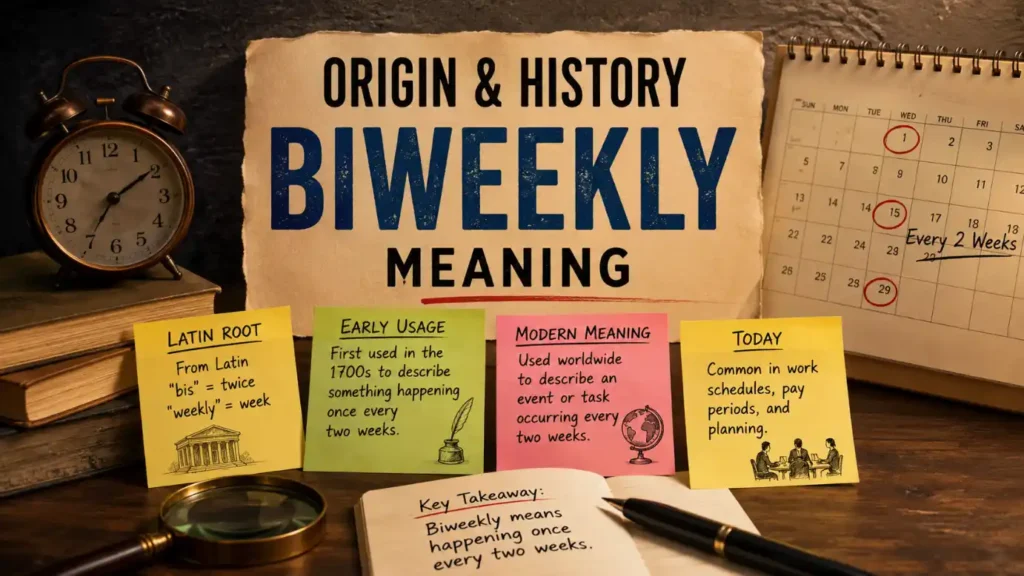
The prefix “bi-” comes from Latin and generally means “two.” Applied to time-related words, it should logically produce “every two [units],” which explains the “every two weeks” reading of biweekly. Words like “biennial” (every two years) follow this same pattern consistently.
However, English speakers have long also used “bi-” loosely to mean “twice within” a period, likely by analogy with words like “bimonthly,” which carries the same ambiguity, and possibly influenced by how people use “biannual” to mean “twice a year” in everyday speech, even though “biennial” specifically means “every two years.“
Over decades of inconsistent usage, both meanings gained enough traction that dictionary editors eventually recorded both as legitimate definitions, rather than picking one as correct and treating the other as an error. This kind of dual meaning affects a handful of English words, and biweekly stands out as one of the most commonly encountered examples.
Different Contexts and Meanings
In payroll and HR. Biweekly almost always means “every two weeks” in this context, referring to a pay schedule that produces 26 paychecks per year rather than the 24 you’d get with a strictly twice-monthly schedule.
In scheduling and meetings. Context usually clarifies the meaning here, but “biweekly” leans toward “every two weeks” in most professional settings, since that’s the more common recurring meeting cadence.
In publishing. Biweekly magazines or newsletters can mean either “every two weeks” or “twice a week,” depending on the specific publication, making this one of the contexts where the ambiguity causes the most real confusion.
In casual conversation. People often use biweekly loosely without much precision, assuming the listener will infer the intended meaning from context, which doesn’t always work reliably.
As a source of workplace confusion. Because payroll, scheduling software, and calendar invites all rely on the word, miscommunication over which meaning applies can cause real scheduling mix-ups, which is why some companies avoid the word entirely in official documents.
Examples
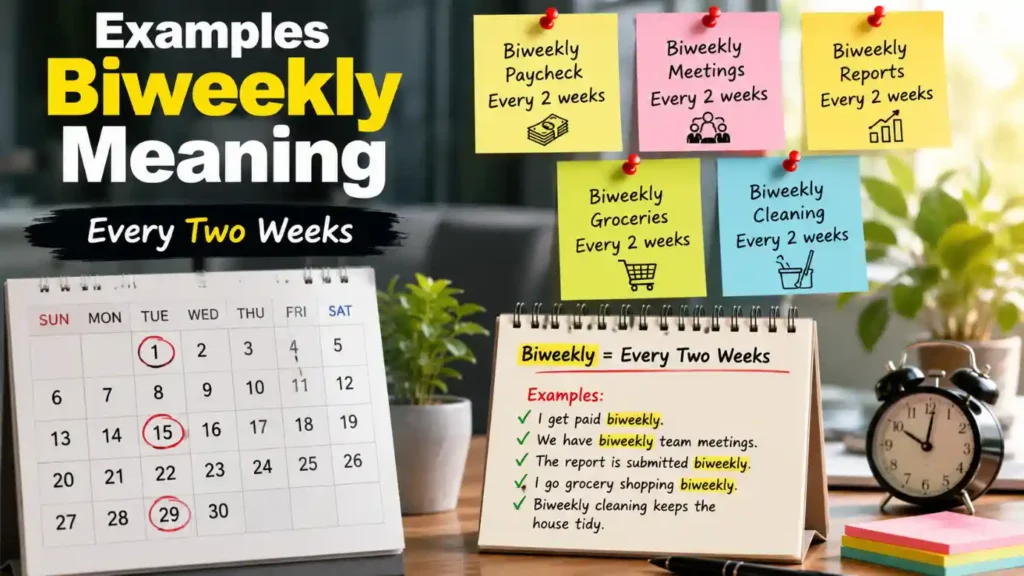
- “We get paid biweekly, so paychecks land every other Friday.”
- “The magazine used to publish biweekly, twice every week, before switching to a monthly schedule.”
- “Our team holds a biweekly check-in, roughly every other Tuesday.”
- “The newsletter goes out biweekly every Monday and Thursday.”
- “HR clarified that biweekly pay means every two weeks, not twice a week.”
- “The book club meets biweekly, so we only gather every other week.”
- “I misread the invite and thought biweekly meant twice a week.”
- “The company switched from biweekly to semi-monthly pay to avoid confusion.”
- “That publication’s biweekly schedule confused new subscribers for years.”
- “We should just say ‘every two weeks’ instead of biweekly to avoid the mix-up.”
How to Use It (Grammar and Context)
Biweekly functions as both an adjective and an adverb: “a biweekly meeting” (adjective) or “we meet biweekly” (adverb). Because the word carries two valid meanings, careful writers often add a clarifying phrase right after it, such as “biweekly (every two weeks)” or “biweekly (twice a week),” especially in formal or official communication.
Style guides increasingly recommend dropping biweekly altogether in contexts where precision matters, swapping in clearer alternatives instead.
Common Mistakes
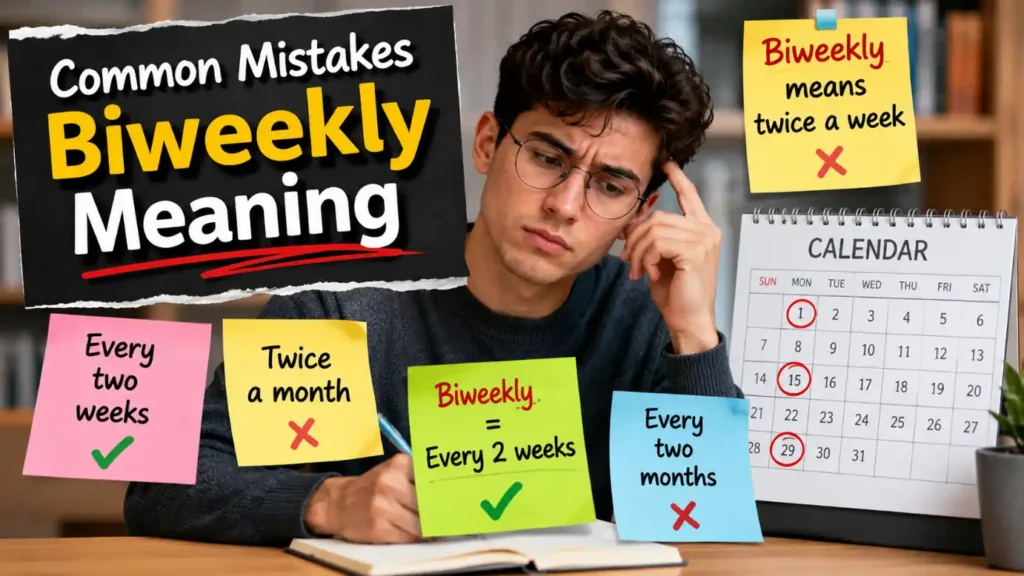
Assuming everyone shares the same definition. Because both meanings exist, one person’s “biweekly” can genuinely differ from another’s, even within the same conversation or document.
Using it in official schedules without clarification. Calendar invites, payroll documents, and contracts that use “biweekly” without specifying which meaning applies can create real confusion, especially around pay dates.
Confusing it with “semimonthly.” Semimonthly specifically means twice a month (typically on fixed dates like the 1st and 15th), which differs from both meanings of biweekly and adds yet another layer of possible confusion.
Assuming a dictionary will resolve the ambiguity. Looking up “biweekly” won’t settle the question, since standard dictionaries list both definitions as correct rather than favoring one.
Similar Words
| Word | Meaning | Difference from Biweekly |
| Fortnightly | Occurring every two weeks | Fortnightly avoids the ambiguity entirely, since it only means “every two weeks” |
| Semimonthly | Occurring twice a month, usually on fixed calendar dates | Semimonthly ties to the month rather than a recurring two-week cycle |
| Bimonthly | Occurring every two months, or twice a month | Bimonthly carries the same kind of dual-meaning ambiguity as biweekly, just applied to months instead of weeks |
| Biennial | Occurring every two years | Biennial avoids ambiguity, consistently meaning “every two years” rather than “twice a year” |
Opposite Words
| Word | Meaning | Why It’s an Opposite |
| Weekly | Occurring once every week | A single, unambiguous frequency, unlike biweekly’s dual meaning |
| Daily | Occurring once every day | Represents a much more frequent, single-meaning schedule |
| Annually | Occurring once a year | A far less frequent, clearly defined schedule with no ambiguity |
Pronunciation
People pronounce biweekly as by-WEEK-lee, stressing the second syllable.
Quick Facts
| Fact | Detail |
| First meaning | Every two weeks (once every fortnight) |
| Second meaning | Twice a week |
| Type of word | Contronym (a word with two contradictory meanings) |
| Prefix origin | “Bi-” from Latin, meaning “two” |
| Common in | Payroll, scheduling, publishing |
| Recommended fix | Use “fortnightly” or “twice a week” instead, when precision matters |
FAQs
Does biweekly mean every two weeks or twice a week?
Both. Dictionaries list both meanings as correct, so context alone determines which one applies in a given sentence.
What does biweekly pay mean?
In payroll, biweekly almost always means “every two weeks,” producing 26 paychecks a year rather than the 24 you’d get from a twice-monthly schedule.
How do I avoid confusion when using biweekly?
Add a clarifying phrase, such as “biweekly (every two weeks),” or use an unambiguous alternative like “fortnightly” or “twice a week.”
Is fortnightly the same as biweekly?
Fortnightly specifically means “every two weeks,” matching one of biweekly’s two meanings, but without the ambiguity.
Why does biweekly have two meanings?
The confusion traces back to inconsistent historical use of the “bi-” prefix, which logically should mean “every two,” but which people have also long used loosely to mean “twice within.”
What’s the difference between biweekly and semimonthly?
Semimonthly means twice a month, usually on fixed calendar dates, while biweekly refers to a two-week cycle and carries its own separate ambiguity.
Does bimonthly have the same problem as biweekly?
Yes. Bimonthly carries a similar dual meaning, referring to either “every two months” or “twice a month,” depending on usage.
Should I stop using the word biweekly altogether?
Not necessarily, but in contexts where precision matters, like payroll or contracts, it’s safer to clarify the meaning directly or use a less ambiguous word.
Key Takeaways
- Biweekly can mean either “every two weeks” or “twice a week,” and both definitions count as correct.
- Context, not dictionary definitions, usually determines which meaning applies.
- Payroll almost always uses the “every two weeks” meaning.
- “Fortnightly” avoids the ambiguity entirely if you specifically mean “every two weeks.”
- Style guides recommend clarifying or replacing “biweekly” in situations where precision genuinely matters.
Conclusion
The biweekly meaning ultimately depends on who’s using it and in what context, since the word itself refuses to settle on a single definition. That built-in ambiguity makes it one of English’s more frustrating everyday words, especially anywhere real scheduling or money is involved.
The safest approach treats “biweekly” as a word that always needs a second glance rather than one you can take at face value. If you’re the one writing a schedule, invite, or pay policy, spelling out “every two weeks” or “twice a week” directly costs you almost nothing and eliminates the guesswork entirely. If you’re on the receiving end of a biweekly anything, a quick clarifying question upfront can save you from showing up to the wrong meeting or budgeting around the wrong paycheck.
Words like this stay rare in English, but biweekly shows up often enough, and matters enough in daily life, that it’s worth remembering permanently: when you see it, don’t assume check.

I am Stephen King an American author known for compelling storytelling. At writemora.com, we value clear, accurate, and reader-focused content inspired by excellence in writing.