
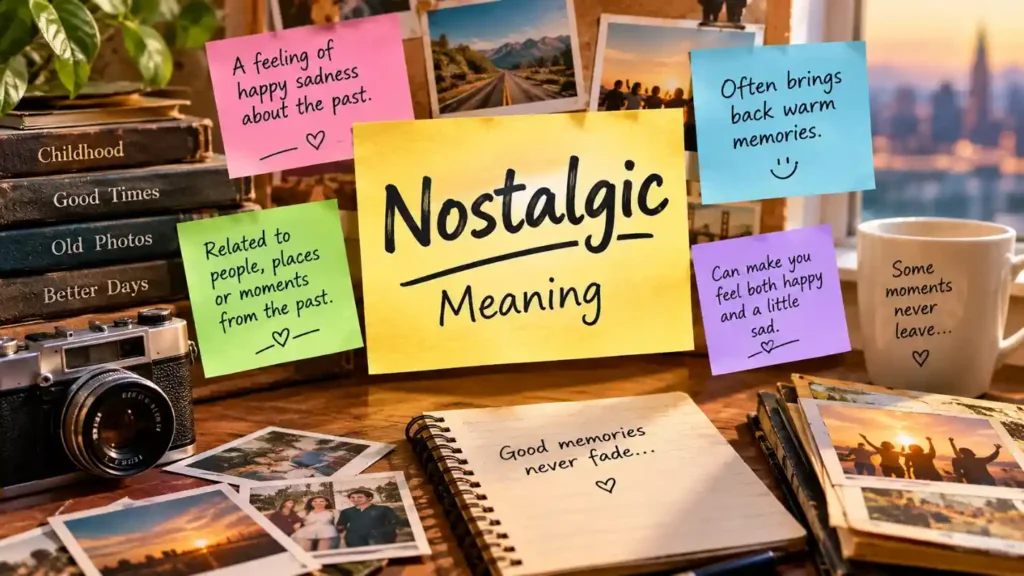
Nostalgic describes a sentimental, often bittersweet longing for the past, typically triggered by a memory, place, sound, or object connected to an earlier, meaningful time in someone’s life. The feeling mixes genuine warmth and affection with a touch of wistfulness, since the moment being remembered can’t actually be relived.
You’ll encounter nostalgia constantly describing everything from childhood memories to old songs, movies, and even discontinued products. Understanding the nostalgic meaning helps clarify that specific emotional blend of happiness and gentle loss the word actually captures.
This guide covers what nostalgic means, where the word comes from, how people use it, and the mistakes writers sometimes make when reaching for it.
What It Means
In simple terms, nostalgia describes feeling a sentimental longing or affection for the past, usually triggered by something that reminds a person of an earlier, meaningful time. A nostalgic feeling often arrives suddenly, prompted by a specific sound, smell, image, or place connected to an earlier chapter of someone’s life.
In a fuller sense, nostalgia involves a distinctive emotional combination that sets it apart from simple happy memories or plain sadness. It blends genuine warmth and fondness for the remembered time with an underlying awareness that this moment has passed and can’t be fully recovered, creating a bittersweet quality unique to this specific feeling.
The word can describe both the internal emotional experience (feeling nostalgic) and, by extension, things that trigger or evoke that feeling in others (a nostalgic song, a nostalgic scent), making it flexible across both personal experience and descriptive writing.
Origin & History

Nostalgic comes from the Greek words “nostos” (meaning “homecoming” or “return home”) and “algos” (meaning “pain” or “ache”), combining to literally mean “the pain of returning home” or “homesickness.” A Swiss physician, Johannes Hofer, coined the original term “nostalgia” in 1688 to describe a medical condition he observed in soldiers stationed far from home, characterized by severe homesickness and longing.
For centuries after its coining, nostalgia remained understood primarily as a medical or psychological affliction, specifically tied to physical distance from one’s homeland, sometimes considered serious enough to warrant treatment. This original, more clinical understanding gradually shifted over the 19th and 20th centuries toward the broader, more universally relatable emotional concept people recognize today.
By the 20th century, nostalgia and its adjective form, nostalgic, had shed most of their original medical connotations, instead describing the common, widely shared human experience of sentimental longing for the past, regardless of physical location or homesickness specifically.
Different Contexts and Meanings
Describing a personal emotional state. This is the word’s most common modern use, feeling wistfully sentimental about a memory or past experience: “She felt nostalgic looking through old photographs.”
Describing objects, media, or experiences that evoke the feeling. People often use “nostalgic” to describe things that trigger the emotion in others, such as music, movies, food, or products: “The restaurant had a nostalgic 1950s diner theme.”
In marketing and pop culture. Brands and entertainment companies frequently lean into nostalgic appeal, deliberately evoking memories of earlier decades or trends to connect emotionally with audiences.
In psychology and wellbeing discussions. Researchers and psychologists have studied nostalgia specifically as an emotion with measurable psychological benefits, including boosting mood, strengthening social connection, and providing comfort during difficult times.
In casual conversation about shared generational experiences. People frequently bond over nostalgic references to shows, toys, music, or trends specific to their generation, using shared nostalgia as a form of connection.
Examples
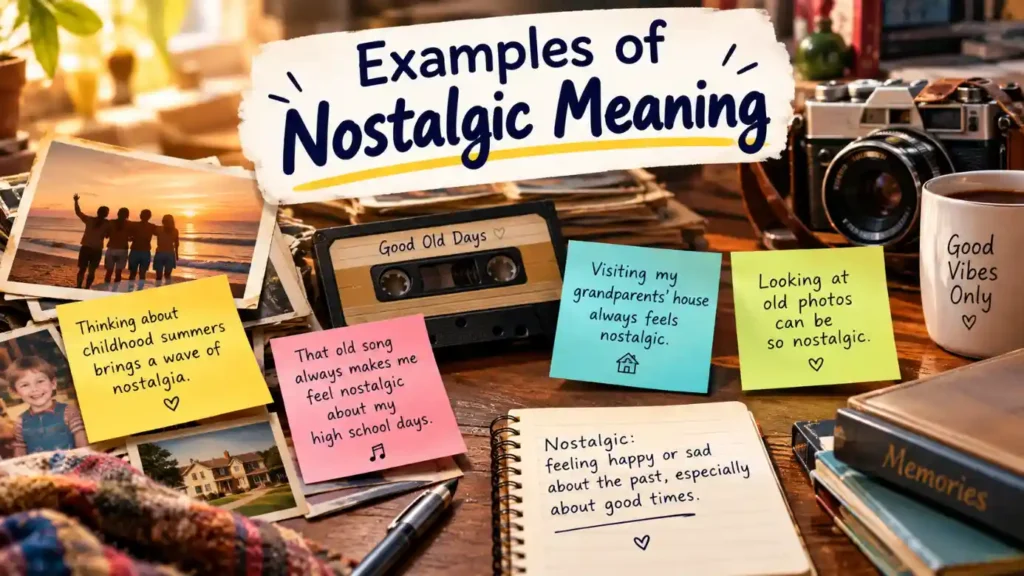
- “Hearing that old song made her instantly nostalgic for her college years.”
- “The smell of fresh-baked bread brought back a wave of nostalgic memories of his grandmother’s kitchen.”
- “The film relied heavily on nostalgic references to appeal to fans of the original series.”
- “He felt a pang of nostalgia walking past his old elementary school.”
- “The reunion was filled with nostalgic stories about their shared childhood.”
- “That toy brand recently launched a nostalgic line reviving its 1990s packaging.”
- “She scrolled through old text messages, feeling unexpectedly nostalgic.”
- “The documentary captured a genuinely nostalgic portrait of small-town life in the 1970s.”
- “Visiting his childhood neighborhood left him feeling deeply nostalgic.”
- “The playlist was full of nostalgic songs from their high school years.”
How to Use It (Grammar and Context)
Nostalgic functions as an adjective, typically describing a person’s feeling (“she felt nostalgic”) or a thing that evokes that feeling (“a nostalgic song”). It commonly pairs with the preposition “for,” specifying what the feeling centers on: “nostalgic for his childhood,” “nostalgic for simpler times.”
The related noun form, “nostalgia,” names the feeling or emotional state itself: “a wave of nostalgia washed over her.” The word can also function adverbially in phrases like “looking back nostalgically” to describe how someone recalls or discusses the past.
Common Mistakes
Confusing nostalgia with simply sadness about the past. Nostalgia specifically involves a blend of warmth and gentle wistfulness, not pure sadness or grief the feeling includes genuine fondness alongside any sense of loss.
Assuming nostalgia only applies to distant memories. While often associated with childhood or long-past experiences, people can feel nostalgic about relatively recent events too, as long as enough emotional distance or change has occurred.
Overusing the word for mild fondness. Nostalgic implies a meaningful emotional pull toward the past, not just casual appreciation of something old or vintage without any personal emotional connection attached.
Assuming nostalgia is always accurate to the past. Nostalgic memories often carry an idealized, softened version of the past, sometimes overlooking genuine difficulties from that time, a quality worth recognizing when discussing the emotion critically.
Similar Words
| Word | Meaning | Difference from Nostalgic |
| Sentimental | Having or expressing tender, often exaggerated emotion, particularly related to memory | Sentimental is broader, applying to many emotional contexts; nostalgic specifically ties that emotion to longing for the past |
| Wistful | Full of yearning or vague longing, tinged with melancholy | Very close to nostalgic, though wistful doesn’t always specifically connect to a personal past experience |
| Homesick | Missing one’s home while away from it | Homesickness reflects nostalgia’s original literal meaning, though modern nostalgic usage extends far beyond physical homesickness |
| Reminiscent | Serving to remind one of something, often the past | Reminiscent describes a resemblance triggering memory; nostalgic describes the emotional response to that memory itself |
Opposite Words
| Word | Meaning | Why It’s an Opposite |
| Forward-looking | Focused on the future rather than the past | Directly contrasts with nostalgic’s backward-looking emotional focus |
| Indifferent | Feeling no particular interest or emotional connection | Opposes the warm, sentimental attachment central to nostalgia |
| Present-focused | Fully engaged with the current moment, without dwelling on the past | Contrasts with nostalgia’s emotional pull toward earlier times |
Pronunciation
Nostalgic is pronounced nah-STAL-jik, with the stress on the second syllable.
Quick Facts
| Fact | Detail |
| Word origin | Greek “nostos” (homecoming) + “algos” (pain), literally “homesickness” |
| Coined by | Swiss physician Johannes Hofer, in 1688 |
| Original meaning | A medical condition involving severe homesickness |
| Modern meaning | Sentimental, bittersweet longing for the past |
| Related noun | Nostalgia |
| Common pairing | “Nostalgic for” (specifying what triggers the feeling) |
Key Takeaways
- Nostalgic describes a sentimental, bittersweet longing for the past, blending warmth with gentle wistfulness.
- The word comes from Greek roots literally meaning “the pain of homecoming.”
- It originally described a medical condition before evolving into today’s broader emotional concept.
- Nostalgia can involve both distant and relatively recent memories, not just childhood.
- The related noun “nostalgia” names the feeling itself, often triggered by specific sensory cues.
FAQs
What does it mean to be nostalgic?
Being nostalgic means having warm or emotional feelings when remembering people, places, experiences, or moments from the past.
Is nostalgia sad or happy?
Nostalgia can be both happy and sad. It often brings pleasant memories while also creating a feeling of longing for the past.
Is it correct to say feeling nostalgic?
Yes, “feeling nostalgic” is completely correct. It means experiencing emotions or memories connected to something from the past.
What is an example of nostalgia?
An example is feeling nostalgic when you hear a childhood song and remember playing with friends when you were young.
What’s a better word for nostalgic?
Depending on the context, words like sentimental, wistful, reflective, or reminiscent can be used instead of nostalgic.
Is being nostalgic a good thing?
Yes, nostalgia can be positive because it can strengthen connections with meaningful memories and bring comfort or happiness.
Is nostalgia a form of depression?
No, nostalgia itself is not a form of depression. It is a normal emotional response to memories, although persistent sadness should be considered separately.
What does God say about nostalgia?
The Bible does not specifically use the modern concept of nostalgia, but it often discusses remembering the past while encouraging people to trust God and live in the present.
What triggers nostalgia?
Nostalgia can be triggered by music, smells, photographs, familiar places, old movies, food, conversations, or objects connected to meaningful memories.
What is a person who is very nostalgic called?
A person who is very nostalgic can be called a nostalgic person or someone who is sentimental and strongly attached to memories of the past.
How do I use nostalgia in a sentence?
Example: “Listening to that old song filled me with nostalgia for my school days.”
How do I use nostalgia?
Use “nostalgia” when talking about a sentimental feeling or longing connected to memories of the past, such as “The movie brought back a sense of nostalgia.”
Conclusion
The nostalgic meaning carries real weight once you trace it back to its origin: a word coined specifically to describe soldiers aching for a home they couldn’t return to. That original sense of homesickness has since expanded into something almost universal, but the emotional core remains remarkably similar to a genuine ache for something meaningful that’s now out of reach.
What makes nostalgia such a distinctive feeling, rather than just plain sadness, is exactly that combination the word captures so well: real warmth and fondness sitting right alongside the quiet awareness that the moment has passed. Few emotions manage to feel both comforting and slightly painful at the same time in quite the same way.
If triggered by an old song, a childhood scent, or a photograph you haven’t looked at in years, nostalgic remains one of the most precise words in English for that particular, familiar ache happy to remember, a little sad it’s over.

I am Olivia Brooks an American editor and content researcher dedicated to creating clear, accurate content. At writemora.com, I help readers to understand words, phrases, and modern language with confidence.