
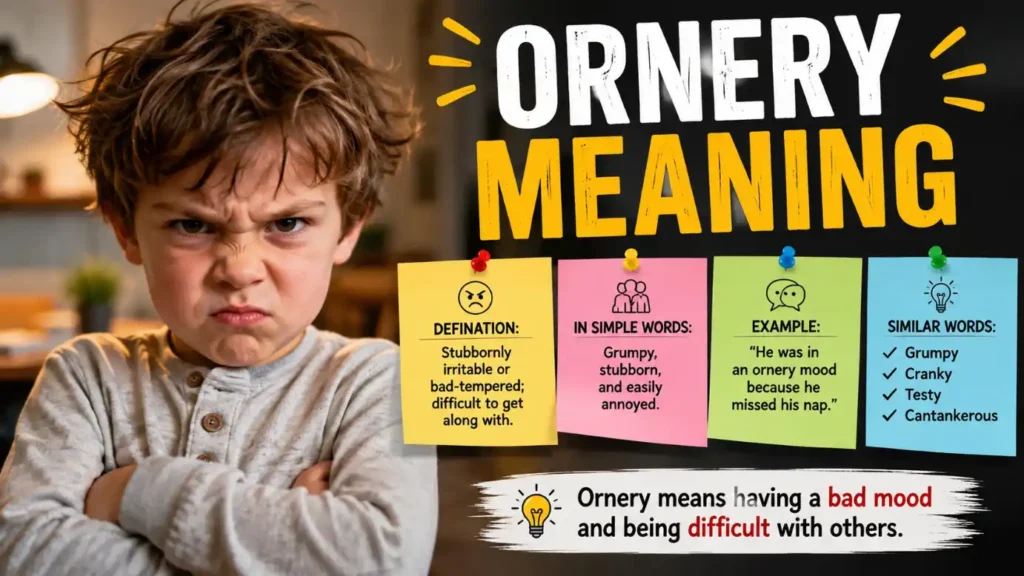
What does it mean when someone calls you ornery? If you’ve ever heard this word and wondered if it’s an insult or a compliment, you’re not alone. The ornery meaning is richer and more interesting than most people realize.
At its core, ornery describes someone who is stubborn, grumpy, and difficult to deal with. Think of that neighbor who complains about everything, the old mule that refuses to move, or even that tough cut of meat that won’t tenderize no matter what you do. That’s ornery.
But here’s the thing the word has a surprising backstory. It didn’t always mean what it means today. In fact, it started as a simple twist on the word “ordinary.” How did “ordinary” become “ornery“? That’s a story worth telling. And why do some people use it as an insult while others use it as a term of affection?
In this article, we’ll cover everything you need to know about the ornery meaning: its history, how to pronounce it, real-world examples, common mistakes, synonyms and antonyms, and how to use it correctly in conversation. By the end, you’ll not only know what ornery means you’ll know how to wield it like a native speaker.
What Does Ornery Mean? A Deep Dive

The ornery meaning has a few layers. Let’s break them down so you can use the word with confidence.
The Simple Definition
In plain terms, ornery means:
- Stubborn and difficult to deal with
- Grumpy and easily irritated
- Having a bad temper or cranky disposition
When you call someone ornery, you’re saying they’re not easy to get along with. They might argue for the sake of arguing, refuse to cooperate, or just wake up in a bad mood and stay that way all day.
The Nuanced Definition
But the ornery meaning isn’t always purely negative. Sometimes, it carries a hint of affection. Picture a beloved grandfather who complains about everything but secretly loves having his grandkids around. That’s ornery in a fond way. Or consider a mischievous child who’s always causing harmless trouble that’s ornery too.
The word also works for things that aren’t people. A stubborn mule is ornery. A rusty bolt that won’t budge is ornery. A recipe that requires fifteen steps and still fails is ornery. When something is difficult to manage or work with, the ornery meaning fits perfectly.
How Ornery Differs from Other Grumpy Words
| Word | Core Meaning | Key Difference |
| Ornery | Stubborn, grumpy, difficult | Implies a mix of irritability and defiance |
| Grumpy | Bad-tempered and sulky | Lacks the stubbornness element |
| Cantankerous | Argumentative and uncooperative | Often sounds more formal or literary |
| Crotchety | Irritable, especially in old age | Usually linked to older people |
| Surly | Rude and hostile | More aggressive and mean-spirited |
Understanding these distinctions helps you choose the right word for the right situation. If someone is just in a bad mood, “grumpy” works. If they’re stubbornly refusing to cooperate while complaining the whole time, “ornery” is more accurate.
The Surprising History of “Ornery”

Here’s where things get fascinating. The ornery meaning we know today is a classic example of how words evolve over time in unexpected ways.
From “Ordinary” to “Ornery”
The word “ornery” is an American dialectal contraction of the word “ordinary.” It first appeared in American English around the early 1800s.
At that time, “ordinary” could mean several things:
- Commonplace or normal
- Of poor quality or coarse
- Plain or unremarkable
Over time, the sense of “coarse” or “low-quality” extended from describing things to describing a person’s character. Someone with an “ordinary” temperament meaning a coarse, unpleasant one became known as “ornery.”
By about 1860, the ornery meaning had fully shifted to what we recognize today: mean, cantankerous, and stubborn. The word had completely divorced itself from its “ordinary” roots.
Why Did This Shift Happen?
Language doesn’t change in a vacuum. Words shift meaning because of how people use them. In the case of “ornery,” the American frontier context likely played a role.
Picture life in rural America during the 1800s. People dealt with stubborn mules, difficult weather, and tough living conditions. Calling something “ordinary” in the sense of “coarse” or “inferior” naturally extends to describing a difficult person or animal. Over time, the pronunciation slurred into “ornery,” and the new meaning stuck.
The word has remained largely American. You rarely hear it in British English, though it might be understood. In the US, it’s become a folksy, informal word that still feels at home in rural and Southern speech.
How to Pronounce Ornery Correctly
If you’re unsure how to say this word, you’re not alone. The pronunciation trips up plenty of people.
Standard Pronunciation
The standard American English pronunciation is AW-nuh-ree (phonetically written as /ˈɔːrnəri/).
Here’s how to break it down:
- First syllable: “AW” like the word “aw” or the “au” in “caught”
- Second syllable: “nuh” like the “nu” in “nut”
- Third syllable: “ree” like the “ree” in “free”
Common Variation
You’ll also hear it pronounced as AWN-ree, a two-syllable version that’s common in casual speech, especially in the South and Midwest. This shorter pronunciation drops the middle syllable entirely.
Both pronunciations are correct. Choose whichever feels more natural to you.
How to Use “Ornery” in Real Life
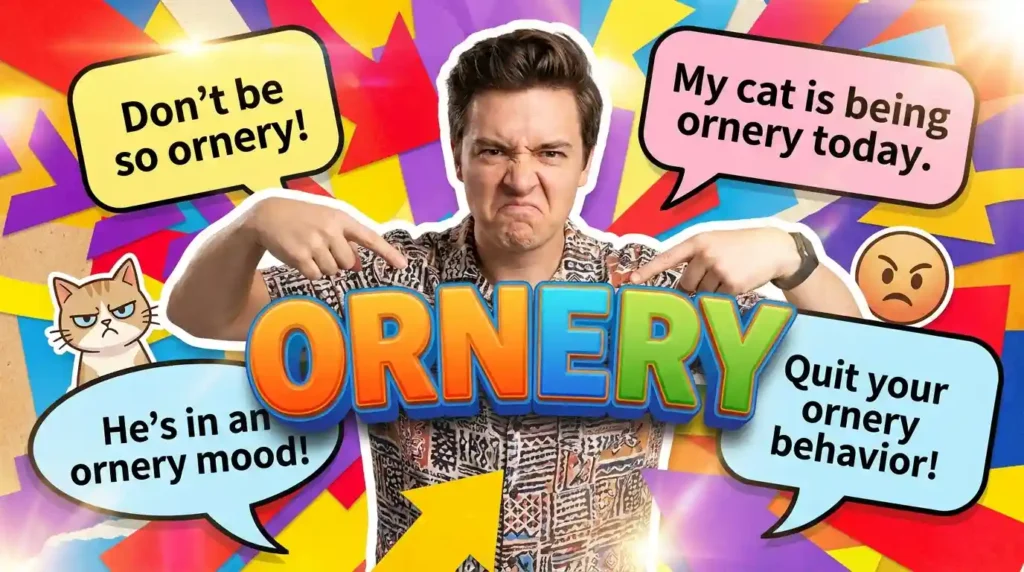
The ornery meaning works in many contexts. Here are real-world examples to show you how native speakers use it.
Describing a Bad-Tempered Person
This is the most common use. When someone is ornery, they’re irritable and quick to complain.
“My boss gets ornery when the team misses deadlines.”
“He’s ornery in the morning until he’s had his coffee.”
“Don’t bother her right now, she’s ornery today for no reason.”
Describing a Stubborn Animal
Farmers and ranchers have used “ornery” for animals for generations, especially mules.
“That ornery mule won’t let anyone get near him.”
“The old goat is ornery and butts anyone who comes close.”
“I tried to herd the sheep, but that ornery ram had other plans.”
Describing a Difficult Thing or Task
You can also use the word for inanimate objects or challenges.
“Brisket is an ornery cut of meat that needs hours of slow cooking.”
“This old tractor is ornery and it stalls every time I try to start it.”
“That jar lid is ornery; I can’t get it open.”
Using It Affectionately or Lightheartedly
This is where tone matters most. When used with affection, “ornery” can mean “lovably grumpy” or “mischievous.”
“My grandfather is a bit ornery, but we love him anyway.”
“That ornery little boy hid all the cookies from his sister.”
“Grandma’s ornery cat hisses at visitors but cuddles with her all day.”
Describing a Challenge or Situation
Sometimes, a whole situation can feel ornery.
“Filing taxes this year has been an ornery process.”
“Getting this old car to start has been ornery all winter.”
“The negotiations got ornery once both sides refused to compromise.”
Common Mistakes to Avoid with “Ornery”
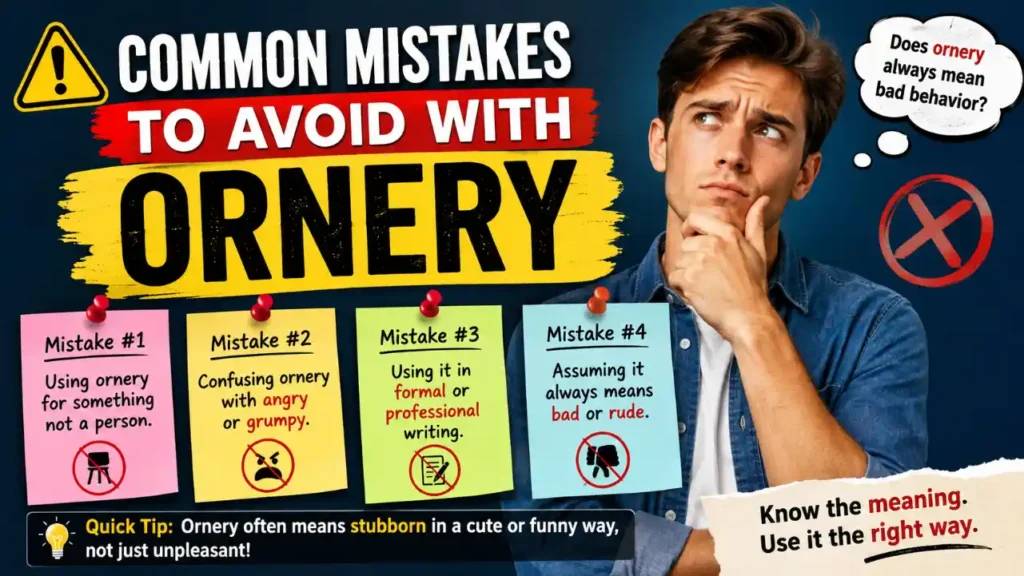
Even native speakers mess this up sometimes. Here’s what to watch out for.
Mistake 1: Confusing It with “Ordinary”
Because of its origin, some people think “ornery” means “ordinary” or “normal.” This is flat-out wrong.
- Incorrect: “He’s an ornery guy who blends in with the crowd.”
- Correct: “He’s an ornery guy who yells at everyone.”
Mistake 2: Using It in Formal Writing
The ornery meaning is informal and folksy. It doesn’t belong in academic papers or professional reports.
- Avoid: “The data suggests an ornery correlation between variables.”
- Use: “The data suggests a stubborn correlation between variables.”
Mistake 3: Misreading the Tone
When you hear someone described as ornery, consider the context. The speaker might be genuinely annoyed or they might be using it fondly.
If you’re not sure, pay attention to tone of voice and body language. A smile and a chuckle mean affection. A frown and crossed arms mean frustration.
Similar Words and How They Differ
Understanding the ornery meaning gets easier when you compare it to similar words.
| Word | Meaning | Difference from Ornery |
| Cantankerous | Bad-tempered and argumentative | Very close in meaning, but sounds more formal and literary |
| Crotchety | Irritable, often in old age | Implies eccentricity; often linked to older people |
| Grumpy | Sulky and bad-tempered | Lacks the stubbornness that’s central to ornery |
| Irascible | Easily angered | Focuses on quick temper rather than stubbornness |
| Pugnacious | Eager to fight or argue | More aggressive and confrontational |
| Surly | Rude and unfriendly | Lacks the “stubborn” element; focuses on hostility |
| Testy | Irritable and impatient | Similar to grumpy; lacks the defiance |
Opposite Words (Antonyms)
If you want to describe the opposite of ornery, here are your best options.
| Word | Meaning |
| Amiable | Friendly, pleasant, and good-natured |
| Agreeable | Willing to cooperate and go along with things |
| Easygoing | Relaxed and not easily upset |
| Good-tempered | Cheerful and calm |
| Genial | Warmly cheerful and friendly |
| Compliant | Willing to follow rules or requests |
Quick Facts About “Ornery”
| Attribute | Detail |
| Part of Speech | Adjective |
| Origin | American English dialectal contraction of “ordinary,” circa 1816 |
| Primary Meaning | Stubborn, grumpy, difficult to deal with |
| Secondary Meaning | Troublesome or uncooperative (for things or situations) |
| Tone | Informal, folksy, predominantly American |
| Emotional Connotation | Can be negative or affectionately teasing |
| Common Contexts | Describing people, animals, tasks, and challenges |
| Pronunciation | AW-nuh-ree or AWN-ree |
Frequently Asked Questions About Ornery
Is “ornery” a bad word?
No, it’s not a curse word or profanity. It’s an adjective that can be negative or affectionate depending on context.
Can you call a child ornery?
Yes. When applied to a child, it often means “mischievous” or “playfully stubborn.” It’s usually not meant as a severe insult.
Is “ornery” the same as “mean”?
Not exactly. “Ornery” includes stubbornness and grumpiness. “Mean” implies cruelty or unkindness, which is harsher.
Where is “ornery” most commonly used?
It’s most common in the United States, especially in Southern and rural dialects. It’s rarely used in British English.
Can a dog be ornery?
Absolutely. A dog that refuses to come when called, snaps at strangers, or stubbornly pulls on the leash could be called ornery.
Is “ornery” outdated?
Not at all. While it has an old-fashioned, folksy feel, it’s still widely used in American English today.
Key Takeaways
- The ornery meaning describes someone or something that is stubborn, grumpy, and difficult to deal with.
- The word has a surprising origin: it started as a dialectal twist on “ordinary” in early 19th-century America.
- Pronunciation is AW-nuh-ree or the shorter AWN-ree. Both are correct.
- It’s an informal, distinctly American word with a folksy character.
- The tone can range from negative (genuine complaint) to affectionate (lovably grumpy or mischievous).
- Context is everything. Pay attention to tone of voice and body language.
- Synonyms include cantankerous, crotchety, and grumpy. Antonyms include amiable, agreeable, and easygoing.
Conclusion
So, what does ornery mean? It’s a word with a journey. It started as an ordinary word meaning “ordinary,” wandered through American frontier speech, and emerged with a whole new personality. Today, it describes the stubborn mule, the grumpy neighbor, the mischievous child, and the tough cut of meat all with a dose of colorful character.
The ornery meaning is versatile enough to be an insult, a compliment, or somewhere in between. The key is knowing your audience and reading the room. But once you understand its layers, you’ll find this word is too useful to ignore.
Next time someone calls you ornery, take it as a compliment or don’t. That’s the beauty of it. You get to decide.

I am Stephen King an American author known for compelling storytelling. At writemora.com, we value clear, accurate, and reader-focused content inspired by excellence in writing.