
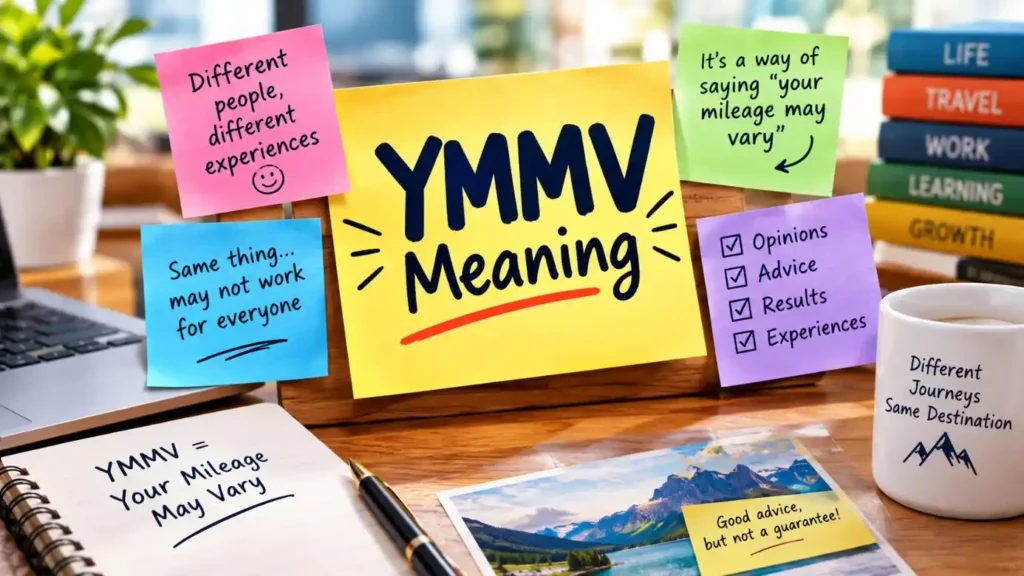
YMMV stands for “Your Mileage May Vary,” a phrase people use to signal that their personal opinion, advice, or experience might not apply the same way to someone else. It’s a quick, humble way of adding a disclaimer to a recommendation, acknowledging that individual results or reactions can differ.
You’ll see YMMV constantly in forums, product reviews, advice threads, and technical discussions, wherever someone wants to soften a strong claim with a note of realistic uncertainty. Understanding the YMMV meaning helps clarify exactly what that disclaimer is doing and why people reach for it so often.
This guide covers what YMMV stands for, where the phrase originated, how people use it across different contexts, and the mistakes people sometimes make with it.
What It Means
In simple terms, YMMV stands for “Your Mileage May Vary,” used to acknowledge that a specific piece of advice, opinion, or personal experience won’t necessarily produce the same result for everyone. Someone adds YMMV to signal, “this worked for me, but your situation or reaction might genuinely be different.”
In a fuller sense, the phrase functions as a built-in disclaimer, protecting the speaker from overclaiming universal truth while still sharing something genuinely useful. Rather than stating a recommendation as an absolute fact, YMMV frames it as one data point among potentially many different outcomes, respecting that individual circumstances, preferences, or biology can lead to different results.
The phrase works especially well in situations involving subjective experience, taste, comfort, personal reactions, technical setups where a single universal answer genuinely doesn’t exist.
Origin & History
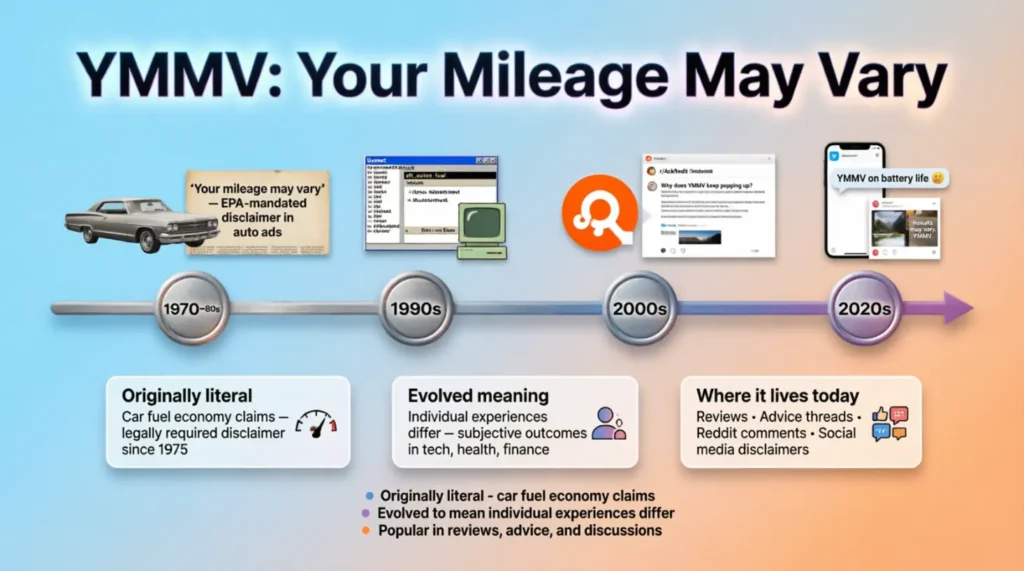
The phrase “your mileage may vary” originated literally in American automotive advertising, particularly around fuel economy disclaimers starting in the 1970s. Car advertisements listing a vehicle’s estimated miles-per-gallon rating commonly included this exact disclaimer, acknowledging that actual fuel efficiency depends heavily on individual driving habits, road conditions, and other variable factors.
As internet forums and early online communities grew through the 1980s and 1990s, particularly on platforms like Usenet, users began borrowing this literal automotive phrase figuratively, applying the same “results may vary” concept to opinions, product reviews, and general advice shared online. The shortened abbreviation “YMMV” followed naturally as online communication favored quick, efficient typing.
By the 2000s and 2010s, YMMV had become a firmly established piece of internet vocabulary, appearing constantly across forums, review sites, and social media, far removed from its original context of literal automotive fuel economy.
Different Contexts and Meanings
In product reviews and recommendations. This remains one of the most common uses: someone shares their positive or negative experience with a product while acknowledging others might have a different experience: “This supplement worked great for me, but YMMV.”
In technical and troubleshooting discussions. YMMV frequently appears in tech support forums and coding communities, where a specific fix or workaround might not apply identically to every system configuration: “This solved my issue, YMMV depending on your setup.”
In advice and opinion threads. People use YMMV to soften subjective opinions or personal advice, acknowledging that individual taste, circumstances, or values might lead someone else to a different conclusion.
In casual conversation about experiences. Beyond formal reviews, people use YMMV casually when sharing personal reactions to movies, restaurants, or other subjective experiences: “I loved the ending, but YMMV.”
As an expected forum etiquette marker. In many online communities, adding YMMV to a strong personal claim has become an almost expected courtesy, signaling humility and awareness that the poster’s experience isn’t necessarily universal.
Examples
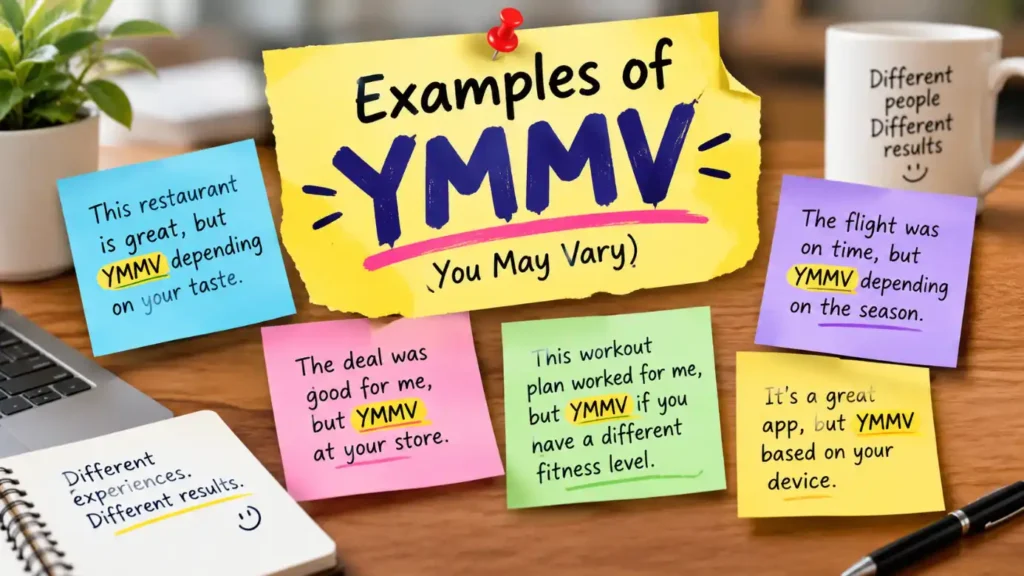
- “This diet worked well for me, but YMMV depending on your body type.”
- “The fix solved my printer issue immediately YMMV, though, since printer models vary a lot.”
- “I thought the movie was fantastic, but YMMV if you’re not into slow-paced films.”
- “This budget laptop handled my workload fine, YMMV for more demanding tasks.”
- “The trick worked for restoring my account access, though YMMV based on your specific error.”
- “I found the book life-changing, but YMMV it’s a pretty polarizing read.”
- “This home remedy helped my headache, YMMV of course.”
- “The commute takes about 20 minutes for me, YMMV depending on traffic.”
- “That workout routine got me great results, though YMMV based on fitness level.”
- “The setting worked perfectly on my device, YMMV on older hardware.”
How to Use It (Grammar and Context)
YMMV functions as an independent clause or standalone phrase, typically appearing at the end of a statement as a qualifying disclaimer: “It worked for me. YMMV.” It can also appear mid-sentence, often set off by commas: “The trick fixed my issue, YMMV, depending on your device.”
Because the phrase already functions as a complete thought (“your mileage may vary”), it doesn’t require additional grammatical modification; people simply drop it into a sentence wherever the disclaimer feels relevant.
Common Mistakes
Assuming YMMV weakens the original claim entirely. The disclaimer doesn’t mean the advice or opinion is unreliable; it simply acknowledges that individual results can differ, without undermining the value of the original information.
Overusing YMMV to avoid taking any position. While useful for genuine disclaimers, attaching YMMV to every single statement can come across as excessive hedging rather than a meaningful, targeted qualifier.
Missing the phrase’s literal automotive origin. Some people use YMMV without realizing it originated specifically from fuel economy advertising disclaimers, missing an interesting piece of the phrase’s history.
Using YMMV for objective facts rather than subjective experiences. The phrase works best for genuinely variable outcomes (taste, technical setups, personal reactions), not for statements of clear, verifiable fact where no real variation should exist.
Similar Words
| Phrase | Meaning | Difference from YMMV |
| IMO/IMHO | “In my opinion” / “In my humble opinion” | IMO signals a statement is opinion-based from the start; YMMV specifically flags that results or reactions might differ for the reader |
| Take with a grain of salt | Advice to be skeptical or cautious about accepting something fully | Similar cautionary function, though YMMV focuses specifically on variability of outcome rather than general skepticism |
| Results not guaranteed | A more formal disclaimer common in marketing or advertising | Functionally similar, though YMMV carries a more casual, conversational, internet-native tone |
| Your experience may differ | A plain-language version of the same underlying idea | Nearly identical in meaning; YMMV is simply the internet-slang abbreviated version |
Opposite Words
| Phrase | Meaning | Why It’s an Opposite |
| Guaranteed results | A claim promising the same outcome for everyone | Directly opposes YMMV’s acknowledgment of variability |
| Universally true | Something that applies identically to everyone, without exception | Contrasts with YMMV’s implicit admission that individual circumstances matter |
| One-size-fits-all | An approach assumed to work identically for everyone | Opposes the individualized variability YMMV specifically acknowledges |
Pronunciation
People typically don’t say YMMV out loud as a word; they either read the letters individually, Y-M-M-V, or say the full phrase “your mileage may vary.”
Quick Facts
| Fact | Detail |
| Stands for | “Your Mileage May Vary” |
| Original context | American automotive fuel economy advertising, starting in the 1970s |
| Adopted online | Usenet and early internet forums, 1980s–1990s |
| Common uses | Product reviews, tech troubleshooting, personal advice, casual opinions |
| Function | A humble disclaimer acknowledging individual variation in results |
| Typical tone | Casual, conversational, and self-aware |
FAQs
What does YMMV mean?
YMMV stands for “Your Mileage May Vary,” a phrase used to acknowledge that personal advice, opinions, or experiences might not produce the same results for everyone.
What does YMMV mean in Reddit?
YMMV means “Your Mileage May Vary.” On Reddit, it means people may have different experiences or results with something.
Is YMMV commonly used in text messages?
Yes, YMMV is commonly used in texts and online chats to show that an experience or result may differ from person to person.
What does YMMV stand for in massage?
In massage discussions, YMMV still means “Your Mileage May Vary,” indicating that the results or experience may differ between people.
What does YMMV mean in TV Tropes?
On TV Tropes, YMMV means “Your Mileage May Vary,” referring to opinions or experiences that can differ among viewers.
What does YMMV mean in slang?
YMMV is internet slang for “Your Mileage May Vary.” It is used when something may not work or feel the same for everyone.
What’s a good example of YMMV?
“YMMV, but this study method works really well for me.” It means the method may produce different results for other people.
What does “YMMV” mean when referring to deals?
For deals, YMMV means “Your Mileage May Vary,” suggesting that availability, pricing, or discounts may differ by store or location.
What does “MM” mean in slang?
“MM” can have different meanings depending on context, including “my man,” “morning,” or other abbreviations used in online conversations.
What does WMG mean?
WMG commonly stands for “Wild Mass Guessing,” especially on TV Tropes, where people share speculative theories about fictional stories.
What is the abbreviation for massage?
“Massage” is commonly abbreviated as “msg” in informal contexts, although writing out “massage” is clearer and more widely understood.
Key Takeaways
- YMMV stands for “Your Mileage May Vary,” acknowledging that results or experiences can differ from person to person.
- The phrase originated literally in 1970s American automotive fuel economy advertising.
- It spread into internet culture through early forums like Usenet before becoming widely recognized shorthand.
- YMMV works best for subjective, variable outcomes, not objective facts.
- The phrase functions as a humble, self-aware disclaimer rather than a sign of unreliable advice.
Conclusion
The YMMV meaning traces back to something refreshingly literal: a disclaimer about actual car fuel economy, borrowed decades later to describe the much broader unpredictability of human experience, taste, and circumstance. That practical, humble origin still shapes exactly how the phrase functions today, a quick, honest acknowledgment that no single experience automatically applies to everyone else.
Part of what makes YMMV so useful is how much work it does in so few letters. Rather than writing out a lengthy qualifier explaining that individual results depend on countless variable factors, four letters accomplish the same honest disclaimer instantly, letting someone share genuinely useful advice without overpromising a universal outcome.
Next time you’re about to recommend something you’re genuinely unsure will work the same way for someone else, YMMV remains one of the internet’s most efficient ways to share what worked for you while staying honest about the limits of your own single experience.

I am Stephen King an American author known for compelling storytelling. At writemora.com, we value clear, accurate, and reader-focused content inspired by excellence in writing.