
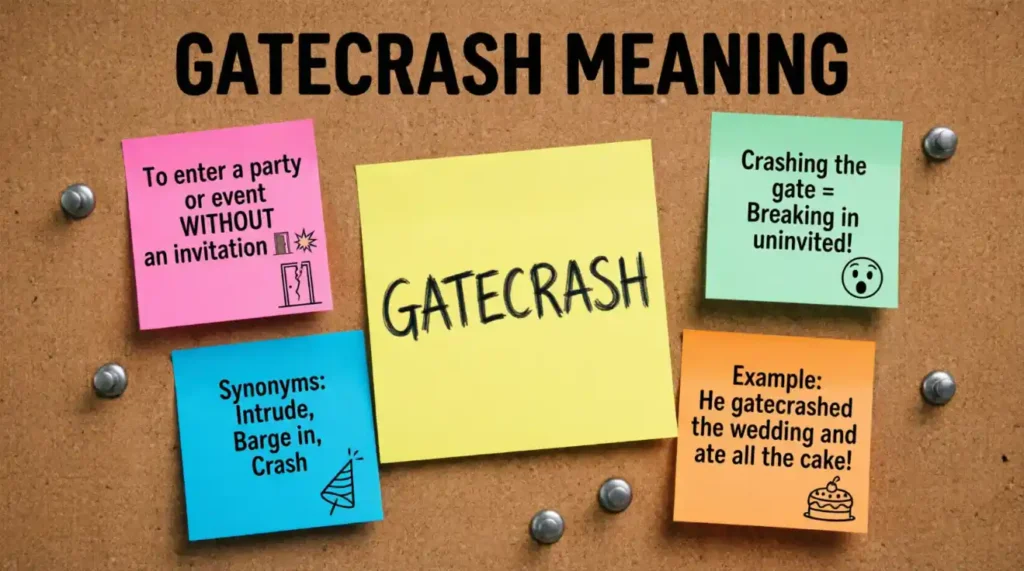
Gatecrash means to attend an event, party, or venue without an invitation or ticket, often by sneaking past security, a checkpoint, or someone controlling entry. The word implies a deliberate, sometimes bold move to get into a place you weren’t asked to be.
You’ll hear it most often in British and Australian English, describing everything from uninvited party guests to protesters forcing their way into restricted areas. Understanding the gatecrash meaning clears up exactly what separates it from simply showing up somewhere unannounced.
This guide covers what gatecrash means, where the word comes from, how people use it across different contexts, and how it compares to similar words like “crash.”
What It Means
In simple terms, gatecrash means to enter an event, party, or place without permission, invitation, or a ticket. Someone who gatecrashes typically wasn’t asked to attend and often has to get past some kind of barrier, a locked gate, a guest list, a security checkpoint, or a bouncer to get in.
In a fuller sense, the word carries a slight edge of boldness or audacity. Gatecrashing implies more than just wandering in accidentally; it suggests the person knew they weren’t invited and made a deliberate choice to enter anyway, sometimes through cleverness, sometimes through outright forcing their way past a barrier.
The word applies most naturally to social events like parties, weddings, and concerts, but people also extend it to describe uninvited entry into more formal or restricted settings, like meetings, ceremonies, or secured areas.
Origin & History

Gatecrash combines two simple English words “gate” and “crash” and emerged in early 20th-century British English. The imagery is straightforward: someone metaphorically or literally “crashes” through a gate meant to keep them out.
The word likely built on the earlier use of “crash” alone to describe uninvited attendance, a usage that dates back to at least the early 1900s in American slang, particularly around parties and social gatherings. Adding “gate” to the front sharpened the image, emphasizing the barrier the person had to get past rather than just the general act of showing up uninvited.
Gatecrash became especially common in British and Australian English through the 20th century, while American English tended to favor the shorter “crash” (as in “crash a party”) for the same basic idea, without the “gate” addition.
Different Contexts and Meanings
Gatecrashing a party. This remains the word’s most common and recognizable use: someone showing up to a party, wedding, or celebration without an invitation, often trying to blend in once inside.
Gatecrashing an event with security. The word also applies to more formal settings with actual security or checkpoints, such as concerts, festivals, or exclusive venues, where gatecrashing implies getting past an actual physical or procedural barrier.
Gatecrashing a meeting or gathering. People sometimes use the word for uninvited attendance at more formal or professional gatherings, implying someone inserted themselves into a space where they weren’t expected or welcome.
In protest or activism contexts. News coverage sometimes uses “gatecrash” to describe protesters or activists forcing entry into restricted areas, buildings, or events to make a political statement.
As a playful or joking description. Friends sometimes use the word lightly to describe someone showing up somewhere uninvited in a harmless, humorous way, without any real conflict involved.
Examples
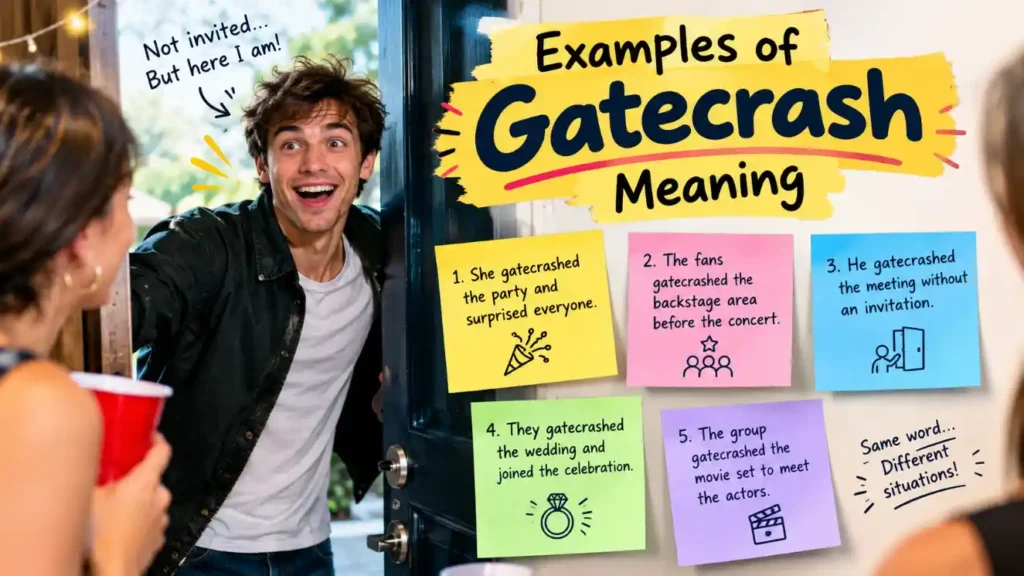
- “A group of strangers gatecrashed the wedding reception after hearing the music from outside.”
- “Security caught the gatecrashers trying to sneak in through a side entrance.”
- “He gatecrashed his old college reunion just to see his former classmates.”
- “Protesters gatecrashed the conference to demand a public statement from organizers.”
- “The party got out of hand once word spread and people started gatecrashing.”
- “She joked about gatecrashing her neighbor’s barbecue since it smelled too good to resist.”
- “The film’s plot centers on two friends who gatecrash a series of exclusive events.”
- “Local teenagers reportedly gatecrashed the private beach club over the weekend.”
- “He gatecrashed the press conference by posing as a journalist.”
- “They gatecrashed the awards ceremony after failing to get official tickets.”
How to Use It (Grammar and Context)
Gatecrash functions as a verb: “to gatecrash a party,” “he gatecrashed the event.” The related noun form, “gatecrasher,” describes the person doing the gatecrashing: “security removed several gatecrashers from the venue.”
The word works in both formal news writing and casual conversation, though its tone shifts depending on context, playful among friends describing harmless uninvited attendance, more serious in news coverage of security breaches or forced entry.
Common Mistakes
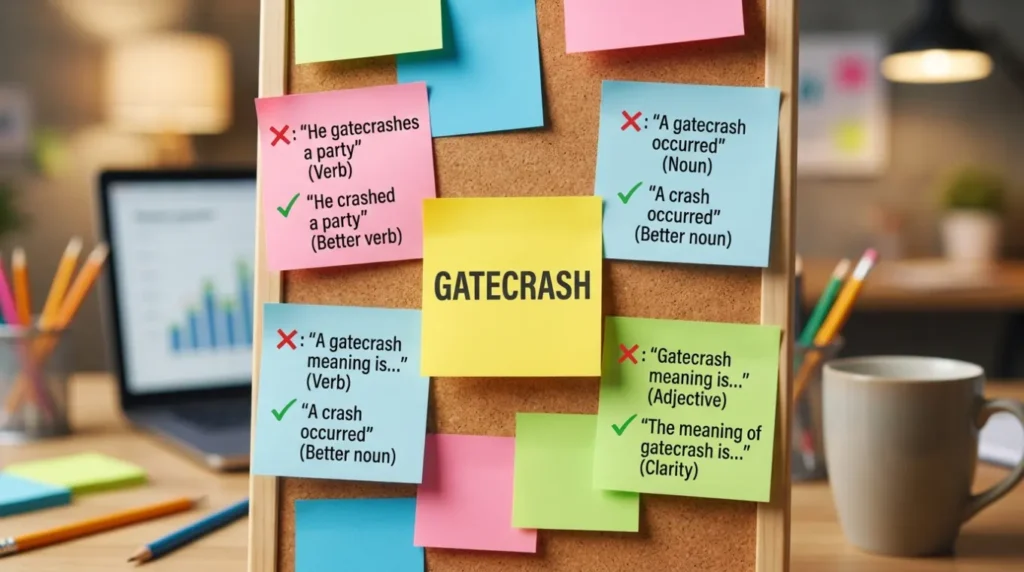
Assuming it only applies to parties. While parties remain the classic example, gatecrash applies to any event or venue someone enters without permission, including formal, professional, or secured settings.
Confusing gatecrash with simply arriving late. Gatecrashing specifically implies lacking an invitation or permission altogether, not just showing up after the scheduled start time.
Treating gatecrash and “crash” as identical in every region. American English speakers more commonly use “crash” alone (“crash a party”), while “gatecrash” appears more frequently in British and Australian English, though both describe the same basic act.
Assuming gatecrashing always involves conflict. While some gatecrashing incidents involve confrontation or security removal, plenty of cases go unnoticed or get resolved without any real conflict at all.
Similar Words
| Word | Meaning | Difference from Gatecrash |
| Crash (a party) | To attend an event uninvited | Nearly identical meaning; “crash” is more common in American English, “gatecrash” more common in British and Australian English |
| Trespass | To enter property without permission or legal right | Trespass carries a stronger legal connotation and applies to property generally, not just events |
| Sneak in | To enter somewhere quietly or covertly, avoiding detection | Sneaking in emphasizes stealth; gatecrashing can involve boldness rather than pure secrecy |
| Barge in | To enter a place or situation abruptly and without invitation | Barging in emphasizes forcefulness or rudeness of entry, often into a room or conversation rather than a full event |
Opposite Words
| Word | Meaning | Why It’s an Opposite |
| RSVP | To formally confirm attendance at an invited event | Represents the proper, invited process gatecrashing bypasses entirely |
| Invited guest | Someone formally asked to attend an event | The direct opposite of an uninvited gatecrasher |
| Turned away | Denied entry to an event or venue | Represents the outcome gatecrashing specifically tries to avoid |
Pronunciation
Gatecrash is pronounced GAYT-krash, with the stress on the first syllable.
Quick Facts
| Fact | Detail |
| Word type | Verb (also used as a noun: “gatecrasher”) |
| Word origin | Combination of “gate” and “crash,” early 20th-century British English |
| Common regions | Especially common in British and Australian English |
| American equivalent | “Crash” (as in “crash a party”) |
| Typical settings | Parties, weddings, concerts, formal events, secured venues |
| Related noun | Gatecrasher (the person who gatecrashes) |
FAQs
Gate crashing means attending an event, party, wedding, or gathering without an invitation or permission from the host.
Gatecrashers are people who attend an event without being invited or without having permission to enter.
Another word for gatecrashing is intruding. Depending on the context, you can also use trespassing, crashing, sneaking in, or entering uninvited.
The idiom “gate crasher” refers to someone who enters or attends an event without an invitation or permission.
In slang, “crashed” can mean showing up somewhere unexpectedly or without an invitation. For example, “He crashed the party” means he attended the party without being invited.
In slang, “gate” can have different meanings depending on context. In phrases like “gatecrashing,” it refers to the entrance or access point to an event or place.
A more formal or sophisticated word for crash is collide, impact, or intrude, depending on the meaning. For attending an event without an invitation, intruding is appropriate.
Five good synonyms for gatecrashing are intruding, trespassing, sneaking in, crashing, and entering uninvited.
Another word for killjoy is spoilsport. Other alternatives include party pooper, wet blanket, buzzkill, and grump.
In English, a gatecrasher is a person who attends an event without an invitation or enters a place without permission.
Crashers generally mean people who attend an event without an invitation. For example, “The party had several crashers” means several uninvited people attended.
When someone says a girl is “crashing out,” it usually means she is becoming extremely upset, angry, overwhelmed, or emotionally distressed. In modern slang, it can also describe reacting dramatically to a situation.
What is another word for “gatecrashing”?
Another word for gatecrashing is intruding. Depending on the context, you can also use trespassing, crashing, sneaking in, or entering uninvited.
What does the idiom “gate crasher” mean?
The idiom “gate crasher” refers to someone who enters or attends an event without an invitation or permission.
What does “crashed” mean in slang?
In slang, “crashed” can mean showing up somewhere unexpectedly or without an invitation. For example, “He crashed the party” means he attended the party without being invited.
What is another word for “killjoy”?
Another word for killjoy is spoilsport. Other alternatives include party pooper, wet blanket, buzzkill, and grump.
What does “gatecrasher” mean in English?
In English, a gatecrasher is a person who attends an event without an invitation or enters a place without permission.
What does the word “crashers” mean in English?
Crashers generally mean people who attend an event without an invitation. For example, “The party had several crashers” means several uninvited people attended.
Key Takeaways
- Gatecrash means to attend an event or venue without an invitation, ticket, or permission.
- The word combines “gate” and “crash,” emerging in early 20th-century British English.
- “Gatecrasher” names the person who gatecrashes an event.
- The word applies to parties, weddings, concerts, and more formal or secured settings alike.
- American English typically favors “crash” alone, while “gatecrash” remains more common in British and Australian English.
Conclusion
The gatecrash meaning captures something specific: not just showing up somewhere uninvited, but getting past whatever barrier a guest list, a locked door, a security checkpoint was meant to keep you out. That extra layer of boldness is what separates gatecrashing from simply wandering into the wrong room by accident.
The word’s regional split also tells its own small story. British and Australian English kept the fuller, more vivid “gatecrash,” while American English trimmed it down to the punchier “crash,” yet both versions describe the exact same social move: showing up somewhere you weren’t asked to be, and staying anyway.
If you picture a stranger sneaking into a wedding reception for free food or a group of protesters forcing their way into a restricted press conference, gatecrash captures that same core idea every time an entrance nobody planned for, made anyway.

I am Stephen King an American author known for compelling storytelling. At writemora.com, we value clear, accurate, and reader-focused content inspired by excellence in writing.