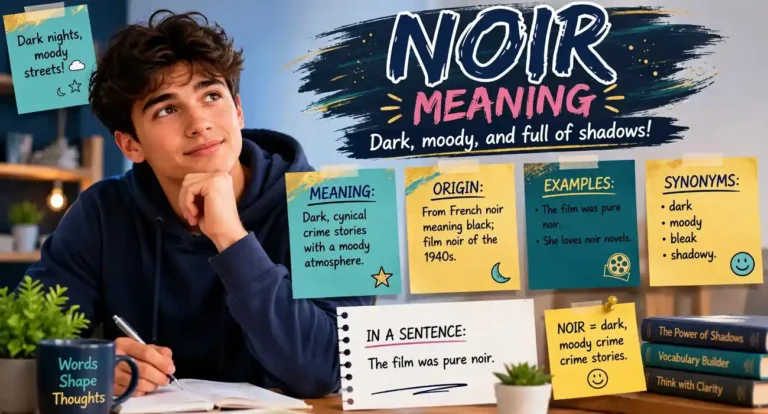
Noir is the French word for “black,” and in English it names a mood as much as a color. Most people meet it in the phrase film noir, the shadowy Hollywood crime dramas of the 1940s and 1950s, but the noir meaning has traveled far beyond cinema into fashion, design, and everyday descriptions of anything dark, cynical, or mysterious.
Understanding the noir meaning matters because the word carries different weight in different settings. In French it is simply a color; in English it suggests an entire atmosphere of rain-slicked streets and moral gray zones. This guide covers what noir means, where the word comes from, its most famous uses, and the mistakes people commonly make with it.
What It Means
In simple terms, noir means “black” in French, and the noir meaning in English describes anything with the dark, moody quality of classic crime films. A “noir novel,” a “noir wardrobe,” or a “noir atmosphere” all borrow the same idea: shadow, mystery, and a touch of danger.
The word works as both adjective and noun: noir fiction, noir lighting, noir fashion as an adjective; film noir or neo-noir as a noun.
It is worth noting that noir rarely means just the color black in English. Saying a room has “noir style” says more than “the room is black.” It suggests drama, contrast, and attitude: the difference between a black wall and a black wall in a detective’s office at midnight.
Origin & History
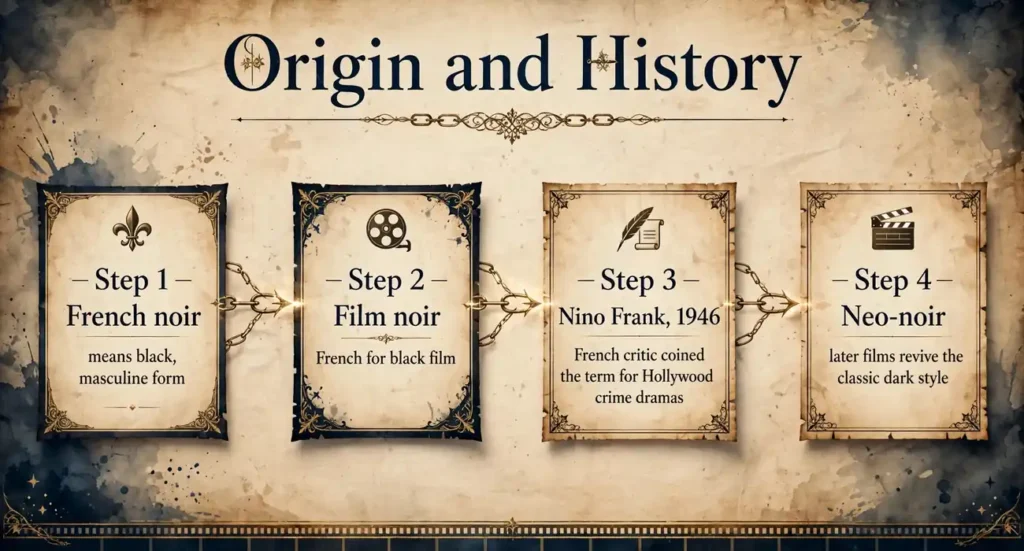
Understanding the noir meaning begins with its origin: noir comes directly from French, where “noir” (masculine; “noire” for feminine nouns) means black. It entered English through the phrase film noir, French for “black film,” first applied to Hollywood crime dramas by French critic Nino Frank in 1946, after a wave of dark American films reached Paris following the war.
The classic period of film noir ran through the 1940s and 1950s: black-and-white cinematography, cynical detectives, femme fatales, and stories of crime and moral compromise, many rooted in American hardboiled fiction of the Depression era. The American filmmakers themselves barely used the term; critics defined the category afterward, and it only became widely adopted in the 1970s.
Later films with the same spirit became neo-noir (“new noir”), and the word spread into literature, fashion, and general speech.
Different Contexts and Meanings
Film noir. The noir meaning in its original and most famous use: Hollywood crime dramas of the 1940s and 1950s with shadowy visuals, cynical heroes, and doomed romances. The Maltese Falcon and Double Indemnity are classic examples.
Neo-noir. Films from the 1960s onward that revive the classic noir style, often in color and with self-aware nods to the originals, such as modern crime films with morally gray detectives.
Noir fiction. Crime novels in the hardboiled tradition, featuring tough protagonists, corrupt cities, and bleak outcomes, from the American classics to their international descendants.
Noir in fashion and design. An all-black or dark aesthetic described as noir suggests elegance with an edge: black clothing, dark interiors, high-contrast photography. Here the word sells attitude, not just color.
Examples
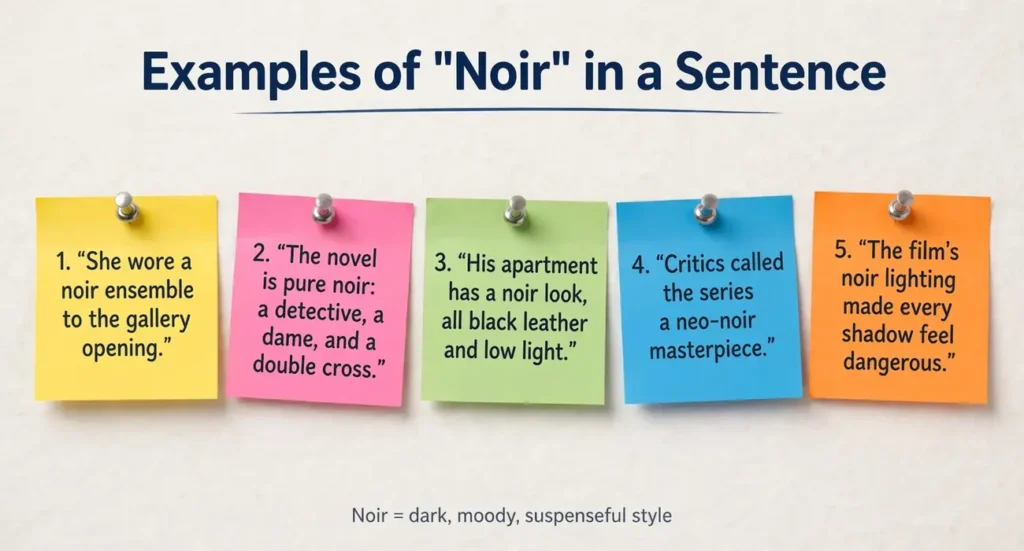
- “She wore a noir ensemble to the gallery opening.”
- “The novel is pure noir: a detective, a dame, and a double cross.”
- “His apartment has a noir look, all black leather and low light.”
- “Critics called the series a neo-noir masterpiece.”
- “The film’s noir lighting made every shadow feel dangerous.”
- “She loves noir fiction from the 1940s.”
- “The photographer favors a noir style with deep blacks.”
- “He described the city’s back streets as pure film noir.”
- “The bar’s noir decor felt like a scene from a 1940s detective film.”
- “She chose a noir palette for the photo shoot, all shadow and contrast.”
How to Use It (Grammar and Context)
The noir meaning works as an adjective placed before a noun: “noir film,” “noir novel,” “noir aesthetic.” It does not change form in English. Unlike French, English never adds an “e” for feminine nouns, so “noire” is generally a spelling error in English text.
As a noun, noir almost always appears inside a fixed phrase: film noir, neo-noir. Saying “I love noir” is understood to mean the genre or the aesthetic, but on its own the word is vague, so pairing it with a noun is safer.
The word carries a stylish, positive charge: calling a film noir is praise, calling an outfit noir a compliment. Use it when you want the mood, not just the shade.
Common Mistakes
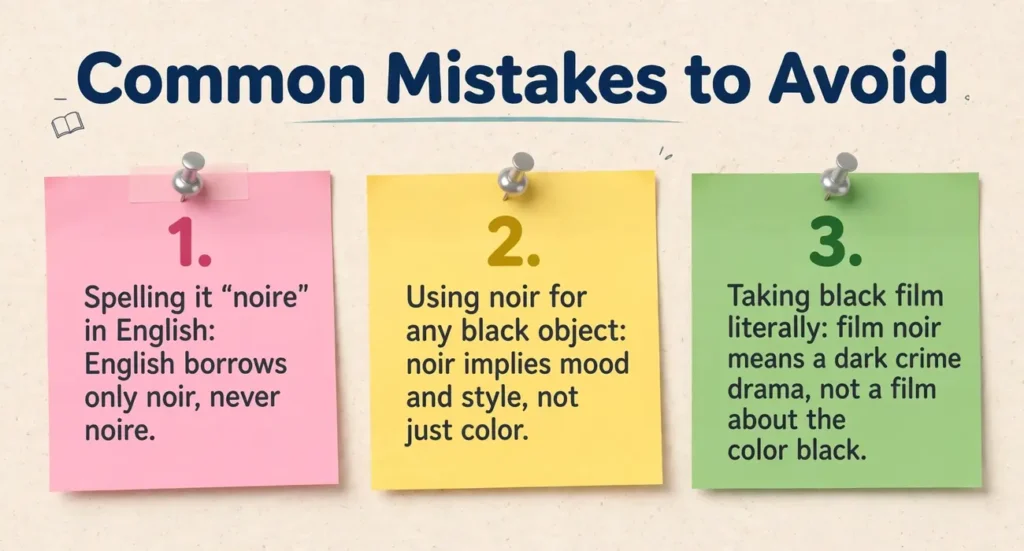
Spelling it “noire” in English. In French, “noire” is the feminine form, but English borrows only “noir.” Writing “film noire” is a common error.
Using the noir meaning for any black object. Noir implies mood and style, not just color. A black toaster is not noir; a black leather jacket in a detective film might be.
Taking “black film” literally. Film noir does not mean a film about the color black. It means a dark crime drama, named for its shadows, themes, and moral darkness.
Overusing it until it means nothing. Because noir sounds stylish, writers attach it to anything slightly dark. If everything is noir, the word loses the specific crime-film atmosphere that gives it power.
Similar Words
| Word | Meaning | Difference from Noir |
|---|---|---|
| Dark | Lacking light, or sinister in tone | Dark is general; noir points specifically to the crime-film mood |
| Gothic | Mysterious and eerie, often with horror | Gothic leans toward horror; noir toward crime and cynicism |
| Hardboiled | Tough, unsentimental crime-fiction style | Hardboiled describes the writing attitude; noir the whole atmosphere |
| Cynical | Distrustful and bleak in outlook | Cynical is an attitude; noir is an aesthetic that includes cynicism |
| Shadowy | Full of shadows, secretive | Shadowy is literal darkness; noir adds the stylish genre frame |
Opposite Words
| Word | Meaning | Why It’s an Opposite |
|---|---|---|
| Bright | Full of light, cheerful | Directly opposes the darkness at the heart of noir |
| Wholesome | Morally good and innocent | Contrasts with noir’s corruption and moral gray zones |
| Lighthearted | Carefree and not serious | Opposes noir’s brooding seriousness |
| Pastoral | Rural, peaceful, and idyllic | The calm countryside set against noir’s corrupt city streets |
Pronunciation
Noir is pronounced “nwahr,” in a single syllable. The vowel is a rounded French sound, but the anglicized “nwar” is widely accepted in American speech.
Quick Facts
| Fact | Detail |
|---|---|
| Word origin | French “noir” (black); “film noir” coined by critic Nino Frank, 1946 |
| Part of speech | Adjective (“noir fiction”); noun in set phrases (“film noir”) |
| Common phrases | Film noir, neo-noir, noir fiction, noir aesthetic |
| Key distinction | Noir means a dark mood or style, not just the color black |
| Common confusion | “Noir” vs “noire” (feminine French form, not used in English) |
| Related words | Neo-noir (noun), noir-ish (informal adjective) |
Key Takeaways
- The noir meaning is French for “black,” but in English it names a dark, moody style rooted in 1940s crime films.
- The term “film noir” was coined by French critic Nino Frank in 1946 for Hollywood crime dramas.
- Neo-noir describes later works that revive the classic noir spirit.
- In fashion and design, noir means an all-black aesthetic with attitude.
- In English, always spell it “noir,” never “noire.”
FAQs
What does noir mean literally?
In French, noir literally means “black.” In English, it usually carries the added sense of a dark, mysterious mood borrowed from crime films.
What is film noir?
A style of Hollywood crime drama from the 1940s and 1950s, known for shadowy black-and-white visuals, cynical detectives, femme fatales, and morally gray stories.
What is the difference between noir and neo-noir?
Classic noir refers to the original 1940s-1950s films. Neo-noir (“new noir”) describes later works that update the noir style, often in color and with modern settings.
How do you pronounce noir?
One syllable: “nwahr.” The vowel is a rounded French sound, but the anglicized “nwar” is common and accepted in American English.
Can you use noir to describe clothes?
Yes. A “noir look” in fashion means an all-black or dark outfit with a dramatic, edgy feel. It suggests style rather than just color.
Conclusion
The noir meaning starts with a simple French color word and grows into an entire atmosphere. From Nino Frank’s 1946 label for shadowy Hollywood crime dramas, noir has become English shorthand for stylish darkness: in film, in fiction, in fashion, and in the way we describe a rain-soaked street at midnight.
What keeps the word alive is its precision: noir means dark with a story behind it, cynicism, danger, and glamour in uneasy balance.
Use it when the mood is genuinely there: the shadows, the moral gray, the edge. Save it for the real thing, and noir will keep its power to turn a simple description into a scene.

I am Olivia Brooks an American editor and content researcher dedicated to creating clear, accurate content. At writemora.com, I help readers to understand words, phrases, and modern language with confidence.