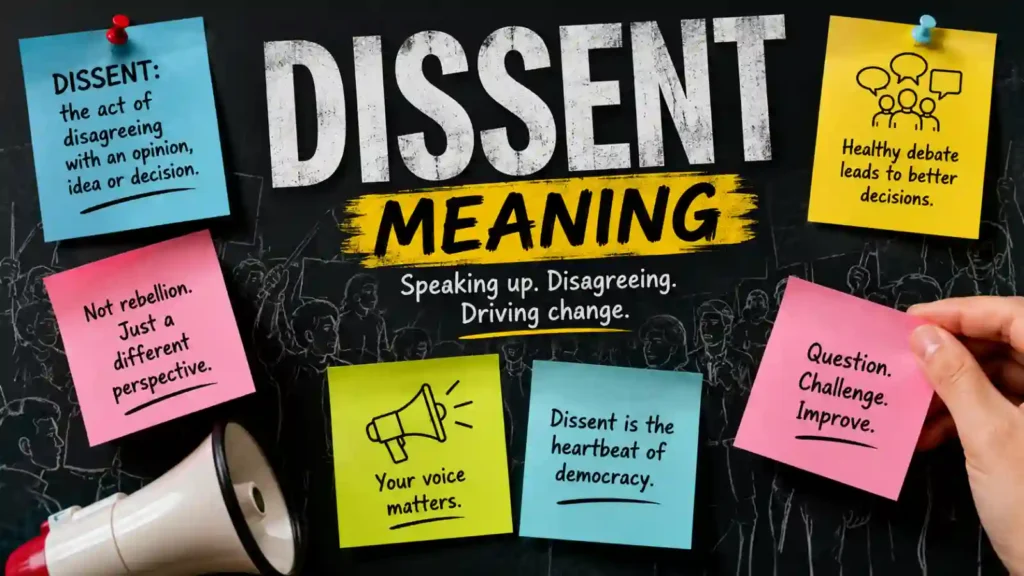
Dissent meaning, in simple terms, is disagreement specifically, the act of holding or expressing an opinion that goes against the official or majority view. When a judge writes a dissenting opinion, or a citizen protests a government policy, they’re dissenting: pushing back against what most people around them believe or have decided.
The word shows up everywhere, from courtrooms to church history to office meetings. But it carries a specific weight that “disagreement” alone doesn’t quite capture. Dissent isn’t just a quiet difference of opinion; it usually implies standing apart from an established authority, group, or consensus, often publicly and sometimes at a cost.
This guide breaks down what dissent means, where the word comes from, how it’s used across different fields, and how to use it correctly yourself.
What It Means
The simple version
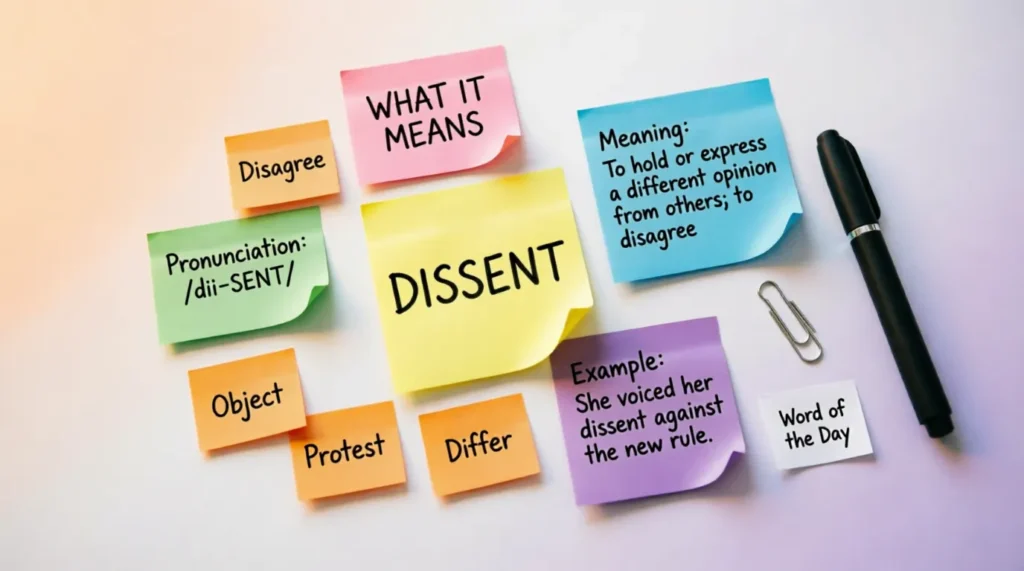
Dissent means to disagree, especially with a decision, policy, or belief that’s official, popular, or widely accepted. As a noun, dissent is the disagreement itself, the objection, the opposing view, the pushback.
The fuller picture
Dissent is stronger and more specific than ordinary disagreement. Three things usually separate dissent from a casual “I don’t agree”
- There’s an established position being challenged. You dissent from something: a ruling, a policy, a doctrine, a group decision. It’s relational, not just a standalone opinion.
- It’s often formal or public. A judge’s dissent goes on the record. A political dissenter speaks out or organizes. Dissent tends to leave a trace.
- It carries some friction or risk. Because dissent goes against authority or the majority, it can invite pushback, from mild disapproval to serious consequences, depending on the setting.
Dissent can be a single word of protest or a fully reasoned argument. What makes it dissent is the act of standing against the accepted view, not the volume or length of the objection.
Origin & History
Dissent comes from the Latin word dissentire, built from dis- (apart, differently) and sentire (to feel or think). Literally, it means “to feel differently” or “to think apart from.”
The word entered English through Old French and Latin roots and has been used since at least the 16th century, largely in religious and political contexts. Its early and most persistent use was tied to religious dissent people who broke from an established church’s teachings or practices. In England, “Dissenters” became a specific historical term for Protestants who refused to conform to the Church of England after the Reformation, including groups like Baptists, Quakers, and Congregationalists. That religious usage is part of why “dissent” still carries a sense of principled, sometimes costly, departure from an official line, rather than just casual disagreement.
From there, the word expanded into political and legal life, especially as modern democracies developed formal ways to record disagreement, such as dissenting votes and dissenting judicial opinions.
Different Contexts and Meanings
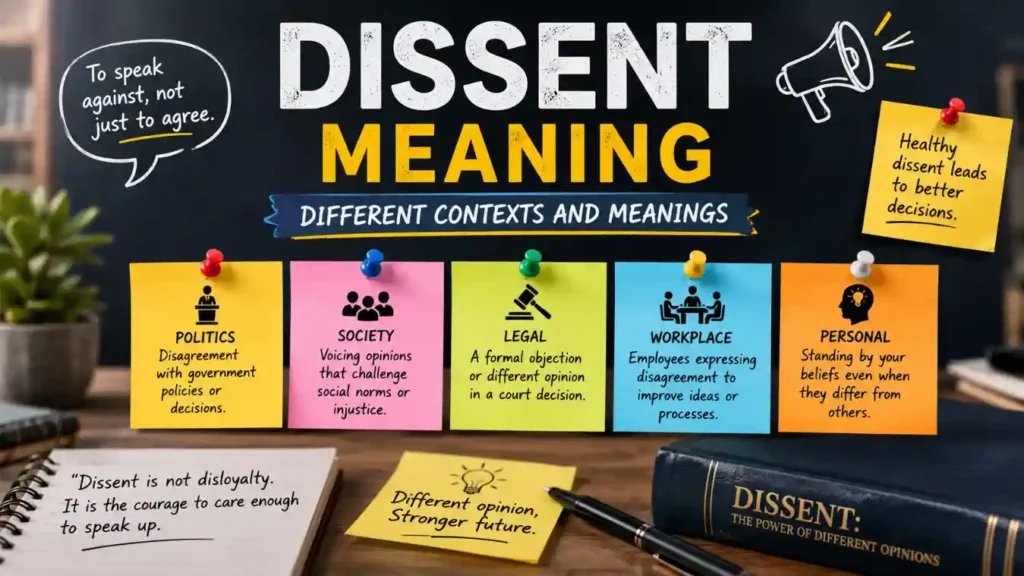
The core idea, disagreement with an established position, stays constant, but the word shifts depending on where you encounter it.
Legal dissent
In law, a dissenting opinion is written by a judge who disagrees with the majority ruling in a court case. It doesn’t change the outcome of that case, but it lays out an alternative legal reasoning that can influence future cases, legal scholarship, or even later court decisions that overturn the original ruling.
Political dissent
Political dissent refers to opposition to a government, its policies, or its leadership. This can take many forms: public protest, criticism in the press, organized activism, or refusal to comply with certain laws. In authoritarian systems, political dissent is often suppressed; in democracies, it’s generally protected as free speech, though the degree of protection varies by country and situation.
Religious dissent
Historically, religious dissent meant breaking from an official or state-sanctioned church. Today the term is used more broadly for anyone who publicly disagrees with the official teachings or leadership of a religious institution.
Corporate and organizational dissent
Inside companies and organizations, dissent describes an employee or member who disagrees with a decision, policy, or direction set by leadership. Healthy organizations often try to create space for this kind of dissent, since it can surface problems before they become costly.
Everyday dissent
In casual use, “dissent” can simply describe voicing a different opinion in a group setting, like being the one person in a meeting who says “I don’t think this is a good idea.”
Examples
- The justice’s dissent argued that the majority had misread the statute.
- Public dissent grew as the new tax policy took effect.
- She was one of the few voices of dissent in an otherwise unanimous board.
- The regime had little tolerance for political dissent.
- Early Quakers were treated as religious dissenters in 17th-century England.
- His quiet dissent at the meeting was noted but overruled.
- The article explored the history of labor dissent in the region.
- Even within the party, there was growing dissent over the new platform.
- The professor encouraged respectful dissent during class debates.
- Journalists documented the crackdown on dissent following the election.
- The committee’s decision was passed, but not without vocal dissent.
- Historians study dissent movements to understand how social change happens.
How to Use It (Grammar and Context)
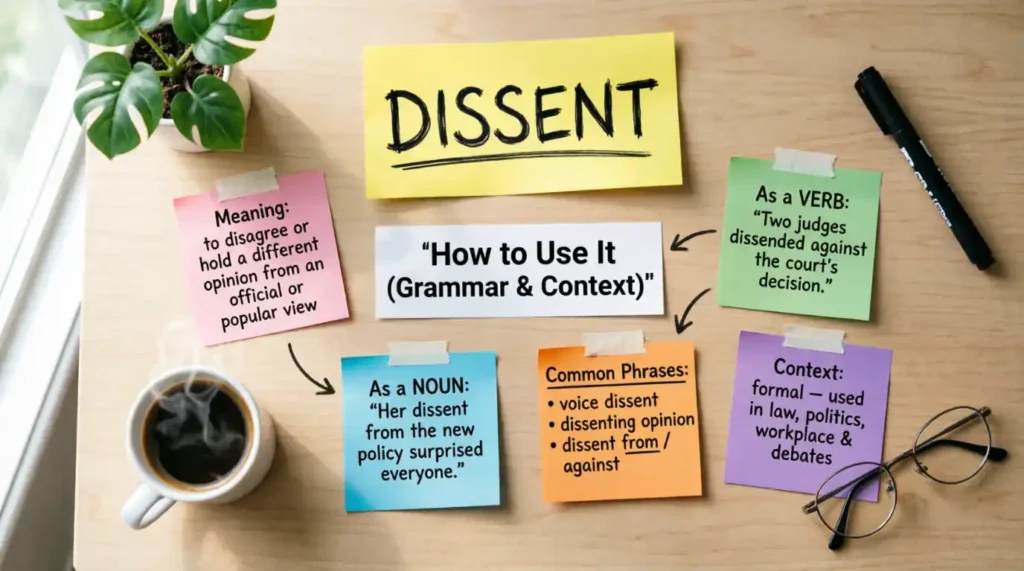
Dissent functions as both a noun and a verb.
- As a noun: “There was strong dissent within the party.” (uncountable you don’t usually say “a dissent,” except in the specific legal sense of a written dissenting opinion, e.g., “Justice Ginsburg’s dissent.”)
- As a verb: “She dissented from the committee’s decision.” Note the preposition: you dissent from a decision, ruling, or view, not “against” or “to.”
Related word forms:
- Dissenter (noun) a person who dissents.
- Dissenting (adjective) describing the disagreement itself, as in “a dissenting vote” or “a dissenting opinion.”
- Dissentious (adjective, less common) prone to causing disagreement or conflict.
Common Mistakes
- Confusing “dissent” with “descent.” They sound alike but mean very different things: descent relates to going downward or lineage, while dissent is about disagreement.
- Using “dissent” for any mild disagreement. Saying “I dissent” about picking a restaurant sounds odd, since the word implies a more formal or consequential kind of pushback.
- Wrong preposition. It’s “dissent from,” not “dissent against” or “dissent with.”
- Treating dissenting meaning as always countable. In most everyday and political contexts, dissent is uncountable (“there was dissent,” not “there were three dissents”), except in the specific legal usage referring to individual written opinions.
Similar Words
| Word | Meaning | Difference from Dissent |
| Disagree | To hold a different opinion | More general and casual; doesn’t necessarily involve an authority or formal setting |
| Object | To express opposition to something specific | Often used for a specific point or proposal, not a broader stance |
| Protest | To publicly express strong objection | Usually more active and visible; often involves collective action |
| Oppose | To actively work against something | Can involve action, not just voiced opinion |
| Rebel | To resist authority, sometimes forcefully | Implies a more active, often defiant break from authority |
Opposite Words
| Word | Meaning |
| Consent | To agree to or approve of something |
| Agree | To share the same opinion or view |
| Concur | To formally express agreement, often used alongside “dissent” in legal contexts |
| Assent | To officially or formally agree |
| Comply | To act in accordance with a rule or request |
Pronunciation
Dissent is pronounced dih-SENT (/dɪˈsɛnt/), with the stress on the second syllable. It rhymes with “cent” and “went.”
Quick Facts
| Fact | Detail |
| Word type | Noun and verb |
| Origin | Latin dissentire (“to feel differently”) |
| First recorded English use | Around the 16th century |
| Common fields of use | Law, politics, religion, organizations |
| Related legal term | Dissenting opinion |
| Common confusion | Often mixed up with “descent” |
FAQs
What does dissent mean in simple terms?
Dissent means to disagree, especially with an official decision, policy, or majority view.
What is a dissenting opinion?
A dissenting opinion is a written statement by a judge who disagrees with the majority ruling in a court case, explaining their own reasoning.
Is dissent the same as protest?
They’re related but not identical. Dissent is the underlying disagreement; protest is one way dissent gets expressed publicly, often through collective action.
What’s the difference between dissent and descent?
Dissent means disagreement. Descent refers to moving downward, or to family lineage (as in “of Irish descent”). They’re unrelated words that happen to sound similar.
Can dissent be a good thing?
Many institutions, courts, companies, and democracies view dissent as valuable because it surfaces alternative viewpoints, tests decisions, and can prevent groupthink.
What is the opposite of dissent?
Common opposites include consent, agreement, and assent.
What is a person who dissents called?
A dissenter.
Where does the word dissent come from?
It comes from the Latin dissentire, meaning “to feel or think differently,” combining dis- (apart) and sentire (to feel).
Is dissent a crime?
Not inherently. In democracies, dissent, especially political and religious dissent, is generally protected as a form of free expression, though laws vary widely by country and context.
What does it mean to dissent from a ruling?
It means formally disagreeing with a decision, typically explaining the reasoning behind that disagreement.
Key Takeaways

- Dissent means disagreeing with an official, majority, or authoritative position, not just holding a different casual opinion.
- The word comes from the Latin dissentire, meaning “to feel differently.”
- It shows up in law (dissenting opinions), politics (opposition to government), religion (breaking from official doctrine), and organizations.
- Dissent is often confused with “descent” ; they’re unrelated words.
- The opposite of dissent includes consent, agreement, and assent.
- A person who dissents is called a dissenter.
Conclusion
At its core, dissent is about disagreeing with something official, if that’s a court ruling, a government policy, a religious doctrine, or a decision made by a group you’re part of. It’s a word with real historical weight, tied to centuries of people who spoke up against the accepted view, sometimes at real personal cost. That’s what separates it from ordinary disagreement: dissent almost always implies a power structure being pushed against, and a degree of courage or risk in doing so.
Understanding the word also means understanding why it matters. Courts publish dissenting opinions because the losing argument in a case can still shape the law later on. Democracies protect political dissent because a society that can’t voice disagreement has a much harder time correcting its own mistakes. Even inside a single company or classroom, a well-placed dissenting view can stop a bad decision before it happens. Dissent, in other words, isn’t just friction, it’s often how systems improve over time.
Next time you come across the word, in a news headline, a legal case, a history book, or a heated meeting at work, you’ll be able to place it precisely: not just disagreement, but disagreement that pushes against something established, and does so out in the open. If you want to go deeper, a natural next step is looking up a specific famous dissenting opinion or historical dissent movement to see the concept in action.

I am Olivia Brooks an American editor and content researcher dedicated to creating clear, accurate content. At writemora.com, I help readers to understand words, phrases, and modern language with confidence.