
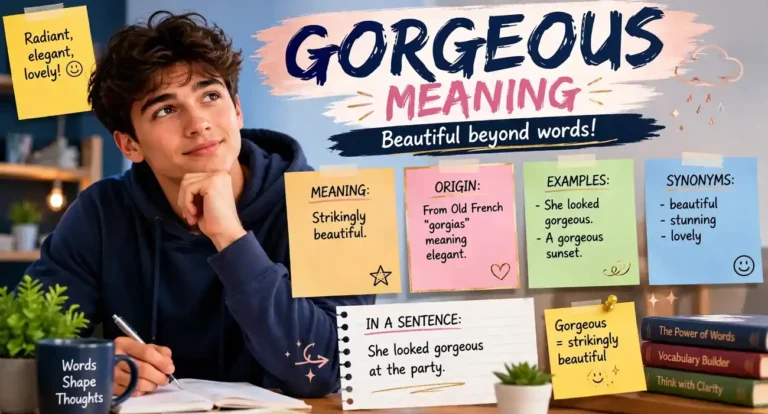
Gorgeous is one of the strongest compliments in English. For example, people use it for a beautiful person, a stunning sunset, a perfect dress, or a meal that looks too good to eat. Meanwhile, the word carries more punch than “pretty” or “nice.” When someone calls something gorgeous, they mean it stopped them for a second. In fact, it dazzled them. Overall, the word works for people, places, objects, and experiences, and it fits casual compliments and poetic descriptions alike. Therefore, this article explains the gorgeous meaning in full, traces its surprising history, and shows how to use it with style.
What “Gorgeous” Means
Gorgeous means strikingly beautiful, dazzling, or splendid. First, it describes something that impresses through beauty, color, or elegance. For example, you can call a person gorgeous, a view gorgeous, or a dress gorgeous. Meanwhile, the word often implies richness or luxury. In addition, a gorgeous hotel lobby has marble, light, and grand details. Similarly, a gorgeous voice has warmth and power. People also use the word playfully. For instance, friends greet each other with “Hey, gorgeous” as a term of affection. Finally, the word works as an adjective, and it can modify almost any noun that can look or feel beautiful. However, it sits above “pretty” in intensity. Pretty pleases the eye. Gorgeous stuns it. As a result, that extra force is why the word remains popular in compliments, fashion writing, travel guides, and song lyrics.
Origin & History
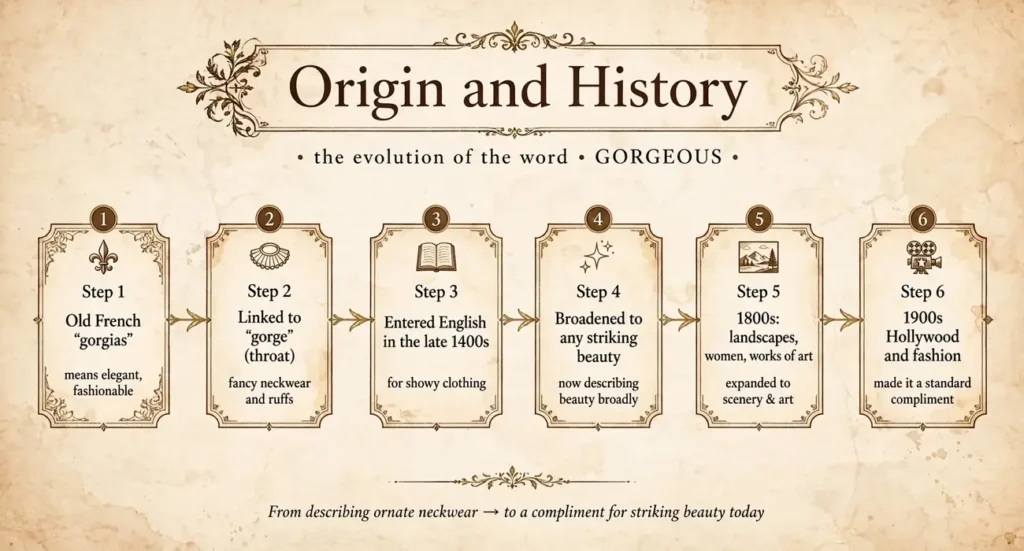
Gorgeous has a surprising origin. First, it comes from the Old French word “gorgias,” which meant elegant or fashionable, and some scholars link it to “gorge,” the throat, because fancy clothing once featured elaborate neckwear and ruffs. Meanwhile, the word entered English in the late 1400s and first described showy clothing and rich decoration. Later, over time, it broadened to describe any striking beauty. In addition, by the 1800s, writers used gorgeous for landscapes, women, and works of art. However, the word kept its sense of richness and splendor. Similarly, in the 1900s, Hollywood and fashion magazines made gorgeous a standard compliment. For example, movie stars were gorgeous, gowns were gorgeous, and premieres were gorgeous affairs. Finally, today, the word appears everywhere, from Instagram captions to wedding vows. Overall, its journey from fancy collars to universal compliment shows how a word can grow beyond its roots while keeping its sparkle.
Different Contexts and Meanings
First, in compliments, gorgeous describes a person with striking beauty. Meanwhile, friends, partners, and family use it to praise looks, style, or presence. Next, in fashion, writers call gowns, shoes, and accessories gorgeous when they combine color, fabric, and design in a memorable way. In addition, in travel writing, gorgeous describes beaches, mountains, and cities that take your breath away. For example, a travel guide might call Santorini gorgeous for its white buildings and blue sea. Similarly, in food writing, gorgeous can describe a dish that looks as good as it tastes. Meanwhile, in nature writing, it fits sunsets, flowers, and autumn leaves. In addition, in music, fans call a voice or a performance gorgeous when it moves them. Finally, in slang, “gorgeous” sometimes works as a playful greeting between friends, regardless of looks. Overall, each use keeps the core idea: beauty strong enough to impress.
Examples of “Gorgeous” in a Sentence
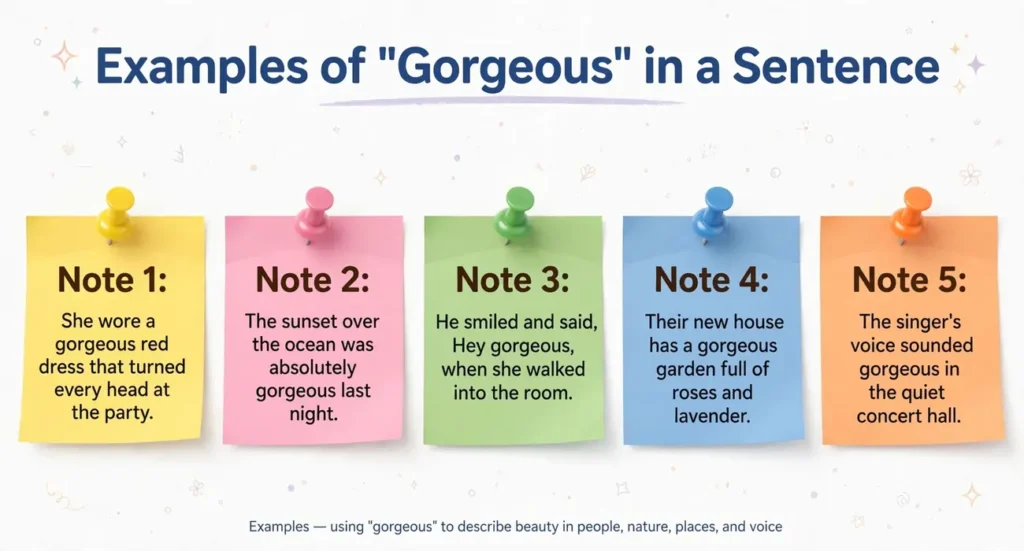
- “She wore a gorgeous red dress that turned every head at the party.”
- “The sunset over the ocean was absolutely gorgeous last night.”
- “He smiled and said, Hey gorgeous, when she walked into the room.”
- “Their new house has a gorgeous garden full of roses and lavender.”
- “The singer’s voice sounded gorgeous in the quiet concert hall.”
- “We stayed at a gorgeous little hotel with views of the mountains.”
- “That chocolate cake looks gorgeous with the berries on top.”
- “She called the autumn leaves gorgeous as they covered the whole street.”
- “The bride looked gorgeous, and everyone said so twice.”
- “He bought her a gorgeous bouquet for their anniversary.”
How to Use “Gorgeous” Correctly
Gorgeous is an adjective, and it usually comes before a noun: “a gorgeous view,” “a gorgeous dress.” For example, you can also use it after a linking verb: “The view is gorgeous.” In addition, you can intensify it with “absolutely,” “truly,” or “so”: “absolutely gorgeous.” However, avoid stacking it with other strong adjectives, since one strong word does the job. Meanwhile, in formal writing, gorgeous fits descriptions of art, nature, and design. In contrast, in casual talk, it fits compliments and greetings. Be careful with compliments at work or with strangers, since commenting on looks can feel unwelcome. Therefore, a safe rule: compliment choices, like clothes or style, more freely than bodies. Finally, when you greet a close friend with “gorgeous,” the tone is affectionate and fun. With someone you barely know, it can feel too familiar. Overall, match the word to the relationship and the setting.
Common Mistakes to Avoid
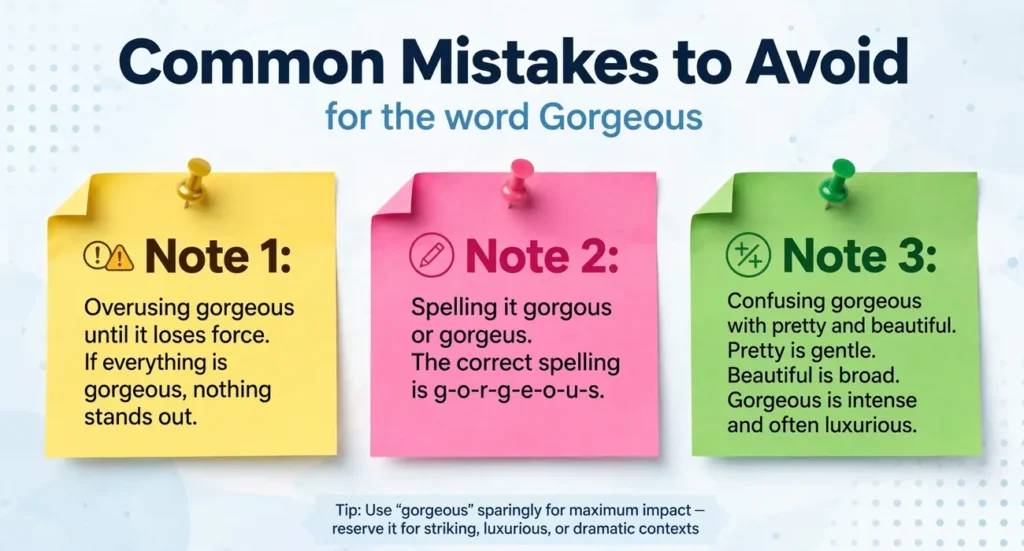
First, one common mistake is overusing gorgeous until it loses force. However, if everything is gorgeous, nothing stands out. Therefore, save it for real standouts. In addition, another mistake is spelling it as “gorgous” or “gorgeus.” Instead, the correct spelling is g-o-r-g-e-o-u-s. Similarly, some people also confuse gorgeous with “pretty” and “beautiful.” Pretty is gentle. Beautiful is broad. Gorgeous is intense and often luxurious. Meanwhile, another error is using gorgeous only for women. In fact, the word fits men, places, objects, and experiences too. Also, people misuse it in formal academic writing where a plainer word like “striking” fits better. Finally, some speakers use gorgeous sarcastically so often that listeners cannot tell when they mean it. Overall, use it sincerely most of the time, and the compliment will land.
Similar Words and Phrases
| Word | Meaning | Difference |
|---|---|---|
| Beautiful | Pleasing to the senses | Broader; gorgeous adds intensity and dazzle |
| Stunning | Shockingly impressive | Similar force; stunning stresses surprise |
| Lovely | Delightful and pleasant | Gentler; gorgeous is stronger |
| Splendid | Magnificent and rich | Formal; gorgeous is warmer and casual |
| Radiant | Glowing with beauty | Stresses light; gorgeous stresses overall impact |
| Exquisite | Finely and delicately beautiful | Refined; gorgeous can be bold and grand |
Opposite Words and Phrases
| Word | Meaning | Why It’s an Opposite |
|---|---|---|
| Ugly | Unpleasant to look at | Direct opposite of beautiful |
| Plain | Simple and unremarkable | Lacks the dazzle of gorgeous |
| Drab | Dull and colorless | No color or life, unlike gorgeous |
| Unsightly | Unpleasant to see | The visual reverse of gorgeous |
Pronunciation
You pronounce the word as GOR-jus. First, stress the first syllable, GOR, which rhymes with “door.” Meanwhile, the second syllable is soft and quick, like “jus.” Finally, the whole word has two syllables, and American speakers often blend them smoothly. For example, say it with warmth, since it is almost always a compliment.
Quick Facts
| Fact | Detail |
|---|---|
| Part of speech | Adjective |
| Core meaning | Strikingly beautiful or splendid |
| Language origin | Old French “gorgias,” elegant or fashionable |
| First English use | Late 1400s, for showy clothing |
| Intensity | Stronger than pretty, similar to stunning |
| Common uses | Compliments, fashion, travel, food, nature |
| Casual greeting | “Hey, gorgeous” between close friends |
Key Takeaways
- Gorgeous means strikingly beautiful, dazzling, or splendid.
- It comes from Old French and once described fancy clothing.
- It fits people, places, objects, and experiences.
- It is stronger than pretty and warmer than splendid.
- Save it for real standouts so the compliment keeps its force.
Frequently Asked Questions
What does gorgeous mean in simple terms?
It means strikingly beautiful. Something gorgeous impresses you with its beauty, color, or elegance.
Is gorgeous stronger than beautiful?
Yes, usually. Beautiful is broad and calm. Gorgeous adds intensity, dazzle, and often a sense of luxury.
Can you call a man gorgeous?
Yes. The word fits anyone, regardless of gender. It also fits places, clothes, food, and views.
What is the difference between pretty and gorgeous?
Pretty pleases the eye gently. Gorgeous stuns it. A pretty garden is nice. A gorgeous garden stops you in your tracks.
Is it okay to call someone gorgeous at work?
Be careful. Complimenting style or work is safer than commenting on looks, and the relationship and setting matter a lot.
Why do friends say “hey gorgeous” as a greeting?
It is a playful, affectionate greeting. Between close friends, it signals warmth and fun rather than a literal comment on looks.
Conclusion
Gorgeous meaning is simple but powerful: beauty that dazzles. The word traveled from fancy French collars to everyday compliments, and it kept its sparkle all the way.
Use it for people, places, and moments that truly impress you. Save it for the standouts, say it sincerely, and it will always land. After all, everyone likes to hear that something about them, or something they made, is gorgeous. For a standard definition, see the dictionary entry for beauty.

I am Stephen King an American author known for compelling storytelling. At writemora.com, we value clear, accurate, and reader-focused content inspired by excellence in writing.
