
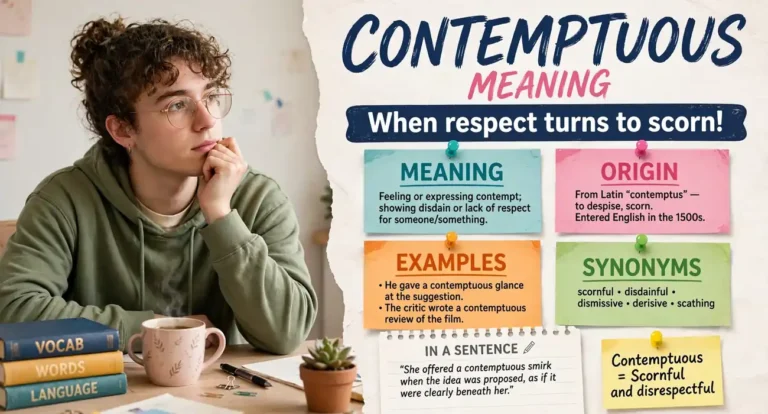
Contemptuous is an adjective that describes someone showing contempt: open scorn, disdain, or a feeling of superiority toward a person or thing. A contemptuous glance, tone, or remark tells the target, without necessarily saying it, that they are considered beneath respect.
Understanding the contemptuous meaning matters because it is easy to confuse with its close cousin “contemptible,” which means almost the opposite. This guide covers what contemptuous means, where it comes from, how it is used, and the mistakes people commonly make with it.
What It Means
In simple terms, contemptuous means full of contempt. Contempt itself is the feeling that someone or something is low, worthless, or unworthy of respect. A contemptuous person does not just dislike the target; they look down on it.
The word usually describes expressions and attitudes rather than private feelings. You can be privately annoyed, but “contemptuous” suggests the scorn shows: in the curl of a lip, the coldness of a tone, the dismissal in a reply. A manager who answers a junior employee’s idea with a contemptuous laugh is communicating scorn whether they intend to or not.
It is a strong, formal word. In everyday speech people more often say “scornful” or “snooty,” but in writing, especially literary or journalistic writing, contemptuous carries precise weight.
Origin & History
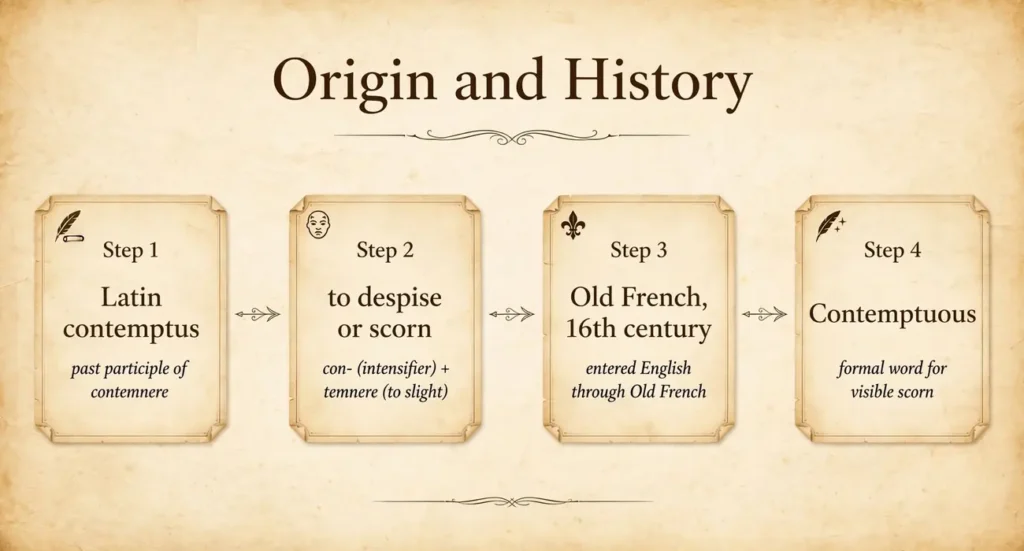
Contemptuous comes from the Latin word “contemptus,” the past participle of “contemnere,” meaning “to despise or scorn.” The root combines “con-“ (an intensifier) with “temnere” (to slight or despise). The idea of “despising” has been baked into the word from the start.
It entered English through Old French in the 16th century, alongside its relatives “contempt” (the noun for the feeling) and “contemptible” (the adjective for something deserving contempt). English writers quickly put it to work in moral and political writing, where describing an opponent’s attitude as contemptuous was a sharp rhetorical strike.
Over the centuries, the word has kept its formal register. You will find it in courtroom reporting, literary criticism, and political commentary far more often than in casual conversation.
Different Contexts and Meanings
Personal attitude. The most common use describes how someone treats others: a contemptuous boss, a contemptuous classmate. It signals a superiority complex made visible.
Tone and expression. Writers use it for voices, looks, and gestures: “a contemptuous smile,” “a contemptuous tone.” Here it captures scorn communicated without explicit insult.
Literature and rhetoric. In novels and speeches, labeling a character’s attitude as contemptuous tells the reader exactly where that character stands morally. It is a favorite tool of narrators who want to condemn snobbery.
Legal language. Note the important boundary: “contemptuous” is not the same as “contempt of court.” Contempt of court is a legal offense, disobeying or disrespecting a court’s authority. A person can behave contemptuously in a courtroom and thereby commit contempt of court, but the two terms belong to different domains.
Examples
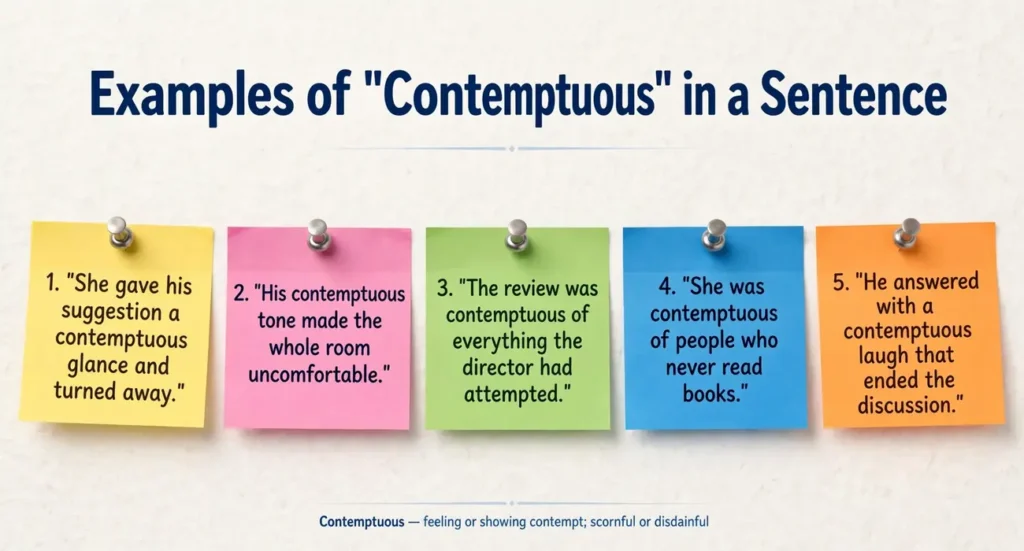
- “She gave his suggestion a contemptuous glance and turned away.”
- “His contemptuous tone made the whole room uncomfortable.”
- “The review was contemptuous of everything the director had attempted.”
- “She was contemptuous of people who never read books.”
- “He answered with a contemptuous laugh that ended the discussion.”
- “Their contemptuous attitude toward the staff caused high turnover.”
- “The novel’s villain is contemptuous of everyone below his station.”
- “Critics called the speech contemptuous of ordinary voters.”
- “Her contemptuous dismissal of the proposal shocked even her allies.”
- “He spoke in a contemptuous whisper that everyone in the room could hear.”
How to Use It (Grammar and Context)
Contemptuous is an adjective, so it modifies nouns: “a contemptuous remark,” “contemptuous behavior.” It also follows linking verbs: “He was contemptuous of the rules.” Note the common pattern “contemptuous of” plus the target of the scorn.
The adverb form is “contemptuously”: “She smiled contemptuously.” The noun for the quality is “contemptuousness,” though it is rare; writers usually prefer the simpler noun “contempt.”
Contemptuously means in a contemptuous way, showing scorn or disdain through tone, expression, or behavior. For example, ‘She dismissed the idea contemptuously, without even looking up.’
Because the word is formal and strong, it fits essays, journalism, fiction, and serious discussion. In casual chat it can sound stiff or overly dramatic, so “scornful” or “snooty” often works better there.
Common Mistakes
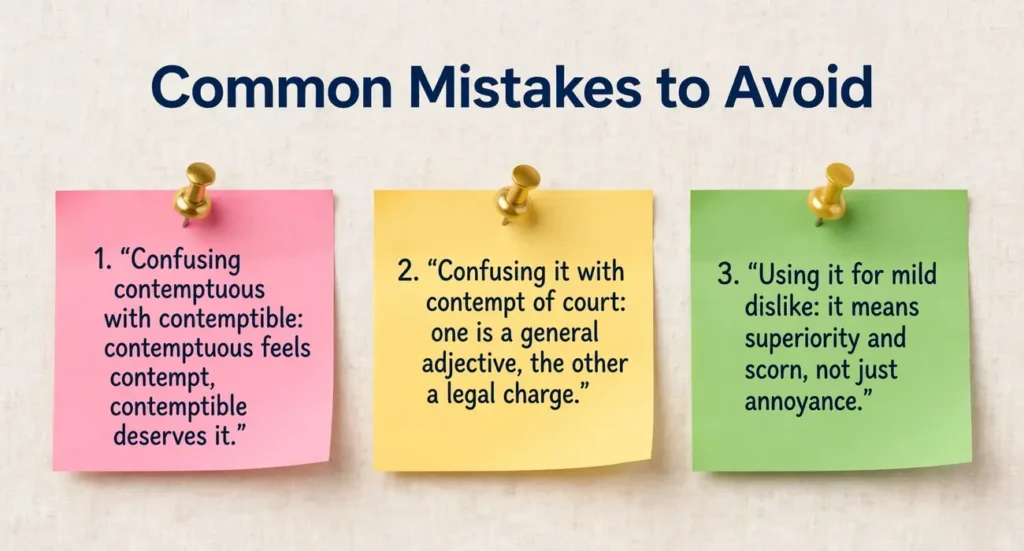
- Confusing contemptuous with contemptible. This is the classic error, and the two mean nearly opposite things. Contemptuous describes someone who feels contempt (“a contemptuous sneer”). Contemptible describes someone or something that deserves contempt (“a contemptible lie”). Remember: the -ous word holds the feeling; the -ible word earns it.
- Confusing it with contempt of court. Contemptuous is a general adjective for scornful behavior. Contempt of court is a specific legal charge. Do not use them interchangeably.
- Using it for mild dislike. Contemptuous implies superiority and scorn, not just annoyance. Someone who merely disagrees with you is not being contemptuous.
- Overusing it. Because it is such a strong word, sprinkling it everywhere dulls its force. Save it for genuine scorn.
Similar Words
| Word | Meaning | Difference from Contemptuous |
|---|---|---|
| Scornful | Full of scorn or disdain | Nearly identical; slightly more common in everyday speech |
| Disdainful | Showing that something is unworthy of respect | Very close; disdainful stresses unworthiness a bit more |
| Derisive | Expressing mockery or ridicule | Derisive leans toward mocking laughter; contemptuous toward cold superiority |
| Sneering | Smiling or speaking in a mocking, scornful way | Sneering describes the physical expression; contemptuous the attitude |
| Supercilious | Behaving as if superior to others | Supercilious stresses arrogant haughtiness specifically |
Opposite Words
| Word | Meaning | Why It’s an Opposite |
|---|---|---|
| Respectful | Showing admiration and regard | Directly opposes the scorn at the heart of contemptuous |
| Admiring | Regarding with approval and delight | The warm opposite of cold disdain |
| Reverent | Showing deep respect, even awe | Contempt looks down; reverence looks up |
| Deferential | Humbly yielding to others’ judgment | The opposite of the superiority in contemptuous |
Pronunciation
Contemptuous is pronounced kun-TEMP-choo-uss, with the stress on the second syllable.
Quick Facts
| Fact | Detail |
|---|---|
| Word origin | Latin “contemptus” (from contemnere, to despise), via Old French |
| Part of speech | Adjective (adverb: contemptuously) |
| Common pattern | “Contemptuous of” + target |
| Key distinction | Contemptuous feels contempt; contemptible deserves it |
| Common confusion | Contemptuous vs. contempt of court |
| Register | Formal; common in literature and journalism |
Key Takeaways
- Contemptuous means showing contempt: open scorn or disdain, usually with a sense of superiority.
- It comes from the Latin “contemptus,” meaning despised or scorned.
- Do not confuse it with “contemptible,” which means deserving contempt, nearly the opposite.
- It typically describes visible attitudes: glances, tones, remarks, and behavior.
- It is a formal word, strongest in writing rather than casual speech.
FAQs
What does contemptuous mean?
It means showing contempt: expressing scorn, disdain, or a feeling of superiority toward someone or something.
What is the difference between contemptuous and contemptible?
A contemptuous person feels contempt; a contemptible person or thing deserves contempt. “A contemptuous sneer” shows scorn, while “a contemptible act” earns it.
What does a contemptuous look mean?
It is a facial expression that communicates scorn, such as a cold stare, a curled lip, or an eye-roll that says the other person is beneath respect.
Is contemptuous a negative word?
Yes. It always describes a negative attitude. Unlike some strong words, it has no positive or neutral use.
What is the adverb form of contemptuous?
Contemptuously. For example: “He spoke contemptuously about his rivals.”
What is the difference between contemptuous and scornful?
Very little. They are near-synonyms. Scornful is slightly more common in everyday speech, while contemptuous is more formal.
Can a tone of voice be contemptuous?
Yes. “A contemptuous tone” is one of the most common uses, describing a voice dripping with disdain.
What is the noun form of contemptuous?
The rare “contemptuousness” exists, but writers almost always use “contempt” instead: “the contempt in his voice.”
Conclusion
The contemptuous meaning centers on visible scorn: the glance, the tone, the remark that places someone above and their target below. From its Latin root meaning “to despise,” the word has carried that downward look for centuries.
Its great trap is its twin, contemptible, which points the judgment in the opposite direction. Keep them straight, use the word sparingly, and it remains one of English’s sharpest tools for naming snobbery when you see it.

I am Stephen King an American author known for compelling storytelling. At writemora.com, we value clear, accurate, and reader-focused content inspired by excellence in writing.