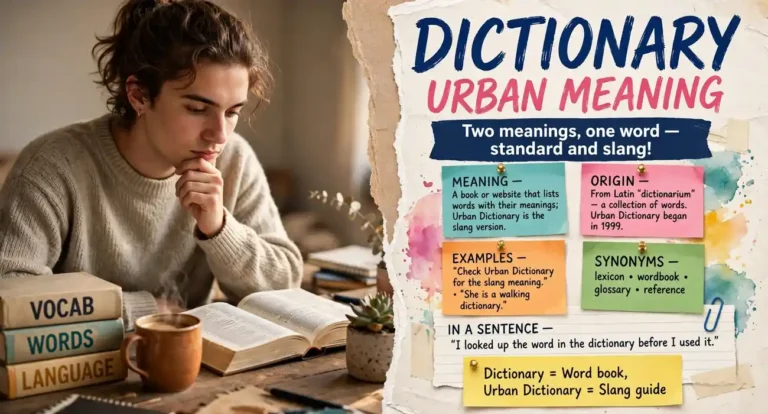
A dictionary is a reference book or online resource that lists words, usually in alphabetical order, and gives their meanings, pronunciations, and uses. In urban and online language, the word takes on a second life: Urban Dictionary lets users crowdsource slang definitions, and “dictionary” itself appears in slang phrases such as “walking dictionary” for a person who knows an unusually large number of words.
The same word points in two directions at once: the formal reference work we use at school and at work, and the fast world of online slang, where ordinary users, not editors, decide what a word means.
What It Means
In simple terms, a dictionary is a book or website where you look up words to find out what they mean, how to spell them, how to say them, and how to use them in a sentence. Most dictionaries list words in alphabetical order, give the part of speech, and often add an example sentence and a note on origin.
The urban meaning adds a different layer. When people say “urban dictionary,” they usually mean Urban Dictionary, the slang website Aaron Peckham started in 1999, where anyone can submit a definition for a slang word or cultural reference. Its motto is “Define Your World.” Unlike a standard dictionary, its users write it, and other users rank its entries by voting.
The word “dictionary” also appears in slang itself. Calling someone a “walking dictionary” means that person seems to know the meaning of every word, often in a teasing or admiring way.
Origin & History
The word “dictionary” comes from the Medieval Latin word “dictionarium,” meaning a collection of words, from “dictio” (a saying, a word) and “dicere” (to say or speak). It entered English through Old French in the 16th century, when English readers needed help with the many Latin and French words entering the language.
Robert Cawdrey published the first well-known English dictionary, *A Table Alphabeticall*, in 1604. Samuel Johnson published his dictionary in 1755, and it set the standard for more than a century, and the *Oxford English Dictionary* became the most complete record of English words.
The urban side is much younger. Aaron Peckham created Urban Dictionary in 1999, when he was a freshman at California Polytechnic State University, as a parody of Dictionary.com, a place to define campus slang that no standard dictionary covered. By 2014 it held more than seven million definitions, with users adding around 2,000 new entries every day.
Different Contexts and Meanings
Standard reference. The most common use is the ordinary one: a book, app, or website you consult to check a spelling or a meaning. “I looked up ‘serendipity’ in the dictionary.” In this sense, a dictionary is a tool for learning and for settling questions about language.
Urban Dictionary, the website. In online conversation, “dictionary” often appears as part of the name “Urban Dictionary.” People quote it to explain slang such as “sus,” “no cap,” or “ghosting.” A definition there may be funny, rude, or only partly true, because a user wrote it and other users voted it up.
A person as a dictionary. “She is a walking dictionary” means she has a very large vocabulary and can explain words on the spot. People usually mean it as a compliment, though they can also use it teasingly when someone corrects others too often.
“Dictionary definition” as an argument. In debates online, people sometimes post a dictionary definition to prove a point. This can settle a question, but it can also miss the point, because dictionaries record how people use words, and usage changes.
Slang and meme culture. On social media, “dictionary” shows up in jokes about words with no proper definition. A post might say “my brain is not a dictionary” to mean “I do not know everything.”
Examples
“I looked up the word in the dictionary before I used it in my essay.”
“Check Urban Dictionary if you want to know what ‘rizz’ means.”
“He is a walking dictionary. Ask him any word and he will know it.”
“She is not a dictionary, so stop asking her to spell everything for you.”
“The teacher told us to bring a dictionary to the spelling test.”
“According to the dictionary, ‘ironic’ does not mean ‘unlucky.'”
“He quoted the dictionary definition to win the argument.”
How to Use It (Grammar and Context)
Dictionary is a noun, and it is countable: “a dictionary,” “two dictionaries.” The plural is “dictionaries,” with the “y” changing to “ies.” Writers usually use it with the articles “a” or “the”: “a pocket dictionary,” “the dictionary on my desk.”
The phrase “Urban Dictionary” is a proper noun, the name of a specific website, so both words take capital letters. Common patterns include “look up in the dictionary,” “check the dictionary,” and “according to the dictionary.” With people, the pattern is “a walking dictionary.”
The word fits almost every register, from a school classroom to a formal essay. “Urban Dictionary,” by contrast, belongs to informal, online language. You would not normally cite it in a formal paper, because editors do not check its entries.
Common Mistakes
Treating Urban Dictionary as a standard dictionary. Users write Urban Dictionary as a record of slang. Its definitions can be funny, biased, out of date, or simply wrong. Professionals edit and check a standard dictionary, such as Oxford or Merriam-Webster. Use each one for the job it was made for.
Trusting the first entry you see. On Urban Dictionary, a word can have many definitions, and the top one has the most votes, not necessarily the most accuracy. Read several entries before you decide what a slang word means.
Confusing “dictionary” with “thesaurus.” A dictionary gives the meaning of a word. A thesaurus gives synonyms and antonyms. They are companion tools, but they do different jobs.
Spelling it “dictionar” or “dictionery.” The correct spelling is d-i-c-t-i-o-n-a-r-y. The middle is “tion,” as in “nation,” and the ending is “ary,” as in “library.”
Similar Words
| Word | Meaning | Difference from Dictionary |
| Thesaurus | A book that lists synonyms and antonyms | A thesaurus gives similar words, not definitions |
| Glossary | A list of difficult words with explanations, usually at the end of a book | A glossary covers only the words in that book or subject |
| Lexicon | The vocabulary of a language or a person | Lexicon is the whole set of words; a dictionary is the book that records them |
| Encyclopedia | A book that gives information about many subjects | An encyclopedia explains topics; a dictionary defines words |
Pronunciation
Pronounce dictionary DIK-shuh-nair-ee, with the stress on the first syllable. Its phonetic spelling is /ˈdɪkʃənəri/. The middle “tion” sounds like “shun,” and the final “ary” sounds like “air-ee” in American English.
Quick Facts
| Fact | Detail |
| Word origin | Medieval Latin “dictionarium,” from “dictio” (word) and “dicere” (to say) |
| Part of speech | Noun (plural: dictionaries) |
| Pronunciation | DIK-shuh-nair-ee /ˈdɪkʃənəri/ |
| Standard meaning | A reference that lists words with their meanings and uses |
| Urban meaning | Urban Dictionary, the slang dictionary Aaron Peckham started in 1999 |
| Urban Dictionary founder | Aaron Peckham |
| Urban Dictionary motto | “Define Your World” |
| Common slang phrase | “Walking dictionary” for a person with a large vocabulary |
| Key distinction | Standard dictionary: professionals edit and check it; Urban Dictionary: users write and vote on it |
Key Takeaways
- A dictionary is a reference that lists words in alphabetical order and gives their meanings, pronunciations, and uses.
- “Dictionary urban meaning” usually points to Urban Dictionary, the slang dictionary Aaron Peckham founded in 1999.
- Urban Dictionary records slang and current usage, but users write its entries, so they are not always accurate.
- In slang, a “walking dictionary” is a person who knows the meaning of almost every word.
- Use a standard dictionary for formal writing and spelling, and use Urban Dictionary to understand slang, memes, and online language.
FAQs
What does dictionary mean?
A dictionary is a book or website that lists words, usually in alphabetical order, and gives their meanings, pronunciations, and uses.
What is the urban meaning of dictionary?
In urban and online language, it usually means Urban Dictionary, a website where users define slang words and phrases. It can also mean the slang phrase “walking dictionary” for a person with a very large vocabulary.
What is Urban Dictionary?
Aaron Peckham founded Urban Dictionary in 1999. It is an online dictionary where users define slang words and phrases. Anyone can submit a definition, and other users vote on it.
Is Urban Dictionary reliable?
It is useful for understanding slang and how people actually use words online, but it is not as reliable as a standard dictionary. Professional editors do not check its entries, so read several definitions and compare them.
Conclusion
The dictionary urban meaning is really two meanings in one word. The first is the old, trusted one: a dictionary defines, spells, and explains words, from Cawdrey’s small list in 1604 to the great Oxford record of English today. The second is the new, online one: Urban Dictionary, where the people who use slang define it, for better and for worse.
Knowing which one someone means is the key. Spelling, a test, or a formal definition means the standard dictionary. Slang, a meme, or a word you will not find in a school book means Urban Dictionary.

I am Olivia Brooks an American editor and content researcher dedicated to creating clear, accurate content. At writemora.com, I help readers to understand words, phrases, and modern language with confidence.