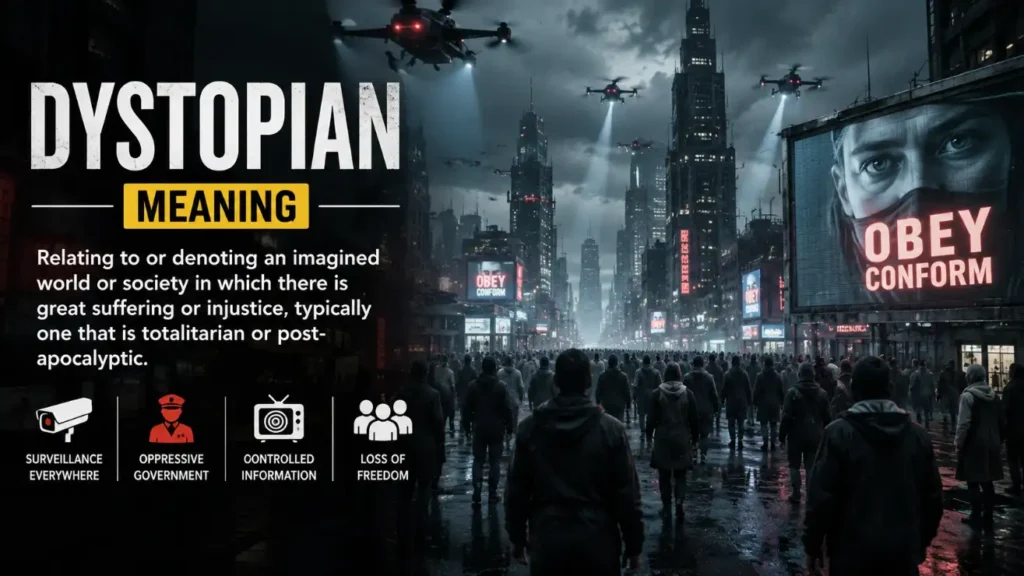
From 1984 to The Hunger Games, some of the most talked-about stories in fiction share one label: dystopian. The dystopian meaning describes an imagined society that’s deeply flawed, oppressive, or frightening, often one that presents itself as ideal or well-ordered on the surface while hiding control, suffering, or injustice underneath.
This guide covers exactly what “dystopian” means, where the word comes from, the traits that define dystopian fiction, and answers to the questions people ask most about it. By the end, you’ll know how to use “dystopian” precisely, if you’re describing a novel, a film, or the real world.
What “Dystopian” Means
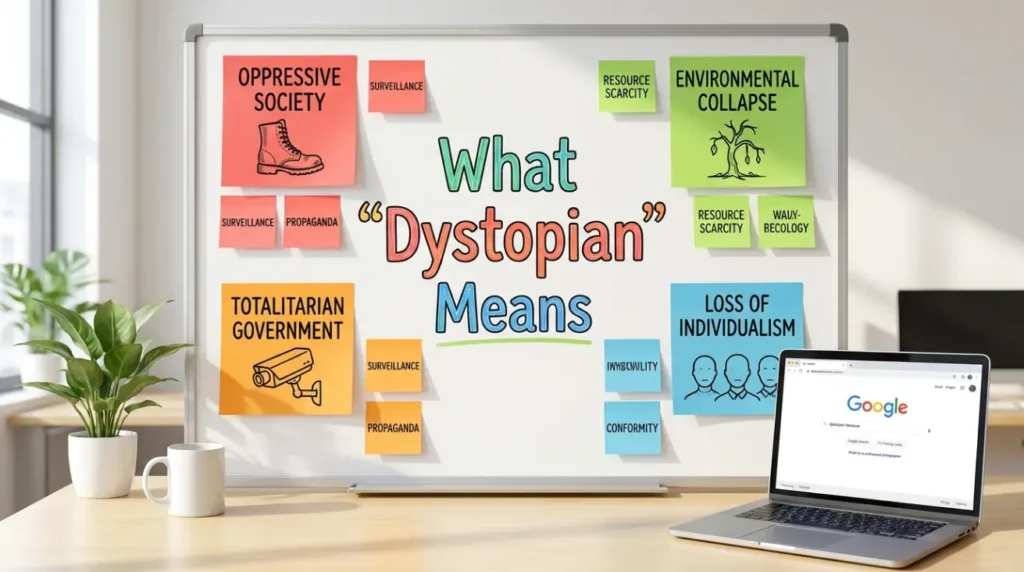
The simple version: “Dystopian” describes an imagined society or world that’s oppressive, controlling, or in serious decline the opposite of a utopia, or perfect society.
The fuller picture: A dystopian setting usually involves some form of authoritarian control, environmental collapse, extreme inequality, or the loss of basic freedoms, often disguised behind propaganda, technology, or the appearance of order. What makes dystopian fiction distinct from a simple “bad future” story is the sense of a deliberately constructed system, a government, corporation, or ideology that maintains control by suppressing individuality, information, or dissent, frequently while insisting things have never been better.
Dystopian stories almost always work as social commentary. Writers use imagined dystopias to explore real-world anxieties, surveillance, censorship, environmental destruction, unchecked technology, or the abuse of power pushed to an extreme, so readers can examine those issues from a safe fictional distance.
Origin and History
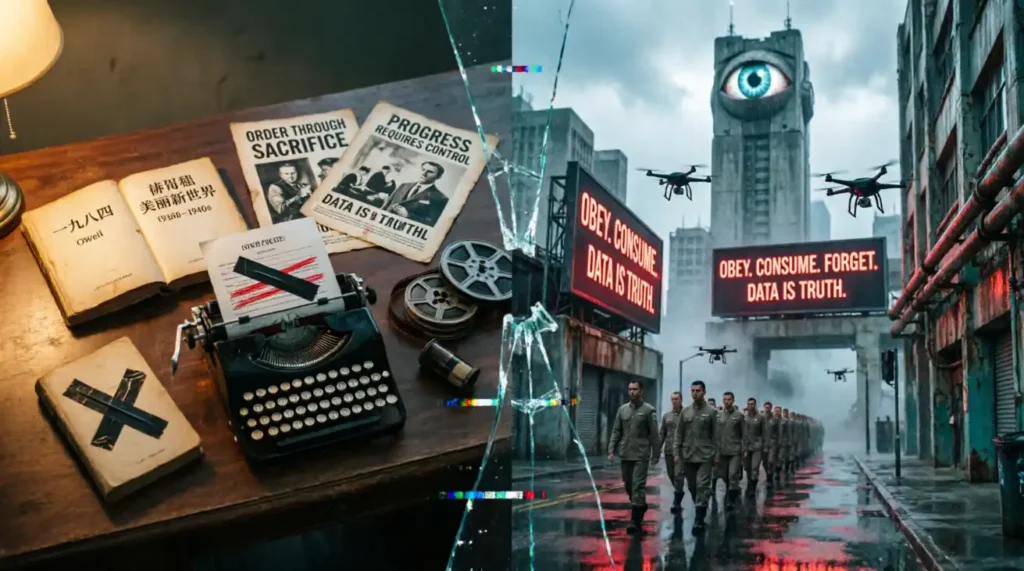
“Dystopian” comes from “dystopia,” which combines the Greek-derived prefix dys-, meaning “bad” or “abnormal,” with -topia, from the Greek word for “place,” the same root found in “utopia.” “Utopia” itself comes from a work of fiction describing an idealized, perfect society, and “dystopia” essentially flips that concept a “bad place” rather than a “good place.”
The term “dystopia” entered wider use gradually, building on the older concept of utopian fiction, which had already established the tradition of using an imagined society to comment on real political and social issues. Dystopian fiction became especially prominent through influential 20th-century novels that imagined oppressive, tightly controlled futures, cementing the genre as a major and recognizable category of speculative fiction.
Since then, dystopian storytelling has remained a consistently popular genre across literature, film, and television, regularly adapting to reflect each era’s specific anxieties from totalitarian control and censorship to surveillance technology, environmental collapse, and corporate power.
Different Meanings and Contexts
Literary and genre use (most common). “Dystopian” most often describes a category of fiction novels, films, or shows set in a flawed, oppressive imagined society, often used to comment on real-world political or social issues.
Descriptive, non-fiction use. Writers sometimes use “dystopian” more loosely to describe real events, policies, or conditions that feel oppressive, bleak, or reminiscent of dystopian fiction for example, calling an invasive surveillance policy “dystopian.”
Academic and critical use. Scholars studying literature and political theory use “dystopia” as a specific critical term, often analyzing how dystopian fiction reflects the anxieties of the era in which it was written.
Casual, exaggerated use. In everyday conversation, people sometimes use “dystopian” hyperbolically to describe something merely unpleasant or poorly run, even without the full weight of an oppressive fictional society behind the comparison.
Examples of “Dystopian” in a Sentence
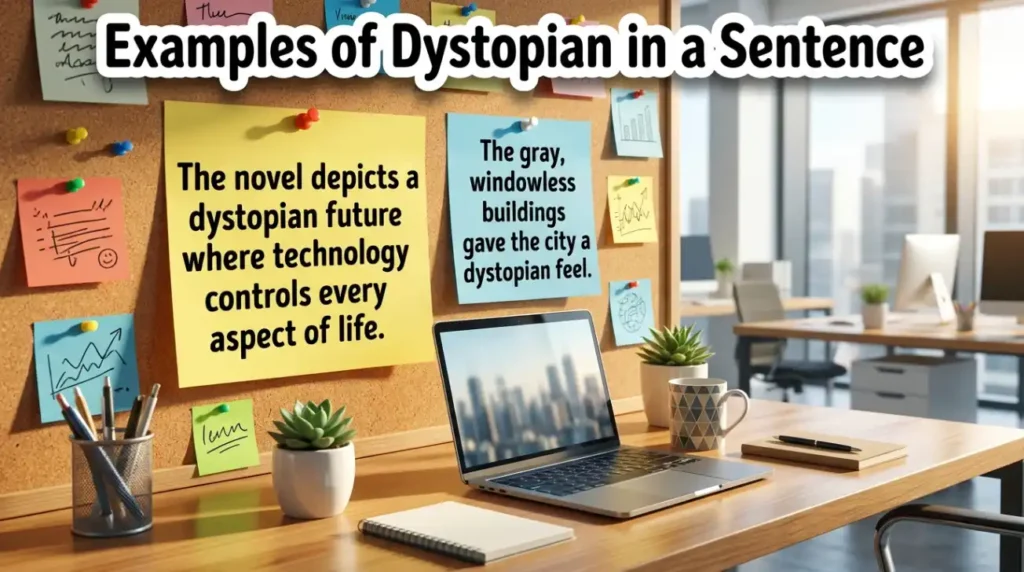
- “The novel imagines a dystopian future where the government monitors every conversation.”
- “Critics praised the film’s bleak, dystopian vision of a world without privacy.”
- “Some readers find dystopian fiction more relevant now than when it was first written.”
- “The show’s dystopian setting explores what happens when corporations control the water supply.”
- “It felt almost dystopian, watching the entire city go dark during the blackout.”
- “Dystopian stories often warn readers about where current trends could eventually lead.”
- “The class discussed how dystopian fiction reflects real historical fears about authoritarian power.”
- “Her new book sits firmly in the dystopian genre, following a society built entirely on constant surveillance.”
- “People jokingly called the endless paperwork process ‘dystopian bureaucracy at its finest.'”
- “The game’s dystopian world-building drew heavily from classic science fiction.”
How to Use “Dystopian” Correctly
“Dystopian” functions as an adjective, describing a noun such as a society, world, story, or setting.
A few usage notes:
- Pair it naturally with words like: future, society, world, fiction, novel, setting, and regime.
- Distinguish it from “apocalyptic.” A dystopian setting can exist without a preceding disaster; the focus is on oppressive social structure, not necessarily destruction or collapse.
- Use it precisely in literary contexts. In academic or critical writing, reserve “dystopian” for genuinely oppressive, controlled imagined societies rather than any generally negative or bleak setting.
- Feel free to use it loosely in casual speech. Everyday, hyperbolic use (“this line is so dystopian”) is widely understood and accepted, even if it stretches the term’s stricter literary meaning.
Common Mistakes to Avoid
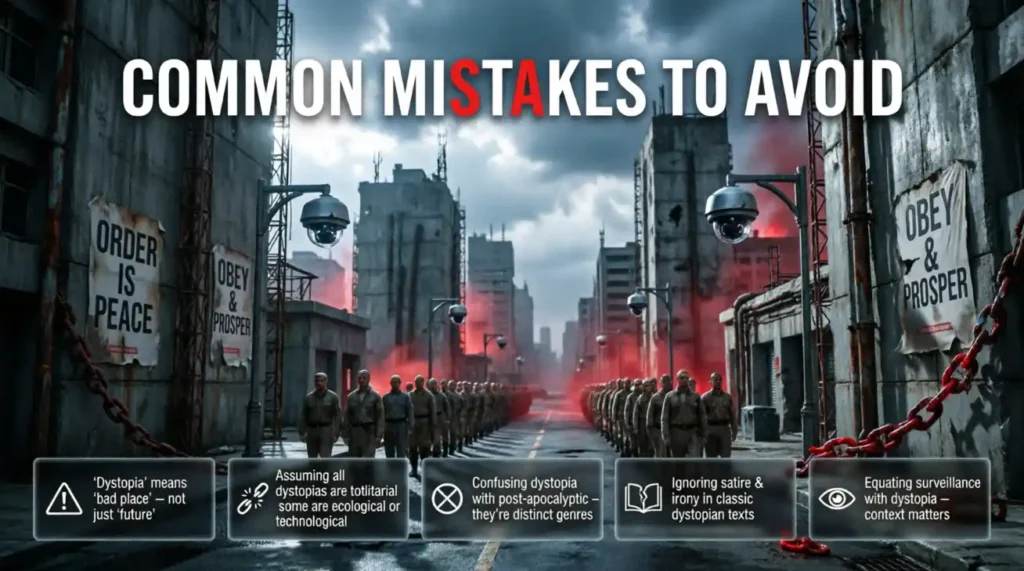
- Confusing “dystopian” with “post-apocalyptic.” A post-apocalyptic story focuses on survival after a catastrophic event; a dystopian story focuses on life within an oppressive, controlled system, which may or may not follow a disaster.
- Assuming dystopian stories are always set far in the future. Many dystopian works are set in a version of the present or near-present, not necessarily a distant future.
- Treating “dystopia” and “dystopian” as interchangeable parts of speech. “Dystopia” is the noun (the place or society itself); “dystopian” is the adjective describing it.
- Overusing the word for anything mildly unpleasant. While casual, exaggerated use is common, leaning on “dystopian” for every minor inconvenience can dilute its impact.
Similar Words and Phrases
| Word | Meaning | How It Differs |
| Post-apocalyptic | Set after a catastrophic, world-altering event | Focuses on survival after collapse, not necessarily an organized oppressive system |
| Totalitarian | Describing a government with complete control over public and private life | A specific political concept often found within dystopian fiction, rather than a genre itself |
| Authoritarian | Favoring strict obedience to authority over individual freedom | Describes a type of governance, which dystopian societies frequently feature |
| Bleak | Grim, hopeless, or bare of comfort | A broader mood descriptor, not specific to an imagined oppressive society |
| Cautionary tale | A story meant to warn against a particular danger or mistake | Describes a story’s purpose, which dystopian fiction often serves, rather than its setting |
Opposite Words and Phrases
| Word | Meaning | Why It’s an Opposite |
| Utopian | Describing an ideal, perfect imagined society | The direct conceptual opposite of a dystopian society |
| Idyllic | Peaceful, picturesque, and pleasant | Opposite in mood and setting to a typically bleak dystopian world |
| Egalitarian | Marked by equal rights and treatment for all | Contrasts with the inequality common in dystopian societies |
| Free society | A society with strong individual rights and freedoms | Opposite of the controlled, oppressive systems central to dystopian fiction |
Pronunciation
“Dystopian” is pronounced dis-TOH-pee-un, with the stress on the second syllable.
Quick Facts
| Fact | Detail |
| Meaning | Describing an oppressive, flawed, or controlled imagined society |
| Origin | From Greek roots meaning “bad place,” opposite of “utopia” |
| Part of speech | Adjective (noun form: dystopia) |
| Common genre | Speculative fiction, science fiction |
| Related concepts | Totalitarianism, surveillance, censorship, propaganda |
| Common pairing | Dystopian future, society, novel, or regime |
Frequently Asked Questions
What does “dystopian” mean?
It describes an imagined society or setting that’s oppressive, controlling, or deeply flawed, often hiding behind an appearance of order or perfection.
What’s the difference between “dystopia” and “dystopian”?
“Dystopia” is the noun referring to the oppressive society or place itself; “dystopian” is the adjective describing something related to that kind of society.
Where does the word “dystopian” come from?
It comes from Greek roots meaning “bad place,” directly opposite to “utopia,” which means an ideal or perfect place.
Is dystopian fiction the same as post-apocalyptic fiction?
Not exactly. Dystopian fiction focuses on an oppressive social or political system, while post-apocalyptic fiction focuses on survival after a catastrophic event; the two sometimes overlap but aren’t identical.
What are common themes in dystopian fiction? Common themes include government surveillance, censorship, loss of individual freedom, environmental collapse, and the abuse of technology or power.
Can “dystopian” describe real-world situations?
Yes, people often use it loosely to describe real policies, technologies, or events that feel oppressive or reminiscent of dystopian fiction.
What’s the opposite of “dystopian”?
“Utopian” is the direct opposite, describing an ideal, perfect imagined society rather than an oppressive one.
How do you pronounce “dystopian”?
“Dis-TOH-pee-un,” with stress on the second syllable.
Key Takeaways
- “Dystopian” describes an oppressive, controlled, or deeply flawed imagined society.
- The word comes from Greek roots meaning “bad place,” the direct opposite of “utopia.”
- Dystopian fiction typically uses an imagined society to comment on real-world political and social issues.
- It’s related to, but distinct from, post-apocalyptic fiction, which centers on survival after disaster.
- “Utopian” works as the clearest opposite of “dystopian.”
Conclusion
“Dystopian” endures as a genre and a word because it gives writers and everyday speakers a precise way to describe a very specific kind of fear: a world that looks orderly, even ideal, while quietly stripping away freedom, privacy, or fairness underneath. That tension between surface-level order and hidden control is exactly what separates dystopian fiction from a simple “bad future” story.
The genre has stayed relevant for so long because each generation finds new anxieties to project onto it surveillance, climate change, corporate power, and unchecked technology have all taken turns as the central fear driving major dystopian works. The label adapts, even as its core warning stays the same.
Next time you pick up a novel or watch a film set in a tightly controlled, unsettling future, you’ll know exactly what makes it dystopian and you’ll be better equipped to spot the real-world anxieties the story is quietly asking you to think about.

I am Stephen King an American author known for compelling storytelling. At writemora.com, we value clear, accurate, and reader-focused content inspired by excellence in writing.