

The mundane meaning describes something ordinary, routine, and unexciting: the everyday tasks and details of normal life. A more formal, older sense of the word means “of this world” as opposed to spiritual or heavenly, and that history explains how an ordinary word for “earthly” came to mean “dull.”
Understanding the mundane meaning matters because the word sits at an interesting crossroads: writers use it for life’s boring parts, philosophers for the earthly versus the divine, and science fiction fans playfully for non-fans. This guide covers what mundane means, where it comes from, its uses, and common mistakes.
What It Means
In simple terms, mundane means ordinary and unexciting. Mundane tasks are the ones nobody looks forward to: doing laundry, filing paperwork, sitting in traffic. The word carries a mild judgment that the thing described lacks interest or imagination.
In its older and more formal sense, the mundane meaning is “belonging to this world” rather than to heaven or the spiritual realm. Mundane concerns are earthly concerns: money, schedules, and daily chores, as opposed to sacred or eternal matters. This sense still appears in philosophy and religion.
Calling something mundane is a matter of perspective. One person’s mundane commute is another person’s favorite quiet hour.
Origin & History
Mundane comes from the Latin word “mundanus,” meaning “belonging to the world,” built on “mundus” (world). It entered English in the 15th century through Old French “mondain,” and for centuries it simply meant earthly or worldly, often set against the heavenly or spiritual.
The shift toward “dull and ordinary” happened gradually. Earthly life, compared with the imagined delights of heaven, was supposed to be unremarkable, and by 1850 the sense of “dull, uninteresting” was firmly established. What began as a neutral description of the physical world became a gentle label for routine life.
In the 20th century the word picked up a playful sense: science fiction fans began calling non-fans “mundanes,” a usage dating back to before 1955 that is usually affectionate rather than cruel.

Different Contexts and Meanings
Everyday routine. The most common use of the mundane meaning: describing dull, repetitive parts of life. Mundane chores, mundane meetings, and mundane errands are the unglamorous maintenance work of being alive.
Work and careers. People describe jobs as mundane when the work feels repetitive and unchallenging. “Mundane office work” suggests tasks done on autopilot, without creativity or growth.
Philosophy and religion. In the older sense, the mundane is the earthly realm contrasted with the spiritual. Mundane desires and mundane affairs belong to this world, not the next.
Science fiction fandom. Among fans, a “mundane” is a non-fan, someone outside the community. Related uses include one’s “mundane name” (a legal name used outside fandom) and “mundane clothes” (everyday dress, as opposed to costume).
Mindfulness and art. Writers and mindfulness teachers often flip the word’s negative charge, urging people to find beauty in the mundane: morning coffee, sunlight on a windowsill, the rhythm of familiar streets.
Examples
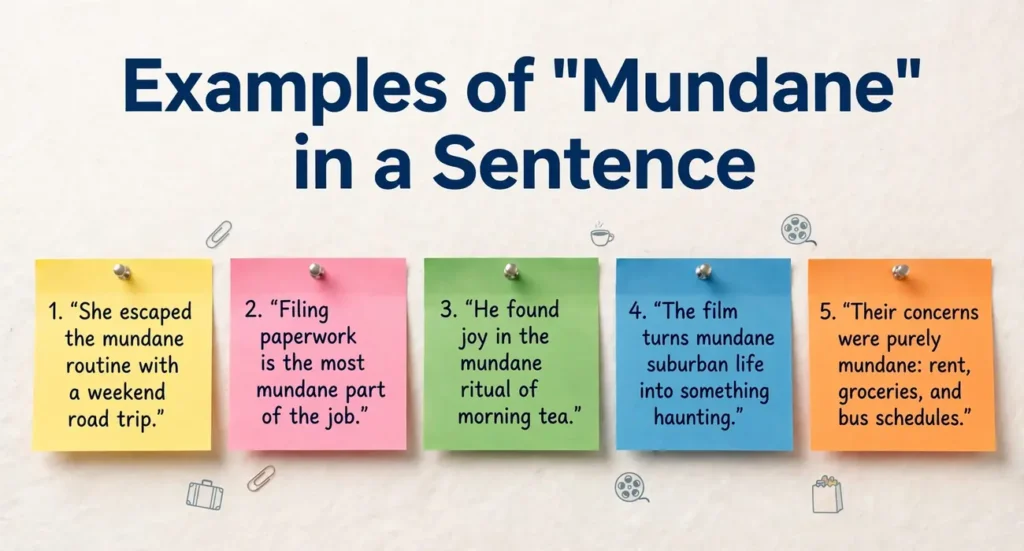
- “She escaped the mundane routine with a weekend road trip.”
- “Filing paperwork is the most mundane part of the job.”
- “He found joy in the mundane ritual of morning tea.”
- “The film turns mundane suburban life into something haunting.”
- “Their concerns were purely mundane: rent, groceries, and bus schedules.”
- “After the excitement of travel, home felt wonderfully mundane.”
- “The novelist writes about mundane details with extraordinary care.”
- “She traded a mundane desk job for work she actually loved.”
- “Even the most mundane chores felt lighter with music playing.”
- “He described his weekdays as a pleasant, mundane rhythm of work and rest.”
How to Use It (Grammar and Context)
Mundane is an adjective, and it usually sits before the noun it describes: “a mundane task,” “mundane details,” “mundane life.” It can also follow a linking verb: “The lecture was mundane.”
The word is mildly negative but not harsh. Calling a task mundane is a complaint, not an insult; calling a person mundane, however, lands harder, suggesting they are dull or unimaginative. Aim it at activities and situations rather than people when you want to stay polite.
Related forms include the noun “mundanity” (the quality of being mundane) and the adverb “mundanely” (“he mundanely filed the reports”). These are correct but far less common than the adjective itself.
Common Mistakes
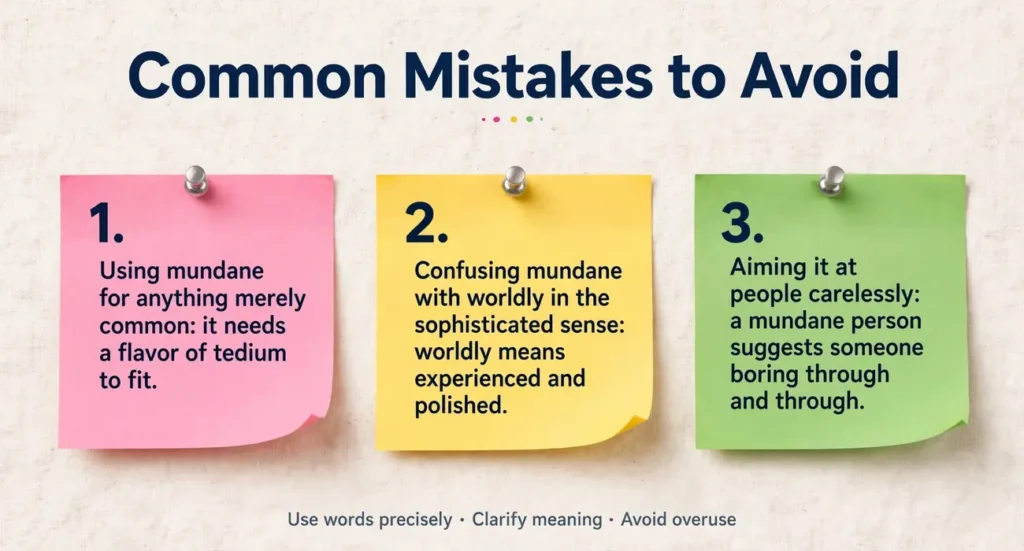
Using the mundane meaning for anything merely common. Common things are not always dull. The word needs that flavor of tedium to fit; for something boring but unusual, “tedious” may fit better.
Confusing mundane with “worldly” in the sophisticated sense. “Worldly” can mean experienced and polished, while mundane in its “of this world” sense is neutral or slightly dismissive. They overlap in origin but not in tone.
Aiming it at people carelessly. “A mundane person” suggests someone boring through and through. Unless that judgment is intended, keep the word on tasks, routines, and details.
Overusing it as a fancy word for “boring.” Mundane carries the extra shade of “routine and everyday.” It is at its best describing the texture of ordinary life, not just anything uninteresting.
Similar Words
| Word | Meaning | Difference from Mundane |
|---|---|---|
| Ordinary | Normal, not special | Ordinary is neutral; mundane adds the sense of being unexciting |
| Banal | Dull and unoriginal | Banal stresses lack of originality; mundane stresses everyday routine |
| Prosaic | Dull, matter-of-fact, unimaginative | Prosaic is more literary; mundane is the everyday choice |
| Tedious | Boring from length or repetition | Tedious emphasizes the drag of time; mundane emphasizes ordinariness |
| Earthly | Of this world, not heavenly | Earthly keeps the old “worldly” sense; mundane usually means dull routine |
Opposite Words
| Word | Meaning | Why It’s an Opposite |
|---|---|---|
| Extraordinary | Very unusual, remarkable | Directly opposes the ordinariness of mundane |
| Exciting | Causing enthusiasm or thrill | Contrasts with mundane’s dullness |
| Heavenly | Of heaven, blissful | Opposes both the earthly and the dull senses at once |
| Remarkable | Worth noticing, striking | What is remarkable refuses to blend into routine |
Pronunciation
Mundane is pronounced “muhn-DAYN,” with the stress on the second syllable, which rhymes with “rain.”
Quick Facts
| Fact | Detail |
|---|---|
| Word origin | Latin “mundanus” (belonging to the world), from “mundus” (world), via Old French |
| Part of speech | Adjective (“a mundane chore”) |
| Common phrases | Mundane tasks, mundane routine, mundane details |
| Key distinction | Means dull routine; older sense means “of this world” vs spiritual |
| Sense history | “Dull, uninteresting” sense attested by 1850 |
| Related words | Mundanity (noun), mundanely (adverb); “mundanes” in sci-fi fandom |
Key Takeaways
- The mundane meaning usually means ordinary, routine, and unexciting, like daily chores and repetitive work.
- The word comes from Latin “mundanus,” meaning “belonging to the world.”
- An older formal sense means “earthly” as opposed to spiritual or heavenly.
- Science fiction fans use “mundanes” playfully for non-fans.
- Aim the word at tasks and routines, not people, to avoid sounding harsh.
FAQs
What does mundane mean in simple words?
It means ordinary and boring: the routine, unexciting parts of everyday life.
What is the difference between mundane and boring?
Boring is broader. Mundane specifically suggests everyday routine: something is mundane because it is ordinary and familiar, not just because it fails to entertain.
Can mundane describe a person?
Grammatically yes, but it is unkind: it suggests the person is dull and unimaginative. It is safer to describe tasks, routines, and details as mundane.
What is a “mundane” in science fiction fandom?
Fans use “mundane” for a non-fan, an ordinary person outside the community. The usage goes back to before 1955 and is usually playful.
Is mundane a negative word?
Mildly. It criticizes dullness and routine, but it is far softer than words like “ foolish” or “worthless.” Context and tone decide how sharp it feels.
How do you use mundane in a sentence?
Place it before a noun (“a mundane errand”) or after a linking verb (“the meeting was mundane”). Keep it on activities and situations for the politest effect.
Conclusion
The mundane meaning carries a small history inside it. From the Latin for “belonging to the world,” it traveled through centuries of philosophy into its modern job: naming the dull, repetitive parts of ordinary life.
That journey explains the word’s double edge. Mundane can dismiss the boring bits of a Tuesday, or it can dignify them, depending on who is speaking. The mindfulness writer who finds wonder in the mundane and the office worker who dreads it are using the same word for opposite experiences.
Use it with that awareness. Point it at routines, not people; at tedium, not mere familiarity. Handled with care, mundane is one of the most honest words in English for the texture of everyday life.

I am Stephen King an American author known for compelling storytelling. At writemora.com, we value clear, accurate, and reader-focused content inspired by excellence in writing.