

Stud covers several distinct meanings depending on context: a male animal kept specifically for breeding, a vertical framing piece in construction, a small piece of jewelry, a raised decorative metal piece on clothing or accessories, and casual slang describing an attractive, confident man. One short word, several genuinely different applications.
Most people know at least a couple of these meanings without necessarily connecting them to the same root word. Understanding the stud meaning means sorting through each specific use rather than assuming one definition covers every context you’ll encounter.
This guide covers each meaning of stud individually, where the word comes from, and how context makes clear which sense applies.
What It Means
In its original and oldest sense, a stud refers to a male animal, most commonly a horse, kept specifically for breeding purposes. A “stud farm” raises and breeds animals using selected males (studs) to produce offspring with desired traits.
In construction, a stud names a vertical framing piece, typically wood or metal, that forms the structural skeleton of a wall, providing support and a surface for attaching drywall or paneling.
Jewelry, a stud describes a small piece of jewelry, especially an earring, that sits close to the skin without dangling, secured by a post through pierced skin.
In clothing and accessories, studs refer to small, raised, often metal decorative pieces attached to leather jackets, belts, or other items, adding a distinctive textured or edgy visual style.
In casual slang, stud describes a man perceived as attractive, confident, and sexually appealing, often implying physical strength or virility, drawing loosely on the word’s original breeding-animal connotation.
Origin & History
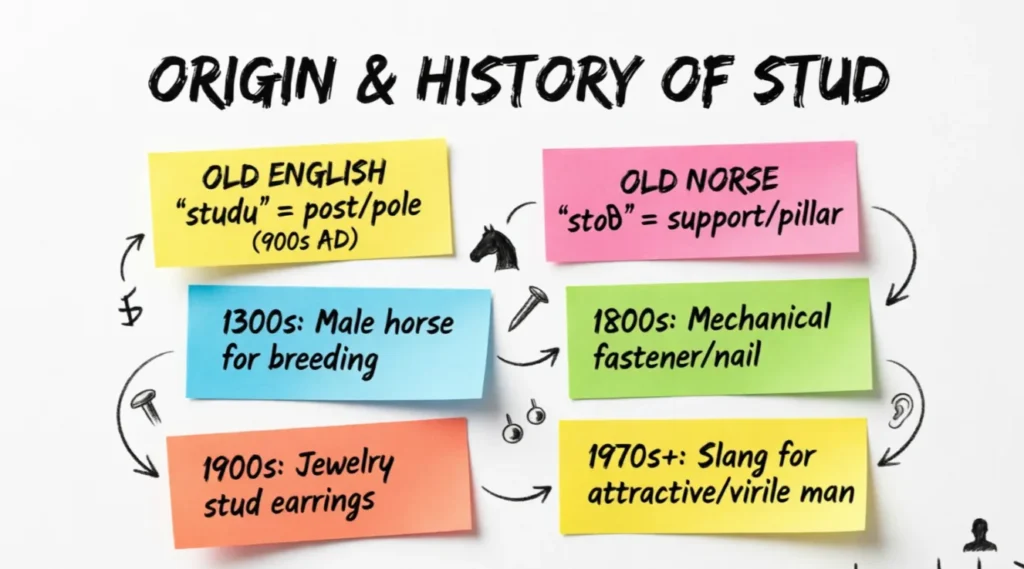
Stud comes from the Old English word “stod,” referring to a herd of breeding horses or the place where such horses were kept, itself connected to older Germanic roots related to standing or a fixed location. This original agricultural and breeding sense remains the word’s oldest documented meaning in English.
The construction meaning of “stud,” referring to a vertical framing post, developed separately, likely connected to an older, more general sense of “stud” as a supporting post or upright piece, distinct from the breeding-animal sense but coexisting in English for centuries.
The jewelry and decorative-metal meanings of stud developed later, drawing on the word’s general sense of a small, fixed, protruding piece much like a small post or peg fixed firmly in place, if in a wall, a piece of jewelry, or a decorative garment.
The slang meaning describing an attractive, virile man emerged more recently, drawing directly and deliberately on the original breeding-animal sense, extending the idea of a prized, physically impressive male animal to describe a similarly impressive human man.
Different Contexts and Meanings
Stud (breeding animal). This remains an active, specific term in animal breeding, particularly horses, dogs, and livestock, referring to a male kept specifically for producing offspring with desirable traits.
Stud (construction). Builders and contractors use “stud” constantly to describe the vertical wood or metal framing pieces that make up a wall’s structural skeleton, spaced at regular intervals (commonly 16 or 24 inches apart in residential construction).
(jewelry). Stud earrings sit flush against the earlobe without dangling, distinguishing them from hoops or drop earrings, and remain one of the most common and versatile earring styles.
Stud (decorative metal piece). Fashion and accessory design use studs to add texture and visual edge to jackets, belts, bags, and boots, particularly associated with punk and rock-influenced style.
Stud (slang for an attractive man). In casual conversation, “stud” describes a man seen as physically attractive, confident, and often sexually appealing, sometimes used admiringly and sometimes more casually or jokingly among friends.
Examples

- “The farm keeps several prized studs for their breeding program.”
- “The contractor marked each stud before hanging the drywall.”
- “She wore simple gold studs instead of dangling earrings.”
- “His leather jacket was covered in silver studs.”
- “Her friends jokingly called him a total stud after the gym session.”
- “The stud wall needed reinforcement before adding the shelving.”
- “The horse became a valuable stud after winning several races.”
- “He picked out diamond studs for her birthday gift.”
- “The punk aesthetic relied heavily on studded belts and jackets.”
- “Everyone agreed he’d become quite the stud since high school.”
How to Use It (Grammar and Context)
Stud functions as a noun across all its meanings, and context almost always clarifies which sense applies. Writers often pair it with a clarifying word for precision: “stud farm,” “wall stud,” “stud earring,” or rely on surrounding context, such as a sentence clearly about construction, jewelry, or casual conversation about someone’s appearance.
The word can also function informally as an adjective in phrases like “stud earrings” or “stud wall,” directly modifying the following noun.
Common Mistakes

Assuming stud only refers to jewelry or construction. While these two meanings are extremely common in everyday life, the original breeding-animal sense remains active and specific within agricultural and animal husbandry contexts.
Overlooking the connection between the breeding and slang meanings. The casual slang use of “stud” to describe an attractive man draws directly on the older breeding-animal sense, rather than developing as a completely separate, unrelated meaning.
Confusing stud walls with load-bearing walls. Not every stud wall bears structural weight for the entire building; some serve purely as room dividers, a distinction that matters in construction and renovation planning.
Using “stud” casually without considering tone. The slang sense describing an attractive man can read as complimentary, joking, or even a bit crude depending on context and relationship, so tone matters when using it that way.
Similar Words
| Word | Meaning | Difference from Stud |
| Sire | A male animal, specifically in the context of being the father of offspring | Very close to the breeding sense of stud, though “sire” specifically emphasizes paternity rather than ongoing breeding use |
| Post | A vertical supporting piece, often in construction | Similar to the construction sense of stud, though “post” applies more broadly beyond wall framing specifically |
| Hoop | A circular style of earring | A hoop earring contrasts directly with a stud earring’s flush, non-dangling style |
| Heartthrob | Slang for an attractive, often famous man who inspires romantic interest | Similar to the slang sense of stud, though heartthrob often implies broader public appeal rather than personal, individual attraction |
Opposite Words
There’s no single grammatical opposite of “stud,” but relevant contrasts include:
| Word | Meaning | Why It Contrasts |
| Dangle earring | An earring style that hangs and moves freely | Directly contrasts with a stud earring’s fixed, flush style |
| Drywall (unsupported) | Wall material without structural framing | Represents the absence of the supporting studs that give a wall its structure |
| Plain | Simple, without decoration | Contrasts with the decorative, textured effect studs add to clothing and accessories |
Pronunciation
Stud is pronounced STUD, rhyming with “mud” and “blood.”
Quick Facts
| Fact | Detail |
| Word origin | Old English “stod,” referring to a herd of breeding horses |
| Original meaning | A male animal kept for breeding |
| Construction meaning | A vertical framing piece supporting a wall |
| Jewelry meaning | An earring style that sits flush against the ear |
| Fashion meaning | Small, raised decorative metal pieces on clothing or accessories |
| Slang meaning | An attractive, confident man, drawing on the original breeding sense |
FAQs
What does a stud mean in slang?
In slang, “stud” usually describes someone who is attractive, confident, and sexually appealing, especially a man.
What does it mean if a girl is a stud?
If a girl is called a stud, it can mean she is confident, attractive, masculine-presenting, or admired for her style and personality.
When you call a guy a stud?
Calling a guy a stud is usually a compliment suggesting he is handsome, confident, strong, or sexually attractive.
Is a stud a female or male?
“Stud” can refer to either gender in general slang, although it is traditionally more commonly used for men.
Can I call a girl a stud?
Yes, you can call a girl a stud, especially when describing her confidence, attractiveness, or masculine style.
Who is a stud in LGBTQ?
In LGBTQ+ usage, particularly among Black lesbians, “stud” can describe a masculine-presenting lesbian with a distinct cultural identity.
Why do girls call me stud?
Girls may call you a stud because they find you attractive, confident, stylish, or impressive. The exact meaning depends on the context.
Can a stud woman be straight?
Yes. While “stud” has a specific meaning in some lesbian communities, people outside those communities may use the term for a masculine or confident straight woman.
Why are some lesbians called studs?
Some lesbians, particularly Black lesbians, use “stud” as a self-identified term for masculine gender expression and lesbian identity within their community.
Is being called a stud an insult?
Usually, no. “Stud” is generally a compliment, but its meaning can depend on the speaker, community, and context.
What is another word for “stud”?
Depending on the context, alternatives include “heartthrob,” “hunk,” “handsome,” “attractive,” “charmer,” or “babe.”
Key Takeaways
- Stud has several distinct meanings: breeding animal, construction framing piece, flush-style earring, decorative metal accent, and slang for an attractive man.
- The word originally comes from Old English “stod,” referring to breeding horses.
- The construction, jewelry, and slang meanings all developed from or alongside this original sense.
- Context almost always makes clear which specific meaning applies.
- The slang meaning directly borrows from the word’s older breeding-animal connotation.
Conclusion
The stud meaning stretches from a barn full of breeding horses to a simple pair of earrings to a jacket covered in metal accents, all traced back to the same short, sturdy word. Each meaning developed its own specific niche, yet a loose thread of something fixed, prominent, or prized runs quietly through several of them.
That connection becomes clearest in the slang sense, which doesn’t emerge from nowhere but borrows directly from the world’s oldest agricultural meaning, repurposing the idea of a prized breeding male for a very different, very modern kind of compliment. Few words carry that much distance between a horse farm and a casual comment among friends.
If you encounter the word next, if on a construction site, in a jewelry store, or in casual conversation, the surrounding context will make clear exactly which version of “stud” you’re dealing with.

I am Stephen King an American author known for compelling storytelling. At writemora.com, we value clear, accurate, and reader-focused content inspired by excellence in writing.