
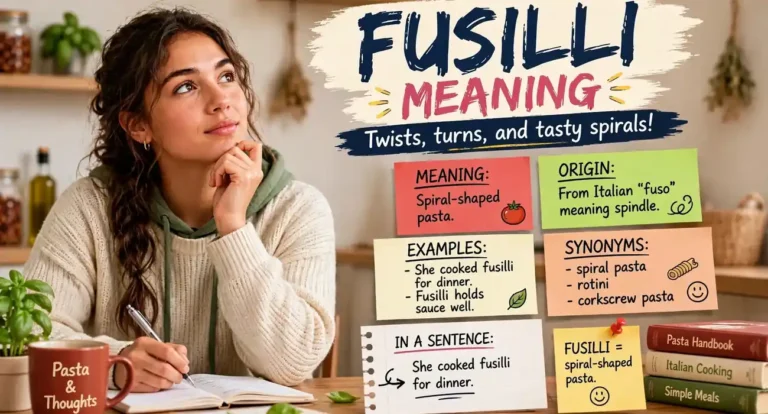
The fusilli meaning starts with a short, corkscrew-shaped pasta. Italian speakers take its name from the word for “spindle.” Each twist catches and holds sauce, which is why fusilli stars in pasta salads, baked dishes, and weeknight dinners.
Understanding the fusilli meaning matters because the name tells the story of how makers create the pasta: they wrap dough around a thin rod, like thread on a spindle. This guide covers what fusilli means, where the name comes from, how cooks use it, and common mistakes.
What It Means
In simple terms, the fusilli meaning is “little spindles” in Italian, and it names the spiral pasta shaped like tiny corkscrews. The singular form is “fusillo.” When a menu or grocery box says fusilli, it promises short, twisted noodles with grooves that grip sauce.
The word is a straightforward food name, not a metaphor. Unlike poetic pasta names, fusilli describes exactly what the pasta looks like and how makers traditionally created it: they wound it around a spindle-shaped rod.
In the United States and Canada, stores often sell the same basic shape as rotini. The two are close cousins, and cooks use them interchangeably in most recipes, though they differ technically in shape.
Origin & History
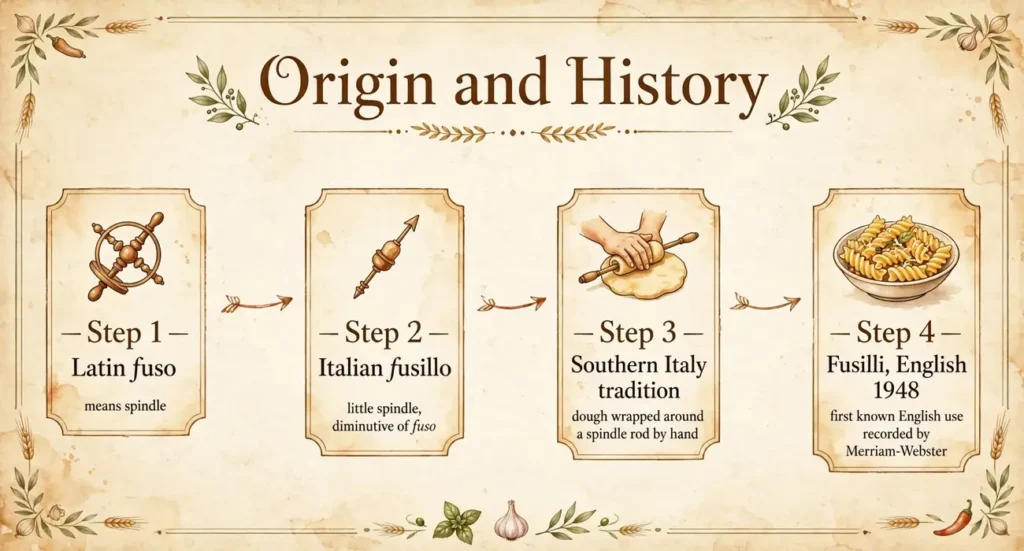
Fusilli comes from Italian “fusillo,” meaning “little spindle,” the diminutive of “fuso” (spindle), which traces back to Latin. The name records the traditional handmade method: pasta makers in southern Italy wrapped thin strips of dough around a spindle-like rod to form the spiral. Merriam-Webster records the first known English use of the word in 1948.
Food historians believe fusilli has very old roots, possibly with Arab influence. In Sicily, people call it busiata, and in Sardinia, people call it busa. Historians think these names come from an Arabic word for the thin reed makers wound the dough around.
Over time, factory extrusion replaced the handmade spiral. In addition, regional varieties multiplied: fusilli bucati (hollow), fusilli Sorrento (long), and fusilloni (large).
Different Contexts and Meanings
The name. Fusilli literally means “little spindles,” a direct reference to the rod makers wound the dough around. The etymology is the meaning: shape and name are one.
The pasta shape. In the kitchen, the fusilli meaning is short, springy corkscrews with open grooves. The grooves are functional, trapping chunky sauces, pesto, and small vegetables far better than smooth shapes.
Fusilli vs rotini. American shoppers often meet the same spiral sold as rotini. Traditionally, makers twist fusilli from flat ribbons while factories extrude rotini with a tighter twist, but cooks use the names interchangeably in everyday cooking.
Regional varieties. In Italy, the fusilli family includes hollow bucati, long Sorrento-style strands, and hand-formed versions named after towns like Avellino, Naples, and Gragnano, each with its own local sauces.
Fusilli in modern cooking. Beyond Italy, fusilli is the go-to pasta for cold salads, baked casseroles, and meal prep, since the sturdy spirals hold shape and sauce even after chilling.
Examples
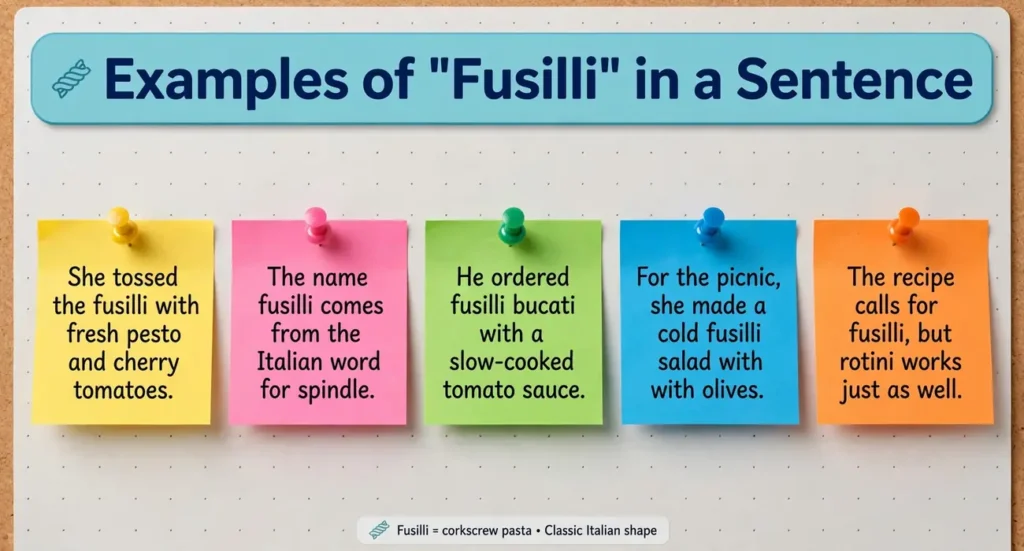
- “She tossed the fusilli with fresh pesto and cherry tomatoes.”
- “The name fusilli comes from the Italian word for spindle.”
- “He ordered fusilli bucati with a slow-cooked tomato sauce.”
- “For the picnic, she made a cold fusilli salad with olives.”
- “The recipe calls for fusilli, but rotini works just as well.”
- “They served hand-formed fusilli the way it is made in Naples.”
- “Her kids love fusilli because the spirals catch every bit of cheese.”
- “She baked the fusilli with ricotta until the top turned golden.”
- “For dinner, they tossed fusilli with roasted vegetables and parmesan.”
- “The fusilli held the creamy sauce better than the smooth pasta shapes.”
How to Use It (Grammar and Context)
Fusilli is a plural noun in Italian, and English treats it the same way. Cooks rarely use the singular “fusillo.”
In recipes and menus, fusilli appears as a straightforward ingredient name: “fusilli with sausage,” “fusilli salad.” It takes no plural ending in English; never write “fusillis.”
The word belongs to food writing and everyday grocery language. Using the fusilli meaning correctly mostly means spelling it with the double l and double i, and not confusing it with similarly twisted shapes when precision matters.
Common Mistakes
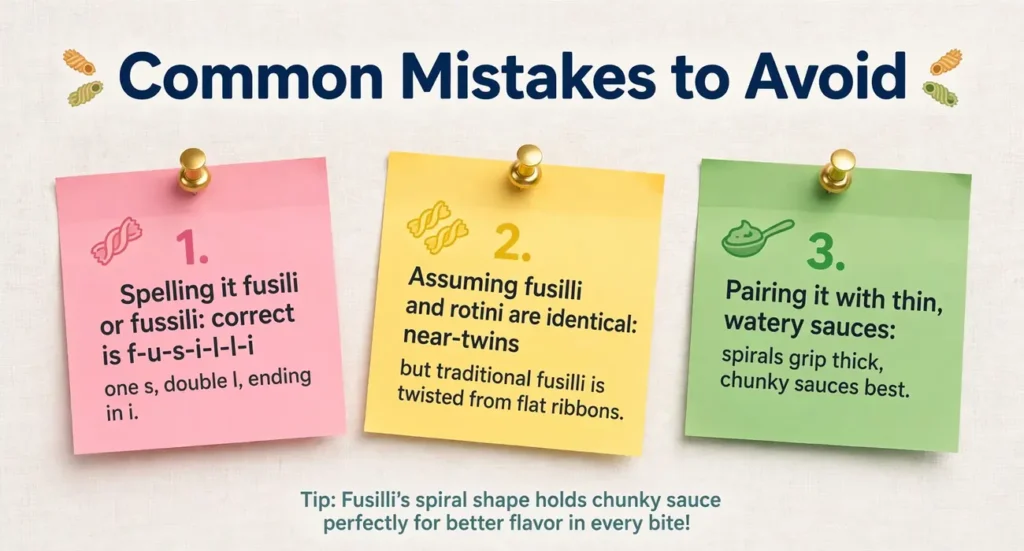
Spelling it “fusili” or “fussili.” The correct spelling is f-u-s-i-l-l-i: one s, double l, ending in i. The misspellings are common on menus and blogs.
Assuming fusilli and rotini are identical. They are near-twins and cooks swap them freely in recipes, but makers traditionally twist fusilli from flat dough ribbons while factories extrude rotini. However, for cooking purposes the difference barely matters.
Pairing it with thin, watery sauces. The spiral’s talent is gripping thick, chunky sauces. A thin broth slides right off; therefore, save delicate sauces for smoother shapes and give fusilli pesto, ragù, or creamy sauces.
Overcooking it. The twists are relatively thin and go from firm to soft quickly. Start tasting a minute or two before the package time, and cook it just past al dente for pasta salads, since the spirals firm up as they chill.
Similar Words
| Word | Meaning | Difference from Fusilli |
|---|---|---|
| Rotini | Tight corkscrew pasta, common in the US | Near-identical in use; technically extruded with a tighter twist |
| Cavatappi | Larger corkscrew-shaped pasta tubes | Bigger, hollower spirals; better for baked dishes |
| Gemelli | Pasta twisted from two strands | Two intertwined strands, not one ribbon |
| Radiatori | Short, ruffled pasta shaped like radiators | Different shape, but shares the sauce-trapping ridges |
| Penne | Short tubes cut diagonally | Smooth tubes vs spirals; less surface for chunky sauce |
Opposite Words
| Word | Meaning | Why It’s an Opposite |
|---|---|---|
| Spaghetti | Long, thin, straight strands | Long and smooth where fusilli is short and twisted |
| Lasagna | Wide, flat pasta sheets | Flat sheets against tight spirals; opposite geometry |
| Orzo | Tiny, rice-shaped pasta | Miniature and smooth where fusilli is springy and ridged |
| Angel hair | Extremely fine, delicate strands | Fragile and quick-cooking vs sturdy and sauce-gripping |
Pronunciation
Fusilli is pronounced “foo-ZEE-lee,” with the stress on the middle syllable. The Italian pronunciation is close to “foo-ZEEL-lee,” with a slightly longer middle sound.
Quick Facts
| Fact | Detail |
|---|---|
| Word origin | Italian “fusillo” (little spindle), from “fuso” (spindle) |
| Part of speech | Plural noun (singular “fusillo” rarely used) |
| Common phrases | Fusilli salad, fusilli bucati, baked fusilli |
| Key distinction | Named for the spindle the dough was wound around |
| Common confusion | Fusilli vs rotini (near-twins, often swapped) |
| Related words | Fusilloni (large), fusilli Sorrento (long), busiata (Sicilian) |
Key Takeaways
- The fusilli meaning is “little spindles” in Italian, named for the rod the dough was wound around.
- It is a short, corkscrew pasta from southern Italy; Americans often know the shape as rotini.
- The spiral grooves are designed to grip chunky sauces, pesto, and dressings.
- Varieties include hollow fusilli bucati, long fusilli Sorrento, and large fusilloni.
- Cook it just to al dente, and start tasting early since the twists cook fast.
FAQs
What does fusilli mean in Italian?
It means “little spindles,” from “fusillo,” the diminutive of “fuso” (spindle). The name refers to the traditional method of winding dough around a spindle-shaped rod.
What is the difference between fusilli and rotini?
In strict terms, makers twist fusilli from flat ribbons of dough while factories extrude rotini with a tighter corkscrew. In practice, brands and recipes use the names interchangeably.
How do you cook fusilli?
Boil dried fusilli in well-salted water for about 10 to 12 minutes, tasting a minute or two early. For pasta salad, cook it just past al dente so it stays tender after chilling.
What sauces go best with fusilli?
Thick, chunky sauces: pesto, ragù, creamy sauces. The spirals trap bits that smooth pasta would let slide off.
Where does fusilli come from?
Southern Italy, where makers traditionally hand-formed it. Regional versions survive in Campania, Sicily (as busiata), and Sardinia (as busa).
Can you use fusilli in pasta salad?
It is one of the best choices. The sturdy spirals hold dressing, stay separate when chilled, and catch small ingredients like peas, corn, and diced peppers.
Conclusion
The fusilli meaning is refreshingly literal: little spindles, named for the tool that shaped them. From southern Italian kitchens, where makers wound dough by hand around thin rods, to supermarket shelves around the world, the name has always described exactly what the pasta is.
What made fusilli last is the clever shape: spirals that hold sauce in every groove and keep their spring through baking, tossing, and chilling.
So the next time the word appears on a menu or a box, you will know the story behind it: pair it with a sauce worth gripping, cook it with attention, and let the little spindles do their job.

I am Olivia Brooks an American editor and content researcher dedicated to creating clear, accurate content. At writemora.com, I help readers to understand words, phrases, and modern language with confidence.