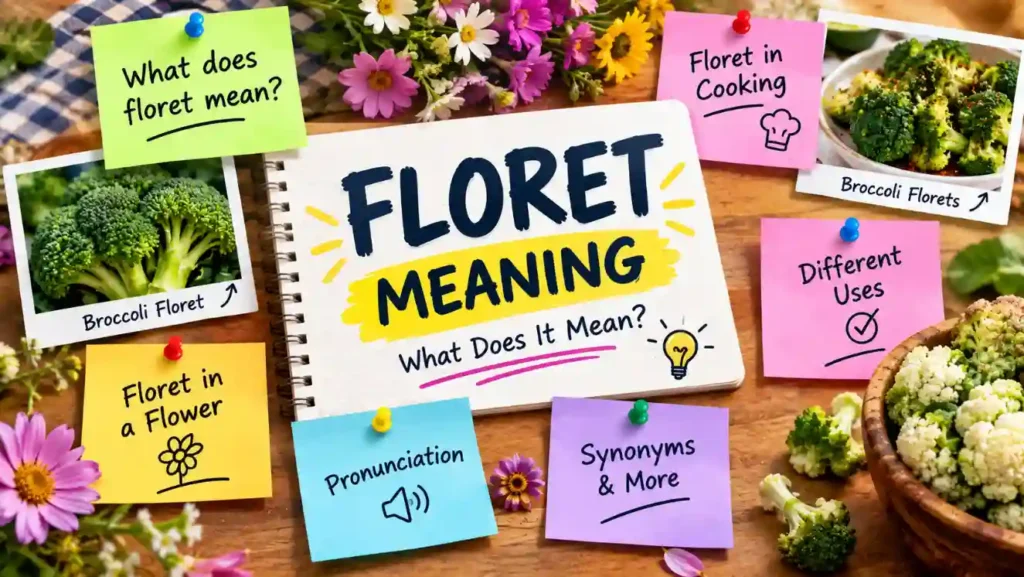
A floret is a small individual flower, typically one of many that make up a larger flower head or cluster. You’ll most often encounter the word in two very different contexts: botany, where it describes tiny flowers within composite blooms like sunflowers, and cooking, where it refers to the small, tree-shaped pieces you cut from vegetables like broccoli and cauliflower.
Most people first learn the word in the kitchen rather than the garden, which is why the cooking sense sometimes overshadows the term’s original botanical meaning. Understanding the floret meaning clears up both uses and shows how they actually connect.
This guide covers what floret means botanically, how the word applies in cooking, where the term comes from, and the mistakes people commonly make with it.
What It Means
In its original botanical sense, a floret names one small flower within a larger cluster or flower head made up of many individual flowers. Plants like daisies, sunflowers, and dandelions produce flower heads that look like a single bloom but actually consist of dozens or hundreds of tiny florets packed tightly together.
In its more familiar culinary sense, a floret refers to one of the small, branching, tree-shaped sections you cut or break off from vegetables like broccoli or cauliflower. These vegetable “florets” are technically clusters of undeveloped flower buds, which is exactly why the culinary term borrows directly from the botanical one.
Both meanings share the same core idea: a small, individual flowering unit that forms part of a larger structure, if that structure ends up in a garden bed or on a dinner plate.
Origin & History
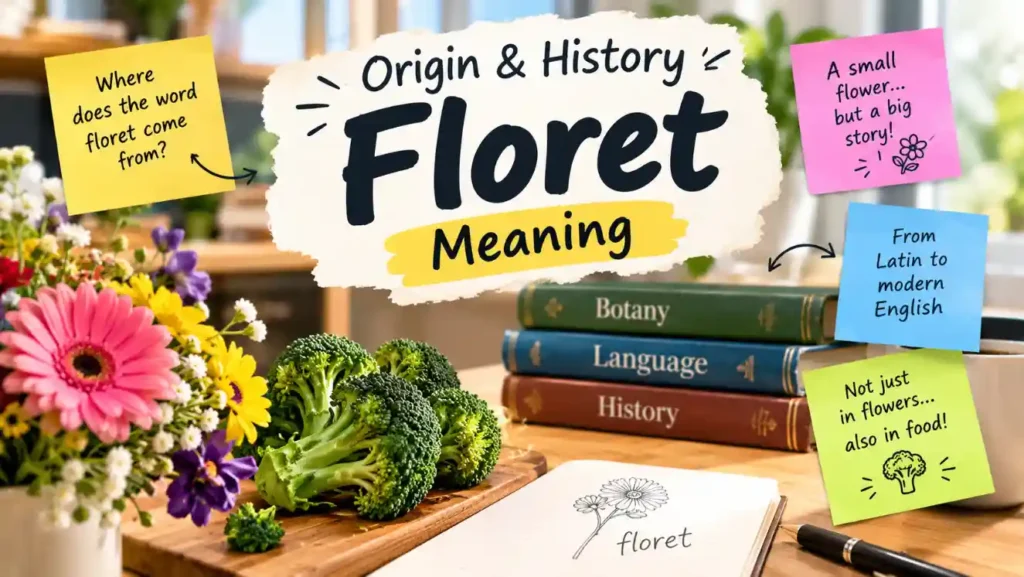
Floret comes from the Latin word “flos,” meaning “flower,” combined with the diminutive suffix “-et,” which typically indicates something small. Put together, “floret” literally translates to something close to “little flower,” a fitting description for its botanical meaning.
Botanists have used the term for centuries to describe the tiny individual flowers found in composite flower heads, particularly within the daisy family (Asteraceae), which includes sunflowers, daisies, and dandelions. These plants produce dense clusters of small florets rather than a single large bloom, and botanical writing needed a precise word to describe each individual flower within that cluster.
The culinary usage developed later, borrowing the botanical term directly because broccoli and cauliflower “florets” are, technically speaking, clusters of the plant’s undeveloped flower buds. Cooks and food writers adopted the botanical vocabulary because it accurately described what these vegetable pieces actually are.
Different Contexts and Meanings
In botany. Florets make up composite flower heads in plants like sunflowers, daisies, dandelions, and many grasses. Botanists further classify florets into specific types, such as ray florets (the petal-like outer flowers) and disc florets (the tightly packed inner flowers) in plants like sunflowers.
In cooking and recipes. Recipes constantly call for “broccoli florets” or “cauliflower florets,” referring to the small, branching pieces cut from the main head of the vegetable, typically used for roasting, steaming, or serving raw.
In grasses and cereal crops. Florets also appear in grass and grain botany, referring to the tiny individual flowers within a grass spikelet, relevant in agricultural and botanical science discussing wheat, rice, and other cereal crops.
In gardening and horticulture. Gardeners sometimes use the term when describing composite flowers in their gardens, particularly when discussing plant structure, pollination, or specific flower varieties.
As a size or shape descriptor. Occasionally, people use “floret” loosely to describe anything shaped like a small, branching cluster, extending slightly beyond its strict botanical or culinary definition.
Examples
- “The recipe calls for two cups of small broccoli florets.”
- “Each sunflower head contains hundreds of tiny florets.“
- “She trimmed the cauliflower into bite-sized florets before roasting.”
- “Botanists studied the ray florets along the edge of the daisy.”
- “The wheat spikelet contains several individual florets.“
- “He arranged the roasted florets around the main dish.”
- “The dandelion’s yellow ‘petals’ are actually individual ray florets.”
- “Cut the broccoli into florets, keeping the stems for later.”
- “The garden guide explained how disc florets differ from ray florets.”
- “Steam the cauliflower florets until just tender.”
How to Use It (Grammar and Context)
Floret functions as a noun, almost always used in its plural form, “florets,” since both flowers and vegetables typically involve multiple small units rather than just one. Recipes and botanical writing alike commonly pair it with a specific vegetable or plant name: “broccoli florets,” “sunflower florets,” “ray florets.”
The word rarely functions as a verb or adjective; it stays firmly a noun describing the small flower or vegetable unit itself.
Common Mistakes
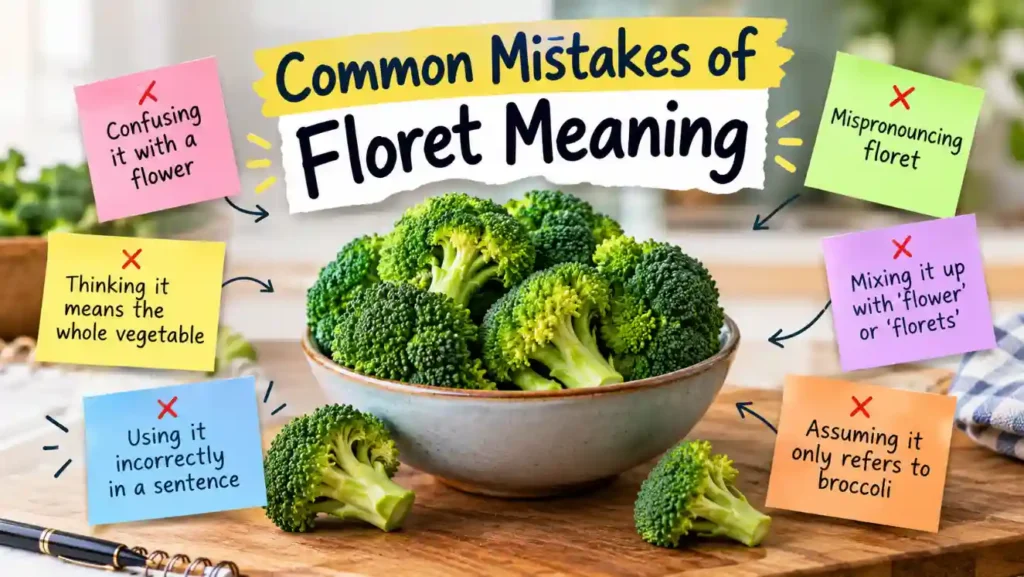
Assuming floret only applies to vegetables. While the culinary use is extremely common, the word’s original and still-active meaning describes tiny individual flowers in botany, not just broccoli and cauliflower pieces.
Confusing floret with “floweret.” “Floweret” is an older, less common English word with a similar meaning, but “floret” remains the standard, more widely used term in both modern botany and cooking.
Overlooking the connection between the two meanings. Some people don’t realize that vegetable florets are literally clusters of undeveloped flower buds, missing the direct link between the culinary and botanical senses of the word.
Misspelling it as “florette” or “flouret.” The correct spelling follows the Latin-derived “floret” pattern, without the extra letters some people mistakenly add.
Similar Words
| Word | Meaning | Difference from Floret |
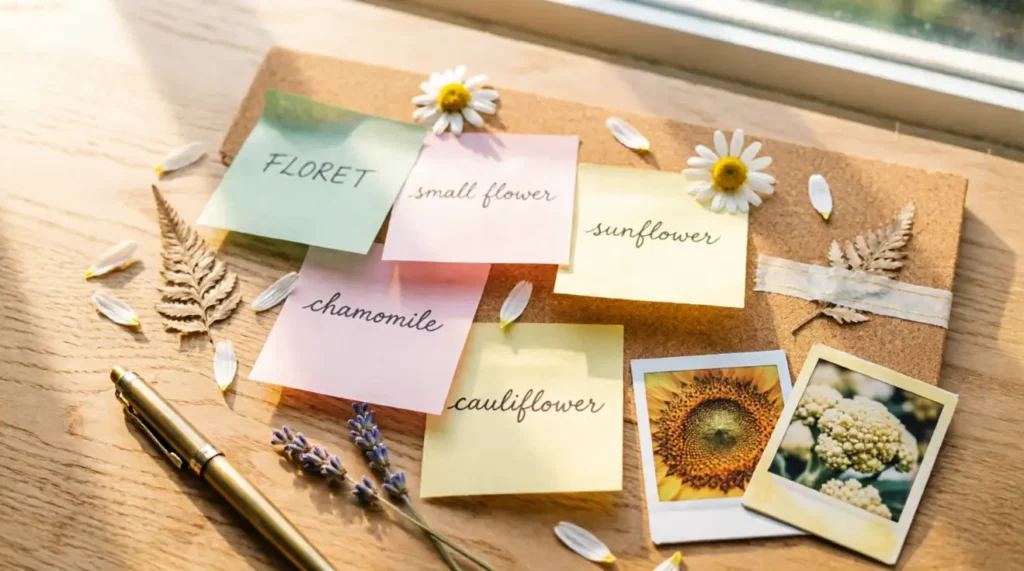
| Floweret | An older, less common synonym for a small individual flower | Nearly identical meaning to floret, though far less commonly used today |
| Petal | One segment of a flower’s outer, often colorful structure | A petal is part of a single flower; a floret is often an entire tiny flower itself, within a larger cluster |
| Bud | An undeveloped flower or leaf before it opens | A floret can be in bud form (as with broccoli) or fully bloomed (as with a sunflower’s individual florets) |
| Inflorescence | The complete flower cluster or arrangement on a plant | Inflorescence describes the whole flowering structure; florets are the individual small flowers that make it up |
Opposite Words
There’s no true grammatical opposite of “floret,” but related contrasts include:
| Word | Meaning | Why It Contrasts |
| Solitary flower | A single flower that grows alone, not part of a cluster | Contrasts with florets, which specifically grow in dense clusters or heads |
| Whole head | The complete, uncut vegetable (like a whole cauliflower) | Represents the vegetable before it’s broken down into individual florets |
Pronunciation
Floret is pronounced FLOR-it or FLOR-et, with the stress on the first syllable.
Quick Facts
| Fact | Detail |
| Word origin | Latin “flos” (flower) plus diminutive suffix “-et,” meaning “little flower” |
| Botanical meaning | A tiny individual flower within a larger flower head or cluster |
| Culinary meaning | Small, branching pieces cut from vegetables like broccoli and cauliflower |
| Common plant family | Asteraceae (daisy family), which includes sunflowers, daisies, and dandelions |
| Common food uses | Roasting, steaming, or serving raw as a snack or side dish |
| Typical grammatical number | Almost always used in plural form, “florets” |
Key Takeaways
- A floret is a small individual flower, usually part of a larger flower cluster or head.
- The word applies both botanically (sunflowers, daisies) and culinarily (broccoli, cauliflower).
- Vegetable florets are technically clusters of undeveloped flower buds, connecting the two meanings directly.
- Floret comes from Latin roots meaning “little flower.”
- The word almost always appears in plural form, “florets.”
FAQs
What does floret mean in French?
In French, “floret” is generally translated as “fleuron,” meaning a small flower or individual flower within a larger cluster.
What is a floret in cooking?
A floret is a small, edible portion of a vegetable such as broccoli or cauliflower, separated from the main stem.
What is a floret in a flower?
A floret is a small individual flower that forms part of a larger flower head or cluster, especially in plants like daisies and sunflowers.
How is broccoli floret pronounced?
“Broccoli floret” is pronounced with the emphasis on the first syllable of “broccoli” and the first syllable of “floret.”
What does floret mean in English?
In English, “floret” means a small or individual flower, especially one that is part of a larger flower head.
What does floret mean?
A floret is a small individual flower or a small flower-like part of a plant, such as one section of broccoli or cauliflower.
What does “cauliflower floret” mean?
A cauliflower floret is a small, separated section of a cauliflower head, usually cut into bite-sized pieces for cooking.
How much is a floret of broccoli?
A typical broccoli floret is roughly 1–2 inches wide, but its size can vary depending on how the broccoli is cut.
How is a floret different from a flower?
A flower can be a complete individual bloom, while a floret is usually a small individual flower that forms part of a larger flower head.
What are some synonyms for “floret”?
Common synonyms include small flower, tiny flower, blossom, bloom, and floweret, depending on the context.
Conclusion
The floret meaning ties together two everyday contexts that most people never think to connect: the garden and the dinner plate. If you’re picturing the tiny individual flowers packed into a sunflower’s center or the small green pieces you just cut from a head of broccoli, the word points to the exact same underlying idea: a small flower doing its part within something larger.
That connection makes a lot more sense once you know that broccoli and cauliflower florets really are undeveloped flower buds, not just a convenient cooking term borrowed for its sound. Recipes reach for the botanical word because it’s simply accurate, even if most cooks never stop to think about the flower they’re about to steam or roast.
Next time a recipe calls for florets, or you spot the tightly packed center of a daisy, you’ll recognize the same small building block at work in both places, proof that a little botanical vocabulary shows up in more everyday places than you might expect.

I am Stephen King an American author known for compelling storytelling. At writemora.com, we value clear, accurate, and reader-focused content inspired by excellence in writing.