
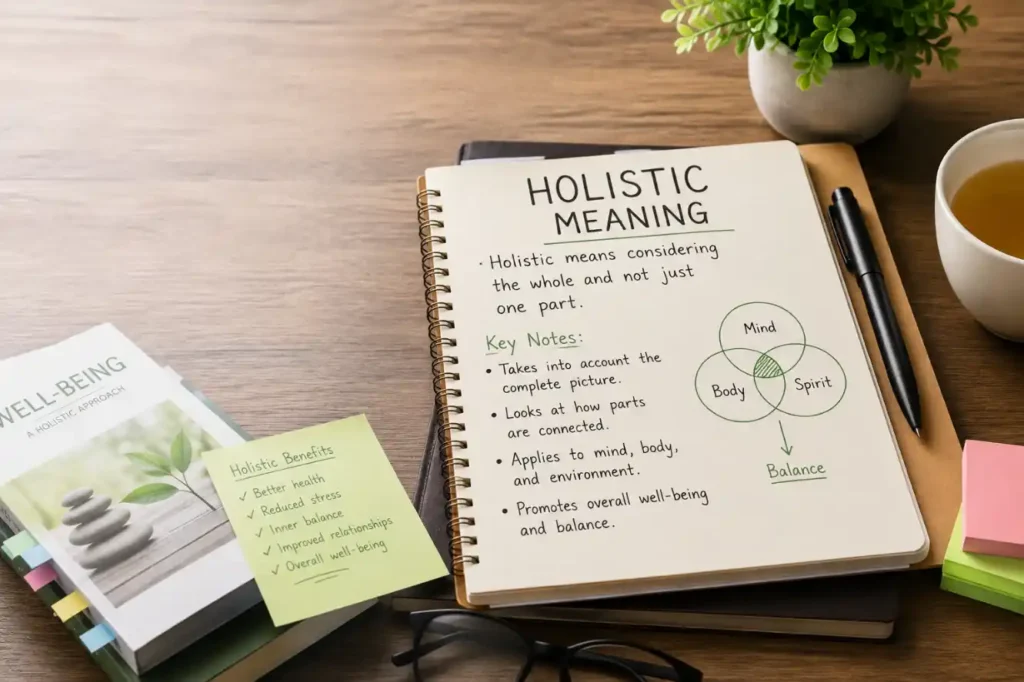
What does “holistic” actually mean? You’ve probably heard it used in all sorts of contexts medicine, education, business, even wellness products. But the core meaning is simpler than you might think.
Holistic means considering something as a complete, interconnected whole rather than breaking it into separate parts . In plain terms, it’s about looking at the whole picture instead of just one piece of it.
This guide breaks down everything you need to know about the holistic meaning from its roots in philosophy to how it’s used in medicine, business, and everyday life. You’ll learn how to use it correctly and avoid common mistakes that even native speakers make.
What Does Holistic Mean? The Simple Definition
At its simplest, holistic is an adjective that means “relating to or concerned with complete systems rather than with individual parts” .
When you take a holistic approach, you don’t just focus on one symptom, one department, or one perspective. Instead, you step back and look at how everything connects. You consider the relationships between parts, not just the parts themselves .
A Quick Example
Think of a car that won’t start. A non-holistic approach might be: “The battery is dead. Replace the battery.” A holistic approach might ask: “Why did the battery die? Is the alternator working? Are there electrical issues? How old is the car overall?” The holistic mechanic considers the entire system to find the root cause.
Where Did the Word Come From? A Brief History
The word “holistic” comes from “holism,” a philosophy that says the whole is more than just the sum of its parts . The term was built from “hol-” (meaning “whole”) plus the adjective suffix “-istic” .
The idea isn’t new. Philosophers have debated the “One versus the Many” for centuries . But “holism” as a formal concept emerged in the early 20th century and eventually gave us the adjective “holistic,” which has since spread across many fields.
How Is Holistic Used in Different Contexts?
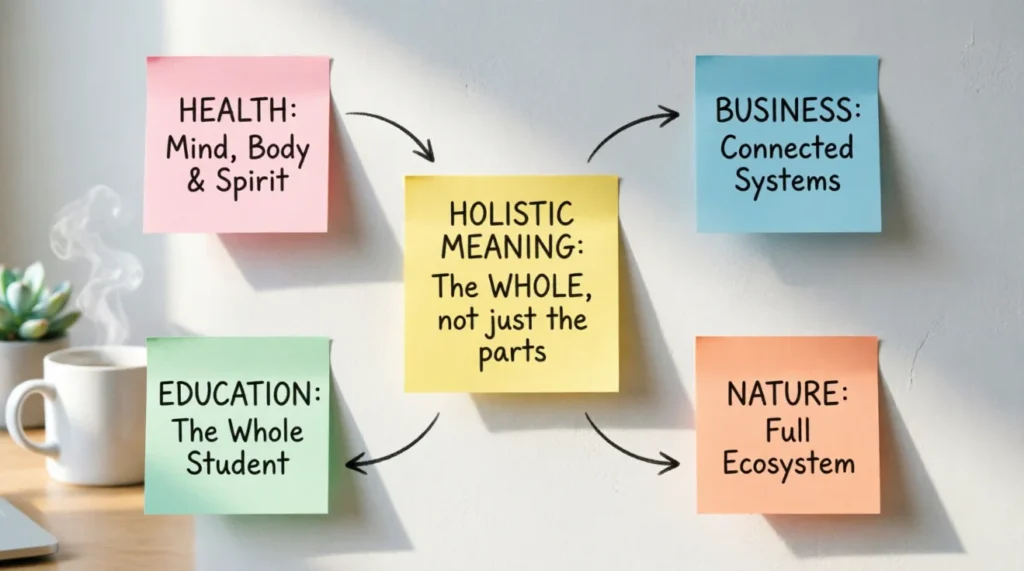
The beauty of “holistic” is that it applies to almost anything. Here are the most common contexts where you’ll encounter it.
Holistic Medicine and Healthcare
This is the most familiar use of the word. Holistic medicine treats the entire person’s mind, body, and spirit, not just the disease or injury .
In practice, this means a doctor might ask about your diet, stress levels, sleep, and emotional state, not just write a prescription. Some holistic medicine draws on traditional or natural remedies to maintain health .
Here’s an example from a dictionary: “Holistic medicine attempts to treat both the mind and the body” .
Holistic Approach in Business and Management
In business, a holistic approach means considering all factors that affect a company’s success, employees, culture, customers, operations, and the broader market. Instead of focusing only on quarterly profits, a holistic leader thinks about long-term sustainability and the well-being of everyone involved.
A dictionary example uses this context perfectly: “We need to take a more holistic approach to improving our schools” . This means looking at teacher training, funding, curriculum, and community support together, rather than changing just one thing.
Holistic View in Education
In education, holistic means looking at the whole student. This includes academic performance, social development, emotional health, and creativity. A holistic school doesn’t just focus on test scores; it builds well-rounded people.
Holistic Thinking in Everyday Life
You can use a holistic approach to solve everyday problems. Let’s say you’re stressed. A non-holistic fix might be “take a pill.” A holistic fix might ask: “What’s causing the stress? Is it sleep, work, relationships, or diet?” You’d then address the whole picture.
Examples of Holistic in Real Sentences
Here are real-world examples to show how versatile the word is :
- “If we were serious about bringing in minority lawyers, I asserted, we’d have to look more holistically at candidates” .
- “Critics argued that separating the legislation makes it difficult to assess the proposal holistically” .
- “There was no nutritional holistic option for the pets other than just dosing them up” .
- “Her holistic practitioner prescribed dietary changes and some relaxation exercises to reduce the frequency of her migraines” .
- “The clinic takes a holistic approach, treating diet, sleep, and stress together” .
- “A holistic view of the economy looks at more than just one industry” .
Holistic Definition
The word holistic describes an approach that considers something as a complete whole rather than focusing on only one part. A holistic perspective looks at how different elements connect and influence one another. For example, a holistic view of well-being may consider physical health, emotional balance, relationships, lifestyle, and mental health together. The term can be used in education, healthcare, business, personal development, and many other areas. Instead of treating individual problems separately, a holistic approach tries to understand the bigger picture. In simple terms, holistic means looking at the entire situation and recognizing that its different parts are often connected.
Holistically Definition
Holistically is the adverb form of holistic and means considering something as a complete system or whole. When a person looks at a situation holistically, they do not concentrate on one isolated detail. Instead, they examine the different factors involved and how those factors work together. For example, a teacher may evaluate a student’s progress holistically by considering academic performance, participation, creativity, behavior, and personal development. Similarly, a business may look at customer satisfaction holistically by examining product quality, service, communication, and overall experience. The word suggests a broad and connected way of thinking rather than a narrow focus on one individual element.
Meaning of Holistic
The meaning of holistic is based on the idea of understanding something as a whole. Rather than examining separate parts independently, a holistic perspective considers how those parts interact and contribute to the overall result. The term is commonly used when discussing health, education, personal growth, psychology, and business. For instance, holistic education focuses not only on grades but also on a student’s social, emotional, creative, and personal development. In everyday language, calling something holistic means that it takes the bigger picture into account. It recognizes that individual parts may be connected and that understanding those connections can lead to a more complete perspective.
Holistic Meaning in Malayalam
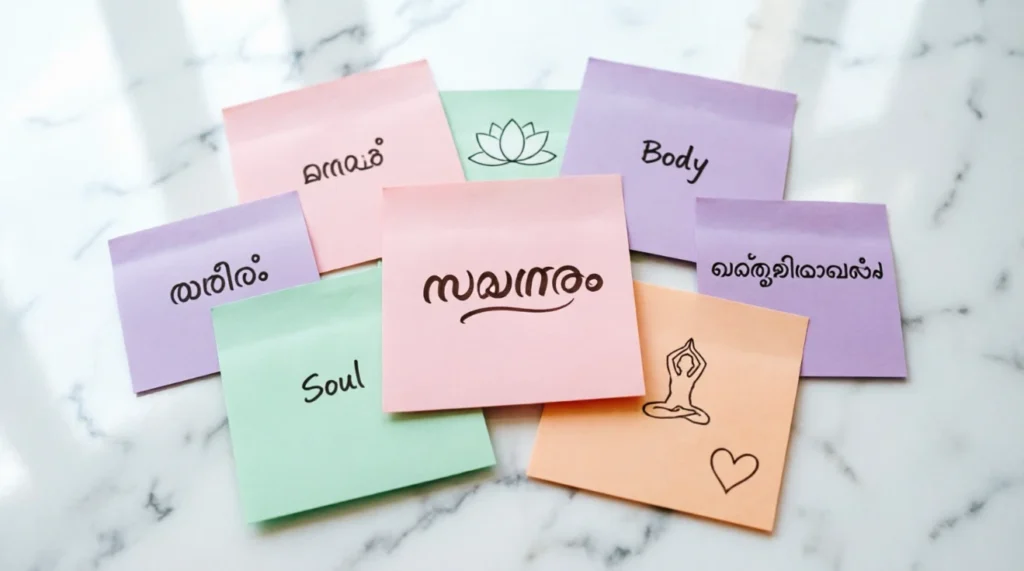
The holistic meaning in Malayalam can be explained as viewing something as a complete whole while considering all of its connected parts. The English word “holistic” is commonly understood in Malayalam through ideas such as സമഗ്രമായ or സമഗ്രതയെ അടിസ്ഥാനമാക്കിയുള്ള സമീപനം. For example, a holistic approach to health does not focus only on a particular illness. It may also consider lifestyle, food, emotions, sleep, physical activity, and overall well-being. In simple Malayalam usage, holistic can therefore describe something that is comprehensive, complete, or concerned with the whole rather than just one part. The exact translation may vary depending on the context in which the word is used.
Holistic Approach Meaning
The holistic approach meaning refers to a way of understanding or solving a problem by considering all relevant factors together. Instead of concentrating on one symptom, issue, or component, this approach examines the larger situation and the relationships between its parts. For example, a holistic approach to education may consider academic knowledge along with creativity, emotional development, communication, and social skills. In business, it might involve looking at customers, employees, operations, finances, and long-term goals together. The main idea is that a situation can be better understood when its different elements are viewed as connected. A holistic approach therefore emphasizes balance, context, and the bigger picture.
Holistic Meaning in Sinhala

The holistic meaning in Sinhala refers to understanding something as a complete whole rather than looking at only one part. In Sinhala, the concept can be explained using ideas related to a comprehensive or overall approach, such as සමස්ත or සමග්ර depending on the context. For example, a holistic approach to health considers physical condition, mental well-being, lifestyle, relationships, and other relevant factors together. The word is often used when explaining a broad perspective that connects different aspects of a situation. Although there may not always be one exact Sinhala translation for every context, the central meaning remains the same: considering the whole system and its interconnected parts.
Holist Definition
A holist is a person who believes that a system or subject should be understood as a whole rather than only by examining its individual parts. The noun is related to the concept of holism, which emphasizes the importance of relationships and connections within a complete system. For example, a person who takes a holistic view of health may believe that physical, emotional, social, and lifestyle factors should be considered together. The term can be used in philosophy, healthcare, education, psychology, and other fields. In simple terms, a holist is someone who emphasizes the bigger picture and believes that the whole can provide an understanding that separate parts alone may not offer.
How to Use “Holistic” Correctly
Using “holistic” is straightforward once you understand its core meaning. Here’s what to remember.
It’s an Adjective
Holistic describes a noun. You can have a holistic approach, a holistic view, or holistic medicine .
- Correct: “We need a holistic approach.”
- Incorrect: “We need to holistic solve this problem.”
It’s About Wholes, Not Just Natural
This is crucial. Many people use “holistic” as a fancy word for “natural” or “alternative” . But that’s not its original meaning. “Holistic” is about whole-picture thinking . A product can be both natural and holistic, but they aren’t the same thing.
Common Mistakes to Avoid
Mistake 1: Using It as a Fancy Synonym for “Alternative”
Wrong: “I’m taking holistic vitamins.” (Unless you mean vitamins are part of a full-body plan, just say “natural.”)
Right: “I’m taking a holistic approach to my health, including diet, exercise, and stress management.”
Mistake 2: Thinking It Only Means Medical
Wrong: “Holistic” only belongs in a doctor’s office.
Right: You can have holistic thinking about business, education, or even fixing a plumbing problem.
Mistake 3: Being Too Vague
Wrong: “Our company is holistic.” (What does that mean? Be specific.)
Right: “Our company takes a holistic view of employee well-being, including mental health, physical fitness, and financial planning.”
Similar Words and Their Differences
| Word | Meaning | Key Difference from “Holistic” |
| Comprehensive | Covering everything. | Focuses on breadth, not necessarily the connection between parts. |
| Integrated | Combining things into a whole. | Focuses on the action of combining, not the philosophical perspective. |
| Alternative | Different from the mainstream. | Often refers to what it is (e.g., alternative medicine), not the approach. |
| Systemic | Relating to an entire system. | Very close! “Systemic” is about the system, while “holistic” is about the whole-system perspective. They are often used similarly. |
Opposite Words
| Word | Meaning |
| Atomistic | Breaking things into separate, isolated parts . |
| Reductionist | Explaining complex things by breaking them down into the simplest components. |
| Compartmentalized | Dividing things into separate categories. |
Pronunciation
Holistic is pronounced hoh-LIS-tik (/hoʊˈlɪs.tɪk/) .
- hoh (like “ho” in “hold”)
- LIS (like “list” without the “t”)
- tik (like “tick”)
Quick Facts
| Fact | Detail |
| Part of Speech | Adjective |
| Pronunciation | hoh-LIS-tik |
| Core Meaning | Concerning complete systems, not just parts |
| Word Origin | From “hol-” (whole) + “-istic” |
| Most Common Use | Holistic medicine, holistic approach |
| Common Mistake | Confusing it with “natural” or “alternative” |
| Antonym | Atomistic |
FAQs
What does holistic mean simple?
Holistic means looking at a person, situation, or problem as a whole instead of focusing on only one part. It considers how different parts work together.
What is a holistic synonym?
Common synonyms for holistic include comprehensive, complete, whole, integrated, overall, and all-inclusive. The best synonym depends on the context.
What is a holistic lifestyle?
A holistic lifestyle focuses on overall well-being by balancing physical health, mental health, emotions, relationships, and daily habits. It aims to support the whole person.
What is an example of holistic?
An example of a holistic approach is treating someone’s health by considering their diet, exercise, sleep, stress, emotions, and lifestyle instead of focusing only on one symptom.
What is a holistic person?
A holistic person considers the bigger picture and understands how different parts of life are connected. They often value balance, well-being, relationships, and personal growth.
What is the opposite of holistic?
The opposite of holistic is usually reductionist or narrow-focused. Instead of considering the whole system, this approach focuses on individual parts separately.
What are 5 good synonyms?
Five good synonyms for holistic are comprehensive, complete, integrated, whole, and all-encompassing. These words suggest considering many parts together.
Does comprehensive mean holistic?
Yes, comprehensive can mean similar to holistic because both suggest considering many aspects of something. However, holistic usually emphasizes how those parts connect and work together.
What does the term “holistically” mean?
Holistically means considering something as a complete whole rather than examining only one part. For example, looking at health holistically means considering physical, mental, and emotional well-being.
What is a holistic woman?
A holistic woman is generally described as someone who considers different areas of her life together, including physical health, emotional well-being, relationships, personal growth, and overall balance.
What are the 7 types of holistic needs?
The seven commonly recognized holistic needs are physical, emotional, social, spiritual, intellectual, environmental, and financial needs. Together, they address different areas that can affect overall well-being.
What is a holistic mindset?
A holistic mindset means looking at the bigger picture and understanding how different factors are connected. It focuses on balance, relationships, and the overall impact of decisions rather than one isolated issue.
Key Takeaways
- “Holistic” means considering the whole system, not just individual parts .
- It’s most commonly used in medicine, but applies to business, education, and everyday problem-solving .
- Don’t confuse it with “natural” or “alternative.” Those are about what something is; holistic is about the approach .
- The word has a philosophical root in holism, the idea that a whole is more than the sum of its parts .
- Use it when you want to say you’re looking at the big picture.
Conclusion
Language evolves, and “holistic” has traveled far from its philosophical roots. Today, it’s a word that shows you’re a big-picture thinker, someone who understands that problems don’t exist in a vacuum and that real solutions require seeing the full landscape.
The next time you hear someone say they’re taking a “holistic approach,” you’ll know exactly what they mean: they’re connecting the dots. And when you use the word yourself, remember its true meaning. Don’t use it as a buzzword. Use it with intention to describe genuine whole-system thinking that considers every piece of the puzzle.
If you’re managing your health, running a team, or just trying to make a better decision, ask yourself one question: Am I looking at the whole, or just a piece? That question alone can transform how you see almost any situation.
Now you know what holistic truly means. Use it wisely and watch how much more you notice when you start seeing the whole picture.

I am Olivia Brooks an American editor and content researcher dedicated to creating clear, accurate content. At writemora.com, I help readers to understand words, phrases, and modern language with confidence.