
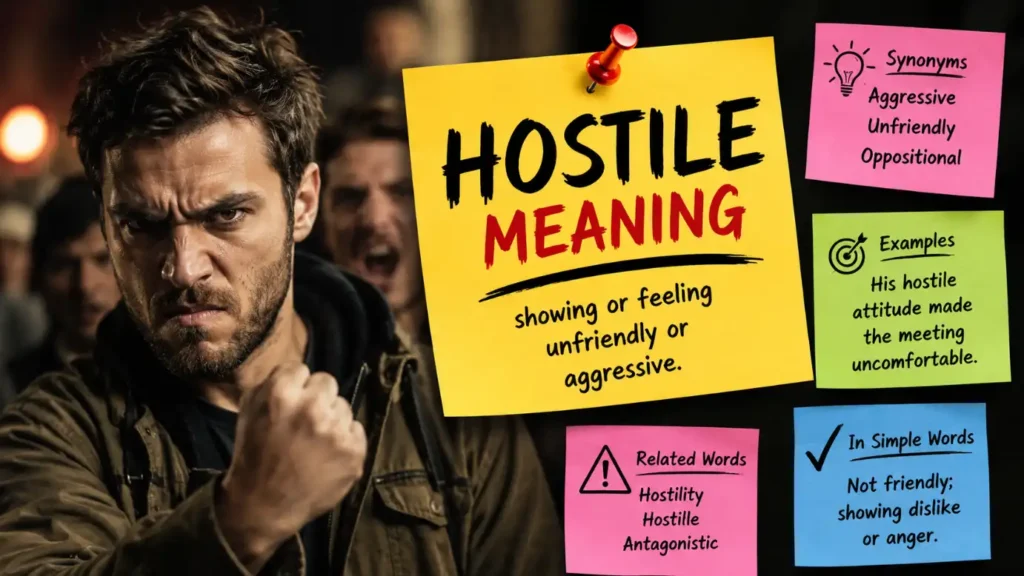
Hostile describes someone or something openly unfriendly, antagonistic, or opposed to a person, group, or idea. It signals more than mild dislike; the word implies active resistance, aggression, or a clear intent to oppose.
You’ll encounter hostility constantly, if describing a person’s tone, a workplace environment, a military action, or even weather conditions. Understanding the hostile meaning helps you use the word precisely instead of reaching for it as a vague stand-in for “unfriendly” or “mean.”
This guide covers exactly what hostile means, where the word comes from, the different contexts it appears in, and the common mistakes people make when using it.
What It Means
In simple terms, hostile describes an attitude, action, or environment that shows clear opposition, unfriendliness, or aggression toward someone or something. A hostile person acts antagonistic or confrontational; a hostile environment feels unwelcoming, tense, or actively unsafe.
In a fuller sense, hostile carries a stronger charge than words like “unfriendly” or “cold.” It implies active opposition rather than passive distance; a hostile response pushes back, challenges, or attacks, rather than simply ignoring or avoiding.
The word applies broadly across emotional, physical, and legal contexts. People, environments, actions, takeovers, weather, and even legal terrain can all carry the label “hostile,” each usage sharing the same underlying sense of active opposition or unfriendliness.
Origin & History

Hostile comes from the Latin word “hostilis,” meaning “of an enemy,” which itself derives from “hostis,” meaning “enemy” or “stranger.” The word entered English through French in the 15th century, carrying its original military and adversarial connotations from the start.
Early uses of hostile in English closely tied to warfare and enmity between nations or armies describing enemy forces, hostile territory, or acts of open aggression between opposing sides. Over centuries, English speakers expanded the word beyond strict military contexts, applying it to interpersonal conflict, workplace tension, legal disputes, and even inhospitable environments or conditions.
Despite this broadening, hostile retained its core sense of active opposition from its earliest Latin roots the word never fully lost its connection to conflict and enmity, even as its use spread into everyday, non-military language.
Different Contexts and Meanings
Describing a person’s attitude or behavior. This is the most common everyday use: someone acting hostile shows clear unfriendliness, aggression, or antagonism toward another person, often through tone, body language, or direct confrontation.
Describing an environment or atmosphere. A “hostile work environment” refers to a workplace marked by harassment, intimidation, or discrimination, a term that also carries specific legal weight in employment law.
In military and political contexts. Hostile describes enemy forces, hostile nations, or hostile territory, referring to active conflict or opposition between countries or groups.
In business and finance. A “hostile takeover” describes an attempt to acquire a company against the wishes of its management or board, often by going directly to shareholders.
Describing physical conditions. Hostiles can describe environments unsuitable or dangerous for survival, such as a “hostile climate” or “hostile terrain,” extending the word’s core sense of opposition to non-human contexts.
Examples

- “He gave a hostile response when asked about the delay.”
- “The meeting turned hostile once budget cuts came up.”
- “She filed a complaint about a hostile work environment.”
- “The soldiers advanced into hostile territory.“
- “The company faced a hostile takeover attempt from a rival firm.”
- “The desert’s hostile climate makes long-term survival difficult without proper supplies.”
- “His hostile tone made the negotiation harder than it needed to be.”
- “The crowd grew hostile as the decision was announced.”
- “Diplomatic relations between the two nations remained hostile for decades.”
- “The customer became hostile after the refund was denied.”
How to Use It (Grammar and Context)
Hostile functions as an adjective, typically modifying a noun directly (“a hostile crowd”) or following a linking verb (“the crowd became hostile”). It also pairs commonly with prepositions like “to” or “toward“: “hostile to the idea,” “hostile toward outsiders.”
The related noun form, “hostility,” describes the state or quality of being hostile, while the adverb “hostilely” exists but appears rarely in modern usage, since writers more often restructure sentences to avoid it.
Common Mistakes
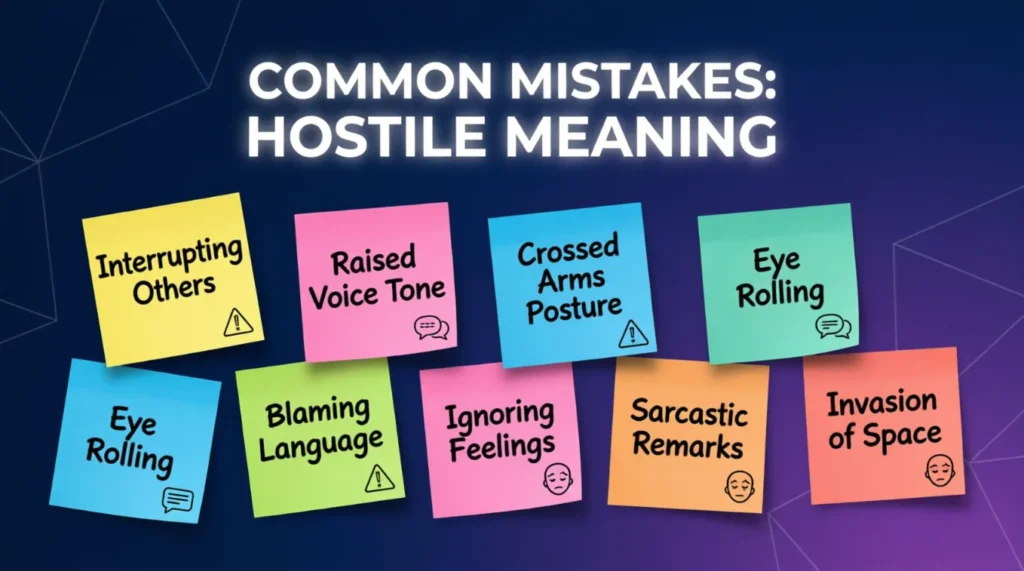
Using it interchangeably with “unfriendly” or “rude.” Hostile implies something stronger than mild rudeness, active opposition or aggression, not just poor manners or coldness.
Overusing it for mild disagreement. Calling a simple disagreement “hostile” overstates the tone; the word fits situations involving real antagonism or aggression, not just differing opinions calmly expressed.
Misapplying “hostile work environment” casually. This specific phrase carries legal meaning in employment law, referring to a workplace involving harassment or discrimination using it loosely for any unpleasant job can create confusion in serious contexts.
Confusing “hostile” with “hostage.” The words share a root but mean entirely different things: hostile describes an attitude or opposition, while hostage refers to a person held captive.
Similar Words
| Word | Meaning | Difference from Hostile |
| Aggressive | Forceful, ready to attack or confront | Aggressive emphasizes forcefulness of action; hostile emphasizes underlying opposition or enmity |
| Antagonistic | Actively opposed or unfriendly toward someone | Very close in meaning; antagonistic often implies ongoing conflict, while hostile can describe a single moment or attitude |
| Belligerent | Aggressively hostile, especially eager for conflict | Belligerent implies a stronger, more combative readiness for confrontation than hostile alone |
| Unfriendly | Not warm, welcoming, or kind | Unfriendly is milder; hostile implies active opposition rather than simple coldness |
Opposite Words
| Word | Meaning | Why It’s an Opposite |
| Friendly | Warm, kind, and welcoming | Directly opposes the antagonism and unfriendliness at the core of hostile |
| Amicable | Characterized by goodwill and absence of conflict | Describes cooperative, peaceful interaction, the opposite of hostile confrontation |
| Welcoming | Open, inviting, and accommodating | Contrasts with the unwelcoming, opposed nature of a hostile environment |
Pronunciation
Hostile is pronounced HAH-stul in American English, or HAH-stile in British English, with the stress on the first syllable.
Quick Facts
| Fact | Detail |
| Word origin | Latin “hostilis” (of an enemy), from “hostis” (enemy, stranger) |
| Entered English | Around the 15th century, via French |
| Part of speech | Adjective |
| Related noun | Hostility |
| Common legal phrase | “Hostile work environment” (specific meaning in employment law) |
| Common business phrase | “Hostile takeover” |
FAQs
What does hostile mean simply?
Hostile describes someone or something openly unfriendly, aggressive, or actively opposed to a person, group, or idea.
What’s the difference between hostile and aggressive?
Aggressive emphasizes forceful action or confrontation, while hostile emphasizes underlying opposition or enmity, which may or may not involve direct aggression.
What does a hostile work environment mean legally?
In employment law, a hostile work environment refers to a workplace involving harassment, intimidation, or discrimination severe enough to interfere with someone’s ability to work.
What is a hostile takeover?
A hostile takeover describes an attempt to acquire a company against the wishes of its management or board, typically by appealing directly to shareholders.
Where does the word hostile come from?
It comes from the Latin word “hostilis,” meaning “of an enemy,” derived from “hostis,” meaning “enemy” or “stranger.”
Can hostile describe something other than a person?
Yes. It can describe environments, weather, terrain, takeovers, and relationships between groups or nations, not just individual behavior.
Is hostile stronger than unfriendly?
Yes. Unfriendly implies coldness or lack of warmth, while hostile implies active opposition, confrontation, or aggression.
What’s the noun form of hostile?
“Hostility” describes the state or quality of being hostile.
Key Takeaways
- Hostile describes active opposition, unfriendliness, or aggression toward a person, group, or idea.
- The word comes from Latin roots meaning “of an enemy.”
- It applies across many contexts, including personal behavior, workplaces, business, military conflict, and physical environments.
- “Hostile work environment” carries specific legal meaning in employment law.
- Hostile is stronger than “unfriendly,” implying real confrontation or antagonism rather than simple coldness.
Conclusion
The hostile meaning centers on one consistent idea across every context it appears in: active opposition, if that shows up in a person’s tone, a company’s takeover attempt, or a stretch of unforgiving terrain. Tracing the word back to its Latin root for “enemy” makes that thread easy to see, even in uses that feel far removed from actual warfare.
Precision matters here because hostile carries real weight, especially in legal and professional settings where the word triggers specific meanings and consequences. Calling a tense email exchange “hostile” when it was really just blunt, or labeling ordinary workplace friction a “hostile work environment” without the legal criteria behind it, can muddy a conversation that needs clarity rather than exaggeration.
Used accurately, though, hostile remains one of the more efficient words in English for signaling real conflict, a single word that instantly communicates opposition, tension, or danger, without needing a longer explanation to back it up.

I am Stephen King an American author known for compelling storytelling. At writemora.com, we value clear, accurate, and reader-focused content inspired by excellence in writing.