

Deferred describes something postponed or delayed until a later time, rather than canceled or refused outright. You’ll encounter the word constantly in finance, education, and legal contexts, always carrying the same core idea: a decision, payment, or action pushed back to a future date.
Understanding the deferred meaning matters because the word shows up in situations with real consequences, from college admissions to loan payments to legal proceedings. This guide covers what deferred means, where the word comes from, its most common specific uses, and the mistakes people sometimes make with it.
What It Means
In simple terms, deferred means postponed or put off until a later time. When something gets deferred, it doesn’t happen immediately or as originally scheduled, but the plan remains in place for it to happen eventually, distinguishing it clearly from being canceled or denied.
In a fuller sense, deferring implies an active, often deliberate choice to delay, rather than a passive or accidental postponement. A person, institution, or system typically makes the decision to defer something for a specific reason — financial timing, incomplete information, or a need for more time before finalizing a decision.
The word applies across many different fields, but the underlying meaning stays consistent: whatever gets deferred still exists as a pending matter, just relocated to a future point in time rather than resolved now.
Origin & History
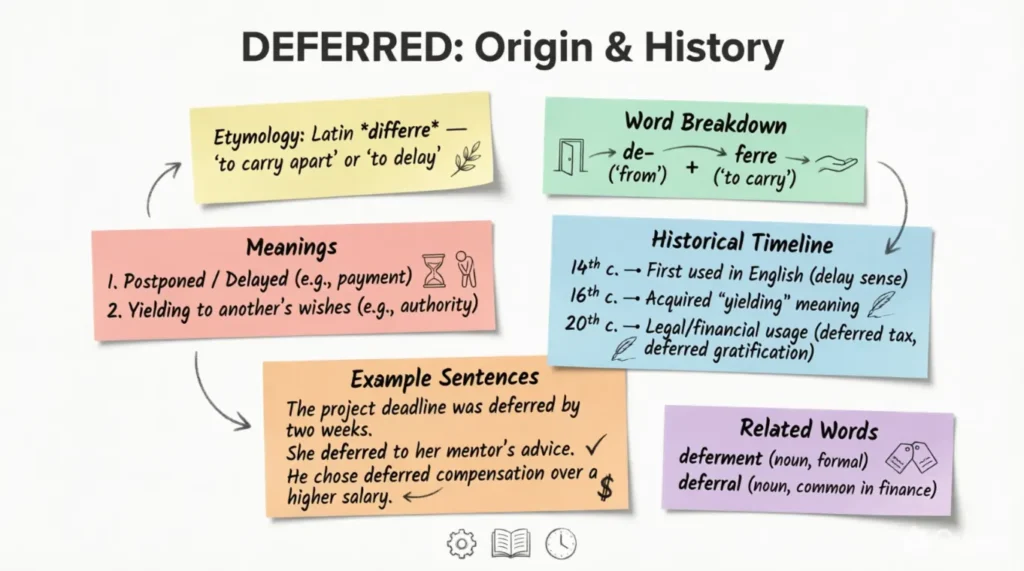
Deferred comes from the Latin word “differre,” meaning “to carry apart,” “to postpone,” or “to differ,” which itself combines “dis-“ (apart) and “ferre” (to carry or bear). This same Latin root also produced the English word “differ,” reflecting an underlying sense of separating or setting something apart from the present moment.
The word entered English through Old French in the 14th century, already carrying the meaning of delay or postponement. English speakers have used “defer” and its past-tense form “deferred” consistently in that sense for centuries, applying it to an increasingly wide range of formal and informal contexts as those systems (banking, education, law) developed.
Over time, “deferred” became especially embedded in specific institutional vocabulary deferred payments in finance, deferred admission in education, deferred prosecution in law each borrowing the same core meaning of postponement within its own specialized system.
Different Contexts and Meanings
Deferred payment. This describes an arrangement where a payment gets pushed to a later date rather than paid immediately, common in loans, financing plans, and certain purchase agreements.
Deferred admission (education). Colleges and universities sometimes offer deferred admission, allowing an accepted student to delay their enrollment by a semester or year, often to travel, work, or handle personal circumstances before starting.
Deferred prosecution (law). In legal contexts, a deferred prosecution agreement allows a defendant to avoid immediate prosecution by meeting certain conditions over a set period, with charges dropped if those conditions are met successfully.
Deferred compensation (employment and finance). This describes an arrangement where part of an employee’s earnings gets paid out at a later date, often for tax planning purposes or retirement savings.
Deferred maintenance. This term describes repairs or upkeep that get postponed, often due to cost or scheduling constraints, common in discussions about buildings, infrastructure, and equipment.
Examples
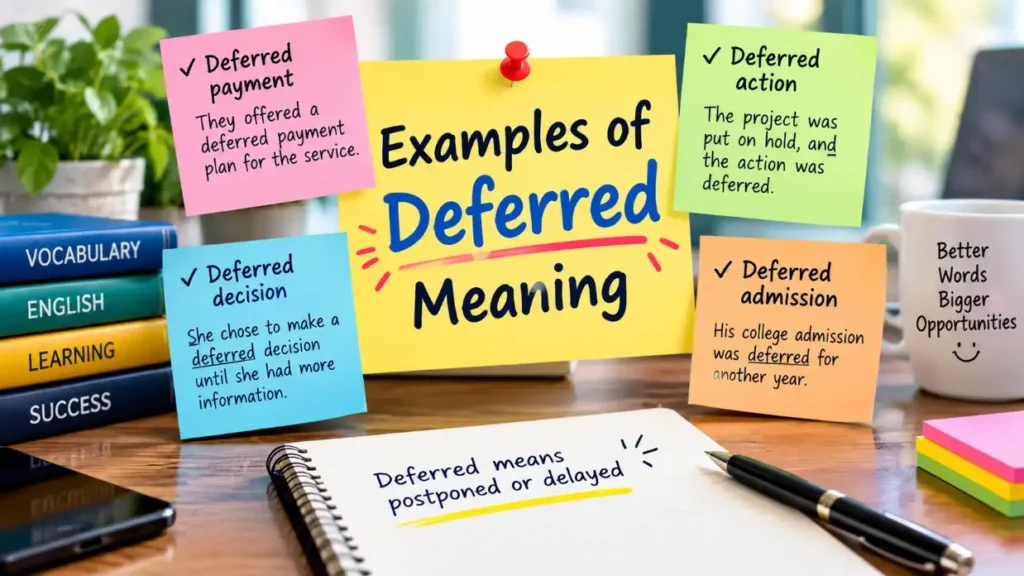
- “Her college offered her deferred admission so she could take a gap year.”
- “The company offers deferred payment plans for larger purchases.”
- “He negotiated a deferred prosecution agreement with the district attorney.”
- “Part of her salary goes into a deferred compensation plan for retirement.”
- “The building suffered from years of deferred maintenance.”
- “The bank agreed to a deferred payment schedule during his financial hardship.”
- “She deferred her law school acceptance for a year to work abroad.”
- “The judge deferred sentencing until additional evidence could be reviewed.”
- “Employees can choose to defer part of their bonus into next year’s tax filing.”
- “The city budget listed several deferred infrastructure projects.”
How to Use It (Grammar and Context)
Deferred functions as the past tense and past participle of the verb “defer,” and it also works as an adjective modifying a noun directly: “a deferred payment,” “deferred admission,” “deferred maintenance.” The base verb form, “defer,” describes the ongoing action: “she decided to defer the payment.”
The word often pairs with specific nouns tied to its context payment, admission, prosecution, compensation, maintenance each forming a recognized phrase with its own specific institutional meaning.
Common Mistakes
Assuming deferred means canceled. Deferring something specifically means postponing it, not eliminating it entirely; the deferred item or decision remains pending for a future date.
Confusing deferred with denied. In contexts like college admissions, a deferred decision differs meaningfully from a denial — a deferred applicant still has a chance at acceptance, typically reconsidered at a later date.
Overlooking the conditions attached to deferral. Many deferred arrangements, especially deferred prosecution or deferred payment plans, come with specific conditions that must be met, not just an automatic delay with no requirements attached.
Misusing “defer” and “differ” interchangeably. Despite sharing a Latin root, these words mean different things today — “defer” means to postpone (or to yield to someone’s judgment), while “differ” means to be unlike or disagree.
Similar Words
| Word | Meaning | Difference from Deferred |
| Postponed | Delayed to a later time | Nearly identical in meaning to deferred, though “postponed” applies more broadly and casually across contexts |
| Suspended | Temporarily stopped or paused | Suspended often implies an indefinite pause without a clear resumption plan, while deferred usually implies a specific future point |
| Delayed | Held back or slowed from happening on schedule | Delayed can apply to something already in progress being slowed, while deferred usually applies to something not yet started |
| Adjourned | Formally paused, especially in legal or official proceedings | Adjourned specifically applies to meetings or formal proceedings; deferred applies more broadly across many contexts |
Opposite Words
| Word | Meaning | Why It’s an Opposite |
| Immediate | Happening right away, without delay | Directly opposes the postponement implied by deferred |
| Finalized | Completed and settled, with no further changes pending | Contrasts with deferred’s implication of something still pending |
| Denied | Refused or rejected outright | Represents a different, more final outcome than a deferred decision, which remains open |
Pronunciation
Deferred is pronounced dih-FURD, with the stress on the second syllable.
Quick Facts
| Fact | Detail |
| Word origin | Latin “differre” (to carry apart, postpone), via Old French |
| Part of speech | Past tense/participle of “defer”; also functions as an adjective |
| Common phrases | Deferred payment, deferred admission, deferred prosecution, deferred compensation |
| Key distinction | Deferred means postponed, not canceled or denied |
| Common fields | Finance, education, law, employment, infrastructure |
| Related verb | Defer (base form) |
Key Takeaways
- Deferred means postponed or delayed until a later time, not canceled outright.
- The word comes from the Latin “differre,” meaning “to carry apart” or “postpone.”
- Common specific uses include deferred payment, deferred admission, deferred prosecution, and deferred compensation.
- A deferred decision remains open and pending, distinct from a final denial.
- “Defer” and “differ” share a root but carry different modern meanings.
FAQs
What does it mean if something is deferred?
It means something is postponed or delayed until a later time, rather than being dealt with immediately.
What does it mean to defer to someone?
To defer to someone means to respect their knowledge or judgment and allow them to make the decision.
What is the meaning of deferred?
“Deferred” means postponed, delayed, or put off until a later time.
What does deffer mean?
“Deffer” is usually a misspelling of “defer,” which means to postpone something or yield to someone’s judgment.
Does “deferred” mean “not accepted”?
Not necessarily. “Deferred” usually means a decision or action has been delayed, while “not accepted” means it was rejected.
What does “defer” mean in simple sentences?
In simple terms, “defer” means to delay something or to let someone else decide because you respect their judgment.
What is another word for “defer”?
Common synonyms include postpone, delay, put off, and yield, depending on the context.
Why do people defer?
People may defer because they need more time, lack enough information, or trust someone else’s knowledge or authority.
Can I say I defer to you?
Yes. “I defer to you” is a polite way to say that you respect the other person’s judgment and will follow their decision.
Conclusion
The deferred meaning centers on one consistent idea across every field it touches: something real and pending, just relocated to a future point in time rather than resolved right now. If it’s a payment, a college decision, or a legal case, deferred status keeps the door open rather than closing it.
That distinction matters more than people sometimes realize, especially in high-stakes situations like admissions or legal proceedings, where confusing “deferred” with “denied” can lead to unnecessary panic or missed follow-up steps. Recognizing that deferral usually comes with specific conditions or a defined future checkpoint helps make sense of what actually happens next.
If you’re waiting on a deferred college decision, managing a deferred payment plan, or reading about a deferred prosecution agreement in the news, the same underlying idea applies every time: nothing has ended yet, it’s just been pushed further down the calendar.

I am Olivia Brooks an American editor and content researcher dedicated to creating clear, accurate content. At writemora.com, I help readers to understand words, phrases, and modern language with confidence.