
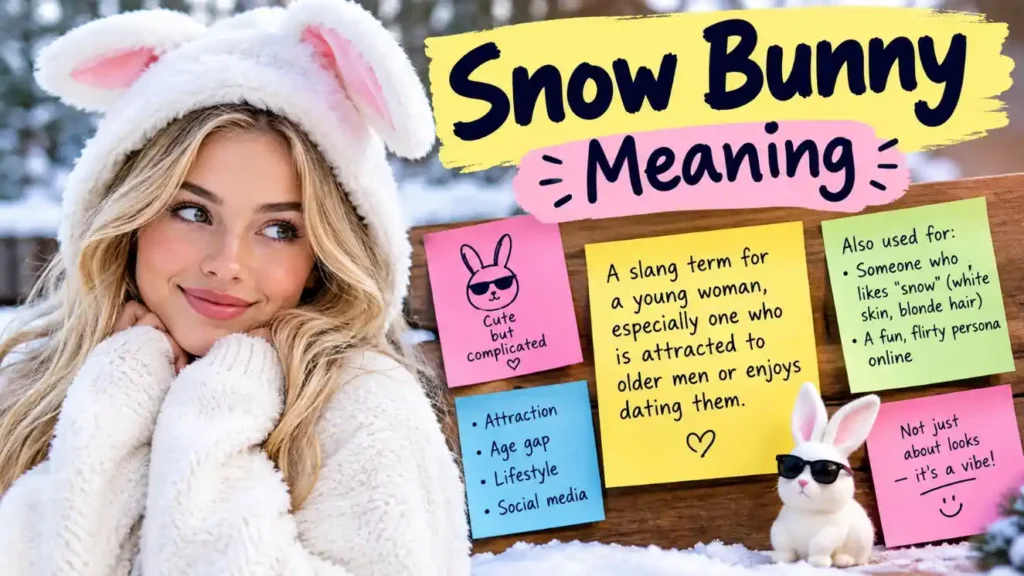
Snow bunny originally described a young woman who enjoys skiing or snowboarding, often associated more with the social scene and stylish winter gear at ski resorts than serious athletic skill. Over time, the phrase picked up a second, more controversial meaning in Black American vernacular and hip-hop culture, referring specifically to a white woman who dates Black men.
Because the same phrase now carries two genuinely different meanings, context determines a lot about how the term lands. This guide covers where each meaning came from, how people use the phrase today, and why the racial sense in particular can be read very differently depending on who’s using it and why.
What It Means
In its original ski-culture sense, a snow bunny refers to a young, often stylish woman who frequents ski slopes and resorts, sometimes more for the social atmosphere, fashion, and après-ski lifestyle than for serious skiing or snowboarding ability. The term dates back to the mid-20th century and generally carries a light, sometimes slightly teasing tone about inexperience on the slopes.
In its separate, more recent slang sense, particularly within Black American and hip-hop vernacular, snow bunny refers to a white woman who dates or pursues relationships with Black men, with “snow” referencing whiteness in contrast to the original ski-related meaning. This usage carries real cultural weight and, depending on context and tone, can range from casual and descriptive to stereotyping or genuinely offensive.
Which meaning applies depends heavily on context: ski and winter sports content points clearly to the original sense, while music, dating discussions, and certain online communities point to the racialized meaning.
Origin & History
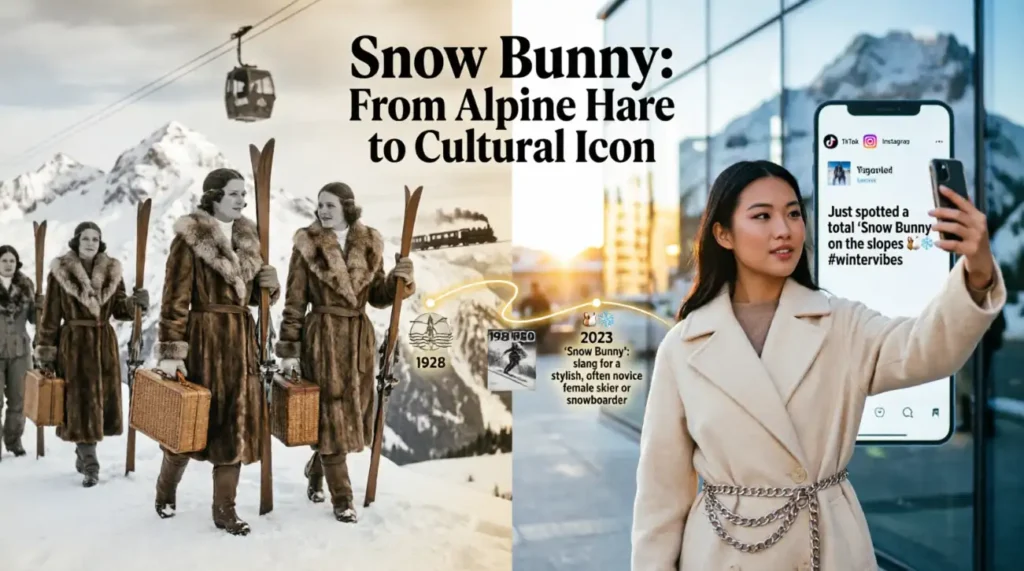
The ski-related meaning of “snow bunny” emerged in the 1950s, coinciding with skiing’s growing popularity in postwar America, the debut of women’s Nordic skiing at the 1952 Winter Olympics, and a booming middle-class leisure culture. “Bunny” had long served as casual slang for an attractive woman, and pairing it with “snow” created a catchy, era-appropriate term for women associated with the glamorous, increasingly accessible ski scene.
The racialized meaning developed later and separately, gaining particular traction through hip-hop culture and slang starting in the 1990s and 2000s. Several prominent rappers used the term in song lyrics specifically to reference white romantic partners, which helped cement this second meaning as widely recognized cultural vocabulary, distinct from its ski-culture origins.
Both meanings continue to coexist today, with the specific context of using a ski magazine versus a song lyric or social media post about dating making clear which one applies in most situations.
Different Contexts and Meanings
In ski and snowboard culture. This remains the term’s original and least controversial use, describing someone associated with the ski resort lifestyle, sometimes with a light implication of favoring style and socializing over actual skill.
In hip-hop and Black American vernacular. Here, the term specifically references a white woman dating or pursuing a Black man, a usage that has appeared repeatedly in song lyrics and continues to circulate in cultural commentary about interracial dating.
As casual or self-applied slang. Some people, including some white women in relationships with Black men, use the term about themselves casually or even affectionately, particularly on social media platforms like TikTok.
As a term some consider offensive or reductive. Because the racialized meaning can carry stereotypes or assumptions about interracial relationships and dating patterns, many people consider it inappropriate or offensive, particularly when an outsider uses it to characterize someone else’s relationship.
In pop culture and celebrity commentary. The term sometimes surfaces in gossip coverage or online discussion of celebrity interracial relationships, again carrying the racialized rather than ski-related meaning.
Examples

- “She has spent every winter weekend at the resort as a total snow bunny since college.”
- “The ski shop’s ad specifically targeted the snow bunny crowd with stylish winter gear.”
- “The song lyrics referenced his preference for dating snow bunnies.”
- “Some people online debated if the term snow bunny is inherently offensive.”
- “She joked about being in her ‘snow bunny era’ after a season of skiing every weekend.”
- “The article traced the phrase’s shift from ski slang to a term with racial connotations.”
- “He avoided using the term altogether, aware it could carry different meanings depending on the audience.”
- “The magazine used ‘snow bunny’ purely in its original, skiing-related sense.”
- “The professor discussed the term’s dual meaning as an example of slang evolution.”
- “Commenters flagged the term’s racialized usage under the celebrity relationship post.”
How to Use It (Grammar and Context)
Snow bunny functions as a noun phrase, typically used descriptively: “she’s a snow bunny,” “the snow bunny crowd.” Because the phrase carries such different meanings depending on context, writers discussing it directly, as this article does, generally need to clarify which sense they mean rather than assuming readers will infer it correctly.
Given the racialized meaning’s potential to read as reductive or offensive, many writers and speakers avoid using the term casually in mixed or uncertain contexts, reserving it for its original ski-culture sense or for direct, deliberate discussion of the slang meaning itself.
Common Mistakes
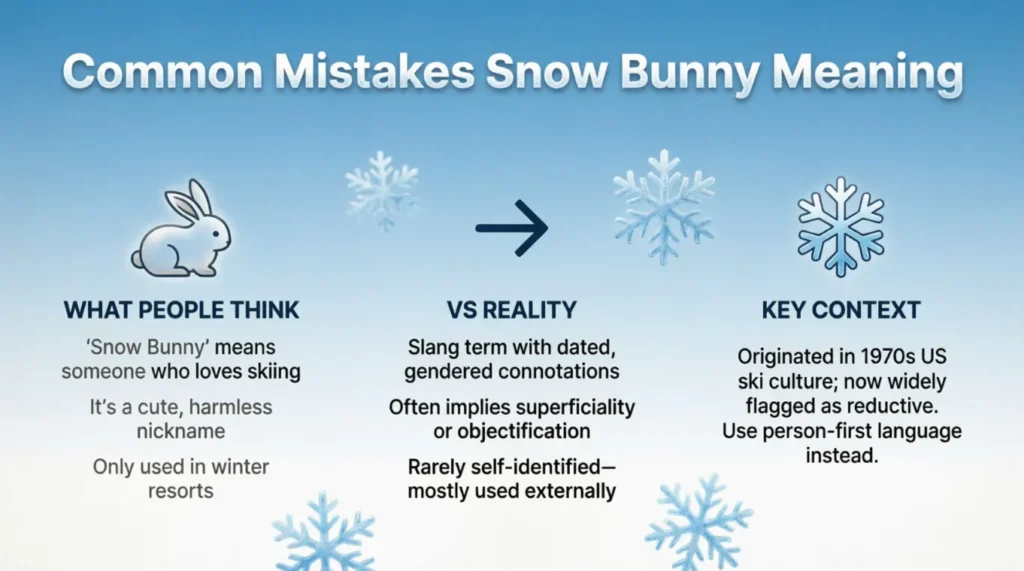
Assuming the term only has one meaning. Someone familiar only with the ski-culture sense might use the phrase without realizing its other, racially loaded meaning, potentially causing unintended confusion or offense.
Assuming the racialized meaning is always used negatively. The distinction between casual, descriptive use and genuinely offensive stereotyping depends heavily on who’s using the term, their intent, and the specific context it isn’t uniformly one or the other.
Using the term about someone else’s relationship without their input. Applying the racialized meaning to characterize someone else’s specific relationship, rather than as a general cultural reference, risks reducing a real relationship to a stereotype.
Overlooking the term’s origin in ski culture. Some people encounter only the racialized meaning online and assume that’s the term’s sole or original usage, missing its decades-old, unrelated ski-culture roots.
Similar Words
| Word/Phrase | Meaning | Difference from Snow Bunny |
| Ski bunny | A near-identical term for someone associated with ski resort culture | Functions almost interchangeably with the original meaning of snow bunny, without the racialized secondary meaning |
| Groupie | Someone who follows and pursues relationships with musicians, athletes, or other public figures | Groupie is broader and not tied to race or a specific sport/setting the way snow bunny’s meanings are |
| Jersey chaser | Slang for someone who pursues relationships specifically with athletes | Related in cultural context to the racialized meaning of snow bunny, though jersey chaser applies specifically to sports figures rather than race |
| Interracial dating | A general, neutral term describing romantic relationships between people of different races | Interracial dating is a neutral descriptive term; snow bunny (in its racialized sense) is slang that can carry stereotype or judgment |
Opposite Words
There’s no true grammatical opposite of “snow bunny,” but related contrasts include:
| Word/Phrase | Meaning | Why It Contrasts |
| Expert skier | Someone highly skilled and experienced in skiing | Contrasts with the original meaning’s implication of style over serious skill |
| Neutral description | A description of a relationship without racial framing or stereotype | Contrasts with the reductive quality some critics associate with the racialized meaning |
Pronunciation
People pronounce snow bunny as SNOH BUH-nee, with standard English pronunciation of both words.
Quick Facts
| Fact | Detail |
| Original meaning | A young woman associated with ski resort and skiing culture |
| Origin | 1950s, tied to skiing’s postwar popularity boom |
| Secondary meaning | A white woman who dates Black men, in Black American/hip-hop slang |
| Secondary meaning’s rise | Gained wider use through hip-hop culture, 1990s–2000s |
| Related term | “Ski bunny,” largely interchangeable with the original meaning |
| Reception | Ranges from casual/affectionate to considered offensive, depending on context and usage |
FAQs
What does “snow bunny” mean on TikTok?
On TikTok, “snow bunny” usually refers to a white woman, often in the context of dating or attraction to Black men. Meaning can vary by context.
Why are girls called snow bunnies?
The term is commonly used as slang for white women, especially those associated with or attracted to Black men. It can be descriptive, playful, or sexual depending on context.
What does a bunny mean in slang?
“Bunny” can be an affectionate nickname for a cute or attractive woman. In some contexts, it may also have romantic or sexual meanings.
What does a snowbunny girl look like?
There is no specific appearance that defines a snow bunny. The term generally refers to a white woman rather than a particular hairstyle, clothing style, or body type.
What does it mean when someone asks if you’re a snow bunny?
They may be asking whether you are a white woman who is attracted to or dates Black men. The intended meaning depends on the conversation and speaker.
What’s the male equivalent of a snowbunny?
There is no single universally accepted male equivalent. “Snow bunny” is mainly used for women, while related slang terms for men vary by community and context.
When did the term “snow bunny” come out?
“Snow bunny” has been used in American slang for decades, with meanings that have changed over time. Its modern racial and dating-related usage became more prominent later.
What does it mean if a guy calls you a bunny?
If a guy calls you “bunny,” he may be using it as a cute or affectionate nickname. Depending on context, it can also suggest romantic or sexual interest.
What does the slang term “white bunny” mean?
“White bunny” can be used as slang for a white woman, particularly in racial or dating contexts. Its meaning depends heavily on the speaker and situation.
What does it mean if a girl is a bunny?
Calling a girl a “bunny” can mean she is cute, attractive, or sweet. It may also be an affectionate nickname rather than a specific slang label.
What is “bad bunny” slang for?
“Bad bunny” can describe an attractive woman with a bold, confident, or rebellious personality. It can also refer to the Puerto Rican artist Bad Bunny, depending on context.
What does “bunny” mean in a relationship?
In a relationship, “bunny” is often used as a sweet pet name for a partner. It can express affection, playfulness, or romantic closeness.
What does “snow bunny” mean in TikTok?
On TikTok, “snow bunny” generally describes a white woman, particularly in discussions involving interracial dating or attraction. The term can be casual, humorous, or sexual depending on context.
Key Takeaways
- Snow bunny originally describes a young woman associated with ski resort and skiing culture, dating back to the 1950s.
- A separate, later meaning, popularized through hip-hop culture, refers to a white woman who dates Black men.
- The racialized meaning can range from casual or affectionate to genuinely offensive, depending on context and intent.
- Context almost always clarifies which meaning applies in a given situation.
- Many people avoid casual use of the racialized meaning specifically because it can carry stereotypes about interracial relationships.
Conclusion
The snow bunny meaning traces two very different paths from the same catchy phrase: one leading to a ski lodge and a pair of stylish winter boots, the other leading into a much more culturally loaded conversation about race and dating. Both meanings remain in active use today, which is exactly why context does so much of the interpretive work whenever the phrase comes up.
That split also makes the term a useful example of how slang can develop entirely separate lives within different communities, sometimes without much overlap or awareness between them. Someone deeply familiar with ski culture might have no idea the phrase carries a racialized meaning elsewhere, while someone who only knows hip-hop usage might be surprised to learn the term started on a mountain slope decades earlier.
If you come across the phrase yourself, paying attention to the surrounding context and thinking carefully about tone if you’re the one using it will tell you almost everything you need to know about which “snow bunny” is actually being discussed.

I am Stephen King an American author known for compelling storytelling. At writemora.com, we value clear, accurate, and reader-focused content inspired by excellence in writing.