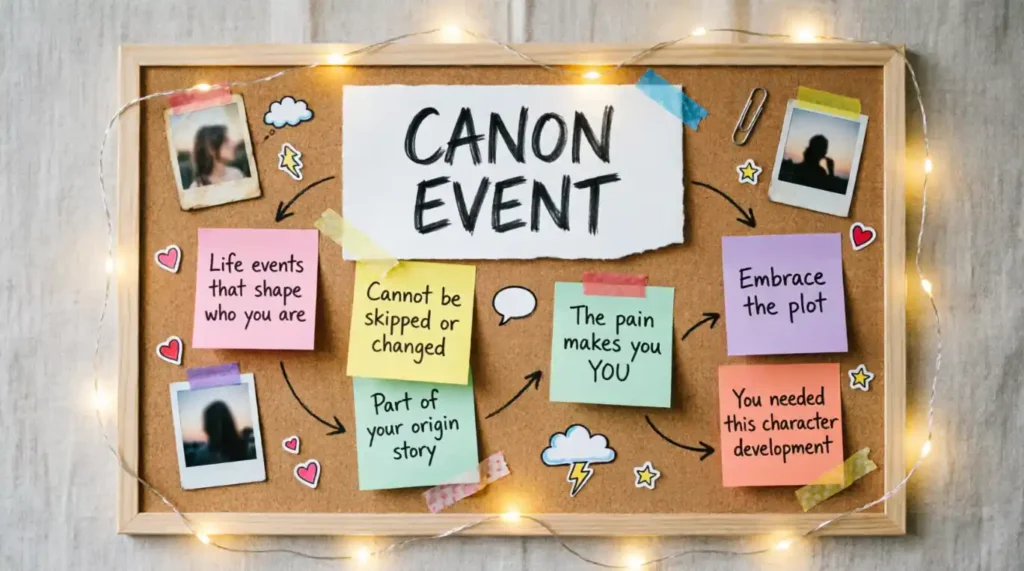
A canon event describes a difficult, formative, or defining moment that shapes who a person becomes something people frame as an unavoidable, necessary part of their personal story. The phrase treats real life like a story with a set plot, where certain painful experiences have to happen for someone to grow into who they’re “supposed to” become.
The term exploded online after appearing in a major superhero film, and people quickly adapted it into everyday language for talking about hardship, growth, and identity. Understanding the canon event meaning explains both where the phrase came from and why it resonated so widely.
This guide covers what a canon event actually is, where the term originated, how people use it across different contexts, and the common mistakes people make with it.
What It Means
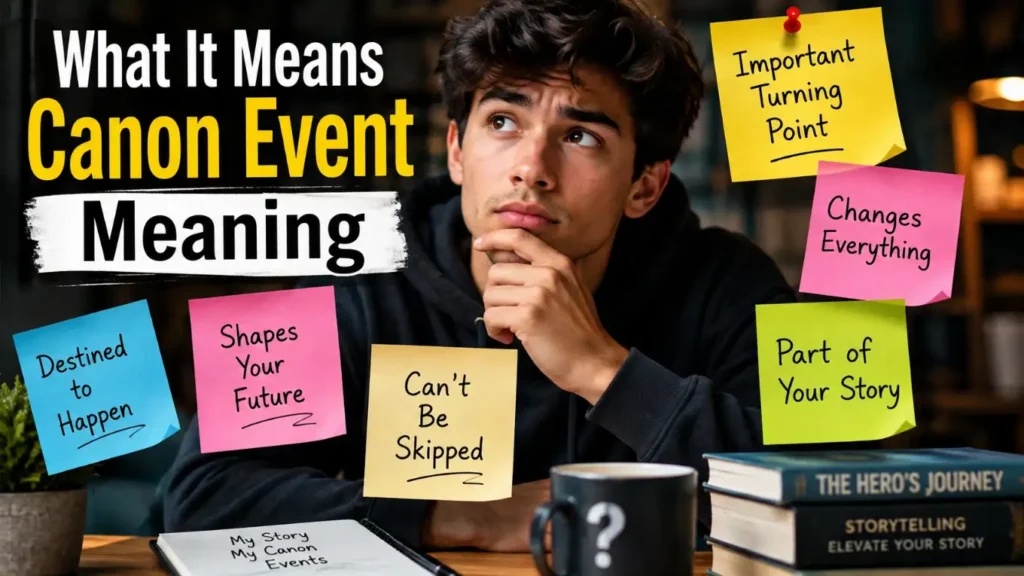
In simple terms, a canon event names a significant, often painful experience that a person treats as a necessary, defining part of their life story, the kind of moment that “had to happen” for them to become who they are.
In a fuller sense, the phrase borrows from fiction and fandom vocabulary, where “canon” refers to the official, accepted storyline of a franchise, as opposed to fan-made or alternate versions. Applying that idea to real life implies that certain hardships, a breakup, a failure, an embarrassing moment, a loss function like fixed plot points nobody can skip, shaping a person’s development the way a key scene shapes a character’s arc.
People typically use the phrase with a mix of humor and genuine reflection. It lets someone acknowledge a hard experience while framing it as meaningful and almost inevitable, rather than purely negative.
Origin & History
The phrase traces back to the 2023 film Spider-Man: Across the Spider-Verse, where a character explains that certain painful events count as “canon” for every version of Spider-Man across the multiverse moments so essential to the character’s identity that they have to happen, no matter which universe he comes from.
Shortly after the film’s release, the phrase spread rapidly across social media, particularly TikTok and Twitter/X, as people began applying “canon event” to their own lives. Users described personal hardships, embarrassing memories, or formative failures as their own canon events, borrowing the multiverse concept to suggest that everyone, in some form, has to go through certain defining moments.
The phrase caught on quickly because it gave people a shorthand for something everyone already recognized: certain experiences feel inevitable in hindsight, and framing them as “canon” turned that recognition into a viral, shareable joke with genuine emotional weight underneath it.
Different Contexts and Meanings

As a nod to the original film reference. Many uses of the phrase still directly reference the Spider-Verse scene, especially in fan communities discussing the movie itself.
As a way to describe formative hardship. Outside fandom, people use “canon events” to label a real experience, often something embarrassing, painful, or difficult that shaped who they became.
As dark humor about inevitability. The phrase often carries a joking, self-aware tone, letting people describe genuinely tough experiences with some emotional distance and humor rather than pure heaviness.
As a bonding phrase. People frequently use “canon event” in conversation to relate to someone else’s story, implying “that sounds like something everyone has to go through in some form.”
As a broader meme format. The phrase also spread into meme templates and captions unrelated to personal stories, applied loosely to describe any moment that feels unavoidable or fated within a narrative, fictional or real.
Examples
- “Getting my heart broken in college was definitely a canon event.“
- “Everyone has a canon event where they embarrass themselves in front of their crush.”
- “That job rejection ended up being a canon event that pushed me toward a better career.”
- “She said failing that class was her canon event, it’s what got her serious about school.”
- “Is getting your car towed once a canon event for every college student?”
- “The show gave the character her canon event in the season finale.”
- “That awkward first date was a canon event I’ll never live down.”
- “Losing to my little brother at chess was apparently a canon event in our family.”
- “Every superhero seems to have the same canon event: losing someone close to them.”
- “That embarrassing haircut in middle school was a canon event for basically everyone.”
How to Use It (Grammar and Context)

Canon event functions as a noun phrase, almost always used with “a” or “my/your/their” before it: “a canon event,” “my canon event,” rather than as a standalone verb or adjective. People typically pair it with a specific story or memory, either stated directly or implied by context.
The word “canon” on its own, borrowed from fandom vocabulary, describes anything considered official or “true” within a fictional universe, as opposed to non-canon or fan-created content. “Canon event” applies that same framing to a specific, defining real-life moment.
Common Mistakes
Assuming it only applies to Spider-Man discussions. While the phrase originated from a specific film scene, people now use it broadly for any personal formative experience, unrelated to superheroes or fiction.
Treating it as purely comedic. While the phrase often carries humor, many people use it sincerely to reflect on genuinely meaningful or difficult experiences, not just as a punchline.
Confusing “canon” with “cannon.” The word comes from “canon,” meaning official or accepted storyline, not “cannon,” the weapon a common spelling mix-up online.
Overusing it for minor inconveniences. Some people stretch the phrase to describe trivial daily annoyances, which dilutes its original meaning of a genuinely formative or significant experience.
Similar Words
| Word/Phrase | Meaning | Difference from Canon Event |
| Character-building experience | A hardship framed as valuable for personal growth | Similar in spirit, but lacks the fictional/multiverse framing that gives “canon event” its specific tone |
| Coming-of-age moment | A formative experience tied to growing up or maturing | Coming-of-age moments specifically relate to youth and maturity; canon events can happen at any age |
| Rite of passage | A traditional or expected milestone marking a life stage | Rites of passage are often culturally recognized and expected; canon events feel more personal and individual |
| Formative experience | Any experience that shapes someone’s development or personality | Formative experience is the plain-language version; canon event adds a pop-culture, storytelling framing |
Opposite Words
| Word/Phrase | Meaning | Why It’s an Opposite |
| Non-canon | In fandom terms, something not officially part of a story’s accepted continuity | Directly opposes the idea that an experience is essential or unavoidable |
| Forgettable moment | An insignificant experience with little lasting impact | Contrasts with a canon event’s defining, memorable nature |
| Random occurrence | Something with no larger meaning or narrative significance | Opposes the “inevitable, meaningful” framing built into canon event |
Pronunciation
People pronounce canon event as KAN-un ee-VENT, stressing the first syllable of “canon” and the second syllable of “event.”
Quick Facts
| Fact | Detail |
| Origin | Popularized by the 2023 film Spider-Man: Across the Spider-Verse |
| Original context | Describes essential story moments shared across every version of a character |
| Borrowed from | Fandom terminology, where “canon” means official, accepted storyline |
| Common platforms | TikTok, Twitter/X, Instagram captions |
| Typical tone | Mix of humor and genuine reflection |
| Common use | Labeling a formative, often difficult personal experience |
FAQs
What does a canon event mean?
A canon event describes a significant, often difficult experience that someone treats as a necessary, defining part of their life story.
Where did the phrase canon event come from?
It comes from the 2023 film Spider-Man: Across the Spider-Verse, where a character explains that certain painful moments are “canon” for every version of Spider-Man.
Is a canon event always used seriously?
No. People often use it with humor, though many also use it sincerely to reflect on meaningful or difficult experiences.
Does the canon event only apply to Spider-Man fans?
No. While it started as a movie reference, people now apply it broadly to their own lives and experiences, regardless of fandom.
What does “canon” mean on its own?
In fandom terminology, “canon” refers to the officially accepted storyline of a franchise, as opposed to fan-made or alternate versions.
Can a canon event be a happy memory?
Usually the phrase describes difficult or embarrassing experiences, but people occasionally apply it to any formative moment, positive or negative.
How is a canon event different from “character-building”?
Both describe formative hardship, but “canon event” specifically borrows fictional, multiverse-style framing that implies the experience was somehow unavoidable or fated.
Is “canon event” the same as “canon” spelled with two N’s?
Yes, some people mistakenly spell it “cannon event,” confusing it with the weapon, but the correct spelling relates to “canon” as in the official storyline.
Key Takeaways
- A canon event describes a formative, often difficult experience treated as a necessary part of someone’s life story.
- The phrase comes from Spider-Man: Across the Spider-Verse, which described certain events as essential across every version of the character.
- People use it with both humor and genuine sincerity to reflect on hardship and growth.
- It borrows the concept of “canon” from fandom, meaning the official, accepted version of a story.
- The phrase spread widely on social media, especially TikTok and Twitter/X, shortly after the film’s release.
Conclusion
The canon event meaning boils down to a simple but resonant idea: some experiences feel so central to who you become that they seem impossible to skip, the same way a key scene feels essential to a character’s story. Borrowing that multiverse framing gave people a fun, slightly dramatic way to talk about something everyone already understood intuitively.
Part of why the phrase spread so fast is that it works on two levels at once. It’s funny enough to use casually, dropped into a caption about a minor embarrassment, but it’s also flexible enough to carry real emotional weight when someone uses it to describe genuine hardship, loss, or growth. That range is rare for internet slang, which usually leans hard into one tone or the other.
So if you’re using it to joke about an awkward first date or to genuinely process something difficult you went through, calling it your “canon event” taps into the same idea: some things simply had to happen for you to become who you are now.

I am Olivia Brooks an American editor and content researcher dedicated to creating clear, accurate content. At writemora.com, I help readers to understand words, phrases, and modern language with confidence.