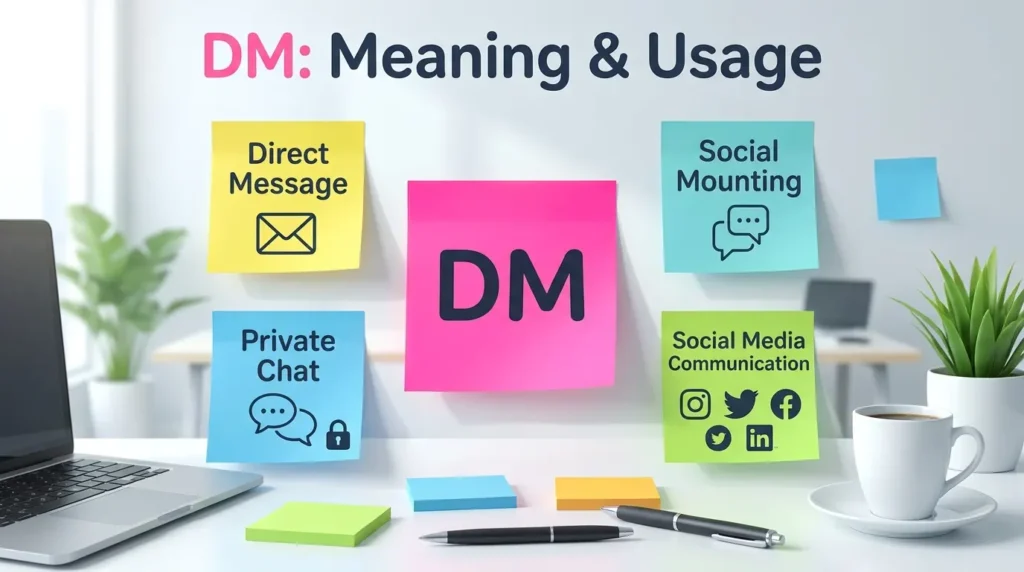
“Just DM me” has become one of the most common phrases in online communication, if it’s a friend planning weekend plans or a brand handling a customer complaint privately. The DM meaning you’ll run into most often is “direct message” a private message sent between users on a social media platform, separate from public posts or comments.
This guide covers the main meaning of “DM,” the other things the same two letters can stand for depending on the setting, real examples, and answers to the questions people ask most often. By the end, you’ll know exactly how to use “DM” correctly and recognize which meaning fits a given context.
What “DM” Means
The simple version:
“DM” most commonly means “direct message” , a private message sent between users on platforms like Instagram, Twitter/X, TikTok, and Discord, separate from public comments or posts.
The fuller picture:
“DM” works as both a noun and a verb. As a noun, it refers to the private message itself (“check your DMs”). As a verb, it describes the act of sending one (“just DM me the details”). The term became essential vocabulary once social media platforms introduced private messaging features alongside public posting, giving users a way to talk one-on-one without everyone else seeing the conversation.
Outside of social media, the same two letters stand for a few unrelated things depending on the context:
- Dungeon Master the person who runs and narrates a tabletop role-playing game, most famously Dungeons & Dragons
- District Manager a common job title in retail and business, overseeing multiple store or branch locations
- Direct Mail a marketing term referring to physical advertising sent through the postal system
Context makes the meaning obvious almost every time. On social media or in a text, “DM” means “direct message.” On game night, it means “Dungeon Master.” In a retail job posting, it likely means “District Manager.”
Origin and History
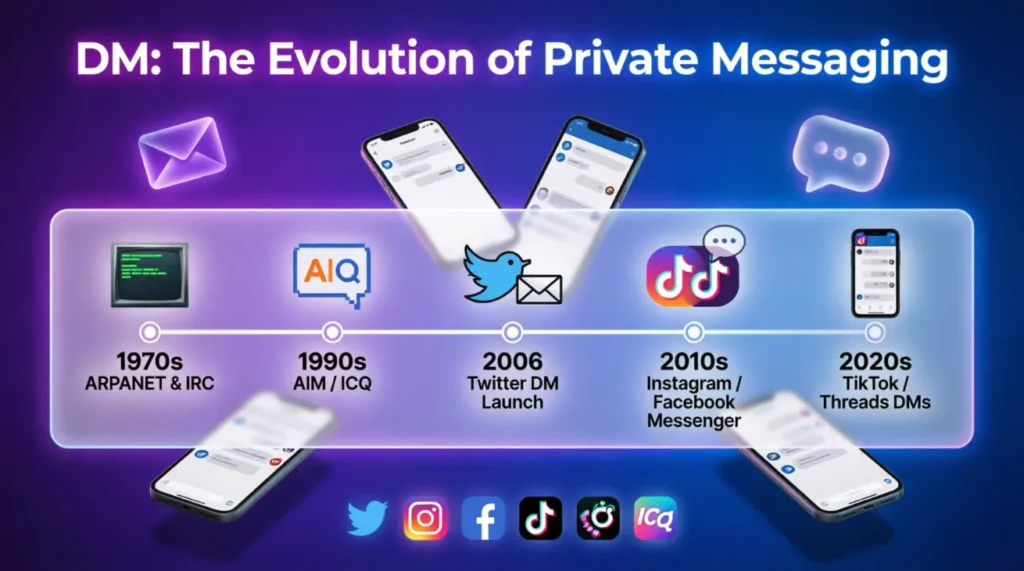
“DM” as an abbreviation for “direct message” grew directly out of the rise of social media messaging features. Early platforms like Twitter popularized the term by labeling their private messaging feature “Direct Messages,” and users quickly shortened it to “DM” in everyday conversation, both as a noun and a verb. As more platforms Instagram, Facebook, TikTok, and others added similar private messaging tools, “DM” spread across nearly all of social media as the default term for this kind of communication.
The word’s flexibility helped it stick. Turning “direct message” into a two-letter shorthand fits naturally into the fast, abbreviation-heavy culture of texting and social media, alongside other shortened terms people already used constantly.
The unrelated meanings Dungeon Master, District Manager, and Direct Mail developed independently in their own communities and industries, some well before social media existed, and simply happen to share the same initials.
Different Meanings and Contexts
Social media and texting (most common). “DM” means “direct message,” referring to a private message sent between users on a social platform, separate from public posts or comments.
Tabletop gaming. In role-playing games, especially Dungeons & Dragons, “DM” stands for “Dungeon Master” , the person who runs the game, creates the story, and manages the rules for the other players.
Business and retail. “DM” commonly stands for “District Manager,” a job title for someone who oversees multiple retail locations or branches within a defined region.
Marketing. In advertising and marketing contexts, “DM” can refer to “Direct Mail,” physical promotional material sent to potential customers through the postal system.
Examples of “DM” in a Sentence
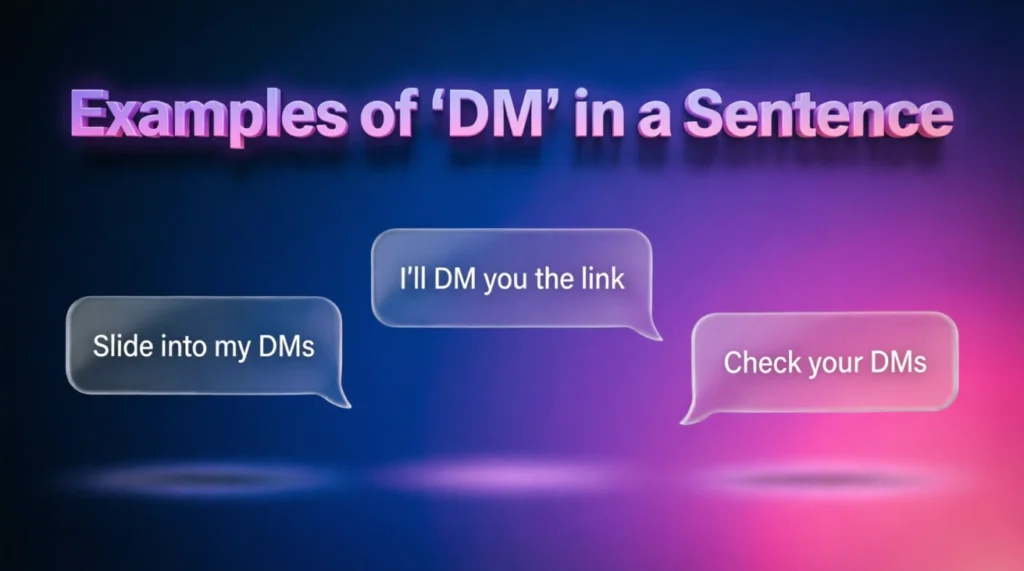
- “Just DM me and I’ll send over the address.”
- “Check your DMs. I sent you the photos from last night.”
- “She slid into his DMs after seeing his post.”
- “Our DM campaign for the sale goes out early next week.”
- “The brand handled the complaint quietly through a DM instead of a public reply.”
- “Our DM ran an incredible campaign that had the whole table on the edge of their seats.”
- “I’ll DM you the link once it’s live.”
- “He’s been the DM for our regional stores for almost five years.”
- “Don’t post it publicly, just DM the file directly.”
- “She’s a great DM; her dungeons always feel genuinely unpredictable.”
How to Use “DM” Correctly
“DM” functions as both a noun (“send me a DM”) and a verb (“just DM me”), and both uses are widely accepted in casual writing and speech.
A few usage notes:
- Capitalization is flexible. Most casual writing uses uppercase “DM,” though lowercase “dm” also appears often in very informal texting.
- Plural form. “DMs” is standard for referring to multiple messages or an inbox as a whole (“check your DMs”).
- Match the setting. “DM” fits casual conversation, social media, and informal business communication about messaging. In a formal document or announcement, “direct message” spelled out reads more professionally.
- Watch for the acronym clash. In gaming or retail conversations, capitalized “DM” almost certainly refers to “Dungeon Master” or “District Manager” instead of context should make the meaning obvious.
Common Mistakes to Avoid
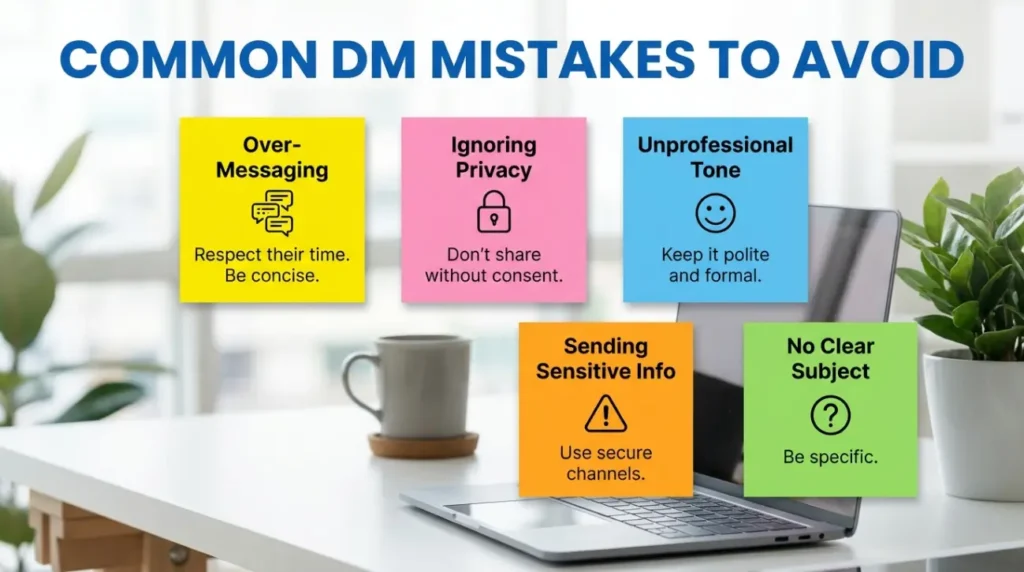
- Assuming it only means “direct message.” In a gaming or retail context, “DM” points to something else entirely; don’t assume the social media meaning applies everywhere.
- Using it in very formal writing. While widely understood, “DM” still reads as casual shorthand official communications typically spell out “direct message” instead.
- Confusing “DM” with “PM.” Some platforms and communities use “PM” (private message) instead of “DM” for essentially the same thing; the terms are close synonyms, though “DM” has become more dominant on major social platforms.
- Forgetting it works as a verb. Some writers only think of “DM” as a noun and miss that it also works naturally as a verb (“I’ll DM you”).
Similar Words and Phrases
| Term | Meaning | How It Differs |
| PM (Private Message) | A private message between users | Functionally the same concept as a DM, though the term “DM” now dominates most major platforms |
| Inbox | The collection of private messages a user has received | Refers to the overall message collection, not a single message |
| Text | A message sent via SMS or a messaging app | Typically refers to phone-based messaging rather than social media platforms |
| Slide into DMs | To send someone a private, often flirtatious or bold first message | A specific, informal idiom built on top of the general “DM” concept |
| Chat | An ongoing private conversation, often on messaging apps | Emphasizes an ongoing conversation rather than a single message |
Opposite Words and Phrases
| Term | Meaning | Why It’s an Opposite |
| Public post | Content visible to anyone who can see the account | Directly opposite to the privacy implied by a DM |
| Comment | A public reply visible to everyone viewing a post | Public and visible, unlike a private DM |
| Broadcast | A message sent to a wide, general audience | Opposite of the one-on-one privacy of a direct message |
| Open forum | A publicly visible discussion space | Contrasts with the private, one-on-one nature of DMs |
Pronunciation
People almost never say “DM” out loud as a single word; it’s read as two separate letters: D-M. In speech, people also commonly say “message me” or “direct message” instead of spelling out the abbreviation.
Quick Facts
| Fact | Detail |
| Most common meaning | “Direct message” |
| Origin | Social media messaging features, popularized by platforms like Twitter |
| Part of speech | Noun and verb |
| Plural form | DMs |
| Common alternate meanings | Dungeon Master, District Manager, Direct Mail |
| Formality | Casual spell out “direct message” in formal writing |
Frequently Asked Questions
What is DM slang for?
DM stands for “direct message,” a private message sent through social media or online platforms.
Why do people DM instead of text?
People DM when they want to communicate privately without sharing phone numbers or leaving the conversation public.
How do you DM somebody?
Open the person’s profile, select the message option, type your message, and send it.
What does DM mean exactly?
DM means “direct message,” referring to a private online message between users.
What is DM in Gen Z slang?
Gen Z uses “DM” to mean sending someone a private message, especially on Instagram, TikTok, Snapchat, or similar apps.
What does DM mean from a girl?
If a girl says “DM me,” she usually means she wants you to send her a private message online.
When someone tells you to DM them, what does that mean?
It means they want you to contact them privately through the platform’s direct messaging feature.
How do you know if someone read your DM?
Many apps show a “Seen,” “Read,” or similar indicator when the recipient opens your message.
Is there a difference between a DM and a text message?
Yes. A DM is sent through a social platform, while a text message is typically sent through a phone’s messaging service.
How do I reply to a DM?
Open the conversation, type your response in the message box, and tap the send button.
Key Takeaways
- “DM” most commonly means “direct message” , a private message sent between users on social media or messaging apps.
- It functions as both a noun and a verb in everyday use.
- Outside of social media, “DM” can also mean “Dungeon Master” (gaming) or “District Manager” (retail/business), depending on context.
- “DMs” is the standard plural form for referring to multiple messages or an inbox.
- Spell out “direct message” in formal writing; “DM” fits casual and semi-formal communication.
Conclusion
“DM” earned its place in everyday language by naming something people needed a fast way to say constantly: a quick, private exchange separate from the public noise of posts and comments. Once social platforms built private messaging into their core features, the shorthand practically wrote itself, and it’s now second nature to most people who spend any time online.
The main thing worth remembering is that context does the heavy lifting. Among friends or on social media, “DM” almost always means a private message. Around a gaming table or in a retail workplace, the same two letters point somewhere completely different, and a quick read of the setting clears up any confusion instantly.
Next time you want to move a conversation somewhere more private, you’ll know exactly what to say and next time you spot “DM” in an unfamiliar setting, you’ll know to check the context before assuming which meaning applies.

I am Olivia Brooks an American editor and content researcher dedicated to creating clear, accurate content. At writemora.com, I help readers to understand words, phrases, and modern language with confidence.