MBN most commonly stands for “must be nice.“ People use it as a quick reaction to someone else’s good fortune, a vacation, a day off, a promotion and the tone can range from genuine happiness for them to a bit of playful envy.
The abbreviation shows up constantly in comments, group chats, and social media replies, and its meaning shifts depending on tone, emojis, and context. This guide breaks down the MBN meaning, where it came from, the different ways people use it, and how to avoid misreading it.
You’ll also learn about a less common second meaning, “my bad now,” so you can tell the two apart based on context.
What It Means
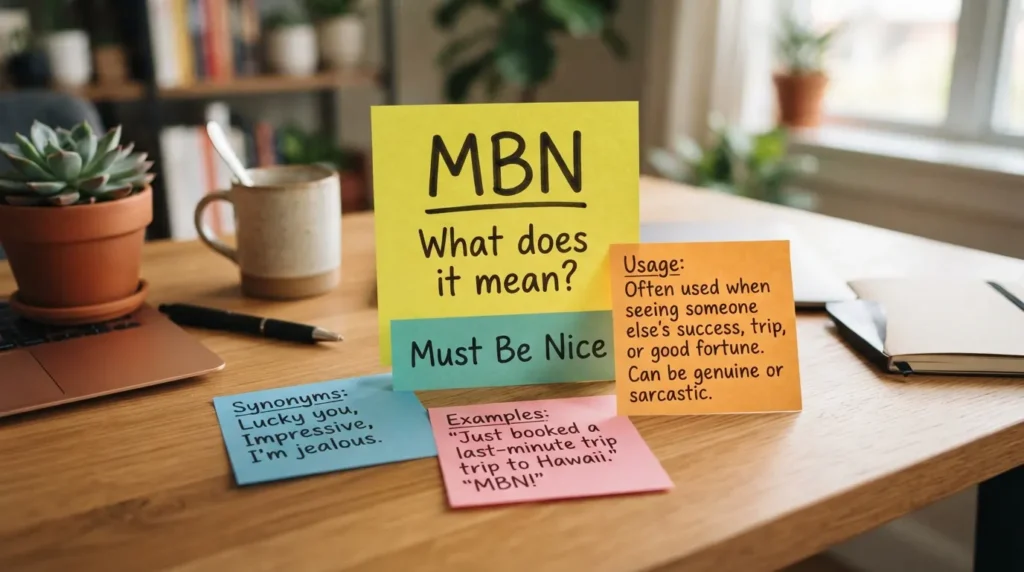
In simple terms, MBN stands for “must be nice.” People type it as a short reaction when someone shares good news or describes an enviable situation, functioning like a quicker version of saying “lucky you” or “wish that were me.”
In a fuller sense, MBN carries a range of tones packed into three letters. It can express sincere happiness for someone else, light-hearted jealousy among friends, or sharper, more sarcastic envy when someone feels genuinely annoyed by another person’s advantage. Readers usually have to lean on context, punctuation, and emojis to figure out which tone the sender intends.
A smaller number of people use MBN to mean “my bad now,” a casual way of admitting a mistake. This usage shows up far less often than “must be nice,” and context almost always makes clear which meaning applies: an apology-shaped sentence signals “my bad now,” while a reaction to someone’s good news signals “must be nice.”
Origin & History
The phrase “must be nice” has existed in everyday spoken English for decades, used sarcastically or sincerely whenever someone describes an enviable situation. As texting and social media grew through the 2000s and 2010s, people shortened frequently repeated phrases into quick abbreviations, and “must be nice” eventually became MBN.
The abbreviation gained real traction on social media platforms, where short, punchy reactions work better than full sentences in comment sections and replies. It spread especially fast in youth and internet slang culture, where compressing common phrases into a few letters is standard practice.
The secondary meaning, “my bad now,” developed separately and simply reuses the same three letters for a different, less common phrase. Its use case tends to be more limited and more dependent on surrounding conversation.
Different Contexts and Meanings
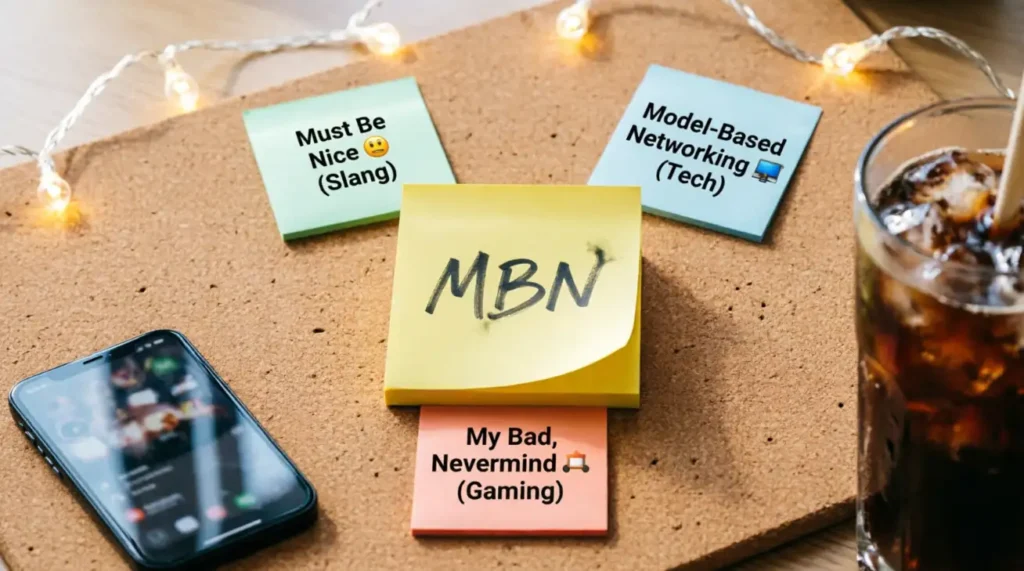
As a reaction to good news. This is the dominant use. Someone posts about a trip, a raise, or a lazy day off, and a friend replies “MBN” to react with a mix of admiration and envy.
As sarcasm. In some contexts, especially when the situation feels unfair or the sender feels genuinely frustrated, MBN carries a sharper, more pointed tone rather than a playful one.
As a compliment or genuine happiness. Among close friends, MBN can simply mean “that’s great, I’m happy for you,” without any real jealousy behind it depending heavily on the relationship between the people texting.
As an apology (less common). Occasionally, MBN stands for “my bad now,” used to casually own up to a small mistake, usually in a quick, low-stakes exchange.
In social media comments. MBN appears frequently under posts showing travel, relaxation, food, or other enviable moments, often alongside emojis that clarify if the commenter means it warmly or sarcastically.
Examples
- “Just booked a week off work with pay.” “MBN, I wish I could take a break.”
- “MBN! Glad you finally get some rest.”
- “Some people get to sleep in every day… MBN.”
- “Oops, forgot to send that file.” “MBN, I needed it an hour ago.”
- “She got upgraded to first class.” “MBN 😩”
- “MBN, must be nice having a car that actually starts every morning.”
- “You get to work from home all week? MBN.”
- “I’m so sorry I missed your call.” “MBN, it’s fine.”
- “He posted vacation photos again on MBN.”
- “MBN to whoever gets Fridays off.”
How to Use It (Grammar and Context)
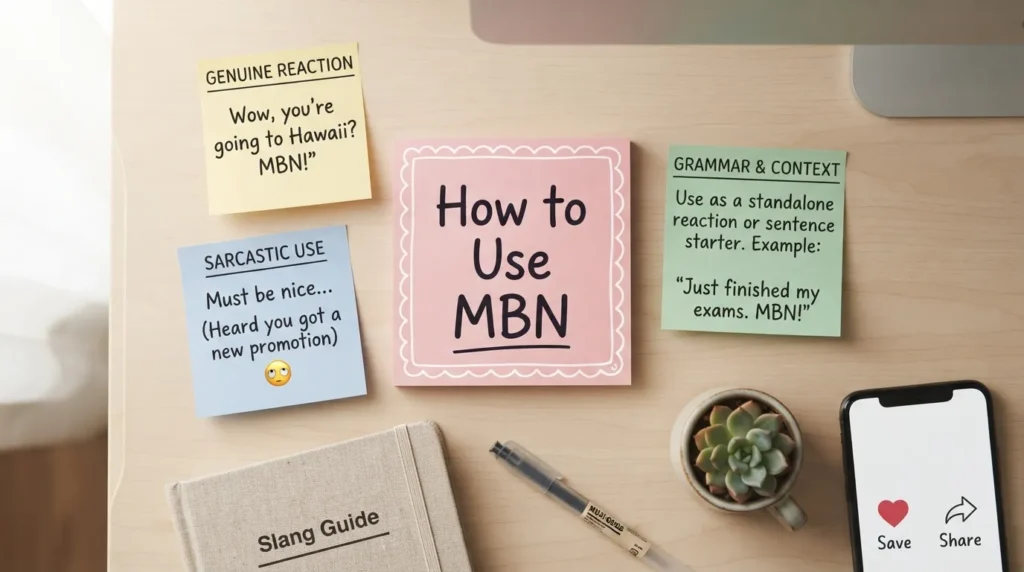
People typically write MBN in all capitals, though lowercase “mbn” appears just as often in casual texting. It usually functions as a standalone reaction rather than part of a full sentence, often paired with an emoji to signal tone a laughing or crying-laughing emoji softens it into playful envy, while a flat delivery with no emoji can read as more sincere or more sarcastic depending on context.
Because MBN relies so heavily on tone, readers should pay attention to the conversation around it rather than the abbreviation alone. The same three letters can read as a genuine compliment in one message and a pointed dig in another.
Common Mistakes
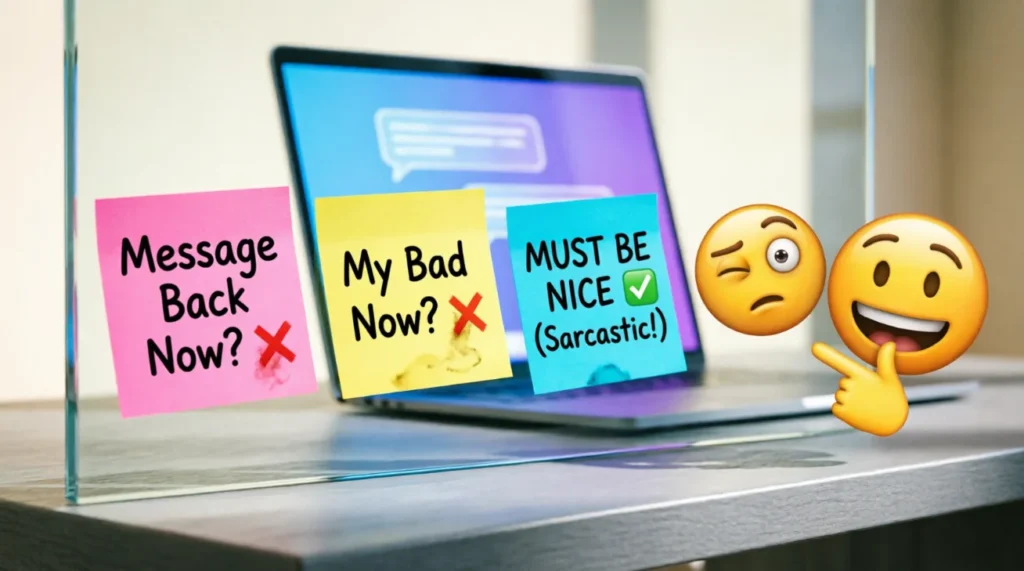
Assuming it’s always sarcastic. Many people read MBN as automatically negative, but it frequently expresses real happiness for someone else, especially between close friends.
Missing the apology meaning entirely. Because “must be nice” dominates, readers sometimes get confused when MBN shows up in an apology context meaning “my bad now.”
Using it in formal messages. MBN belongs firmly in casual texting and social media. Using it in professional emails or formal communication reads as out of place.
Overusing it until it loses meaning. Dropping MBN into every reply can flatten its impact, making it harder for the other person to tell when you actually mean it.
Similar Words
| Word/Phrase | Meaning | Difference from MBN |
| FOMO | Fear of missing out anxiety about missing a good experience | FOMO describes a feeling; MBN is a direct reaction to someone else’s good news |
| Jelly | Casual slang for “jealous“ | Jelly states the emotion outright; MBN implies it more indirectly |
| ICYMI | “In case you missed it” flags something someone may have missed | ICYMI shares information; MBN reacts to information already shared |
| Lucky you | A direct phrase expressing envy or congratulations | Says the same basic idea as MBN, just spelled out instead of abbreviated |
Opposite Words
| Word/Phrase | Meaning | Why It’s an Opposite |
| Couldn’t care less | Complete indifference to someone’s situation | The opposite of the mild envy or admiration behind MBN |
| Genuinely thrilled for you | Sincere, uncomplicated happiness with no envy | Skips the mixed emotion that MBN often implies |
| Same here | A statement that both people share the same situation | MBN highlights a difference in situations; “same here” highlights similarity |
Pronunciation
People typically don’t say MBN out loud as a word; they read it letter by letter, M-B-N, or simply say the full phrase “must be nice” when speaking rather than texting.
Quick Facts
| Fact | Detail |
| Primary meaning | “Must be nice” |
| Secondary meaning | “My bad now” (less common) |
| Common tone | Ranges from sincere happiness to playful or sharp sarcasm |
| Typical use | Reacting to someone else’s good news, luck, or advantage |
| Common platforms | Instagram, TikTok, group texts, Twitter/X, Facebook comments |
| Depends heavily on | Tone, emojis, and relationship between the people texting |
FAQs
What does MBN mean in texting?
MBN most commonly stands for “must be nice,” used as a quick reaction to someone else’s good news or enviable situation.
Is MBN always sarcastic?
No. It often expresses genuine happiness or admiration, especially between friends, though it can also carry a sharper, more sarcastic tone depending on context.
What else can MBN mean?
A less common meaning is “my bad now,” used casually to admit a small mistake. Context usually makes clear which meaning applies.
Is MBN rude to say?
Not typically. It’s casual slang, and most people read it as playful rather than genuinely rude, unless the tone of the surrounding conversation suggests otherwise.
How do I know if someone means MBN sincerely or sarcastically?
Look at emojis, punctuation, and the relationship between you and the sender. A laughing emoji usually signals playfulness, while a flat, terse message can lean more sarcastic.
Is MBN appropriate for work messages?
No. It’s strictly casual slang suited to texting and social media, not professional or formal communication.
Where did MBN come from?
It shortens the long-standing English phrase “must be nice,” which people have said sarcastically or sincerely for decades before texting culture compressed it into an abbreviation.
Can MBN be a compliment?
Yes. Among friends, it often functions as a lighthearted way of saying “that’s great for you” without any real jealousy behind it.
Key Takeaways
- MBN most commonly stands for “must be nice.”
- People use it to react to someone else’s good news, ranging from sincere happiness to playful or sharp sarcasm.
- A less common second meaning, “my bad now,” shows up mainly in casual apology contexts.
- Tone, emojis, and relationship context determine how a specific MBN should be read.
- It belongs to casual texting and social media, not formal or professional communication.
Conclusion
The MBN meaning comes down to three flexible letters standing in for “must be nice” a phrase people have used for decades to react to someone else’s good fortune, now compressed for fast digital conversation. Depending on who sends it and how, those three letters can carry real warmth, light teasing, or genuine frustration, which is exactly why context matters more than the abbreviation itself.
That flexibility is really the reason MBN has stuck around while so many other abbreviations fade out. It does double duty as both a compliment and a complaint, letting people react to good news without committing to a single emotional tone, which fits naturally into fast-moving group chats and comment sections where nobody wants to type out a full sentence. The rarer “my bad now” meaning adds one more layer, but it rarely causes real confusion once you notice the apology context around it.
Next time MBN shows up in your messages, check the tone of the conversation around it rather than the letters themselves, and you’ll know exactly if someone’s happy for you, a little jealous, or just owning up to a small mistake.

I am Olivia Brooks an American editor and content researcher dedicated to creating clear, accurate content. At writemora.com, I help readers to understand words, phrases, and modern language with confidence.