
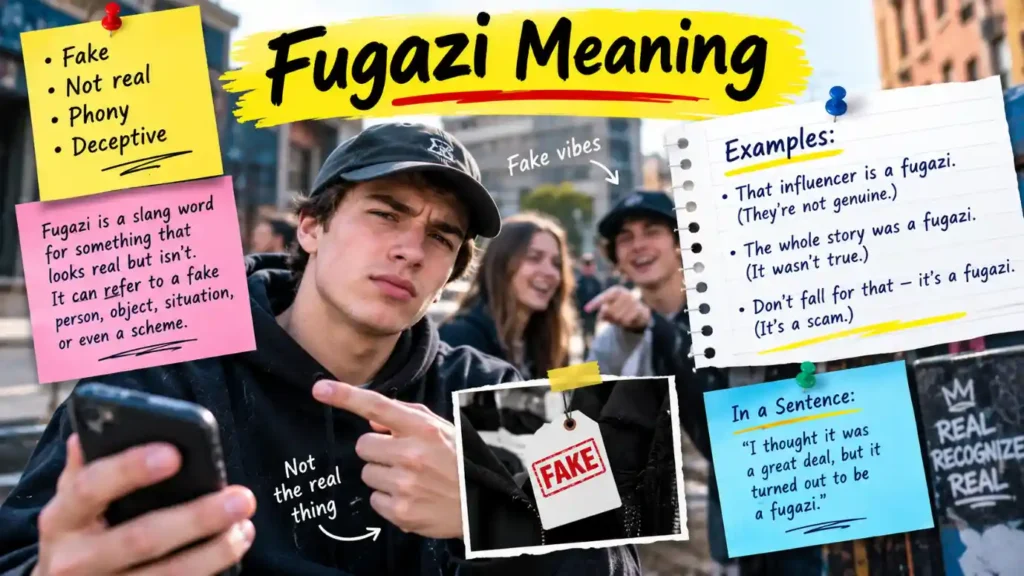
Fugazi is slang for something fake, phony, or counterfeit. When someone calls a designer bag fugazi, they mean it is a knockoff. When they call a promise fugazi, they mean it is empty. The word carries a streetwise, dismissive punch that “fake” alone does not quite deliver.
The word also has other lives: it names a legendary punk band and carries a disputed military origin story. This guide covers what fugazi means, where it came from, and how to use it correctly.
What It Means
In simple terms, fugazi (also spelled fugazy) means not genuine. It describes things that pretend to be what they are not: counterfeit goods, false claims, sham deals, and people who are not who they claim to be. As an adjective, it modifies the fake thing (“a fugazi watch”); as a noun, it names it (“the whole deal was a fugazi”).
The word also appears in the fixed phrase “no fugazi,” which flips the meaning. Like “no joke” or “no lie,” it emphasizes that something is genuine: “No fugazi, this is the best pizza in the city.”
A rarer sense means “completely messed up,” describing chaos rather than fakery, pointing to the word’s possible military roots.
Origin & History
The earliest known print appearance of fugazi is in Mark Baker’s 1981 book *Nam*, an oral history of Vietnam veterans. One soldier says, “We didn’t know anything was fugazi until we got to a certain place,” and the book’s glossary defines it as “fucked up or screwed up.” This is the military connection.
A popular theory claims fugazi is an acronym for “Fucked Up, Got Ambushed, Zipped In,” like SNAFU and FUBAR. But dictionaries note the evidence is scant, and some veterans say they never heard it during the war. Treat the acronym story as colorful but unproven.
Another explanation links the “fake” sense to Fugazy Continental, a New York City limousine service in the 1970s and 80s that was accused of fraud. The word is also strongly associated with Italian American speech in the New York area.
Fugazi entered pop culture through music and film. Marillion titled a 1984 album *Fugazi*. The book *Donnie Brasco* (1988) used “fugazy” for fake diamonds in Mafia circles, and the 1997 film made it famous nationwide. In 1987, Ian MacKaye named his new band Fugazi after the word in Baker’s *Nam*.
Different Contexts and Meanings
Fake or counterfeit. This is the everyday sense. A fugazi handbag is a knockoff, a fugazi diamond is glass, and a fugazi story is a lie. The word is informal and slightly edgy, so it fits casual speech better than formal writing.
A messed-up situation. The older military-flavored sense describes chaos: “The whole operation went fugazi.” You will hear this far less often than the “fake” sense, but it survives in some circles.
The band Fugazi. Capitalized, Fugazi is the Washington, D.C. post-hardcore band formed in 1986 by Ian MacKaye, Guy Picciotto, Joe Lally, and Brendan Canty. Famous for DIY ethics and independent Dischord Records releases, they became one of punk’s most influential bands and have been on hiatus since 2003. Context tells you which is meant: “a Fugazi record” is the band; “a fugazi record” is a fake.
“No fugazi.” This emphatic construction asserts authenticity. A seller who says “no fugazi” is promising the real thing.
Examples
“He paid full price for what turned out to be a fugazi watch.”
“Her promises were fugazi from the start.”
“The email saying I had won a prize was a total fugazi.”
“No fugazi, that was the best concert I have ever seen.”
“Their Fugazi vinyl collection is worth a small fortune.”
“Do you realize this whole plan is totally fugazi?”
“She spotted the fugazi designer bag in seconds.”
“The politician dismissed his rival as a complete fugazi.”
“They covered a Fugazi song at the show last night.”
“He said the contract was legit, no fugazi.”
How to Use It (Grammar and Context)
Fugazi works as both an adjective and a noun. As an adjective it comes before the noun it describes: “a fugazi diamond,” “fugazi promises.” As a noun it stands alone: “The painting was a fugazi.” It is always informal slang, so it belongs in conversation, lyrics, dialogue, and casual writing, not in business reports or academic papers.
Spelling varies. Fugazi is standard, especially for the band. Fugazy appears often for the slang sense, particularly in New York-area usage. Both are understood in casual use.
It is pronounced foo-GAH-zee, with the stress on the middle syllable and a broad “ah” sound. Capitalize it only when you mean the band.
Common Mistakes
Using it in formal settings. Fugazi is slang with rough edges. Dropping it into a job interview or a formal email will sound out of place.
Assuming the acronym origin is proven. The “Fucked Up, Got Ambushed, Zipped In” story is popular but poorly documented. Present it as a theory, not a fact.
Confusing the band with the slang. Capitalization and context separate them. “Fugazi” with a capital F in a music discussion is the band; lowercase “fugazi” describing an object means fake.
Thinking it is Italian. Despite the Italian American association, fugazi is American slang, not standard Italian.
Similar Words
| Word | Meaning | Difference from Fugazi |
| Fake | Not genuine | The plain, neutral term; fugazi is slangier and more dismissive |
| Phony | Not real or sincere | Similar in meaning but older and milder in tone |
| Bogus | False or counterfeit | Close synonym, slightly more playful |
| Counterfeit | An illegal imitation | Formal and legal; fugazi is street-level slang |
| Sham | A thing presented as genuine but false | More formal; often describes schemes rather than objects |
Opposite Words
| Word | Meaning | Why It’s an Opposite |
| Genuine | Truly what it claims to be | The direct opposite of fake |
| Authentic | Real and original | What a fugazi item pretends to be |
| Legitimate | Lawful and real | Contrasts with the shady feel of fugazi |
| Real | Actually existing, not imitation | The simplest antonym |
Pronunciation
Fugazi is pronounced foo-GAH-zee, with the stress on the second syllable. The “a” sounds are broad, like “father.”
Quick Facts
| Fact | Detail |
| Core meaning | Fake, phony, counterfeit |
| Alternate spelling | Fugazy |
| Earliest print use | Mark Baker’s *Nam* (1981) |
| Possible origin | Vietnam-era military slang; acronym theory unproven |
| Popularized by | *Donnie Brasco* (book 1988, film 1997) |
| Band | Fugazi, Washington D.C., formed 1986, hiatus since 2003 |
| Pronunciation | foo-GAH-zee |
Key Takeaways
- Fugazi is slang for fake, phony, or counterfeit, used as a noun or adjective.
- Its earliest known print use is in the 1981 Vietnam veterans book *Nam*.
- The acronym origin story is popular but not well documented.
- Capitalized, Fugazi is the influential Washington, D.C. punk band formed in 1986.
- “No fugazi” is an emphatic way to say something is genuine.
FAQs
What does fugazi mean?
It is slang for fake, phony, or counterfeit. A fugazi item is an imitation pretending to be the real thing.
Is fugazi an acronym?
Some claim it stands for “Fucked Up, Got Ambushed, Zipped In,” but dictionaries note the evidence is scant. The acronym explanation should be treated as a theory, not a confirmed fact.
What is the band Fugazi?
Fugazi is an American post-hardcore band formed in Washington, D.C. in 1986 by Ian MacKaye, Guy Picciotto, Joe Lally, and Brendan Canty. Known for DIY ethics and independent releases, they have been on hiatus since 2003.
Is it spelled fugazi or fugazy?
Both appear. Fugazi is standard, especially for the band. Fugazy is common for the slang sense, particularly in New York-area usage.
Is fugazi an Italian word?
No. Although associated with Italian American speech in New York, it is American slang, not standard Italian.
How do you pronounce fugazi?
Foo-GAH-zee, with the stress on the middle syllable and broad “ah” sounds.
What does “no fugazi” mean?
It is an emphatic way to assert that something is genuine, similar to saying “no lie” or “for real.”
Conclusion
Fugazi packs a disputed Vietnam-era origin, a starring role in mob movies, and a legendary punk band’s name into three syllables. At its core, the meaning stays simple: something fugazi is something false.
Use it where slang belongs, keep the band capitalized, and treat the acronym story as legend rather than fact. Do that, and you will use one of American slang’s most colorful words exactly right.

I am Stephen King an American author known for compelling storytelling. At writemora.com, we value clear, accurate, and reader-focused content inspired by excellence in writing.