
Someone can “have presence” in a room, practice “being present” in meditation, or simply confirm their “presence” at a meeting. The presence meaning shifts depending on context, but at its core, the word always points to one basic idea: the fact or state of being somewhere, noticed or felt in some way, whether physically, emotionally, or even digitally.
This guide covers the core definition of “presence,” the mindfulness and self-improvement sense of the word, its other common uses, and answers to the questions people ask most often. By the end, you’ll understand exactly which meaning fits a given sentence and how to use the word precisely.
What “Presence” Means
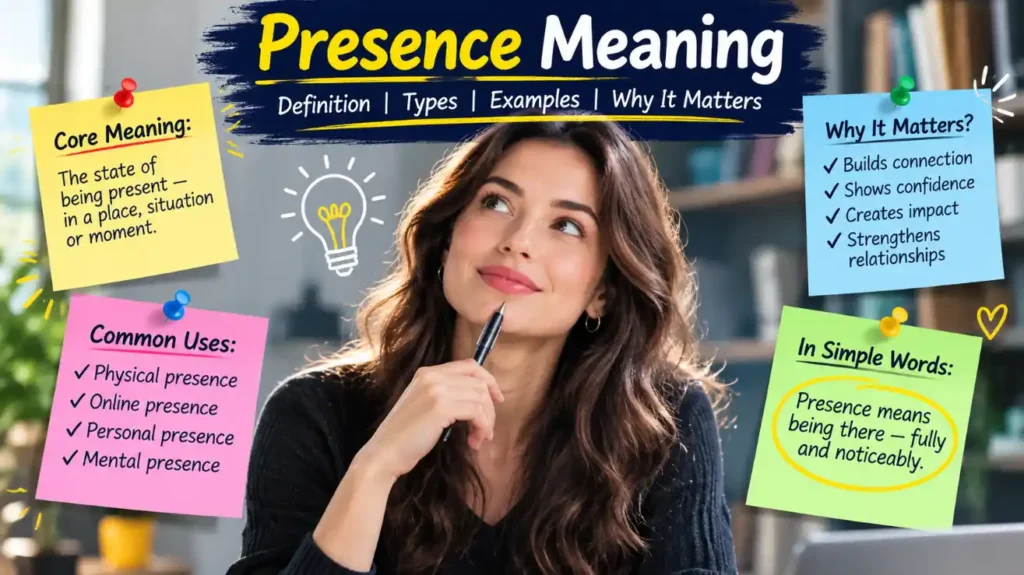
The simple version: “Presence” means the state of being in a particular place, or the fact of existing and being noticeable in some way — physically, emotionally, or through influence.
The fuller picture: At its most basic, “presence” simply confirms that someone or something is there. “Your presence is requested” means the organizers want you physically there. But the word carries a lot of extra weight in other contexts. “She has a strong presence” doesn’t just mean she’s in the room, it means people notice her, feel her energy, or sense her confidence and influence. “Practicing presence” in mindfulness and meditation contexts means intentionally paying full attention to the current moment, rather than getting lost in thoughts about the past or future. And “online presence” refers to how visible and active someone or something appears across the internet and social media, entirely separate from physical location.
The common thread across all these uses is the idea of being noticeably there — whether that’s a body in a room, a felt sense of someone’s personality, a state of focused attention, or a digital footprint.
Origin and History
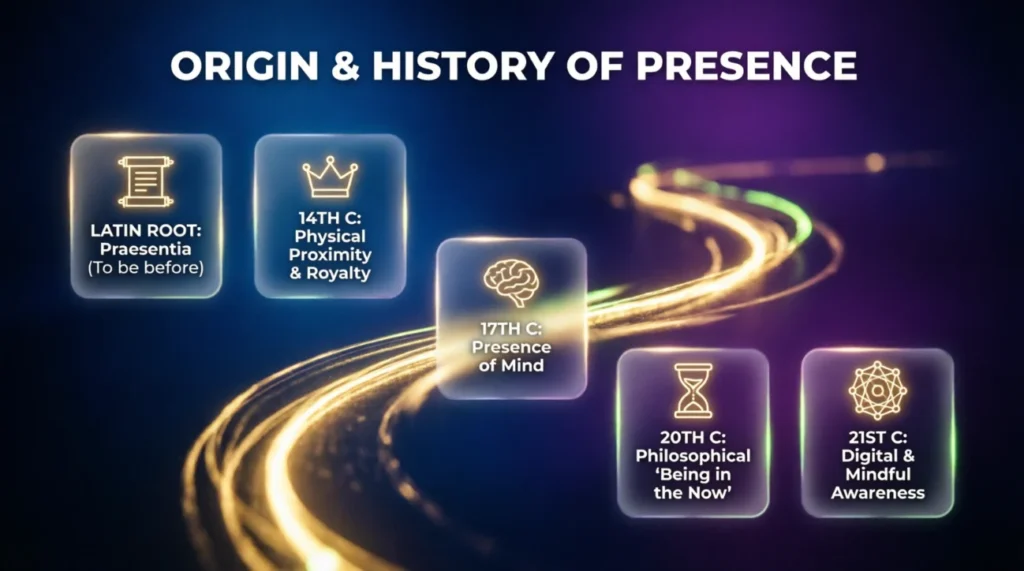
“Presence” traces back to Latin, ultimately from praesentia, related to praesens, meaning “being before” or “at hand” combining prae- (“before”) with a form of the verb “to be.” The word passed into English through French, carrying its core sense of being physically located somewhere, present and available rather than absent.
Over centuries, English speakers expanded the word well beyond its literal, physical meaning. It grew to describe not just where someone stood, but how strongly they registered with others their charisma, authority, or noticeable energy in a room. The mindfulness and meditation sense of “presence,” meaning full attention to the current moment, draws on much older contemplative and spiritual traditions, though the specific English phrase “being present” became especially popular through the modern mindfulness and wellness movement.
More recently, “presence” picked up an entirely new dimension with the rise of the internet, giving rise to phrases like “online presence” and “social media presence” that would have made little sense before digital platforms existed.
Different Meanings and Contexts
Physical presence (core meaning). The most basic sense of “presence” simply means being physically located somewhere “his presence in the room went unnoticed” or “please confirm your presence at the event.”
Commanding or charismatic presence. “Presence” often describes a person’s noticeable energy, confidence, or influence when someone “has presence” when they naturally draw attention or command respect, independent of anything they actually say or do.
Mindfulness and “being present.” In self-improvement, therapy, and meditation contexts, “presence” describes a mental state of full attention to the current moment, without distraction from worries about the past or future.
Sensed or felt presence. People sometimes describe “feeling a presence,” referring to a sense that someone or something is nearby, even without clear physical evidence, a usage common in ghost stories, spiritual writing, and descriptions of eerie or unsettling situations.
Online or digital presence. In marketing, business, and everyday tech conversation, “presence” describes how visible, active, or established someone or something appears across websites, apps, and social media platforms.
Military and diplomatic presence. In political and military contexts, “presence” describes the stationing of troops, resources, or influence in a particular region for example, “a military presence” or “a diplomatic presence.”
Examples of “Presence” in a Sentence
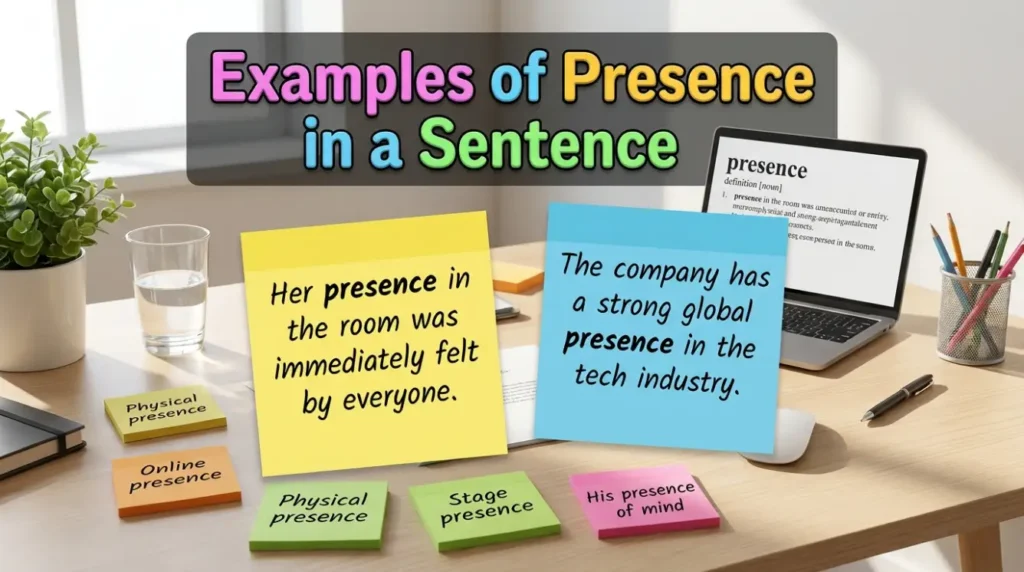
- “Your presence at the ceremony means a lot to the whole family.”
- “She commands a room the moment she walks in, she just has presence.”
- “He’s been working on practicing presence during difficult conversations.”
- “The company needs a stronger online presence to reach younger customers.”
- “The old house had an unsettling presence that nobody could quite explain.”
- “Their presence at the negotiation table helped calm tensions immediately.”
- “The actor’s stage presence made even the smallest role feel unforgettable.”
- “The country maintains a small diplomatic presence in the region.”
- “Meditation taught her how to stay present, even during stressful moments.”
- “You could feel his presence in the room before he even said a word.”
How to Use “Presence” Correctly
“Presence” functions as a noun, and its meaning shifts heavily based on the words surrounding it, so context does most of the work in signaling which sense applies.
A few usage notes:
- Pair it with the right modifier. Words like online, physical, calming, commanding, spiritual, and military all sharpen exactly which type of presence you mean.
- Distinguish it from “presents.” “Presence” and “presents” (gifts) sound identical but have completely different meanings and spellings, a common source of writing mistakes.
- Use “presence of mind” carefully. This related phrase means quick thinking or composure in a difficult moment (“she showed real presence of mind during the emergency”), distinct from the broader meaning of simply being present.
- Know the adjective form. “Present” works as the adjective (“she was present at the meeting”), while “presence” is the noun describing that state or quality.
Common Mistakes to Avoid
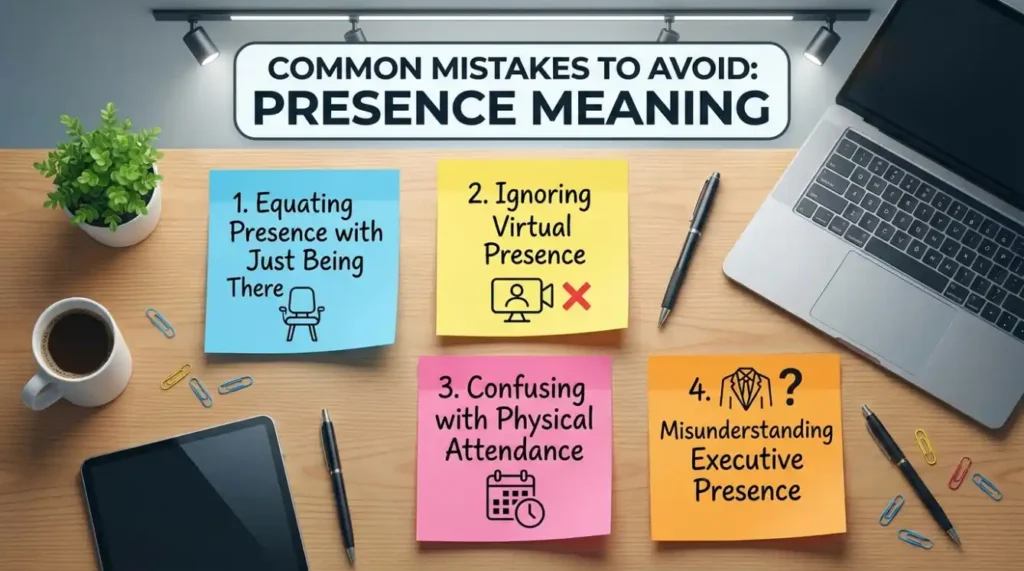
- Confusing “presence” and “presents.” Despite sounding the same, “presence” (being somewhere) and “presents” (gifts) are entirely unrelated words with different spellings.
- Overusing “presence” vaguely in writing. Phrases like “she had a presence” can feel vague without more detail specifying what kind of presence (calming, intimidating, commanding) makes writing more precise.
- Assuming “online presence” is only about follower counts. It actually covers overall visibility and consistency across platforms, not just a single metric like followers or likes.
- Mixing up “presence” and “attendance.” “Attendance” specifically refers to showing up to something (like a meeting or event), while “presence” is broader and can describe an ongoing state, an energy, or even a digital footprint.
Similar Words and Phrases
| Word/Phrase | Meaning | How It Differs |
| Attendance | Showing up to a specific event or place | Narrower, focused specifically on being at a scheduled occasion |
| Charisma | A compelling attractiveness or charm that draws people in | Focuses specifically on personal magnetism, one type of “presence” |
| Mindfulness | Full, non-judgmental awareness of the current moment | Closely related to “being present,” though a broader mental practice |
| Aura | A distinctive atmosphere or quality someone seems to give off | Similar to “presence” in describing an intangible personal energy |
| Existence | The state of being real or existing at all | Broader and more abstract than “presence,” which implies noticeable location or influence |
Opposite Words and Phrases
| Word/Phrase | Meaning | Why It’s an Opposite |
| Absence | The state of not being present somewhere | The direct grammatical and conceptual opposite of “presence” |
| Invisibility | Being unnoticed or unseen | Contrasts with the noticeable quality often implied by “presence” |
| Distraction | A state of scattered, unfocused attention | Opposite of the focused “being present” mindfulness sense |
| Detachment | A lack of emotional or mental engagement | Opposite of the attentive, engaged quality “presence” often implies |
Pronunciation
“Presence” is pronounced PREZ-ənss, with the stress on the first syllable.
Quick Facts
| Fact | Detail |
| Core meaning | The state of being somewhere, physically or figuratively |
| Origin | Latin praesentia, meaning “being before” or “at hand” |
| Part of speech | Noun |
| Adjective form | Present |
| Common phrases | “Online presence,” “commanding presence,” “presence of mind” |
| Common field usage | Mindfulness, marketing, diplomacy, performance |
Frequently Asked Questions
It means the state of being somewhere, physically or figuratively, and being noticeable, felt, or acknowledged in some way.
It usually describes someone’s noticeable energy, confidence, or influence in the sense that people feel their impact in a room, independent of what they say or do.
It means focusing fully on the current moment, without getting distracted by thoughts about the past or the future.
They sound identical but mean completely different things: “presence” refers to being somewhere, while “presents” refers to gifts.
It refers to how visible, active, and established someone or something appears across websites, apps, and social media platforms.
It describes the ability to think clearly and act effectively during a stressful or unexpected situation.
It usually describes a sense that someone or something is nearby, even without clear physical proof — common in spooky or spiritual contexts.
“Absence” works as the most direct opposite, describing the state of not being somewhere.
It means the state of being somewhere, physically or figuratively, and being noticeable, felt, or acknowledged in some way.
It usually describes someone’s noticeable energy, confidence, or influence in the sense that people feel their impact in a room, independent of what they say or do.
It means focusing fully on the current moment, without getting distracted by thoughts about the past or the future.
They sound identical but mean completely different things: “presence” refers to being somewhere, while “presents” refers to gifts.
It refers to how visible, active, and established someone or something appears across websites, apps, and social media platforms.
It describes the ability to think clearly and act effectively during a stressful or unexpected situation.
It usually describes a sense that someone or something is nearby, even without clear physical proof common in spooky or spiritual contexts.
“Absence” works as the most direct opposite, describing the state of not being somewhere.
Key Takeaways
- “Presence” broadly means the state of being somewhere, physically or figuratively.
- It can describe a person’s noticeable energy or charisma, a mindfulness practice of full attention, or a sensed but unseen force.
- “Online presence” extends the word into the digital world, describing visibility across websites and social platforms.
- “Presence” and “presents” sound alike but mean completely different things.
- “Absence” works as the clearest direct opposite of “presence.”
Conclusion
Few words stretch as far as “presence” while still holding onto a single core idea: the sense of being genuinely there, in whatever form that takes. If it’s a name on an attendance list, a magnetic personality that fills a room, or a quiet, focused attention on the here and now, every use of the word circles back to that same basic thread of being noticeably, meaningfully somewhere.
That flexibility is exactly why “presence” shows up in so many different corners of modern life: therapy sessions, marketing meetings, ghost stories, and diplomatic briefings all lean on the same word for very different kinds of “being there.” Paying attention to the context around it is usually all you need to know exactly which sense applies.
Next time you hear someone described as having “real presence,” or you’re encouraged to simply “be present,” you’ll know precisely what’s being asked of you and you’ll have the vocabulary to describe your own presence, in whichever sense fits.

I am Olivia Brooks an American editor and content researcher dedicated to creating clear, accurate content. At writemora.com, I help readers to understand words, phrases, and modern language with confidence.