

Tenacious describes someone or something that holds firmly onto a goal, belief, or grip, refusing to let go despite obstacles or pressure. It carries a strong sense of persistence and determination, often used as a compliment for people who don’t give up easily.
You’ll see tenacious describing athletes, entrepreneurs, negotiators, and even physical objects that grip or stick firmly. Understanding the tenacious meaning helps you use the word precisely, distinguishing genuine persistence from simple stubbornness.
This guide covers what tenacious means, where the word comes from, the different ways people use it, and common mistakes to avoid.
What It Means
In simple terms, tenacious describes someone who holds firmly to a course of action, belief, or goal, refusing to give up even when facing difficulty or resistance. A tenacious person keeps pushing forward, staying determined and persistent well past the point where others might quit.
In a fuller sense, tenacious also applies to things beyond personality: a physical grip, a material’s ability to hold together, or a substance that clings firmly to a surface can all count as tenacious. The word’s core meaning always centers on a firm, unwavering hold, If that hold is emotional, mental, or physical.
Tenacious generally carries a positive or admiring tone, unlike similar words that can sound more negative. Calling someone tenacious usually praises their determination, rather than criticizing them for being difficult.
Origin & History

Tenacious comes from the Latin word “tenax,” meaning “holding fast” or “gripping,” which itself derives from “tenere,” meaning “to hold.” This root shows up across many related English words, including “tenant” (someone who holds property), “tenure” (a firm hold on a position), and “retain” (to hold onto something).
The word entered English in the early 17th century, initially describing a firm physical grip or a substance that holds together strongly, such as tenacious clay or a tenacious adhesive. Over time, English speakers extended the word to describe personality and behavior, applying the same “firm hold” concept to determination, persistence, and refusal to give up on a goal or belief.
This shift from physical to psychological meaning follows a common pattern in English, where words describing physical grip or strength often expand to describe mental or emotional persistence as well.
Different Contexts and Meanings
Describing personal determination. This is the most common modern use: someone who pursues a goal with unwavering persistence, refusing to quit despite setbacks or obstacles.
Describing physical grip or attachment. Tenacious can describe an actual physical hold, such as an animal’s tenacious grip on a branch, or a material’s tenacious bond to a surface.
In business and negotiation. People often describe successful negotiators, salespeople, or entrepreneurs as tenacious, praising their persistence in pursuing deals, clients, or opportunities despite rejection or difficulty.
In sports and competition. Commentators frequently use tenacious to describe athletes who play with relentless effort and refuse to back down, especially in defensive or high-pressure situations.
Describing beliefs or memory. Tenacious can describe a firmly held belief or a strong, persistent memory something that “sticks” mentally the way a tenacious grip holds physically.
Examples

- “Her tenacious pursuit of the promotion finally paid off after two years.”
- “The dog held on with a tenacious grip, refusing to drop the toy.”
- “He’s known as a tenacious negotiator who never accepts the first offer.”
- “The team’s tenacious defense kept the score close until the final minute.”
- “She remained tenacious in her belief that the project would eventually succeed.”
- “The adhesive formed a tenacious bond that survived years of outdoor exposure.”
- “His tenacious work ethic helped him finish the marathon despite the injury.”
- “The reporter was tenacious in tracking down every source for the story.”
- “Despite repeated rejections, she stayed tenacious about pursuing her dream job.”
- “The vine’s tenacious roots made it nearly impossible to remove from the wall.”
How to Use It (Grammar and Context)
Tenacious functions as an adjective, typically describing a person, animal, quality, or physical grip: “a tenacious competitor,” “a tenacious grip,” “tenacious determination.” It commonly pairs with nouns like “pursuit,” “grip,” “defense,” or “spirit.”
The related adverb, “tenaciously,” describes how an action gets carried out: “she tenaciously pursued the opportunity.” The related noun, “tenacity,” names the quality itself: “his tenacity impressed the entire team.”
Common Mistakes
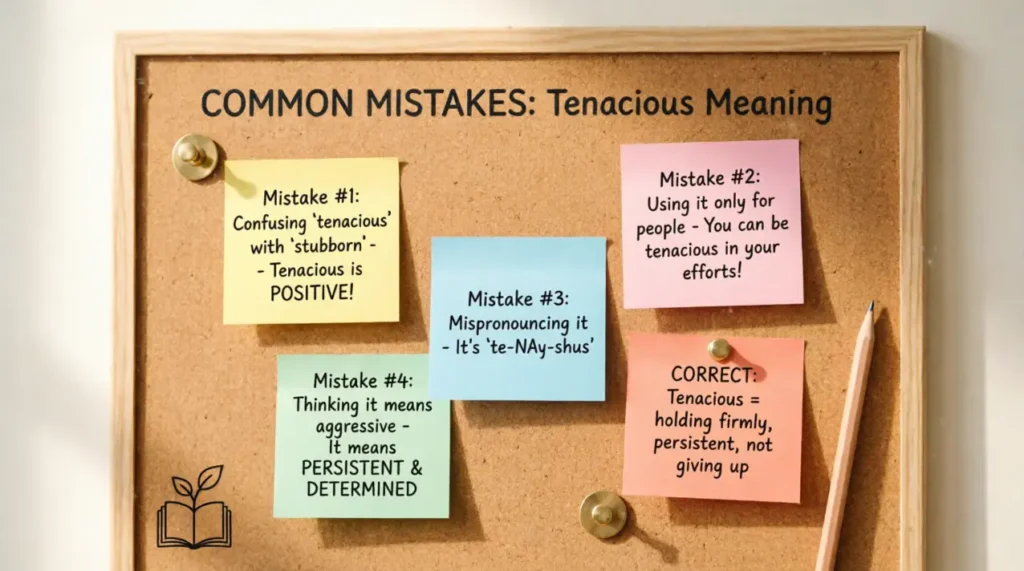
Confusing tenacious with stubborn. While related, “stubborn” often carries a negative connotation, implying unreasonable refusal to change one’s mind, while tenacious usually implies admirable persistence toward a worthwhile goal.
Overusing it for simple effort. Tenacious implies persistence specifically in the face of real obstacles or resistance, not just general hard work or effort without any particular struggle involved.
Misspelling it as “tenatious” or “tenaceous.” The correct spelling follows the Latin root “tenax” closely, and writers sometimes guess at an incorrect spelling based on how the word sounds.
Applying it only to people. Tenacious also describes physical grip, materials, and even memory or belief, not just personality or behavior.
Similar Words
| Word | Meaning | Difference from Tenacious |
| Persistent | Continuing firmly despite difficulty or opposition | Very close in meaning; tenacious often implies a stronger, more physical sense of “holding on” |
| Stubborn | Refusing to change one’s mind or approach, often unreasonably | Stubborn often carries a negative tone; tenacious usually implies admirable determination |
| Relentless | Showing no signs of slowing down or stopping | Relentless emphasizes unstoppable intensity; tenacious emphasizes a firm, unwavering hold |
| Resolute | Firm and determined in purpose or belief | Resolute focuses on firmness of resolve; tenacious adds the specific sense of gripping or holding on despite resistance |
Opposite Words
| Word | Meaning | Why It’s an Opposite |
| Wavering | Uncertain, unsteady, or lacking firm commitment | Directly opposes the firm, unwavering hold implied by tenacious |
| Quitting | Giving up on an effort or goal | The clearest opposite of tenacious persistence |
| Fickle | Changing frequently, lacking steady commitment | Contrasts with the steady, unwavering nature of tenacious behavior |
Pronunciation
Tenacious is pronounced tuh-NAY-shus, with the stress on the second syllable.
Quick Facts
| Fact | Detail |
| Word origin | Latin “tenax” (holding fast), from “tenere” (to hold) |
| Entered English | Early 17th century |
| Related words | Tenant, tenure, retain (share the same Latin root) |
| Related adverb | Tenaciously |
| Related noun | Tenacity |
| Typical tone | Usually positive or admiring |
FAQs
What does tenacious mean simply?
Tenacious describes someone or something that holds firmly onto a goal, belief, or grip, refusing to let go despite obstacles or difficulty.
Is tenacious a compliment?
Generally yes. The word usually praises determination and persistence, unlike related words like “stubborn,” which can carry a more negative tone.
What’s the difference between tenacious and persistent?
The words overlap closely, but tenacious often carries a stronger sense of physically or mentally “holding on” against resistance, while persistent simply describes continued effort over time.
Can tenacious describe something other than a person?
Yes. It can describe a physical grip, a material’s ability to bond or hold together, or even a firmly held belief or memory.
Where does the word tenacious come from?
It comes from the Latin word “tenax,” meaning “holding fast,” which itself comes from “tenere,” meaning “to hold.”
What’s the noun form of tenacious?
“Tenacity” names the quality of being tenacious.
Is tenacious the same as stubborn?
Not exactly. Stubborn often implies unreasonable resistance to change, while tenacious implies admirable persistence toward a worthwhile goal.
How do you use tenacious in a sentence?
You can use it to describe a person’s determination (“her tenacious pursuit of the goal”), a physical grip (“a tenacious hold”), or even a material (“a tenacious adhesive”).
Key Takeaways

- Tenacious describes a firm, unwavering hold on a goal, belief, or physical grip.
- The word comes from the Latin “tenax,” meaning “holding fast.”
- It usually carries a positive, admiring tone, unlike related words like “stubborn.”
- Tenacious applies to people, animals, materials, beliefs, and memory, not just personality.
- Related forms include the adverb “tenaciously” and the noun “tenacity.”
Conclusion
The tenacious meaning centers on one clear image: something or someone holding on tightly and refusing to let go, if that grip is physical, mental, or emotional. Tracing the word back to its Latin root for “holding fast” makes that image easy to picture, even centuries after English first borrowed the term.
What makes tenacious especially useful is the positive charge it carries compared to near-synonyms like stubborn or obstinate. Reaching for tenacious instead signals genuine admiration for someone’s persistence, framing their refusal to quit as a strength rather than a flaw, a distinction that matters a lot in how the word lands in conversation.
If you’re describing an athlete who won’t back down, a business owner who kept pushing through rejection, or simply a stain that refuses to come out of the carpet, tenacious captures that same core idea every time: a hold that doesn’t loosen, no matter what pushes against it.

I am Stephen King an American author known for compelling storytelling. At writemora.com, we value clear, accurate, and reader-focused content inspired by excellence in writing.