
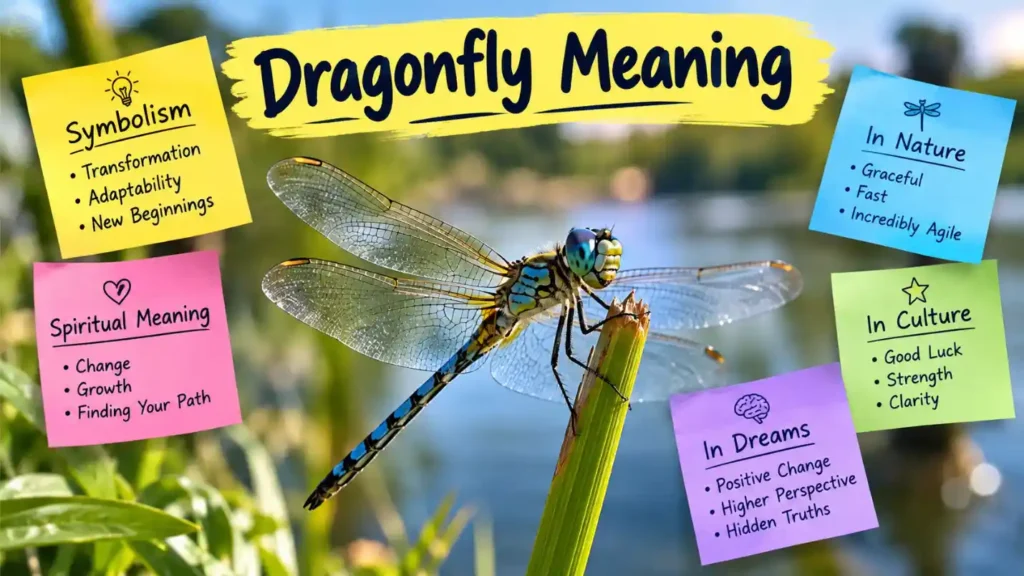
A dragonfly is a flying insect known for its long, slender body, large multifaceted eyes, and two pairs of transparent wings that let it fly with remarkable speed and precision. Beyond the literal insect, “dragonfly” also carries significant symbolic meaning across many cultures, frequently associated with change, transformation, adaptability, and self-realization.
Most people searching for the dragonfly meaning want to understand both what the insect actually is and why it holds such widespread symbolic weight in art, spirituality, and personal reflection. This guide covers the literal biological definition first, then explores the dragonfly’s rich symbolic and cultural significance.
What It Means
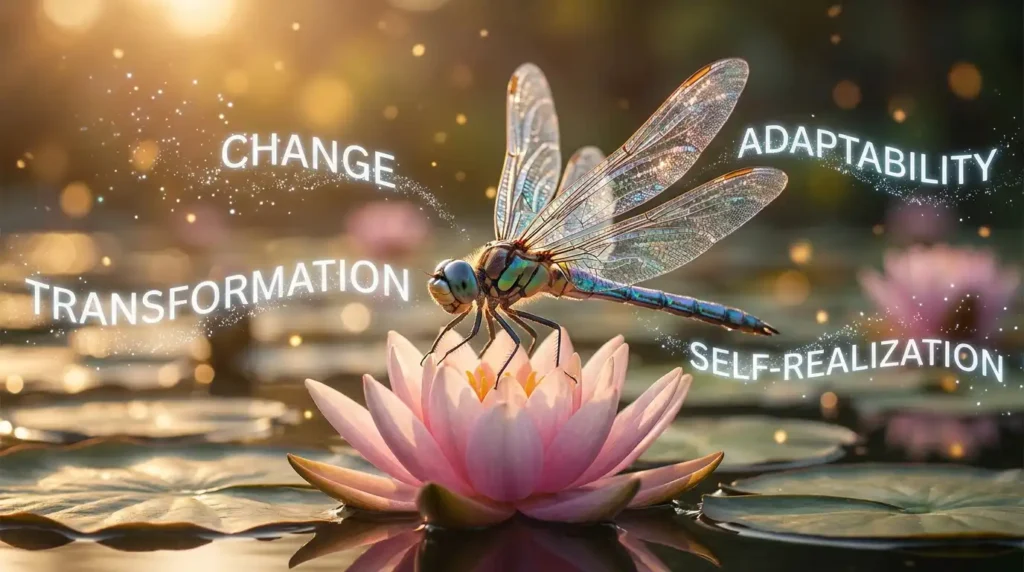
In its literal, biological sense, a dragonfly refers to an insect belonging to the order Odonata, suborder Anisoptera, characterized by an elongated body, large compound eyes that provide nearly 360-degree vision, and two sets of wings that operate independently, giving dragonflies exceptional flying agility. Dragonflies begin life as aquatic nymphs before undergoing metamorphosis into their recognizable adult flying form.
In its symbolic sense, the dragonfly represents change, transformation, and adaptability across many cultures and belief systems. This symbolism draws directly from the insect’s own dramatic life cycle, spending most of its life underwater as a nymph before transforming completely into a swift, colorful, airborne creature, a literal embodiment of profound personal change.
Many people also associate dragonflies with self-realization, emotional depth, and living authentically, connecting the insect’s iridescent, light-catching wings to ideas of seeing beyond illusion and embracing one’s true nature.
Origin & History
Dragonflies rank among the oldest insect species on Earth, with fossil evidence showing ancestors of modern dragonflies existing hundreds of millions of years ago, some with wingspans far larger than any dragonfly alive today. This ancient lineage has contributed to the insect’s mystique and symbolic weight across human cultures throughout history.
Symbolically, dragonflies have held meaning across numerous cultures for centuries. In Japanese culture, the dragonfly has long symbolized strength, courage, and victory, historically associated with samurai culture, and Japan itself has sometimes been poetically referred to as the “Land of the Dragonflies.” Native American traditions in various cohort shave associated dragonflies with swiftness, activity, and pure water, given the insect’s close connection to healthy aquatic ecosystems.
In many Western and New Age spiritual traditions, particularly gaining popularity from the late 20th century onward, the dragonfly’s symbolic association with transformation and change grew alongside broader interest in animal symbolism and spiritual meaning, drawing directly on the insect’s remarkable metamorphosis from water-bound nymph to graceful flying adult.
Different Contexts and Meanings
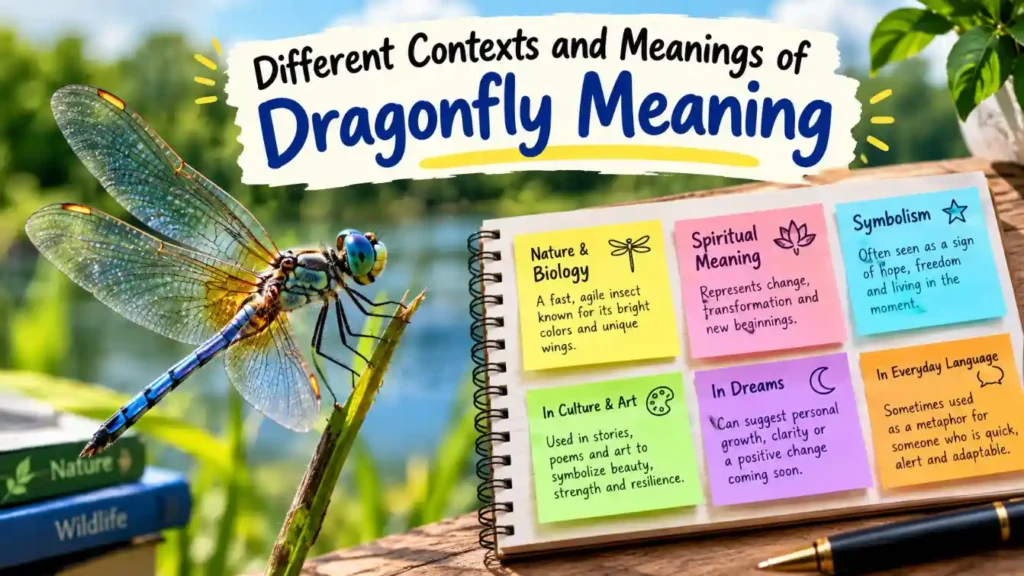
As a biological insect. This remains the term’s literal, scientific meaning describing the actual insect species within the order Odonata, studied in entomology and ecology for its unique flight capabilities and role in controlling mosquito and other insect populations.
As a symbol of transformation. The dragonfly’s dramatic metamorphosis from aquatic nymph to flying adult makes it a widely recognized symbol for major personal change, growth, or life transitions.
As a symbol of adaptability. Because dragonflies thrive in two completely different environments (water and air) across their lifecycle, many associate the insect with flexibility and the ability to adapt successfully to changing circumstances.
In spiritual and grief-related symbolism. Some spiritual traditions and personal belief systems associate dragonflies with messages from loved ones who have passed away, viewing an unexpected dragonfly sighting as a meaningful, comforting sign.
In art, tattoos, and jewelry. The dragonfly’s striking appearance and rich symbolic meaning make it a popular subject in decorative art, tattoos, and jewelry design, often specifically chosen to represent personal transformation or resilience.
Examples
- “The pond attracted dozens of dragonflies during the warm summer evening.”
- “She got a dragonfly tattoo to symbolize the major changes in her life that year.”
- “In Japanese culture, the dragonfly has traditionally symbolized courage and strength.”
- “He saw a dragonfly right after the funeral and found it strangely comforting.”
- “The nature documentary explained how dragonflies remain agile predators in flight.”
- “She gave her friend a dragonfly necklace to mark her recent life transformation.”
- “Native American folklore in several cohorts associates dragonflies with swiftness and pure water.”
- “The garden pond was specifically designed to attract dragonflies and other beneficial insects.”
- “He described the dragonfly’s metamorphosis as a perfect metaphor for his own personal growth.”
- “Scientists study dragonfly flight patterns to better understand efficient aerial movement.”
How to Use It (Grammar and Context)
Dragonfly functions as a noun, referring either to the literal insect or, in symbolic and metaphorical writing, to the broader concept of transformation and change it represents. Writers often clarify which sense they intend through context: a nature or biology discussion points to the literal insect, while spiritual, personal, or artistic writing usually points to the symbolic meaning.
The word doesn’t typically function as a verb or adjective in standard usage, remaining firmly a noun in both its literal and symbolic applications.
Common Mistakes
Assuming dragonfly symbolism is universal across all cultures. While transformation and change appear as common themes, specific meanings vary significantly between cultures, and assuming one single, universal interpretation overlooks this genuine diversity.
Confusing dragonflies with damselflies. Dragonflies and damselflies belong to the same insect order but different suborders; dragonflies typically rest with their wings spread flat, while damselflies fold their wings along their body, among other physical differences.
Overlooking the insect’s genuine ecological role. Some people focus entirely on symbolic meaning without recognizing dragonflies’ real ecological importance as natural predators that help control mosquito populations.
Assuming symbolic meaning is a modern invention. While dragonfly symbolism has grown in popularity recently, particularly in Western spiritual contexts, many of its cultural associations, like those in Japanese and Native American traditions, have genuinely ancient roots.
Similar Words
| Word | Meaning | Difference from Dragonfly |
| Damselfly | A closely related insect in the same order but a different suborder | Damselflies are generally smaller and more delicate, folding their wings along their body rather than holding them spread flat |
| Mayfly | A short-lived aquatic insect known for its brief adult lifespan | Mayflies belong to an entirely different insect order and typically live only a day or two as adults, unlike dragonflies |
| Butterfly | An insect known for its own dramatic metamorphosis and colorful wings | Butterflies belong to a completely different insect order (Lepidoptera) and follow a different life cycle process than dragonflies |
| Firefly | A beetle known for its bioluminescent glow | Fireflies belong to a different insect order entirely and share no close biological relationship with dragonflies |
Opposite Words
There’s no true grammatical opposite of “dragonfly,” but symbolically relevant contrasts include:
| Word | Meaning | Why It Contrasts |
| Stagnation | A state of no change, growth, or movement | Directly opposes the transformation and change the dragonfly commonly symbolizes |
| Rigidity | Inflexibility or resistance to change | Contrasts with the adaptability associated with the dragonfly’s dual-environment life cycle |
Pronunciation
Dragonfly is pronounced DRAG-uhn-fly, with the stress on the first syllable.
Quick Facts
| Fact | Detail |
| Scientific classification | Order Odonata, suborder Anisoptera |
| Life cycle | Begins as an aquatic nymph before metamorphosing into a flying adult |
| Age of species | Ancestors date back hundreds of millions of years |
| Common symbolic meanings | Transformation, change, adaptability, self-realization |
| Notable cultural association | Strength and courage in Japanese culture |
| Common modern association | A comforting sign connected to loved ones who have passed away |
FAQs
What is the spiritual meaning of the dragonfly?
Dragonflies are often associated with transformation, renewal, adaptability, and personal growth. Spiritual interpretations vary by culture and belief.
What is the angel message of dragonflies?
Some spiritual traditions view dragonflies as a reminder to embrace change, stay hopeful, and trust your personal journey.
Is dragonfly a good omen?
In many cultures, dragonflies are considered a positive symbol associated with good luck, transformation, happiness, and new beginnings.
Why am I suddenly seeing dragonflies?
You may be seeing more dragonflies because of seasonal conditions, nearby water, weather, or increased insect activity. Spiritually, some people interpret it as a sign of change.
When God sends a dragonfly?
There is no specific biblical teaching that says God sends dragonflies as messages. Some people personally view an unexpected dragonfly as a comforting reminder of hope or renewal.
How rare is it to see a dragonfly?
Dragonflies are not generally rare, especially near ponds, lakes, streams, wetlands, and gardens. Their visibility varies by species, season, weather, and location.
Are dragonflies signs from heaven?
Some people believe dragonflies can symbolize messages or reminders from loved ones who have passed away, but this is a spiritual belief rather than a scientifically established fact.
Does the Bible say anything about dragonflies?
The Bible does not specifically mention dragonflies. Therefore, interpretations connecting them with biblical signs or messages come from later spiritual traditions rather than Scripture.
What are dragonflies attracted to?
Dragonflies are commonly attracted to areas with water because they breed there and find many insects to eat. They may also visit sunny gardens and places with abundant prey.
What is the Old Wives tale about dragonflies?
Traditional folklore includes various beliefs about dragonflies, including ideas that they bring good luck, signal changes in weather, or represent transformation and renewal.
Is a dragonfly a visitor from heaven?
Some spiritual traditions interpret a dragonfly appearing unexpectedly as a symbolic visit from heaven, but there is no scientific evidence that dragonflies are literally visitors from the afterlife.
Will a dragonfly let you touch it?
A dragonfly may occasionally land close to or on a person, but it can fly away quickly if disturbed. It is best to avoid touching it and simply observe it.
Key Takeaways
- A dragonfly is literally a flying insect known for its long body, large eyes, and agile flight.
- Symbolically, dragonflies commonly represent transformation, change, and adaptability.
- This symbolism draws directly from the insect’s dramatic metamorphosis from aquatic nymph to flying adult.
- Cultural meanings vary, with notable associations in Japanese and Native American traditions.
- Many people today associate dragonfly sightings with comfort or connection to loved ones who have passed away.
Conclusion
The dragonfly meaning works on two levels that turn out to connect beautifully once you understand both. Biologically, it’s simply a remarkable insect with ancient origins and striking flight ability. Symbolically, that same insect has become one of the most widely recognized natural metaphors for change, precisely because its own life story already tells that transformation so vividly of a creature that spends its early life submerged in water before emerging as something entirely different, capable of flight.
That built-in symbolism is probably why the dragonfly resonates so consistently across such different cultures and belief systems, even when the specific details of that symbolism vary. Few animals offer such a clean, visible metaphor for personal transformation, which makes the insect a natural choice whenever people want to represent growth, change, or resilience in art, jewelry, or personal reflection.
If you’re drawn to dragonflies for their genuine biological fascination or for what they represent symbolically, both layers of meaning point back to the same underlying idea: real transformation is possible, and sometimes the clearest proof of that is flying right past you on a summer afternoon.

I am Olivia Brooks an American editor and content researcher dedicated to creating clear, accurate content. At writemora.com, I help readers to understand words, phrases, and modern language with confidence.