
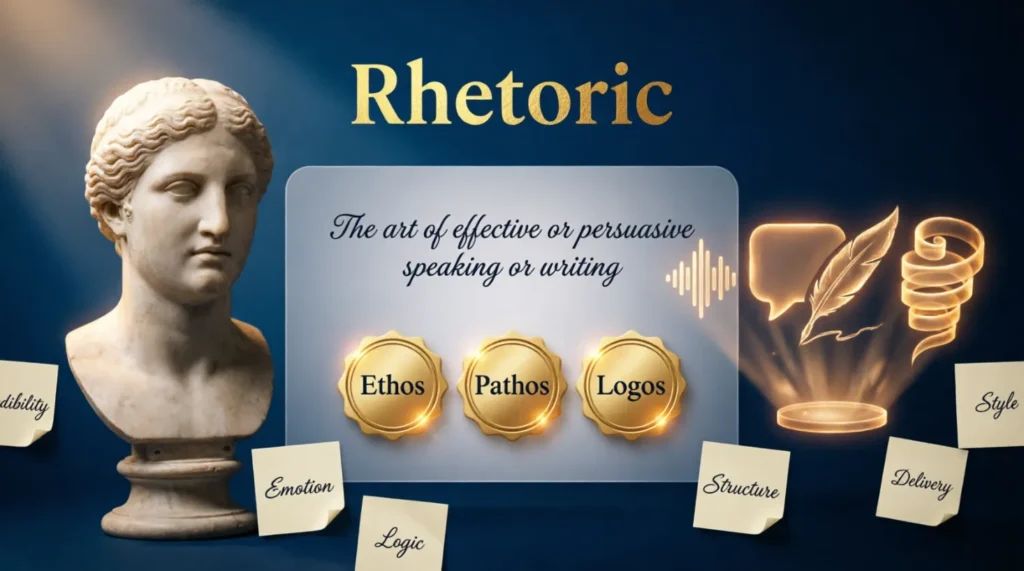
Rhetoric describes the art of using language effectively to persuade, inform, or influence an audience. In its neutral, academic sense, rhetoric refers to the skilled, deliberate use of language and argument, a legitimate and ancient discipline studied since antiquity. In casual modern use, however, the word often carries a more critical edge, implying empty or manipulative language that prioritizes persuasion over genuine substance.
Understanding the rhetoric meaning means recognizing both of these distinct senses, since the word functions very differently depending on if it’s used academically or dismissively. This guide covers what rhetoric means, where the word comes from, its different uses, and how to tell its neutral and critical senses apart.
What It Means
In its original, neutral sense, rhetoric refers to the formal art and study of effective communication and persuasion, encompassing the deliberate use of language, argument structure, and stylistic technique to inform, persuade, or move an audience. This sense treats rhetoric as a legitimate skill, studied in academic and professional contexts like law, politics, and writing.
In its more common, critical modern sense, rhetoric describes language that sounds persuasive or impressive but lacks genuine substance, sincerity, or follow-through. When someone dismisses a politician’s promises as “just rhetoric,” they mean the words sound good but don’t reflect real intent or meaningful action.
Both senses share the same underlying concept language deliberately shaped to persuade but they diverge sharply in tone. The academic sense respects rhetoric as a genuine skill worth studying; the critical sense treats it almost as an accusation, implying manipulation or emptiness behind the words.
Origin & History
Rhetoric comes from the Greek word “rhetorike,” meaning “the art of the orator” or “skill in speaking,” derived from “rhetor,” meaning a public speaker or teacher of rhetoric. Ancient Greek philosophers, particularly Aristotle, treated rhetoric as a serious, structured discipline, writing extensively about how speakers could effectively persuade audiences through logic, emotion, and credibility.
The word entered English through Old French and Latin in the 14th century, retaining its original academic and formal meaning tied to the structured study of persuasive language. For centuries, rhetoric remained a respected, foundational subject in Western education, taught alongside grammar and logic as one of the classical liberal arts.
The word’s more critical, dismissive modern connotation developed later, particularly as political speech and public communication grew more prominent and, at times, more distrusted. Over the 19th and 20th centuries, “rhetoric” increasingly became shorthand for language perceived as hollow or manipulative, especially in political and media contexts, layering this newer, skeptical meaning on top of the older academic one.
Different Contexts and Meanings
In academic and formal study. Rhetoric remains a legitimate, respected field within communication, English, and classical studies, examining how language and argument structure effectively persuade or inform an audience.
In political commentary. This is where the word’s critical sense appears most frequently, describing political speech perceived as persuasive-sounding but insincere, exaggerated, or disconnected from real action: “That’s just campaign rhetoric.”
In everyday critical conversation. People commonly use “rhetoric” dismissively to describe any language, not just political, that seems to prioritize sounding good over being genuinely true or meaningful.
In legal and professional contexts. Lawyers and professional communicators study rhetorical technique deliberately and neutrally, learning how to structure persuasive arguments effectively within courtrooms, negotiations, or formal writing.
In classical and historical study. Rhetoric holds a specific, foundational place in the history of Western education, tracing back to ancient Greek and Roman thought, studied alongside logic and grammar as one of the core “liberal arts.”
Examples
- “The professor taught a course specifically on classical rhetoric and persuasive writing.”
- “Critics dismissed his promises as empty rhetoric with no real plan behind them.”
- “Her speech demonstrated skilled rhetoric, blending logic and emotional appeal effectively.”
- “The debate coach focused heavily on rhetorical technique and argument structure.”
- “Voters grew tired of political rhetoric that never translated into actual policy.”
- “Aristotle’s writings on rhetoric remain foundational texts in communication studies.”
- “The lawyer’s closing argument showcased impressive rhetorical skill.”
- “He accused the ad campaign of relying on rhetoric rather than facts.”
- “The class analyzed the rhetoric used in famous historical speeches.”
- “She cut through the rhetoric to ask a direct, specific question.”
How to Use It (Grammar and Context)
Rhetoric functions as a noun, typically uncountable, referring to either the general discipline or a specific instance of persuasive language: “the study of rhetoric,” “his rhetoric was compelling.” The related adjective, “rhetorical,” describes something related to or characteristic of rhetoric: “a rhetorical question,” “rhetorical strategy.”
Context and surrounding tone typically clarify if a writer intends the neutral, academic sense or the more critical, dismissive modern sense, since the word itself doesn’t grammatically distinguish between them.
Common Mistakes
Assuming rhetoric always carries a negative connotation. While extremely common in critical, dismissive contexts, the word retains a fully legitimate, neutral academic meaning describing persuasive skill generally, without any inherent implication of dishonesty.
Confusing rhetoric with simple public speaking. Rhetoric specifically involves the deliberate, structured use of persuasive technique, not just speaking in general; someone can speak publicly without necessarily employing notable rhetorical skill.
Overusing the dismissive sense to avoid engaging with an argument. Labeling something as “just rhetoric” can sometimes function as a way to dismiss an argument without actually addressing its substance, which risks oversimplifying a genuine point.
Missing the word’s legitimate academic and professional applications. Some people only encounter rhetoric in its critical, political sense, without realizing it remains a serious, respected field of study in communication, law, and classical education.
Similar Words
| Word | Meaning | Difference from Rhetoric |
| Persuasion | The act of convincing someone to believe or do something | Persuasion describes the broader goal or effect; rhetoric describes the specific art, technique, and study of achieving that persuasion |
| Oratory | The art of formal public speaking | Oratory focuses specifically on spoken delivery; rhetoric covers a broader range of persuasive language, spoken and written |
| Spin | A critical term for presenting information in a biased or misleading way | Spin implies deliberate distortion; rhetoric (in its critical sense) implies emptiness or insincerity, not necessarily outright deception |
| Eloquence | Fluent, persuasive, and articulate use of language | Eloquence emphasizes skillful, graceful expression; rhetoric more specifically emphasizes the deliberate technique of persuasion itself |
Opposite Words
| Word | Meaning | Why It’s an Opposite |
| Substance | Genuine, meaningful content or action | Directly opposes the “empty words” implication in rhetoric’s critical sense |
| Sincerity | Genuine honesty and lack of pretense | Contrasts with the insincerity often implied when rhetoric is used dismissively |
| Plain speech | Straightforward, unadorned communication without persuasive technique | Opposes rhetoric’s deliberate, technique-driven approach to language |
Pronunciation
Rhetoric is pronounced RET-uh-rik, with the stress on the first syllable.
Quick Facts
| Fact | Detail |
| Word origin | Greek “rhetorike” (art of the orator), from “rhetor” (public speaker) |
| Classical significance | One of the core liberal arts in ancient Greek and Roman education |
| Neutral meaning | The formal art and study of persuasive language and argument |
| Critical modern meaning | Language that sounds persuasive but lacks genuine substance |
| Related adjective | Rhetorical |
| Notable historical figure | Aristotle, who wrote foundational texts on the subject |
Key Takeaways
- Rhetoric refers to the art of using language effectively to persuade or inform, in its neutral, academic sense.
- In everyday use, particularly regarding politics, the word often critically implies empty or insincere language.
- Rhetoric comes from ancient Greek roots and remains a respected classical and academic discipline.
- The related adjective “rhetorical” describes anything related to persuasive technique.
- Context determines if “rhetoric” carries its neutral academic meaning or its more critical modern connotation.
FAQs
What best defines the term rhetoric?
Rhetoric is the art of using language effectively to persuade, inform, or influence an audience.
What does it mean to speak in rhetoric?
Speaking in rhetoric means using carefully chosen words, arguments, or techniques to influence how people think or feel.
What is the synonym of rhetoric?
Common synonyms for rhetoric include persuasive language, eloquence, expression, discourse, and oratory.
What is an example of rhetoric?
“Who wouldn’t want a better future?” is an example of rhetorical language designed to encourage agreement.
What is a one word definition for rhetoric?
Persuasion is a simple one-word definition of rhetoric.
Which phrase best describes rhetoric?
The phrase “the art of persuasive communication” best describes rhetoric.
What is a person who uses rhetoric called?
A person who skillfully uses rhetoric may be called a rhetorician, especially when studying or practicing persuasive communication.
What does “rhetorical” mean in simple words?
“Rhetorical” means related to persuasive or expressive language, often used to make a point rather than simply ask for information.
Did Jesus use rhetoric?
Yes. The Gospels contain examples of Jesus using questions, parables, contrasts, and other rhetorical techniques to teach and persuade.
What is the opposite of rhetoric?
There is no exact opposite, but plain, direct, and straightforward communication can be contrasted with highly rhetorical language.
How do you explain rhetoric to a child?
Rhetoric is using words in a clever or powerful way to help someone understand an idea or agree with you.
What is negative rhetoric?
Negative rhetoric uses harsh, hostile, or emotionally charged language to criticize, attack, or create a negative impression.
Conclusion
The rhetoric’s meaning splits cleanly into two very different tones depending on where you encounter it: a respected academic discipline tracing back to Aristotle in one context, and a dismissive shorthand for empty political promises in another. Both senses share the same underlying idea of deliberately persuasive language, but the trust placed in that persuasion changes everything about how the word actually lands.
That split says something real about how societies relate to persuasive speech itself. The ancient Greeks treated rhetorical skill as something worth teaching and admiring; modern audiences, especially after decades of political messaging, often approach the same skill with genuine suspicion, wondering what substance, if any, sits behind the polished words.
Recognizing which sense of rhetoric is in play, academic respect or critical dismissal, helps you engage more precisely with whatever you’re reading or hearing, if that’s a classical text on persuasive argument or a news article questioning if a politician’s words actually mean anything at all.

I am Stephen King an American author known for compelling storytelling. At writemora.com, we value clear, accurate, and reader-focused content inspired by excellence in writing.