
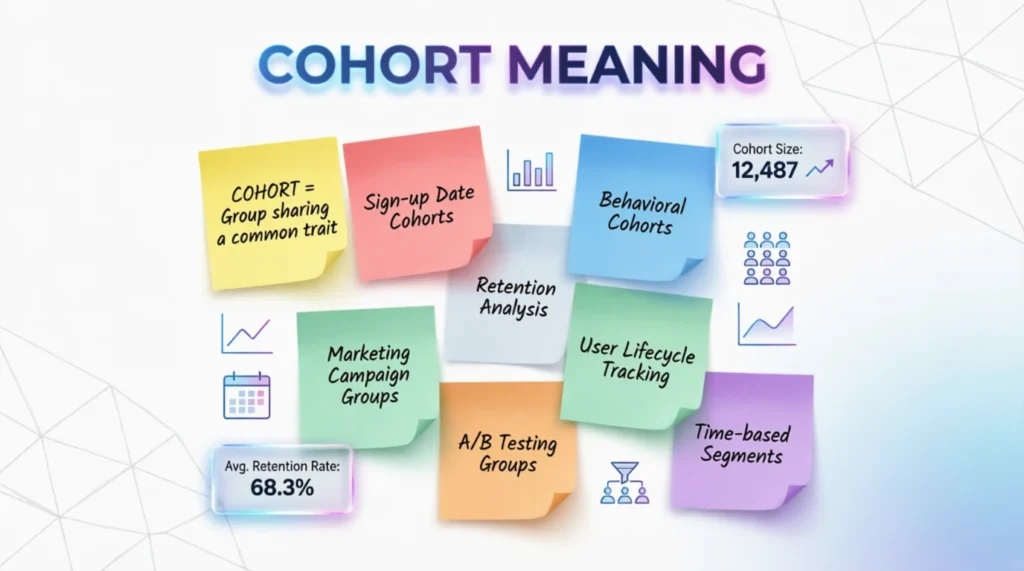
You might hear “cohort” in a research study, a college program, or a casual conversation about a close-knit friend group. At its core, “cohort” means a group of people who share something in common, often tracked or grouped together because of that shared trait or experience.
This guide covers exactly what “cohort” means, the different fields that use the word in slightly different ways, its unexpected military origin, and answers to the questions people ask most often. By the end, you’ll know precisely how to use “cohort” correctly, no matter the context.
What “Cohort” Means
The simple version: A cohort is a group of people who share a common characteristic, experience, or time period, often studied or grouped together because of that shared trait.
The fuller picture: “Cohort” shows up most often in two main ways. In everyday speech, it simply means a group of people associated with each other — colleagues, companions, or people who move through something together, like a graduating class. In research, statistics, and social science, “cohort” carries a more precise meaning: a defined group of people who share a specific starting point or characteristic, such as being born in the same year, starting the same program, or being diagnosed with a condition around the same time. Researchers track cohorts over time to study patterns, outcomes, and trends within that specific group.
There’s also a slightly less common, informal use where “cohort” refers to a single companion or accomplice, almost like a synonym for “sidekick” or “associate,” sometimes with a mildly negative undertone.
Origin and History

“Cohort” comes from the Latin word cohors, which originally referred to a specific military unit in the ancient Roman army, a division of soldiers that made up one-tenth of a legion. Roman legions were organized into ten cohorts, each containing several smaller units of soldiers, making “cohort” a precise term for a structured, organized group working together under a shared command.
Over time, English speakers broadened the word well beyond its military roots, using it more generally to describe any organized or associated group of people. The stricter research and statistical sense of “cohort” , a group sharing a defined starting point, like a birth year or enrollment date developed later, especially as social science, public health, and demographic research matured into more formal, data-driven fields that needed precise language for tracking groups over time.
Today, the word’s military origin has mostly faded from everyday awareness, but it still explains why “cohort” carries a slightly formal, organized connotation compared to more casual words like “group” or “crowd.”
Different Meanings and Contexts
General, everyday use. “Cohort” often simply means a group of people associated with each other, such as colleagues, classmates, or people who share a role or experience.
Research and social science use. In academic and scientific contexts, a “cohort” refers to a specific, defined group of people sharing a starting point or trait, tracked over time as part of a study for example, a “birth cohort” of people born in the same year.
Education and professional programs. Many graduate programs, training courses, and bootcamps organize participants into “cohorts” groups who start and often complete the program together, moving through the curriculum as a unit.
Public health and epidemiology. Health researchers frequently use “cohort studies,” which follow a specific group of people over time to study how certain exposures, behaviors, or characteristics relate to health outcomes.
Informal, slightly negative use. Occasionally, “cohort” refers to a single companion or associate, sometimes implying that person’s role in questionable or mischievous behavior (“he and his cohort caused quite a scene”).
Examples of “Cohort” in a Sentence

- “The professor tracked the same cohort of students through all four years of the program.”
- “Our cohort started the bootcamp together and graduated together six months later.”
- “The study followed a cohort of 5,000 participants over two decades.”
- “She and her usual cohort of friends took over the back booth every Friday night.”
- “Researchers compared health outcomes across different birth cohorts.”
- “The new hire cohort will begin orientation on Monday.”
- “He showed up late, as usual, trailed by his usual cohort of coworkers.”
- “The cohort study revealed a strong link between the two factors over time.”
- “Each cohort in the MBA program takes the same core classes together.”
- “The suspect and his cohort were both questioned separately by police.”
How to Use “Cohort” Correctly
“Cohort” functions as a noun, referring to a defined group of people, and it works in both singular and plural forms depending on how many groups you’re describing.
A few usage notes:
- Pair it naturally with words like: birth, graduating, research, training, and study to specify what kind of cohort you mean.
- Use “cohort of” for a group described by size or trait. Phrases like “a cohort of 200 students” or “a cohort of new employees” are standard and clear.
- Watch the tone in informal use. Referring to someone’s “cohort” (singular companion) can sound slightly mischievous or critical, depending on context it’s worth being aware of that subtle shade of meaning.
- Distinguish it from “group” when precision matters. In research or academic writing, “cohort” implies a specific, defined starting point or shared trait, while “group” is more general and doesn’t carry that same precision.
Common Mistakes to Avoid

- Using “cohort” and “group” as perfect synonyms in technical writing. In research contexts, “cohort” implies a defined, tracked group with a shared starting characteristic swapping in “group” loses that precision.
- Forgetting the informal, singular-companion meaning exists. Some readers may expect “cohort” to always mean a large group, so context should clarify when it refers to a single associate.
- Overlooking the word’s military origin. While not essential for everyday use, understanding “cohort” once described a structured Roman military unit helps explain its formal, organized tone.
- Assuming “cohort” always implies something negative. In most modern contexts education, research, business the word is neutral or even positive, describing collaboration and shared experience rather than trouble.
Similar Words and Phrases
| Word | Meaning | How It Differs |
| Group | A collection of people or things | Broader and less precise than “cohort,” which often implies a shared starting point or trait |
| Class | A group of students who study together | Closely related in education contexts, though “cohort” can extend beyond formal classes |
| Peer group | People of similar age, status, or background | Similar to “cohort” in social science, though slightly less formal |
| Colleague | A person one works with | Refers to individuals, while “cohort” typically refers to the group as a whole |
| Associate | A person connected to someone through work or business | Closer to the informal, singular-companion sense of “cohort” |
Opposite Words and Phrases
| Word | Meaning | Why It’s an Opposite |
| Individual | A single, separate person | Opposite of the collective, group-based concept behind “cohort” |
| Outlier | Someone or something that doesn’t fit the typical pattern of a group | Stands apart from the shared traits that define a cohort |
| Stranger | Someone unknown or unconnected to a group | Opposite of the shared association implied by “cohort” |
| Loner | Someone who prefers to be alone rather than part of a group | Contrasts with the group-oriented nature of a cohort |
Pronunciation
“Cohort” is pronounced KOH-hort, with the stress on the first syllable.
Quick Facts
| Fact | Detail |
| Meaning | A group of people who share a common characteristic, experience, or time period |
| Origin | Latin cohors, referring to a Roman military unit |
| Part of speech | Noun |
| Common fields | Research, statistics, education, public health |
| Related term | Cohort study (a research method tracking a group over time) |
| Informal use | Can also refer to a single companion or associate |
Frequently Asked Questions
It means a group of people who share a common characteristic, experience, or time period, often tracked or grouped together for that reason.
It’s a research method that follows a specific group of people who share a starting point or trait over time, studying how certain factors relate to outcomes, often used in public health and social science.
It comes from the Latin word cohors, originally referring to a division of soldiers in the ancient Roman army.
Yes, informally, “cohort” can refer to a single companion or associate, sometimes with a mildly negative or mischievous undertone.
“Cohort” usually implies a more defined group, often sharing a specific starting point or trait, while “group” is a more general, flexible term.
Yes, many programs organize students into “cohorts” groups who begin and often complete a course of study together.
“KOH-hort,” with stress on the first syllable.
It leans slightly formal, especially in research and academic contexts, though it’s also used casually to describe everyday groups of colleagues or friends.
What does “cohort” mean?
It means a group of people who share a common characteristic, experience, or time period, often tracked or grouped together for that reason.
What’s a “cohort study”?
It’s a research method that follows a specific group of people who share a starting point or trait over time, studying how certain factors relate to outcomes, often used in public health and social science.
Where does the word “cohort” come from?
It comes from the Latin word cohors, originally referring to a division of soldiers in the ancient Roman army.
Can “cohort” refer to just one person?
Yes, informally, “cohort” can refer to a single companion or associate, sometimes with a mildly negative or mischievous undertone.
What’s the difference between “cohort” and “group”?
“Cohort” usually implies a more defined group, often sharing a specific starting point or trait, while “group” is a more general, flexible term.
Is “cohort” used in education?
Yes, many programs organize students into “cohorts” groups who begin and often complete a course of study together.
How do you pronounce “cohort”?
“KOH-hort,” with stress on the first syllable.
Is “cohort” a formal or casual word?
It leans slightly formal, especially in research and academic contexts, though it’s also used casually to describe everyday groups of colleagues or friends.
Key Takeaways
- “Cohort” means a group of people who share a common trait, experience, or starting point.
- The word comes from Latin, originally describing a Roman military unit.
- In research and public health, “cohort” refers specifically to a defined group tracked over time.
- Education programs often use “cohorts” to describe groups who progress through a course together.
- Informally, “cohort” can also refer to a single companion or associate.
Conclusion
“Cohort” has traveled a long way from its origins as a term for Roman soldiers, but it’s kept the same underlying idea the whole way: a defined group, moving through something together, connected by a shared trait or starting point. That structure is exactly why researchers, educators, and everyday speakers all reach for the word when “group” feels too vague.
Understanding the precise research meaning also makes it easier to read scientific and health news accurately when a headline mentions a “cohort study,” it’s describing a specific, tracked group followed over time, not just a loosely defined crowd of people.
Next time you join a new program, read a public health study, or describe your usual group of friends, you’ll know exactly when “cohort” is the sharper, more precise word to reach for and where that surprisingly military-sounding term actually came from.

I am Stephen King an American author known for compelling storytelling. At writemora.com, we value clear, accurate, and reader-focused content inspired by excellence in writing.